

Key Takeaways
Treat digital and traditional marketing as one human customer experience
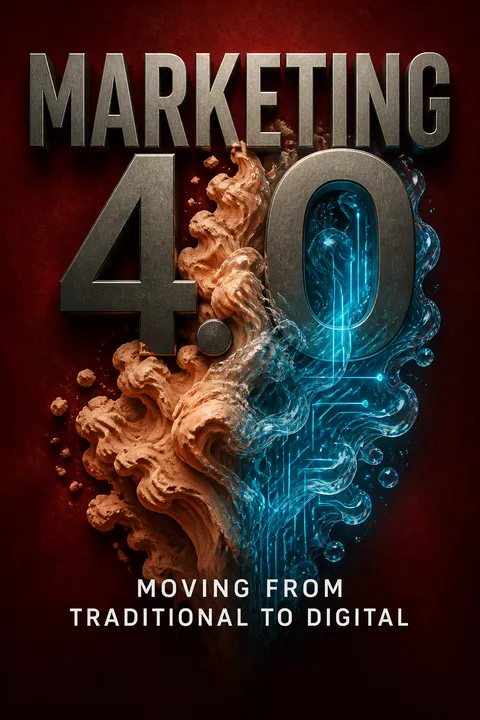
Join technology with touch. Marketing 4.0 is the book’s approach to marketing in a connected economy. It combines online and offline interactions, pairs flexible brand expression with a consistent underlying character, and uses automation to improve efficiency while preserving human connection. Digital channels do not simply replace traditional ones: a customer may discover a brand through advertising, research it on a phone, buy in a store, and seek help through a person.
Keep the promise credible. The authors’ premise is that connectivity makes authenticity more valuable because customers can compare brand claims with one another’s experiences. The practical shift is from treating customers as targets to involving them as participants in product development, communication, and care. Digital tools can scale access and personalization, but a human response can distinguish a brand in a world full of interfaces.
The framework’s strength is refusing the false choice between digital efficiency and human warmth. This resembles service design, which treats an experience as a connected system rather than a collection of isolated channels. A smooth app cannot compensate for a broken promise, and a charming employee cannot fix chronic unavailability. The approach also implies a governance challenge: personalization depends on data, and customers may welcome convenience while rejecting intrusive tracking. A human-centered strategy therefore needs not only warmth, but clear limits on data use and a credible way for customers to retain control.
Let customer communities validate your brand, not just your campaign
Influence has moved sideways. The authors describe a marketplace becoming more horizontal, inclusive, and social. Customers increasingly compare notes with friends, online reviewers, and communities instead of accepting brand messages at face value. Companies also rely more on outside ideas: Procter & Gamble’s Connect + Develop program, for example, sought external innovations for products the company could bring to market.
Find the influential participants. The book highlights youth, women, and active internet contributors as groups with outsized influence. Youth can introduce trends, women often shape household purchases, and netizens create reviews, recommendations, and other online material. The authors cite 1.8 billion people aged 10 to 24 in 2014. These are broad patterns, not reliable descriptions of every person in those groups; the useful lesson is to identify who actually shapes decisions in a particular market.
This account anticipates the shift from audience reach to network influence: a brand message gains force when people choose to pass it along. Network thinking also changes research. The relevant question is not only who buys, but who advises, translates, or challenges a purchase. The segment labels need care, however. Treating women as naturally better researchers or young people as automatic trendsetters can turn observed social roles into stereotypes. A stronger application uses the book’s insight as a hypothesis, then checks local evidence about actual decision-making and community structure.
Design for customers who are informed, distracted, and socially steered
Connectivity creates contradictions. A shopper can compare prices and read reviews instantly, yet feel overwhelmed by competing information and lean on other people’s judgments. The authors cite a study reporting that measured attention span fell from 12 seconds in 2000 to 8 seconds in 2013, using it to illustrate the pressure on brands to earn attention rather than assume it.
Conversation can cut both ways. Connected customers can praise a brand or organize criticism, and negative discussion is not automatically proof that a brand has failed. The book notes YouGov BrandIndex figures in which McDonald’s had 33 percent lovers and 29 percent haters, while Starbucks had 30 percent lovers and 23 percent haters. Such polarization can prompt supporters to speak up, although strong criticism still requires a real response from the company.
The paradoxes matter because they discourage simplistic digital strategies. More information can improve consumer choice while increasing decision fatigue; social proof can reassure buyers while nudging them toward conformity. Behavioral science often describes this as a trade-off between deliberation and cognitive ease. The attention-span statistic should be read cautiously, since a single measure cannot establish that people have lost the ability to focus in every context. The operational point is sturdier: make useful information easy to find, and give customers a reason to keep engaging.
Map the whole journey from first notice to customer advocacy
Follow customers beyond the sale. The Five A’s is the book’s customer-path model: people encounter brands, form an initial preference, seek information, take action, and may recommend what they experience. The stages are not a rigid funnel. Someone might buy on a friend’s recommendation without much prior interest, or admire an expensive brand without purchasing it.
Locate the real influence. The O Zone, also called O3, groups influence into three sources: the customer’s own experience, other people’s opinions, and a brand’s external communications. These forces overlap, but the authors argue that peer influence is especially important. Nielsen research cited in the book found that 83 percent of respondents across 60 countries trusted friends and family as an advertising source, while 66 percent attended to online opinions. The model helps identify where a brand can act and where it must earn trust.
The journey model is useful because it joins marketing, sales, and service around customer movement rather than departmental ownership. It also avoids assuming that every buyer follows one tidy sequence. In practice, customer journeys are better understood as maps of recurring patterns than as scripts for individuals. The distinction between controllable brand communication and less controllable peer influence is especially valuable: it clarifies why companies can facilitate discussion but cannot dictate its conclusion. The model is strongest when teams use observed behavior, not an idealized diagram, to choose which touchpoints deserve attention.
Judge awareness by what it converts into purchases and recommendations
Measure movement, not noise. Purchase Action Ratio, or PAR, compares purchases with brand awareness. Brand Advocacy Ratio, or BAR, compares recommendations with awareness. In the book’s example, 90 of 100 people recognize a brand, 18 buy it, and 9 recommend it. That produces a PAR of 0.2 and a BAR of 0.1: broad recognition has not translated into much action or advocacy.
Find the point where customers drop away. The ratios become more useful when broken into transitions along the customer path. Weak interest may signal poor appeal; research without purchase may point to price, availability, or sales friction; purchases without recommendations may reveal disappointing use or service. Rather than spend more on awareness by default, managers can investigate the weakest transition and repair it.
PAR and BAR turn a familiar measurement problem into a diagnostic one. Their value is not simply that they produce numbers, but that they encourage teams to ask why customers fail to progress. This resembles bottleneck analysis in operations: improving a healthy stage may do little if another stage constrains the whole system. Ratios are not causal explanations, however. A low conversion may reflect economic conditions, competitor activity, or a mismatch between the surveyed population and actual buyers. The metrics are most credible when paired with customer research and clear definitions of awareness, purchase, and recommendation.
Borrow the playbook that fits your industry's buying pattern
Different markets lose customers differently. The book groups customer paths into four archetypes. Door-knob markets, such as everyday packaged goods, tend to involve quick, habitual choices and little research. Goldfish markets, often business-to-business, involve extensive questions and comparison. Trumpet markets, such as luxury goods, can attract advocates who cannot or do not buy. Funnel markets, common in durable goods and services, require customers to consider, investigate, purchase, and judge the experience.
Use the pattern to diagnose. A door-knob brand may need stronger post-purchase loyalty; a goldfish brand may need clearer differentiation; a trumpet brand may face access or affordability barriers; a funnel brand must deliver across many touchpoints. The authors’ ideal is a bow-tie-shaped path, where strong appeal leads to purchases and customers who know the brand are also willing to recommend it.
Archetypes make comparison productive: a business can learn from another industry without copying its tactics blindly. The categories also spotlight different sources of friction, from low attachment to exhausting evaluation. Their weakness is the temptation to treat an industry label as destiny. A grocery purchase can involve careful research, while a costly service can be bought impulsively. The archetypes are best used as starting assumptions, tested against a brand’s own journey data and customer interviews. Their real contribution is diagnostic language, not a permanent taxonomy of markets.
Listen for human needs before giving your brand a personality
Study people in context. Digital anthropology applies observation of human behavior to interactions with technology and online communities. The authors describe social listening as monitoring public online conversation, netnography as participating in online communities to understand them more deeply, and emphatic research as observing and working with people in their everyday settings. These methods seek needs customers may not express in a survey.
Make the brand believable. The book proposes six human attributes for brands: physical appeal, intelligence, sociability, emotional connection, self-awareness, and ethical conduct. Domino’s provides an example of self-awareness: it publicly acknowledged criticism of its pizza and described efforts to improve it. The point is not to make a company pretend to be a person, but to make its behavior more approachable, responsive, and consistent with its values.
The movement from customer data to customer understanding is important. A clickstream shows what people did; observation and conversation can reveal the constraints or anxieties behind that action. This connects to human-centered design, where problem discovery precedes solution design. Still, online behavior is a partial view of a person, shaped by platform norms, anonymity, and who chooses to post. A brand’s human character is also tested most sharply when mistakes occur. Warm language without operational accountability reads as performance, not empathy.
Publish help customers seek, not longer advertisements they skip
Start with the audience’s question. Content marketing creates and distributes useful material for a defined audience, with the aim of earning attention and conversation rather than simply repeating a sales claim. Hipmunk’s travel magazine, for instance, offered practical information about travel rules and changing conditions. The brand connected its content to a service that could help customers plan trips.
Build the work before publishing. The authors describe an eight-part process: set objectives, define an audience, plan themes and formats, create material, distribute it, amplify it through relevant people, evaluate results, and improve the approach. Distribution may use channels a company owns, paid placements, or earned attention from sharing and coverage. Useful content still needs to be findable, credible, and related to the brand’s actual strengths.
Content marketing works when the exchange is clear: audiences receive something useful, while the brand earns attention and trust. That logic is closer to publishing than to interruption advertising, and it demands editorial discipline. The risk is that measurement can quietly recreate the old advertising mindset, rewarding clicks even when content does not help anyone. A mature program therefore asks not only whether people viewed or shared a piece, but whether it answered a real question and supported a truthful picture of the company.
Unify channels around customer tasks, not internal departments
Customers cross channel boundaries. Omnichannel marketing integrates online and offline touchpoints so the experience remains coherent as people move between them. Showrooming means researching or trying an item in person before buying online; webrooming means researching online before purchasing in a store. Both reveal that shoppers care more about completing a task than respecting a company’s channel structure.
Remove organizational friction. The authors recommend mapping the possible customer touchpoints, finding the most common paths, and improving the channels that matter most. Macy’s discovered that a dollar spent on search-engine optimization drove six dollars of in-store purchases, prompting closer integration of its online and physical operations. This kind of coordination requires teams to share goals, budgets, and responsibility instead of competing over which channel receives credit.
Omnichannel thinking corrects a common measurement error: online research can create offline revenue, and a store visit can end in an online order. The customer experiences one brand, while companies often operate several disconnected systems. Integrating them can reduce effort and improve service, but it also expands the temptation to track people across contexts. The promise of relevance should be balanced with data restraint and transparency. A seamless experience is valuable only when the customer experiences it as helpful, rather than as surveillance disguised as convenience.
Turn a purchase into advocacy through useful service and memorable delight
Continue the relationship after checkout. The book highlights mobile apps, social customer relationship management, and gamification as ways to support customers after purchase. Apps can solve practical problems, social CRM handles public questions and complaints through conversation, and game mechanics can reward actions such as reviews or repeat purchases. These tactics work best when they deliver real utility, not just another notification or points scheme.
Make delight personal and shareable. In the book’s closing story, entrepreneur Jia Jiang asked a Krispy Kreme employee to make doughnuts arranged like Olympic rings. The employee fulfilled the unusual request, turning an ordinary service encounter into a surprise that Jiang shared online. The authors call this kind of unexpected, personal experience a WOW moment: a memorable interaction that can prompt customers to tell others.
The final shift is from transaction completion to relationship quality. Service recovery, thoughtful personalization, and community participation can create reasons to advocate that advertising cannot manufacture. The doughnut story is memorable partly because it was unusual, which sets a limit: organizations cannot script every delight, nor should employees be pressured to perform theatrical gestures. They can, however, create room for judgment, resolve problems generously, and remove needless friction. Advocacy is a possible result of good care, not a reward customers owe a brand.
Analysis
Marketing 4.0 is best understood as a book about reallocating influence. Its central claim is not that digital media are inherently superior, but that connectivity changes who can shape a brand’s meaning. Companies still create products, messages, and experiences, yet customers increasingly interpret and circulate those meanings through networks. The book’s practical contribution is to connect that social shift to an operating model: map customer movement, locate the weak transitions, coordinate channels, and improve the experience that customers actually encounter.
Its frameworks are useful precisely because they translate a broad transformation into managerial questions. The Five A’s makes advocacy part of the customer path rather than a separate loyalty concern. PAR and BAR distinguish fame from conversion. Industry archetypes help explain why the same intervention will not work in every market. The tactical chapters then connect those ideas to research, publishing, service, and channel integration. Together, the models form a coherent bridge between strategy and execution.
The limits are equally instructive. A clean journey diagram can make messy, recursive behavior look more orderly than it is. Ratios reveal where a drop occurs, but not its cause. The book’s emphasis on youth, women, and netizens identifies influential groups, yet can slide into broad generalizations if practitioners treat categories as personality profiles. Its 2016 examples also come from a particular platform and technology moment. The durable lesson is not to copy a specific app or campaign, but to keep testing assumptions as customer behavior and infrastructure change.
The book’s strongest ethical implication is that transparency changes the cost of inauthenticity. Claims are easier to compare, and customers can amplify both praise and failure. But transparency is not the same as accountability: companies still need systems that make promises true, protect customer data, and respond when service breaks. Marketing 4.0 is most persuasive when human connection is treated not as a communications style, but as an organizational capability.
Review Summary
Marketing 4.0 receives mixed reviews, with an average rating of 4.07/5. Many praise its insights on digital marketing and the shift from traditional to online strategies. Readers appreciate the book's discussion of customer journeys, brand advocacy, and omnichannel marketing. Some find it essential for marketers in the digital age, while others criticize it for being repetitive or lacking practical examples. The book is seen as a good theoretical overview of modern marketing concepts, though some feel it could be more concise and actionable.
People Also Read






Glossary
Marketing 4.0
Connected, human-centered marketingThe authors’ approach to marketing in a digital economy. It integrates online and offline customer interactions, combines technological efficiency with human contact, and treats customers as connected participants rather than passive targets. Its practical aim is to guide customers from initial awareness toward action and advocacy.
Five A’s
A connected customer pathA model of customer movement through five possible stages: awareness of brands, attraction to some options, seeking information, taking action, and advocating for a brand. The path is flexible rather than a strict funnel. Customers may skip stages, return to earlier ones, or recommend brands they have not purchased.
O Zone (O3)
Three sources of influenceA framework for distinguishing the influences that shape customer decisions: the customer’s own judgment and experience, the opinions of other people and communities, and external communications initiated by brands. The sources interact across the customer path. Marketers can directly plan external communications, but have less control over peer discussion.
Purchase Action Ratio (PAR)
Awareness-to-purchase conversionA marketing productivity measure comparing the number of customers who purchase a brand with the number who are aware of it. The book’s example divides 18 purchases by 90 aware customers, producing a PAR of 0.2. Examining the stages behind a low ratio can help identify barriers to purchase.
Brand Advocacy Ratio (BAR)
Awareness-to-advocacy conversionA measure comparing the number of customers who recommend a brand with the number who are aware of it. The authors use it to assess how well awareness becomes advocacy, rather than treating recognition alone as marketing success. BAR can also be examined alongside the customer-path stages to locate weak transitions.
Industry archetypes
Four customer-path patternsA classification of industry-level customer journeys as door knob, goldfish, trumpet, or funnel patterns. The patterns distinguish markets with quick habitual buying, extensive evaluation, advocacy beyond actual purchase, or a more complete sequence of consideration and use. They are intended as diagnostic comparisons, not fixed descriptions of every customer.
Digital anthropology
Study of people and technologyThe study of how people interact with digital interfaces, behave within technology-rich settings, and use technology to communicate. In marketing, it helps researchers understand how customers discuss brands and what needs or concerns shape their behavior. The book describes social listening, netnography, and emphatic research as related methods.
Netnography
Ethnography in online communitiesA research method associated with Robert Kozinets that adapts ethnographic observation to internet communities. Researchers enter relevant online groups, observe interactions, and may participate in conversations to understand shared practices and meanings. The method requires interpretation and empathy, and research should respect the community and disclose its purpose where appropriate.
Emphatic research
Immersive research into needsA research approach that uses observation, conversation, and participation in people’s real-life settings to uncover needs they may not state directly. Multidisciplinary researchers synthesize what they see and hear into possible products, services, or experiences. The book distinguishes it from online listening by its emphasis on in-person immersion and collaboration.
Content marketing
Useful content that earns attentionThe creation, curation, distribution, and amplification of material that is relevant and useful to a defined audience. Rather than merely presenting a brand’s sales message, content marketing offers information or stories people choose to consume. The process includes planning, production, distribution, evaluation, and improvement.
Omnichannel marketing
Integrated cross-channel experienceThe coordination of multiple online and offline channels so customers can move among them without encountering a disconnected experience. It requires mapping common customer paths, aligning channel roles, and coordinating teams and resources. The goal is to help customers complete their tasks across channels, not to privilege one channel over another.
Social CRM
Relationship care through social mediaThe use of social media to manage customer interactions and build ongoing relationships. Unlike traditional company-initiated customer management, social CRM often begins with a customer inquiry or complaint and takes place in a public, conversational setting. It requires monitoring, responsive human agents, and, where appropriate, help from customer communities.
Gamification
Game mechanics outside gamesThe use of game principles in non-game settings to encourage engagement or particular behavior. Marketing programs may award points, status, badges, or privileges for purchases, reviews, referrals, or other actions. The design should connect rewards to clear objectives and worthwhile customer activity rather than adding competition for its own sake.
FAQ
What's "Marketing 4.0: Moving from Traditional to Digital" about?
- Transition to Digital: The book discusses the shift from traditional marketing methods to digital strategies, emphasizing the integration of both to enhance customer engagement.
- Customer Path Redefined: It introduces a new customer path model, moving from the Four A's to the Five A's: Aware, Appeal, Ask, Act, and Advocate.
- Human-Centric Approach: The authors advocate for a human-centric marketing approach, focusing on building authentic connections with customers.
- Technological Impact: It explores how digital innovations and connectivity are reshaping marketing practices and customer interactions.
Why should I read "Marketing 4.0: Moving from Traditional to Digital"?
- Expert Insights: Authored by Philip Kotler, a leading figure in marketing, the book offers authoritative insights into modern marketing trends.
- Practical Frameworks: It provides actionable frameworks and strategies for integrating digital and traditional marketing.
- Understanding Digital Economy: The book helps readers understand the dynamics of the digital economy and how to leverage them for marketing success.
- Future-Proofing Marketing: It prepares marketers for future challenges by addressing the convergence of technology and human-centric marketing.
What are the key takeaways of "Marketing 4.0: Moving from Traditional to Digital"?
- Five A's Model: The book introduces a new customer path model: Aware, Appeal, Ask, Act, and Advocate, emphasizing the role of connectivity.
- Human-Centric Marketing: It stresses the importance of building brands that connect with customers on a human level.
- Integration of Channels: The book highlights the need for seamless integration of online and offline marketing channels.
- Influence of Digital Subcultures: It identifies youth, women, and netizens as key influencers in the digital marketing landscape.
How does "Marketing 4.0" redefine the customer path?
- From Four to Five A's: The book shifts from the traditional Four A's (Aware, Attitude, Act, Act Again) to the Five A's (Aware, Appeal, Ask, Act, Advocate).
- Social Influence: It emphasizes the role of social influence in shaping customer decisions, particularly in the Ask stage.
- Advocacy as Loyalty: Loyalty is redefined as advocacy, where customers actively recommend brands to others.
- Non-linear Path: The customer path is not always linear; customers may skip stages or loop back based on their experiences.
What is the significance of the Five A's model in "Marketing 4.0"?
- Comprehensive Framework: The Five A's model provides a comprehensive framework for understanding the customer journey in the digital age.
- Focus on Connectivity: It highlights the importance of connectivity and social influence in each stage of the customer path.
- Driving Advocacy: The model aims to drive customers from awareness to advocacy, leveraging peer-to-peer influence.
- Flexible Application: It is applicable across industries, allowing for cross-industry comparisons and insights.
How does "Marketing 4.0" address the integration of traditional and digital marketing?
- Coexistence of Channels: The book emphasizes that digital marketing should complement, not replace, traditional marketing.
- Role Shifts: Traditional marketing initiates customer interaction, while digital marketing focuses on driving action and advocacy.
- Seamless Experience: It advocates for a seamless blend of online and offline experiences to enhance customer engagement.
- Strategic Balance: Marketers are encouraged to find a strategic balance between traditional and digital efforts to maximize impact.
What are the new metrics introduced in "Marketing 4.0" for measuring marketing productivity?
- Purchase Action Ratio (PAR): PAR measures how effectively brand awareness is converted into purchases.
- Brand Advocacy Ratio (BAR): BAR assesses how well brand awareness translates into customer advocacy.
- Conversion Focus: These metrics focus on the conversion process rather than just the outcome, providing deeper insights.
- Improvement Opportunities: By analyzing PAR and BAR, marketers can identify bottlenecks and areas for improvement in the customer path.
How does "Marketing 4.0" define human-centric marketing?
- Approachable Brands: Human-centric marketing involves creating brands that are approachable, likeable, and authentic.
- Addressing Anxieties: It focuses on addressing customers' latent anxieties and desires through empathetic engagement.
- Human Attributes: Brands should possess human attributes like physicality, intellectuality, sociability, emotionality, personability, and morality.
- Building Connections: The approach aims to build genuine human-to-human connections with customers.
What role do digital subcultures play in "Marketing 4.0"?
- Influential Segments: Youth, women, and netizens are identified as the most influential segments in the digital era.
- Trendsetters and Gatekeepers: Youth are trendsetters, women are gatekeepers of market share, and netizens expand heart share.
- Community Influence: These subcultures have strong community networks that amplify their influence on mainstream markets.
- Targeting Strategy: Marketers are encouraged to engage these segments to drive brand advocacy and market success.
What are the best quotes from "Marketing 4.0" and what do they mean?
- "In a high-tech world, people long for high touch." This quote emphasizes the need for human interaction in an increasingly digital environment.
- "The future of marketing is digital and this book is your guide." It highlights the book's role as a roadmap for navigating digital marketing challenges.
- "Customers are no longer passive targets but are becoming active media of communications." This underscores the shift in customer roles from passive recipients to active participants in brand conversations.
- "The WOW factor is what differentiates a brand from its competitors." It stresses the importance of creating memorable experiences that drive customer advocacy.
How does "Marketing 4.0" suggest creating a WOW factor?
- Surprise and Delight: WOW moments are created by exceeding customer expectations and delivering unexpected delight.
- Personalization: Personalizing experiences to address individual customer anxieties and desires can trigger WOW moments.
- Viral Potential: WOW moments are contagious and can lead to widespread advocacy and positive word of mouth.
- Strategic Design: Companies should design strategies, processes, and training to consistently deliver WOW experiences.
What are the tactical applications of "Marketing 4.0" in the digital economy?
- Human-Centric Marketing: Focus on building authentic brands that connect with customers on a human level.
- Content Marketing: Use storytelling to create engaging content that initiates conversations and builds brand curiosity.
- Omnichannel Marketing: Integrate online and offline channels to provide a seamless customer experience and drive commitment.
- Engagement Marketing: Utilize mobile apps, social CRM, and gamification to enhance customer engagement and drive advocacy.
About the Author
Other books by Philip Kotler








Download PDF
Download EPUB
.epub digital book format is ideal for reading ebooks on phones, tablets, and e-readers.








