

Key Takeaways
Treat attention as the first act of love, not a leftover.
Closeness has a sequence. The book argues that intimacy starts when partners notice each other, then give that attention enough time to deepen into empathy, connection, and play. Modern life disrupts the sequence with alerts, overload, and worry. Jim, distracted by heat and traffic, asks his wife twice where they are going. His failure to listen feels personal to her, even though he means no insult. Intent does not cancel impact.
Good news matters, too. The authors cite a study finding that a partner's enthusiastic response to good news predicted relationship strength more strongly than support during bad times. Attention is not merely hearing complaints. It means showing interest in the full life of the person beside you.
What's striking is the book's treatment of attention as relational infrastructure, not a soft extra added after practical life is handled. The cited finding about good news also broadens the usual picture of support: a partner needs someone who can share delight, not only absorb distress. This resembles the idea of active responsiveness, where interest and validation help people feel understood. The caution is that attention cannot be willed into existence indefinitely under exhaustion or impossible workloads. Couples may need to change the conditions consuming their focus, not just promise to listen harder.
Protect uninterrupted time before the outside world claims your marriage.
Availability has a cost. Phones and messages make it easy to reach anyone, but they also make it easy to abandon the person physically present. The authors call a broken, repeatedly interrupted exchange a cracked conversation. They describe the soufflé effect as the way interruptions inflate a task, making a short job consume far more time as concentration repeatedly has to recover.
Build boundaries on purpose. Turn devices off during meals or conversations, set a stopping time for work, and say no to appealing commitments that crowd out what matters. Even a regular twenty-minute stretch of undivided attention can restore a sense of being a team. The key is consistency, not an elaborate romantic production.
This advice anticipates a now familiar problem in cognitive science: switching tasks carries a recovery cost, even when each interruption seems brief. In a relationship, that cost is emotional as well as practical. A partner who repeatedly competes with a screen can experience the interruption as a ranking of priorities. Still, technology is not the only thief of attention. Caregiving, shift work, illness, and financial pressure can impose demands that a phone-free dinner cannot solve. Boundaries work best when both partners help create them and acknowledge the constraints they cannot simply switch off.
Replace character judgments with a map of each partner's attention style.
Different is not defective. The authors use D for the partner who is more distractible or spontaneous, and O for the partner who more often organizes, remembers, and follows through. These are flexible tendencies, not fixed identities or gender roles. A D may bring humor and ideas while struggling with details; an O may keep family life running while building resentment over carrying more of the load.
Describe the pattern, not the person. Forgetting a chore can look like defiance, while repeated reminders can look controlling. The book suggests first considering differences in attention and organization instead of declaring one partner selfish or lazy. That reframing can reduce shame and make practical collaboration possible, but it must not become a permanent excuse for leaving all responsibility to the O.
The useful move here is separating explanation from moral condemnation. That shift can lower defensiveness and help couples design supports around real differences, much as accessible workplaces adapt tasks to different strengths. The model also makes invisible labor easier to discuss: an organizer's competence can conceal the amount of work being absorbed. Its limit is that a shorthand can harden into a stereotype. Neither partner should be reduced to a type, and a neurological explanation should invite shared problem-solving, not exempt anyone from repair or contribution.
Ask what need the argument is hiding before debating its surface.
The stated issue may be a decoy. Couples can turn a missed payment, a driving instruction, or a parenting disagreement into a much larger fight. The authors suggest that the argument often carries an unspoken feeling of deprivation: too little affection, respect, time, sex, freedom, or rest. Instead of proving who is right about the lawn service, ask what feels missing and say it plainly.
Trade revenge for understanding. When one partner feels hurt, the reflex is often to hurt back. The book proposes asking what the pain should lead to instead. In one example, a wife's anger about her husband's attention to another woman opens a conversation about her father's infidelity. Empathy does not erase anger or excuse harm. It can reveal the history and need beneath the immediate conflict.
This approach resembles the distinction between a surface position and an underlying interest in conflict resolution. A dispute about chores may concern fairness, recognition, or control, and addressing that layer can make negotiation more productive. The book is persuasive in warning that retaliatory exchanges deepen injury. Yet not every conflict conceals a hidden wound; sometimes the practical issue really is unequal work or a broken agreement. Empathy should clarify the facts and stakes, not dissolve accountability into endless interpretation.
Bring worry into connection, then turn uncertainty into a plan.
Worry feeds on isolation. The authors describe a cycle in which distraction weakens connection, disconnection increases worry, and worry then consumes more attention. Their response is to avoid carrying serious concerns alone: speak with someone trusted, gather facts, make a revisable plan, and then shift attention once reasonable steps have been taken. A health worry, for example, calls for a medical appointment rather than hours of imagining the worst.
Know when the plan is not enough. The book distinguishes everyday toxic worry from persistent anxiety that disrupts work and relationships. In that case, it recommends seeking professional help rather than treating worry as a simple failure of will. Turning toward a spouse can build solidarity, but the spouse should not be expected to act as the sole therapist or source of certainty.
The sequence converts rumination into action, a useful shift because repetitive worry often feels like preparation while producing no new information. Sharing a concern can also correct distorted assumptions and reduce the loneliness surrounding it. The framework is strongest for problems where facts can be gathered and action is possible. Some uncertainty cannot be resolved, and chronic anxiety may persist despite support and planning. Treating continued distress as a refusal to let go risks blaming the person who is already suffering.
Interrupt anger early, before overload turns frustration into fear.
Notice the state change. The authors call a calm, curious, communicative state C-state, and an agitated, fearful, frustrated state F-state. They argue that overload, poor sleep, interruptions, and pressure can push people toward F-state, where small provocations ignite large reactions. A quick burst of exercise, a pause to breathe, meditation, or a change of attention may help someone regain composure before responding.
Treat danger differently from irritation. Regular sleep, exercise, limits on commitments, and fewer interruptions can reduce some triggers. But anger that intimidates a partner, threatens children, or becomes physically unsafe is not just a self-regulation problem. The book advises professional help when trauma or substance use contributes to dangerous anger. Forgiveness means releasing the grip of resentment, not accepting continued mistreatment.
Naming an escalated state can create a brief gap between impulse and action, a core goal in emotion regulation. The practical emphasis on bodily arousal is valuable because reasoning often becomes harder when someone is already activated. But a breathing exercise is not a substitute for safety planning, treatment, or consequences when anger is abusive. The distinction matters: ordinary frustration may call for a reset, while intimidation changes the conditions under which honest conversation is possible.
If distraction is lifelong and impairing, assess ADD before judging character.
Inconsistent attention has causes. The authors estimate that about 5 percent of adults have ADD requiring treatment, while many more experience attention difficulties intensified by modern life. They describe adult ADD as involving patterns such as wandering attention, inconsistent performance, trouble managing time and sequence, impulsivity, and sometimes intense focus on highly engaging tasks. These patterns can leave a spouse feeling more like a parent than a partner.
Assessment can change the story. Joel repeatedly misses details, including leaving his car running, and his wife is near the end of her patience. The authors argue that if lifelong impairment points to ADD, professional assessment can replace shame with an explanation and guide treatment. They describe care as broader than medication, including education, counseling, coaching, and practical changes. A list of traits is not a diagnosis.
The central contribution is to distinguish unwillingness from impaired capacity without denying the harm a partner experiences. That distinction can redirect a couple from accusation toward useful supports and clinical evaluation. It also guards against treating every modern lapse as a disorder: stress, sleep loss, depression, and other conditions can affect attention. The book's prevalence figure reflects its source and period, not a self-diagnostic rule. Assessment should be conducted by a qualified professional, with responsibility for household effects discussed alongside treatment.
Set shared boundaries around online intimacy before secrecy sets them for you.
Access changes temptation. The book argues that private messaging, sexual websites, and instant contact can make online sexual behavior and affairs easier to begin and conceal. It describes a case in which erotic texting escalated into in-person encounters, despite the person continuing to love his wife. The authors suggest asking what the activity provides, whether it has become hard to stop, and what it may be displacing.
Agree before a breach. Partners should discuss what each considers acceptable online and offline, rather than assuming they share the same rules. If behavior feels compulsive, secrecy and shame can make it harder to address; the book recommends seeking a trusted person or professional and building a plan. Understanding the function of the behavior can guide change, but it does not erase broken agreements or the injured partner's needs.
This section is useful because it treats digital access as a change in the environment, not merely a test of personal virtue. Clear agreements can reduce ambiguity before a crisis forces the conversation. The deeper question is functional: whether the behavior offers novelty, escape, stimulation, or a sense of connection. That inquiry can support treatment without minimizing betrayal. Couples also differ in what they regard as a boundary violation, so the goal is not a universal rule but informed, mutual consent and honest disclosure.
Schedule pleasure before busyness schedules it out of your marriage.
Desire needs room. Couples may still feel attracted to each other yet make love less often than they want because work, children, screens, and fatigue fill the available hours. In the book's example, Hank raises the issue gently, says it is a shared problem rather than his wife's failure, and asks for more intimacy without turning the conversation into blame.
Make space, then ask why. The authors recommend regular time together, including a recurring date and, when useful, planned sex. Scheduling is not meant to guarantee a particular response; it makes an opportunity possible. If desire remains low, the couple should explore anger, depression, exhaustion, or feeling overburdened. Affection and conversation can restore closeness, but pressure or scorekeeping can make sex feel like another obligation.
The counterintuitive point is that spontaneity often depends on prior structure. Calendars can protect the conditions for desire rather than mechanize it, especially in households where unclaimed time disappears quickly. At the same time, scheduling must preserve genuine consent and allow either partner to say no without punishment. A change in sexual frequency can be a signal of many things, including health and stress, so it deserves curiosity rather than a presumption that the relationship is failing.
Make ordinary moments distinctive through rituals, noticing, and a little extra.
Specialness is made, not bought. The authors call the practice of making daily life feel personally meaningful special-izing. Ned remembers grandparents who made visits memorable through focused attention, homemade fudge, a playful handshake ritual, and small allowances that felt generous. Their wealth differed, but the attentiveness did not. Couples can learn what each other enjoys, notice small changes, create traditions, protect the moment from interruptions, and add an occasional thoughtful extra.
Predictability can be romantic. A family dinner, a good-night kiss, or a recurring date can become meaningful because it reliably brings people together. The book cautions that not every moment must be special; ordinary stretches and disagreements are part of long intimacy. Positive energy and celebration matter, too. The aim is to notice what is already shared before envy or routine makes it seem unremarkable.
This idea connects relational meaning to ritual: repeated actions become emotionally significant through shared memory and attention, not novelty alone. The grandparents' examples show how a small, tailored gesture can carry more weight than an expensive display. There is also a useful challenge to consumer culture, which often sells novelty as the route to satisfaction. Still, one partner should not bear the entire burden of creating specialness. Rituals work when both people can shape them and experience them as care rather than performance.
Translate different problem-solving styles into teamwork, not moral verdicts.
People try in different ways. The authors use conation to mean a person's instinctive style of acting when tackling a task. Drawing on Kathy Kolbe's framework, they describe four action modes: Fact Finder gathers information, Follow Thru organizes steps, Quick Start begins readily, and Implementor works hands-on. A partner's preferred approach can differ from another's without either being inherently superior.
Name the difference and negotiate. Donna prefers deciding weekend plans in the moment, while Will wants a clear plan. Once they recognize their contrasting approaches, they agree on a tentative plan they can revise. This turns a contest over irresponsibility versus control into a practical compromise. The framework can offer useful language, but it should be treated as a lens for discussion, not a test that permanently defines either partner.
The concept adds a helpful layer beyond attention: two people may both be focused and still approach action differently. In organizational psychology, task-style differences can become complementary when roles and handoffs are explicit. The tentative weekend plan demonstrates that a compromise can preserve both structure and flexibility. The caution is important because typologies simplify. A person's approach can shift with context, experience, and stakes, so labels should prompt questions rather than become predictions or excuses.
Give marriage a repeatable process and a shared direction, not just good intentions.
Small habits shape the relationship. The authors use process to mean the ordinary arrangements through which a couple handles chores, affection, schedules, conflict, and attention. Left unexamined, these routines can create repeated disappointments. Couples can discuss expectations, divide work, and establish reliable ways to reconnect. A shared dream supplies direction; the authors describe shaping their choices around giving their children a happier childhood than they had.
Make connection a practice. The book's workbook asks couples to spend thirty uninterrupted minutes together on each of thirty sessions, using activities and questions to explore memories, hopes, money, and intimacy. The point is not perfect performance but consistent presence. Hope, in this account, means continuing to search for a better way while remaining realistic: abuse, danger, or persistent destructive behavior may require outside help or leaving.
The pairing of process and direction is stronger than either alone. Procedures without a shared purpose can feel bureaucratic; purpose without daily practices can remain an attractive slogan. Short, recurring conversations resemble implementation intentions because they specify when connection happens, reducing reliance on mood. The workbook's promise should be read as an invitation, not a guarantee: thirty sessions cannot resolve every incompatibility or structural burden. Its value lies in making attention observable and giving partners a place to revise how they live together.
Analysis
The book's most useful claim is that many couples misread a problem of conditions as a problem of character. A missed detail becomes proof of indifference; a reminder becomes proof of control. Hallowell and Hallowell ask readers to notice how interruption, overload, worry, and unequal organization shape those interpretations. This is a powerful move because it creates space for a practical question: what arrangement would make the desired behavior more likely?
The argument is strongest when it moves from insight to design. Put devices away, protect recurring time, clarify household responsibilities, investigate persistent attention problems, and talk explicitly about expectations. These recommendations treat intimacy as something supported by routines and environments, not merely by affection. The book's stories make that premise vivid: a repeated failure to listen can feel like abandonment, while a small ritual can restore a sense of being specially known.
The framework also has limits. Modern distraction is not the only cause of relational distance, and individual partners do not have equal power to reclaim time. Economic insecurity, caregiving demands, disability, and gendered divisions of labor can make the organizer's burden structural, not simply a consequence of mismatched attention styles. Reframing blame as overload may lower shame, but it must not minimize repeated harm or transfer responsibility back to the injured partner. The book is clearest when it treats explanations as starting points for accountability and problem-solving, rather than verdicts.
Its clinical case examples are compelling illustrations, not proof that the same cause explains every couple's conflict. The ADD discussion appropriately points toward professional assessment, while its wider claims about technology and anxiety deserve to be read as the authors' interpretation of their period. The durable insight is less that devices alone damage love than that intimacy requires protected attention, shared responsibility, and repeated acts of responsiveness. Connection is not a mood that busy people either possess or lack. It is a practice that can be made easier, though not guaranteed, by the way a couple organizes daily life.
Review Summary
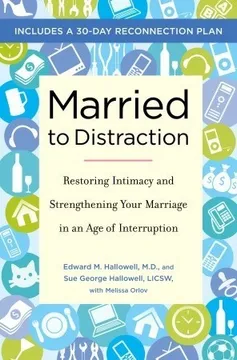
Married to Distraction receives mixed reviews, averaging 3.67 out of 5. Many readers appreciate its practical advice on staying connected in relationships amid modern distractions, praising its 30-day challenge and helpful tips. However, some feel misled, expecting a book focused on ADHD rather than general relationship advice. Several readers were surprised or put off by religious content near the end, while others found it refreshing. Common criticisms include repetitiveness and lack of depth, though many still recommend it for couples seeking to improve their connection.
Glossary
force of distraction
Attention pulled off courseThe authors' term for the combined pressure of interruptions, information overload, speed, and worry that competes for a person's attention. In a relationship, it can make partners less available to one another even when neither intends to withdraw. The term encourages couples to examine their environment and habits, rather than treating every lapse as evidence of a lack of love.
cracked conversation
An interrupted exchangeA conversation repeatedly broken by calls, competing demands, children, or other interruptions. Each partner may hear fragments but miss the meaning or emotional context, allowing irritation and misunderstanding to grow. The authors use the idea to show why clear communication depends not only on choosing the right words, but also on protecting the channel through which they are shared.
soufflé effect
Interruptions inflate task timeThe authors' label for the way repeated interruptions make a task expand far beyond the time it should require. After attention is diverted, a person may need substantial time to recover focus. The concept applies both to work and to important conversations, which can become fragmented or abandoned when interruptions are treated as harmless.
D and O
Distractor and organizer rolesThe book's flexible shorthand for two common patterns within couples. D refers to the partner who tends to be more distractible, spontaneous, or inconsistent with details. O refers to the partner who tends to organize, remember, and follow through. These are tendencies, not fixed identities, moral judgments, or gender categories, and people can shift between them depending on the situation.
pseudonarcissism
Overload mistaken for selfishnessThe authors' term for behavior that looks self-absorbed but may come from stress, worry, and too many competing demands rather than true narcissistic pathology. An overwhelmed person may have little attention left to offer others while still caring about them. The distinction can open a path to practical change, but it does not rule out genuine selfishness or excuse harm.
conation
Instinctive style of tryingA person's characteristic way of moving from thought and feeling into action. In the book, conation describes how someone naturally approaches a task or problem, such as gathering information, organizing a sequence, beginning quickly, or working hands-on. The authors present it as distinct from cognitive style, or how a person thinks, and emotional style, or how a person feels.
action modes
Four ways of actingKathy Kolbe's names for four conative tendencies discussed in the book: Fact Finder, Follow Thru, Quick Start, and Implementor. They describe different approaches to gathering information, structuring steps, initiating action, and engaging practically with materials. The authors use these modes to help couples understand differences in how they tackle problems, rather than deciding that one style is correct.
C-state and F-state
Calm and frustrated statesThe authors' shorthand for two broad states of mind. C-state describes being relatively calm, curious, communicative, and focused. F-state describes being fearful, frantic, frustrated, or furious. The contrast helps people recognize escalation and choose ways to regain composure. It is a practical distinction in the book, not a formal diagnostic system.
screensucking
Mindless time onlineThe authors' term for unintentional stretches of time spent online, such as browsing or exchanging low-value messages without a clear purpose. They argue that this habit consumes time and contributes to mental overload, potentially displacing conversation, rest, or meaningful work. Their proposed response is to use screens deliberately rather than remove technology altogether.
special-ize
Make shared life feel meaningfulThe authors' practice of making ordinary experiences personally significant through attention, knowledge of a partner's preferences, small extras, shared rituals, protected time, and positive energy. It does not mean making every moment exciting. It means noticing and shaping the details that help a couple feel known and connected in everyday life.
present time
Protected, focused couple timeThe workbook's name for a scheduled period in which partners give each other undivided attention without electronic or other interruptions. Its thirty-day program uses half-hour sessions for questions and shared activities. The purpose is to create a repeatable setting for listening, exchanging personal information, and rebuilding connection through practice.
Will You Be There for Me When Things Go Right? Social Support for Positive Events
Study of responses to good newsA study by Shelley Gable, Gian Gonzaga, and Amy Strachman, cited by the authors, on how partners respond to positive events. The book reports that a partner's active, happy response to good news was a stronger predictor of relationship strength than support during bad news. The finding highlights the role of shared celebration, not only crisis support, in close relationships.
About the Author
Other books by Edward M. Hallowell



Download PDF
Download EPUB
.epub digital book format is ideal for reading ebooks on phones, tablets, and e-readers.








