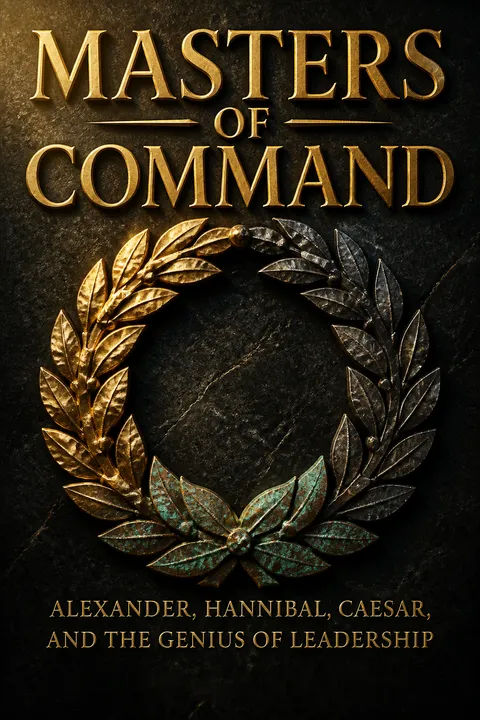


Key Takeaways
Make ambition serve a public purpose, not merely the commander's appetite.
Greatness has a shadow. Alexander, Hannibal, and Caesar possessed immense ambition, courage, and confidence. They also launched wars of conquest, pursued personal supremacy, and showed little restraint when civilians stood in their way. Their military gifts did not make them moral exemplars. The book’s central tension is that the same drive that made these men extraordinary commanders also made them dangerous rulers.
At the Granicus, Alexander fought in the cavalry charge and nearly died. Hannibal stood with his troops at Cannae, while Caesar tried to stop his soldiers fleeing at Dyrrachium. Their presence inspired loyalty, but it also reflected a taste for risk and personal glory. Each could win spectacularly. None consistently converted victory into a stable political order.
The distinction between capability and virtue is essential when leadership stories center on exceptional individuals. Courage can reassure a group in crisis, but a leader’s willingness to gamble with other people’s lives is not automatically admirable. Modern organizations face a quieter version of the same problem when charismatic founders turn institutional resources into extensions of personal ambition. The useful question is not simply whether a leader can achieve a difficult goal, but who bears the cost, who has a voice in the goal, and what remains after the leader leaves.
Train a force to act together, because resources alone do not create power.
Coordination beats inventory. Strauss uses military infrastructure to mean more than equipment or money. It includes trained troops, supply systems, experienced officers, and units able to work together. Philip II built a professional Macedonian army that Alexander inherited and improved. Its infantry, cavalry, engineers, and specialist troops could operate as a coordinated force rather than as separate pieces.
Hannibal’s army was a harder organizational feat. Its North African, Spanish, and Celtic soldiers spoke different languages and had different experience, yet his command made them effective together. Caesar’s legions became fiercely loyal and experienced during the Gallic campaigns. Hannibal’s march from Spain began with about 59,000 men and reached Italy with roughly 26,000, showing both the value of a disciplined core and the price of inadequate replacement capacity.
This is a systems insight as much as a military one. A collection of capable people does not become a capable organization until roles, communication, incentives, and shared practice fit together. Modern emergency response offers a useful parallel: specialized teams matter, but their ability to coordinate under pressure matters more. The comparison also exposes a limit in heroic leadership narratives. Hannibal’s cohesion depended heavily on Hannibal himself, while Rome’s citizen network could replenish armies and endure his absence. A system that works only through one exceptional person is powerful, but fragile.
Earn soldiers' trust through shared risk, rewards, and credible discipline.
Trust is built in action. These commanders did not rely on speeches alone. Alexander shared hardship with his soldiers and famously refused water when his men had none. Hannibal slept among his troops and endured the same campaigns. Caesar treated his veterans as partners, paid them, rewarded service, and knew when a sharp demonstration of authority was needed.
Their leadership mixed care with coercion. They honored bravery and provided for soldiers’ families, but they also punished disobedience severely. When Caesar’s troops mutinied, he addressed them as civilians rather than fellow soldiers, signaling that their military identity and his approval could be withdrawn. The maneuver worked because the men wanted to remain his army. Personal loyalty could hold a force together through hunger, exhaustion, and fear.
The examples reveal a durable leadership mechanism: credibility grows when a leader accepts some of the burdens imposed on others and distributes rewards in ways the group recognizes as fair. Yet shared danger can also create intense in-group loyalty that shuts out dissent. In contemporary teams, trust is healthier when it rests on predictable treatment and meaningful voice, not merely admiration for a leader’s sacrifice. Caesar’s appeal shows the power of belonging, while his use of punishment shows why loyalty and consent should not be treated as interchangeable.
Treat war as a campaign, not a sequence of isolated battles.
Victory has stages. Strauss’s five stages of warfare describe a conflict moving from the decision to strike, through the enemy’s resistance, to a decisive encounter, the effort to turn victory into submission, and finally a settlement that shapes what follows. A battle can be won while the war remains unresolved. The framework insists that military action is political: an enemy must be made to accept the victor’s aims, and the victor must know when to stop.
Alexander understood that defeating Persia’s army did not remove its naval threat, so he besieged Tyre before moving deeper into Asia. Caesar first defeated Pompey’s forces in Spain, reducing the danger behind him before confronting Pompey in Greece. Hannibal won Cannae but failed to bring Rome to terms. His battlefield success did not, by itself, accomplish his political objective.
The framework corrects a familiar bias: people remember dramatic encounters more readily than the administrative work that makes outcomes endure. In strategy, product launches, and public policy, an impressive initial win may only reveal the next set of constraints. The stages are useful as a checklist, not as a rigid timetable. Conflicts can move backward, overlap, or end without a clean settlement. Their strongest contribution is the reminder that operational success and political success are different measures, and that the second cannot be assumed from the first.
After Cannae, Hannibal's hesitation gave Rome the time it needed.
A triumph can expire. At Cannae in 216 BCE, Hannibal’s army faced a Roman force roughly twice its size. The Carthaginians enveloped the Roman infantry, killing about 48,000 and capturing around 20,000. It was a staggering tactical victory, but Rome refused to surrender. Hannibal did not march on the capital, and his plan to win over Rome’s Italian allies produced gains without breaking the central alliance.
Hannibal also lacked the siege capacity and reinforcements needed to force a quick decision. Rome returned to the Fabian strategy, a policy named for Fabius that avoided major battles while harassing Hannibal and denying him supplies. Rome attacked his Spanish base and kept raising armies. Hannibal’s allies required garrisons, while Carthage spent forces across several theaters. The longer the struggle lasted, the more Rome’s resources mattered.
Cannae makes a sharp distinction between tactical brilliance and strategic adequacy. A leader can solve the problem in front of him perfectly and still fail to alter the larger balance of power. The tempting counterfactual is that an immediate march on Rome would have changed everything, but the book does not claim that the city would certainly have fallen. The more defensible lesson is that a victory creates a temporary decision window. It should trigger a fresh assessment of what the enemy can still do, rather than confidence that the original plan is working.
Adapt to the enemy's reply before your first victory becomes a trap.
Plans meet resistance. Strategic intuition, in Strauss’s usage, is the ability to draw on experience and judgment to respond quickly when a situation is new and information is incomplete. Alexander showed it at Issus, where Darius appeared unexpectedly behind his army. Alexander reorganized and fought on terrain that favored his smaller force. In Central Asia, he also changed tactics to meet mobile opponents and difficult terrain.
But adaptability had limits. Alexander dismissed most of his fleet, underestimating the Persian naval threat; the death of the capable Persian commander Memnon helped spare him from the worst consequences. Strauss treats Divine Providence as the unpredictable fortune that can protect a commander when planning is not enough. Caesar, too, learned the cost of clinging to a bad approach: at Dyrrachium, his effort to blockade Pompey nearly destroyed his own army. Recovery mattered as much as the original plan.
The idea resembles adaptive decision-making in fields where outcomes depend on opponents, weather, or changing conditions. A plan is not a prediction that the world will comply. It is a starting hypothesis that must be updated as evidence arrives. The stories also complicate the image of genius: Alexander’s success depended partly on an opponent’s death, and Caesar survived Dyrrachium partly because Pompey failed to press his advantage. Acknowledging luck is not a way to diminish skill. It prevents skill from being mistaken for control.
Use speed and mercy to win support, but don't mistake obedience for consent.
Power needs a story. Caesar moved quickly after crossing the Rubicon, taking towns before Pompey could organize resistance. At Corfinium, he refused to let his troops sack the city and pardoned its prominent defenders, including his enemy Domitius. The gesture helped distinguish him from the bloody precedent of Sulla and encouraged enemy soldiers to join him. Caesar paired force with clemency, presenting himself as a conqueror who could spare rather than simply destroy.
Yet Roman elites experienced clemency as a status insult: Caesar’s mercy implied that he had the authority to decide their fate. His pardons did not dissolve their opposition, and some men he had forgiven later joined the conspiracy that killed him. Dignitas, a Roman term for public rank and standing, mattered deeply to him and to his rivals. He underestimated how humiliation could turn a political concession into another grievance.
This episode shows how the same act can carry opposite meanings for different audiences. A pardon may signal restraint to the public, relief to a defeated soldier, and condescension to an aristocrat who sees himself as an equal. Political communication therefore requires more than a good intention or a popular image. It requires attention to how status and power are interpreted by those affected. The case does not make clemency futile; it shows that mercy can prevent immediate bloodshed without repairing the relationships that produced conflict.
Secure succession and institutions before expanding beyond what you can govern.
Conquest needs an afterlife. Alexander ruled an immense territory but left no clear adult heir and few durable structures to hold the empire together. He died in 323 BCE, still planning campaigns. His generals fought over the succession, his family was killed, and the empire fragmented into kingdoms. Caesar was more attentive to administration and reform, but his concentration of power and poor relations with Rome’s elite left the political order vulnerable. His assassination reignited civil war, although his adopted heir, Octavian, eventually established a durable dynasty.
Hannibal’s weakness was different. He had little influence over Carthage’s political priorities and could not secure the resources his Italian campaign needed. After defeat, however, he served as chief magistrate and reformed Carthage’s finances. These contrasting outcomes suggest that military command, statecraft, and institutional design are separate abilities. A ruler may excel at one while neglecting the others.
Exceptional leaders often solve coordination problems by concentrating authority in themselves. That can make rapid action possible, but it also creates a succession problem: what happens when the person who holds the system together disappears? Institutional design distributes knowledge and decision-making beyond one office or personality. The ancient cases do not show that institutions guarantee stability, only that personal dominance cannot substitute for them indefinitely. Alexander’s empire and Caesar’s republic also caution against treating political reform as legitimate simply because it is efficient or produces order.
End the war when its political purpose is achieved, not when conquest beckons.
The final decision is restraint. Alexander kept pushing east after Darius’s death, fought costly campaigns in Central Asia, invaded India, and faced a mutiny when his troops refused to advance farther. Even after returning, he was preparing another expedition. Caesar defeated Pompey’s coalition, yet planned a new war against Parthia while Rome remained politically unsettled. Both men were more comfortable pursuing campaigns than negotiating a durable order.
Hannibal’s problem was the reverse: he stayed in Italy for years after his strategy had stopped producing a path to victory. By the time Carthage recalled him, Rome had invaded Africa and his defeat at Zama was likely. The book’s standard is not simply to stop fighting early. It is to judge whether further force can achieve a defined political result, and whether the cost will destroy the gains already won.
Stopping is difficult because success changes incentives. Leaders who are rewarded for expansion may interpret every unresolved problem as a reason for one more campaign, while organizations can mistake continued activity for progress. A clear political objective offers a discipline: if the purpose has been secured, expansion needs a separate justification; if it cannot be secured, persistence needs reassessment. The comparison also warns against an overly tidy moral. Hannibal’s prolonged commitment and Alexander’s restless expansion were different failures, but both show how identity can trap a leader in the role that once brought success.
Analysis
Strauss builds his comparison around a useful paradox: the three commanders were outstanding at winning battles, yet battlefield skill did not reliably produce political success. Their shared strengths include judgment under uncertainty, personal authority, speed, audacity, and the ability to make limited forces function as coherent armies. Their differences are just as instructive. Alexander was the most adaptable across terrain and forms of warfare, Hannibal the most dazzling battlefield tactician and the most consistent keeper of troop loyalty, and Caesar the strongest political operator and most deliberate strategist. The book’s five-part account of war is valuable because it refuses to treat a decisive battle as an ending. The crucial question is what follows: whether the victor can secure supplies, break enemy alliances, control the home front, and create terms that can hold. Hannibal’s Cannae exposes the gap between tactical perfection and strategic completion. Alexander’s empire shows that territorial scale can exceed administrative capacity. Caesar’s assassination shows that clemency and popular support do not automatically reconcile an elite that feels dispossessed.
The comparison also resists a simple great-man celebration. Each commander’s strengths were connected to liabilities. Audacity could become overreach; loyalty could become personal dependence; clemency could humiliate its recipients; political branding could obscure self-interest. These histories are especially useful when read as studies of systems, not templates for imitation. Alexander inherited a strong military machine, Hannibal depended on a divided political sponsor, and Caesar operated within a republic already destabilized by powerful generals. Their results cannot be separated from those conditions.
The narrative has limits inherent to ancient history. The evidence is uneven, especially for Hannibal, and many dramatic episodes come from sources with political or literary agendas. Strauss acknowledges uncertainty, but vivid scenes can still make interpretation feel more certain than the surviving record permits. His account is strongest when it compares constraints and consequences, and more debatable when it attributes outcomes to a single decision or to providential luck. Its durable lesson is not that modern leaders should emulate conquerors, but that command, strategy, legitimacy, and governance are different forms of competence. Success in one does not guarantee success in the others.
Review Summary
Masters of Command receives mostly positive reviews for its engaging comparison of Alexander, Hannibal, and Caesar as military leaders. Readers appreciate Strauss's accessible writing style and insightful analysis of the generals' strengths and weaknesses. Some criticize the book's organization and attempts to apply ancient lessons to modern business. Overall, reviewers find it an informative and thought-provoking examination of leadership in the ancient world, though opinions vary on its depth and effectiveness in drawing broader conclusions about military genius.
Glossary
Five stages of warfare
A model of war's progressionStrauss’s framework for following a conflict from the initial decision to attack, through resistance and decisive engagements, into the effort to compel the enemy, and finally toward a settlement. Its central point is that winning battles does not itself win a war: military action must produce a political outcome and a workable postwar order.
strategic intuition
Fast judgment under uncertaintyThe capacity to use education, experience, and perception to recognize a useful response when a commander faces a new situation without complete information. Strauss uses the term to explain how Alexander, Hannibal, and Caesar could read opponents, adjust plans, and act decisively under pressure. It is informed judgment, not mere instinct or impulsiveness.
Fabian strategy
Attrition without decisive battleA policy associated with the Roman commander Fabius Maximus during Hannibal’s invasion of Italy. Rather than risk another pitched battle, Roman forces shadowed Hannibal, harassed his foraging parties, and denied him supplies while preserving Rome’s larger reserves of manpower and food. The approach frustrated Roman military culture but helped prevent Hannibal from turning victories into a quick settlement.
infrastructure
The system behind military powerStrauss uses this term broadly for the resources and organization that make an army effective: money, food, weapons, trained soldiers, experienced officers, and units able to coordinate. It is not just material equipment. A force’s internal cohesion and its ability to replace losses or sustain a campaign are also part of its military infrastructure.
dignitas
Public rank and standingA Roman concept of personal standing grounded in reputation, office, honor, and recognition by one’s peers. Caesar invoked his dignitas when defending his command and political position. The term also helps explain why his clemency could anger former opponents: being pardoned by Caesar could imply subordination to a man they considered a rival, not an equal.
Divine Providence
Fortune beyond a commander’s controlStrauss’s name for the favorable, unpredictable circumstances that sometimes protected these commanders despite errors or incomplete plans. Memnon’s death, for example, removed a highly capable opponent from Alexander’s path. The term complements, rather than replaces, explanations based on judgment, organization, and strategy, and reflects the ancient habit of interpreting chance through divine action.
FAQ
What’s Masters of Command by Barry S. Strauss about?
- Comparative study of leaders: The book analyzes the leadership, military genius, and political strategies of Alexander the Great, Hannibal, and Julius Caesar.
- Focus on war and governance: It explores how these commanders won battles and the challenges they faced in consolidating and governing their empires.
- Modern relevance: Strauss draws lessons from their successes and failures that apply to leadership, strategy, and statecraft today.
Why should I read Masters of Command by Barry S. Strauss?
- Deep leadership insights: The book offers a nuanced look at what makes a great leader, examining both strengths and weaknesses of three iconic figures.
- Lessons beyond history: Strauss connects ancient campaigns to timeless principles of leadership and strategy, making it valuable for readers in business, military, and politics.
- Engaging and accessible: The narrative combines vivid storytelling with scholarly analysis, making complex historical events compelling and easy to understand.
What are the key takeaways from Masters of Command by Barry S. Strauss?
- Leadership is multifaceted: Great commanders blend ambition, audacity, judgment, and political skill, but also possess flaws that can undermine their achievements.
- War is unpredictable and political: Success on the battlefield must be matched by political acumen and the ability to secure lasting peace.
- Knowing when to stop: The inability to end campaigns at the right time often leads to overextension and collapse, a recurring theme among the three leaders.
What are the ten qualities of successful commanders in Masters of Command by Barry S. Strauss?
- Ambition and drive: Commanders are fueled by a desire for honor, conquest, and distinction.
- Judgment and intuition: They make sound decisions under pressure, combining experience, education, and creativity.
- Audacity and risk-taking: Boldness and willingness to share danger with troops are central to their leadership.
- Agility and adaptability: Rapid response to changing conditions, multitasking, and effective time management are crucial.
- Other qualities: Infrastructure, strategy, terror, branding, leadership, and belief in divine providence round out the list, each playing a role in their success and legacy.
What are the five stages of war described in Masters of Command by Barry S. Strauss?
- Attack: The initial decision to go to war and the execution of the opening plan.
- Resistance: The attacker faces obstacles and must adapt to overcome them.
- Clash: Decisive battles that determine control of the battlefield.
- Closing the Net: Pursuing, besieging, or blockading the enemy to force surrender and consolidate gains.
- Knowing When to Stop: Ending the conflict in a way that secures political objectives and postwar stability.
How does Barry S. Strauss describe Alexander the Great’s leadership and strategy in Masters of Command?
- Military innovation: Alexander excelled in combined-arms tactics, using elite cavalry and phalanx infantry for shock attacks and rapid maneuvers.
- Inspirational leadership: He led by example, sharing hardships with his men and inspiring fierce loyalty.
- Governance challenges: Alexander struggled with administration, integration of cultures, and knowing when to halt his conquests, leading to a fragile empire.
What strategic mistakes did Hannibal make according to Masters of Command by Barry S. Strauss?
- Failure after Cannae: Hannibal did not march on Rome after his greatest victory, missing a critical opportunity.
- Weakness in siegecraft: His army excelled in battle but lacked the ability to capture fortified cities, limiting his strategic options.
- Insufficient support: Hannibal suffered from a lack of reinforcements and political backing from Carthage, underestimating Rome’s resilience.
How does Masters of Command by Barry S. Strauss analyze Julius Caesar’s military and political leadership?
- Strategic mastery: Caesar combined audacity with careful planning, excelling in both battlefield tactics and political maneuvering.
- Reform and clemency: He enacted significant reforms and practiced clemency toward enemies, which won popular support but alienated the aristocracy.
- Downfall from arrogance: Caesar’s disregard for the Senate and overconfidence led to his assassination, highlighting the dangers of unchecked ambition.
What does “closing the net” mean in Masters of Command by Barry S. Strauss, and why is it important?
- Definition: Closing the net is the phase after a battlefield victory where a commander must consolidate gains, pursue the enemy, and secure lasting success.
- Execution differences: Alexander and Caesar excelled at this, while Hannibal failed, allowing his enemies to recover.
- Complexity and necessity: This stage requires agility, resource management, and political skill, often determining the ultimate outcome of a campaign.
How does Masters of Command by Barry S. Strauss explain the importance of “knowing when to stop” in leadership and war?
- Critical leadership trait: Recognizing when to end a campaign is essential for securing peace and stability.
- Historical failures: Alexander, Hannibal, and Caesar all struggled with this, leading to overextension, mutiny, or political collapse.
- Lasting consequences: The inability to stop at the right time often resulted in the fragmentation of empires and the downfall of the leaders’ legacies.
What are the most memorable quotes from Masters of Command by Barry S. Strauss, and what do they mean?
- On ambition and danger: “Because he loved honor, he loved danger” (Plutarch on Caesar) highlights the fearless drive of great commanders.
- On missed opportunities: “Vincere scis, Hannibal, victoria uti nescis” (“You know how to win, Hannibal, but not how to use your victory”) warns against failing to capitalize on success.
- On war and peace: Winston Churchill’s “Those who can win a war well can rarely make a good peace…” encapsulates the tension between military conquest and political stability.
What modern leadership lessons can be drawn from Masters of Command by Barry S. Strauss?
- Blend of virtues and vices: Effective leaders must balance ambition, audacity, and judgment with humility and restraint.
- Limits of power: Military success does not guarantee political stability; knowing when to stop is crucial.
- Enduring relevance: The stories of Alexander, Hannibal, and Caesar offer both inspiration and caution for leaders in any field, emphasizing the importance of timing, adaptability, and self-awareness.
About the Author
Download PDF
Download EPUB
.epub digital book format is ideal for reading ebooks on phones, tablets, and e-readers.








