

Key Takeaways
Let numbers reconnect calculation with the senses, rather than forcing a choice between them.
A tool for wholeness. Shesso presents mathematics as one human way to notice patterns, alongside intuition, memory, imagination, and the senses. Counting the petals of an apple blossom does not capture its scent, but it can reveal a shape that links the flower, the fruit, and the planet Venus in the book's symbolic tradition. The point is not to make every experience measurable. It is to let measurement add another kind of attention.
Logic needs company. The book opens with Zero as both a mathematical placeholder and a circle: a boundary that can hold a ritual or a new way of thinking. Its broader claim is that logic becomes limiting when treated as the only trustworthy form of knowledge. Numbers work best here as practical tools for exploration, not verdicts about reality.
What's valuable is the refusal to treat analytical and intuitive thinking as enemies. In cognitive science, perception itself combines sensory input with prior expectations, so even apparently direct knowing involves interpretation. A number can sharpen attention to a pattern without exhausting its meaning. The necessary distinction is between using symbolism as a prompt and treating it as evidence. An apple's five-pointed seed pattern may inspire reflection, but that resemblance alone cannot establish a cosmic cause.
Remember that Zero made calculation powerful by giving absence a place.
A journey of notation. The book traces the decimal system and Zero from Indian mathematics through Arabic scholarship into Europe. It recounts an Indian diplomatic mission to Baghdad in 773 CE, including the astronomer Kanaka, whose expertise impressed Caliph al-Mansur. Later translations helped spread a system with nine numerals and a circular placeholder. The placeholder made positional notation possible: the same numeral could represent 9, 90, or 900 depending on its place.
Counting was embodied. Before written arithmetic, people tracked quantities with fingers, marks, and pebbles. The book describes counting to 12 by touching the joints of four fingers with the thumb, a method that offers a possible bodily route to base-60 counting. These practices show that mathematical abstraction grew from ordinary tasks such as keeping time, trading, and planning for seasons.
The history makes an important point about technology: a symbol system is not decoration added to thought, but a tool that changes what thought can do. Zero lets a compact notation express scale and absence at once. The finger-counting examples also connect mathematical practice to embodied cognition, the idea that reasoning is often scaffolded by bodily action. The book's specific origin stories should be read as historical accounts, not as settled explanations of how every counting system developed.
Observe the Moon directly: its solar month lasts 29.53 days, not 28.
Two lunar clocks. A synodic month is the Moon's cycle of phases relative to the Sun. Its average length is about 29.53 days. A sidereal month, the Moon's circuit against the background stars, lasts about 27.32 days. Because these cycles differ, a Full Moon does not recur in the same zodiacal position each month. The familiar 28-day figure is a convenient approximation, not the precise interval from New Moon to New Moon.
Use your eyes. Shesso offers a hand-based way to follow the visible Moon: the right hand represents waxing, the left waning, and the thumbs mark the Full Moon area. She links waxing with increasing aims and waning with reduction or release. The exercise turns calendar knowledge into repeated observation, while allowing for nights when weather or the Moon's position makes it hard to see.
This is the book at its most persuasive: a symbolic practice is anchored to an observable cycle and exact astronomical distinctions. Watching the sky can build temporal awareness in a way that consulting a date alone cannot. The account also wisely distinguishes the visible crescent from the calendar's exact New Moon. Claims that lunar phases reliably synchronize human physiology require separate evidence, however. A meaningful personal ritual need not be defended by a universal biological claim.
Measure ritual space with your body, then let precision serve meaning.
Portable measures. Feet, hands, spans, fathoms, and cubits began as measures tied to the human body. Shesso adapts that principle to ritual design: use personal footsteps to outline a space, a hand span to size a tool, or an elbow-to-fingertip cubit to set a wand's length. She describes walking five steps in each cardinal direction and connecting the points to create a square whose perimeter totals 28 personal steps, an association she links to lunar symbolism.
Personal scale matters. These measures are not substitutes for standardized units when building a house or buying materials. Their value is practical and symbolic: the tool fits its maker, and the body becomes part of the act of measuring. A chosen dimension can also focus intention, such as using a head measurement in a working concerned with clarity.
Body-based measurement is a useful reminder that all standards begin in human purposes, even when modern systems make them seem impersonal. Design research makes a similar distinction between uniform standards and fit for a particular user. A personal cubit can make a ritual object feel situated and memorable. Its symbolic associations should not be confused with engineering precision, but the book is not asking it to replace engineering. It is proposing a different kind of fit.
Use planetary weekdays as prompts, not rules enforced by the heavens.
A symbolic calendar. The seven-day week is connected in the book to the seven celestial bodies visible to ancient sky-watchers: the Sun, Moon, Mercury, Venus, Mars, Jupiter, and Saturn. Traditional associations give each day a character. Sunday suits vitality and new starts; Monday, imagination and emotional concerns; Tuesday, action; Wednesday, communication and study; Thursday, growth and judgment; Friday, love and art; Saturday, boundaries and endings.
Choose with intention. These correspondences can help someone select a time and focus for a working. But Shesso cautions against treating the schedule as a divine rulebook. If Friday feels wrong and Tuesday feels right, personal intuition matters more than an inherited table. She recommends recording the chosen day, intention, and result, turning repeated practice into a personal reference rather than unquestioned obedience.
Ritual timing can function like a calendar for attention: naming a day as suitable for study or closure may help a person approach that task deliberately. The useful mechanism may be psychological and social rather than celestial, and that does not make the practice meaningless. A caution is that retrospective notes can favor memorable successes and overlook failures. Recording outcomes consistently, including disappointments, makes the practice more informative and less vulnerable to selective memory.
Draw a planetary square in sequence to turn arithmetic into focused attention.
Structured number patterns. A magical square is a numbered grid in which rows, columns, and often diagonals share the same sum. The Chinese Lo Shu is a 3-by-3 example: its numbers 1 through 9 add to 15 across each row, column, and main diagonal. The story credits a turtle's shell pattern with revealing the arrangement, though the book presents this as traditional lore. Planetary squares connect particular grid sizes with planets and symbolic aims.
Make, do not just copy. Shesso suggests drawing the numbers in sequence, then tracing a short intention through the cells to create a line pattern. The Moon's 9-by-9 square offers a further surprise: shading its odd-numbered cells reveals a seed pattern for a seven-circuit labyrinth. The grid is both a mathematical puzzle and a designed object for meditation, not proof that a spell will produce a requested outcome.
The square's strength lies in combining constraint with choice. Its arithmetic limits the possible arrangements, while the act of drawing invites sustained attention. That combination resembles contemplative arts such as calligraphy, where precise repetition can organize attention without requiring supernatural effects. The book's distinction between recreational magic squares and spiritually used magical squares is helpful: identical mathematical properties do not guarantee identical cultural meaning. Meaning depends on history, intention, and the practitioner's interpretation.
Treat Fibonacci proportions as recurring patterns, not nature's universal signature.
A growing sequence. In the Fibonacci series, each term is formed by adding the two before it: 0, 1, 1, 2, 3, 5, 8, 13, and onward. Ratios between neighboring large terms approach 1.618, the Golden Ratio, while the reverse ratio approaches 0.618. Shesso shows how squares and rectangles based on neighboring terms can be nested and turned into a spiral.
Look for form carefully. The book points to patterns in seed arrangements, leaf growth, shells, and human proportions, then connects the ratio to the pentacle. These examples make geometry visible in living forms, but they do not mean every natural spiral or body measurement follows the same exact rule. Use the ratio as a way to investigate shape and proportion, not as a universal stamp that proves nature was built from one numerical recipe.
The enduring appeal of the Golden Ratio comes from a real mathematical property paired with striking visual examples. It offers a compact language for comparing proportions, and that can guide observation in art, biology, and design. Yet popular accounts often select the best-fitting examples and omit the messy ones. The stronger approach is comparative: measure a proposed pattern, state the tolerance, and check alternatives. A pattern becomes more interesting, not less, when its limits are visible.
Track Venus for eight years and watch its appearances sketch a pentacle.
A pattern in the sky. Venus alternates between Morning Star and Evening Star as it moves around the Sun in relation to Earth. Its average synodic period, the time it takes to return to a similar position relative to the Sun, is about 584 days. Track the same kind of conjunction over roughly eight years and its positions against the zodiac come close to five points of a pentacle, returning within a few degrees of the starting place.
Observation meets symbol. The book connects Venus's five-pointed pattern to older symbols of the planet, including the eight-pointed rosette associated with Inanna and Ishtar. The pattern depends on keeping track of the same type of conjunction; mixing inferior and superior conjunctions changes the shape traced. Venus's movements provide an example of how long-term sky observation can yield a geometric pattern with cultural and spiritual resonance.
This is a particularly strong bridge between mathematics and myth because the underlying motion is measurable and repeatable. The symbolic reading is an additional human interpretation, not a replacement for orbital mechanics. Long observational records also show why calendars and geometry mattered to ancient societies: celestial regularities could support timekeeping and prediction. The eight-year cycle is close rather than perfectly exact, a useful reminder that natural patterns often invite approximation instead of delivering flawless diagrams.
Use shapes as cultural lenses, not as timeless meanings built into matter.
Numbers become forms. Pythagorean teaching connected number, geometry, music, and harmony. Its revered Tetraktys is a triangle of ten dots arranged in four rows, expressing 1 + 2 + 3 + 4. The book also explains the 3-4-5 right triangle, whose side lengths demonstrate that 3 squared plus 4 squared equals 5 squared. These examples show how visual arrangements can make mathematical relationships easier to grasp.
Solids carry symbolism. Plato's five regular solids are constructed from identical faces: triangles, squares, or pentagons. Shesso describes their traditional associations with Fire, Earth, Air, Water, and Spirit. The geometry is demonstrable; the elemental meaning is a symbolic system layered onto it. Drawing or building the solids can make spatial relationships tangible, while the associations offer prompts for meditation rather than scientific classifications of matter.
The book's most durable lesson here is that a diagram can be both mathematically exact and culturally interpreted. Geometry establishes what follows from the rules of a shape; symbolism asks what a community chooses to see in it. Keeping those questions distinct protects both. The Tetraktys is memorable partly because its arrangement makes addition spatial. The elemental correspondences are best treated as a historical vocabulary for reflection, not as claims that physical substances literally consist of these five solids.
Let a striking code inspire inquiry, but do not confuse pattern with proof.
A mystery assembled. In its account of Rennes-le-Château, the book surveys stories about Mary Magdalene, the Templars, Cathars, hidden wealth, and coded inscriptions. One proposed decoding begins with intentional-looking errors on a noblewoman's gravestone, combines them with a cipher, and uses a chess Knight's Tour to arrange letters into a message. A Knight's Tour is a route across a chessboard that visits every square once using the knight's distinctive L-shaped move.
Interpretation remains uncertain. The decoded text is connected to painters, local geography, grapes, and a hidden lineage. The book also describes a proposed map alignment between Notre-Dame cathedrals and Virgo. These are presented as intriguing theories, not established historical facts. The narrative shows how numbers and geometry can organize an investigation, but also how much interpretive work is needed to turn coincidences into a coherent story.
The chapter captures the pleasure and risk of pattern detection. Humans are exceptionally good at finding structure, which helps mathematics and historical research but can also make flexible clues seem conclusive. If a code requires many discretionary choices, independent reproduction and a clear prediction become essential tests. The Rennes story remains valuable as an example of imaginative interpretation, provided its claims are held at the level of hypothesis. Wonder does not need certainty to remain engaging.
Personalize symbolic practice and record what actually helps.
Adapt the recipe. Shesso rejects the idea that a spell's effectiveness depends on obeying every inherited instruction. Numbers, colors, planetary days, and objects can help make an intention concrete, but a practitioner may adjust them to fit personal experience. The book compares this to changing a recipe to suit one's taste. Its practical advice is to begin with a known method if useful, then modify it rather than treating another person's directions as law.
Keep a record. Note the intention, chosen numbers and timing, changes made, and what happened afterward. Such notes can help identify which practices feel useful and which do not. The book returns to Zero as a symbol of an open space: a starting point for exploration, not a number that defines a person. Its closing argument is that flexible attention matters more than numerical obedience.
This conclusion preserves the book's spiritual openness while suggesting a disciplined practice. Journaling can distinguish what feels meaningful in the moment from what remains useful across repeated attempts. It also makes room for outcomes that are ambiguous or disappointing. The broader principle extends beyond ritual: personal methods are often strongest when they combine inherited structure with feedback. Adaptation is not a license to confirm every expectation; it is an opportunity to learn from experience while remaining honest about what cannot be measured.
Analysis
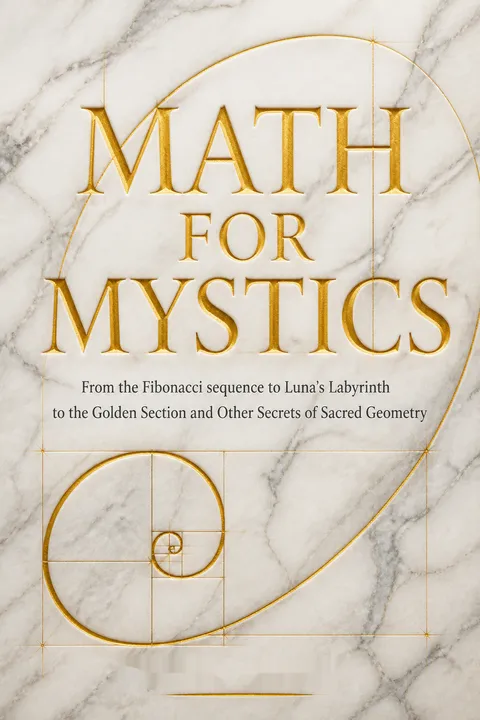
Math for Mystics is best understood as a guided tour through numerical history, sacred symbolism, and personal practice, rather than as a mathematical textbook or a defense of numerology as science. Its organizing claim is that number can be a meeting point between formal reasoning and sensory life. The route moves from fingers, calendars, and bodily measures to the Moon, planetary weekdays, magic squares, Fibonacci patterns, Venus's orbit, geometric solids, and interpretive traditions. The recurring invitation is to make patterns by hand, then let those patterns support attention and meaning.
The book's strongest material keeps observable mathematics visible. Zero's role in positional notation, the arithmetic of the Lo Shu square, the difference between synodic and sidereal lunar cycles, and Venus's near-eight-year pentacle cycle each give readers something they can calculate or observe. These examples make abstract ideas memorable without requiring advanced mathematics. They also show why number systems historically mattered: they supported navigation, trade, timekeeping, and architecture, not only contemplation.
Its central vulnerability is the tendency to let resemblance do too much explanatory work. A seed arrangement can resemble a spiral, a constellation can be overlaid on a map, and a code can be made to yield a story, but resemblance alone does not establish shared origin or hidden intention. The Rennes-le-Château material is especially useful when read as a case study in interpretive possibility, not as proof of a secret history. Similarly, claims about bodily proportions or natural forms should be measured rather than accepted because they sound harmonious.
That tension does not erase the book's value. Symbolic practice can matter without being a scientific causal theory. A repeated act of drawing, watching, or counting may focus attention, help organize reflection, and connect a person to inherited stories. The most reliable reading separates three questions: Is the mathematics correct? Is the historical claim supported? Does the symbol help someone think or act? Keeping those questions distinct allows curiosity to stay expansive without turning every coincidence into evidence.
Review Summary
Math for Mystics receives mixed reviews, with an average rating of 3.69 out of 5. Some readers appreciate its accessible approach to mathematical concepts and their mystical connections, praising Shesso's engaging writing style and the book's blend of math, spirituality, and history. Others criticize the lack of in-depth mathematical content, feeling it focuses more on numerology and mysticism than actual math. The book is generally seen as a good introduction for those interested in the spiritual aspects of numbers and geometry, but may disappoint readers seeking rigorous mathematical analysis.
People Also Read

Glossary
synodic month
Moon phase cycleThe interval between successive returns of the Moon to the same phase, measured in relation to the Sun. A New Moon to New Moon averages about 29.53 days. Because this cycle depends on the changing positions of Earth, Moon, and Sun, it differs from the Moon's circuit against the background stars.
sidereal month
Moon's star circuitThe time the Moon takes to complete a circuit relative to the background stars. Its average length is about 27.32 days. It is shorter than the synodic month because Earth moves along its orbit while the Moon travels, so the Moon needs additional time to return to the same phase relative to the Sun.
Metonic cycle
Nineteen-year lunar cycleA cycle of about 19 years after which lunar phases recur close to the same dates in the solar calendar. The book describes it as a way to track the Moon's recurring position and phase. The cycle is named for the Athenian astronomer Meton and appears in older methods of calendrical reckoning.
magical squares
Symbolic numbered gridsNumbered grids associated with planets and used in occult or ritual practice. Their rows, columns, and principal diagonals share a common total, as in the 3-by-3 Lo Shu square, whose lines total 15. The book distinguishes these spiritually used squares from recreational magic squares that have mathematical properties without ritual associations.
Luna's Labyrinth
Moon square labyrinth patternThe book's name for the seven-circuit labyrinth pattern found by shading the odd-numbered cells of the 9-by-9 Square of the Moon. The remaining visual arrangement resembles a labyrinth seed diagram, a compact pattern used as the basis for drawing a full path. The connection is presented as a discovered visual correspondence.
Golden Ratio
Proportion near 1.618A mathematical proportion in which the ratio of a larger length to a smaller length equals the ratio of their combined length to the larger length. Its value is approximately 1.618, and its reciprocal is approximately 0.618. Ratios between successive large Fibonacci numbers approach these values. The book explores its geometric and symbolic associations.
Knight's Tour
Chessboard route puzzleA route across a chessboard in which a knight visits every square exactly once, moving according to its standard L-shaped move. Some routes are reentrant, meaning the final square can connect to the starting square with one legal knight move. The book discusses mathematical solutions and a speculative use of a tour in a historical code.
gematria
Letter-number interpretationA system that assigns numerical values to letters and examines the totals of words or passages. The book focuses on Hebrew gematria, in which letters have values and additional symbolic meanings. Practitioners may compare words with equal totals and explore possible relationships. It is a complex interpretive tradition, not simply the reduction of words to single digits.
Platonic solids
Five regular polyhedraThe five convex regular polyhedra whose faces are identical regular polygons and whose vertices have the same arrangement: the tetrahedron, cube, octahedron, icosahedron, and dodecahedron. Plato discussed these forms in the Timaeus and associated them with elements, but the shapes predate him. The book treats their elemental links as symbolic correspondences.
Tetraktys
Ten-dot triangular arrangementA triangular arrangement of ten dots in four rows, containing 1, 2, 3, and 4 dots respectively. Pythagoreans revered it, in part because those four numbers sum to 10. The book explains its symbolic interpretations through ideas such as unity, polarity, harmony, and material form.
mudrâ
Finger-based countingThe book uses this Sanskrit term for finger-counting and connects it linguistically with mudrā, the symbolic hand gestures used in religious art and dance. It presents the hand as both a practical counting device and a meaningful bodily form. The connection illustrates how counting and gesture can overlap in cultural practice.
Download PDF
Download EPUB
.epub digital book format is ideal for reading ebooks on phones, tablets, and e-readers.








