

Key Takeaways
A blank test signals panic, not proof that you cannot learn maths
A frightening start. Danica McKellar recalls staring at a year 8 maths test and feeling unable to begin, despite studying. She later describes how a patient teacher gave her time to settle, after which she completed enough to earn a C+. With support and continued work, she became a strong maths student and eventually graduated with a mathematics degree. Her story frames difficulty as a moment in learning, not a permanent verdict on ability.
Confidence has substance. The book argues that competence grows through practice, persistence, and asking for help. Maths can also build independence, from checking a sale price to managing money. Its deeper message to girls is that intelligence and style do not cancel each other out, and that social pressure to appear less capable should not dictate ambition.
What's compelling is the distinction between a student's performance under pressure and her capacity to learn. Anxiety can consume attention that would otherwise be available for reasoning, so a supportive pause may reveal ability that a timed test obscures. The book's encouragement is especially valuable against stereotypes that associate femininity with weak maths skills. Its broader claim that maths makes someone smarter in every area is less certain: the clearest case is for stronger mathematical reasoning and confidence, not a universal increase in intelligence.
Use factors and multiples to expose how numbers fit together
Break numbers apart. A factor divides a number evenly; a multiple is what results when a number is multiplied by whole numbers. Prime numbers have no factors beyond 1 and themselves, so prime factorisation expresses a number as a product of primes. A factor tree makes the process visible: 30 can split into 2 and 15, then into 2, 3, and 5. Different trees may take different routes, but a correct result reaches the same prime factors.
Find shared structure. The highest common factor, or HCF, is the largest number that divides evenly into both numbers. The lowest common multiple, or LCM, is the smallest number they share as a multiple. For 30 and 12, the HCF is 6; for 6 and 9, the LCM is 18. These ideas become useful tools for simplifying and combining fractions.
The progression from grouping objects to prime factorisation gives abstract number structure a physical foothold. This is more than a cute analogy: drawing a factor tree externalises intermediate steps, reducing the need to hold them all in working memory. The chapter also models a useful mathematical habit, checking a result by a second route. Its playful labels may help a learner remember a procedure, though understanding why the shared factors matter is more durable than memorising a nickname.
Treat fractions as amounts, not as unrelated top and bottom numbers
A fraction names a quantity. The denominator tells how many equal parts make one whole, and the numerator counts how many of those parts are being considered. Three fifths, for instance, means three parts when a whole is divided into five equal pieces. An improper fraction can describe more than one whole: seven fifths is one whole and two fifths. The mixed-number and improper-fraction forms differ in appearance, not value.
Preserve the amount. Equivalent fractions represent the same quantity, just as one half can be represented by three sixths. Multiplying or dividing both numerator and denominator by the same nonzero number keeps the value unchanged. Simplifying means reducing the fraction until the numerator and denominator share no factor greater than 1. For calculations, improper fractions are often easier to manipulate; mixed numbers can make a final real-world answer easier to picture.
The pizza model helps learners distinguish the size of each part from the number of parts counted. That distinction is central to fraction sense and prevents a common error: treating the numerator and denominator as two independent whole numbers. The idea also connects naturally to measurement, where the same length can be recorded in different units without changing the length itself. Pictures are an effective entry point, but students benefit from moving between pictures, words, and symbols rather than relying on pizza imagery alone.
Choose fraction operations by asking what the quantities mean
Match the operation to the structure. Fractions multiply by multiplying numerators and denominators. To divide by a fraction, multiply by its reciprocal, the fraction formed by swapping its numerator and denominator. The meaning becomes clearer in a question such as how many half-cups fit into six cups: dividing by one half asks how many half-sized groups can be made, so the answer is larger than six.
Make addition comparable. Fractions can be added or subtracted only after they describe parts of the same-sized whole, which means they need a common denominator. The lowest common denominator is the least common multiple of the original denominators. For complex fractions, simplify the numerator and denominator separately, follow the order of operations, and then divide the resulting fractions. Simplifying common factors before multiplying keeps the arithmetic manageable.
This section balances procedural shortcuts with a conceptual explanation of division. That balance matters because a rule learned without meaning is brittle: a student may remember to flip a fraction yet have no way to notice when the result is implausible. The book's advice to reduce numbers before working also reflects a general problem-solving principle, simplify the representation before doing costly computation. One caution is that a shortcut should remain subordinate to the structure it represents, especially when operations are mixed.
Convert fractions, decimals, and percentages to compare the same value
One quantity, several notations. A decimal records place value in tenths, hundredths, and smaller parts. A percentage expresses a quantity per hundred, so 25% equals 0.25 and one quarter. To compare decimals, inspect digits from left to right, since the first place where they differ determines which value is greater. For decimal addition and subtraction, line up the decimal points. For multiplication, multiply as whole numbers, then restore the total number of decimal places.
Translate before calculating. Convert a fraction to a decimal by dividing its numerator by its denominator. Convert a terminating decimal to a fraction by placing it over 10, 100, or another suitable power of ten, then simplify. To convert a percentage to a decimal, move the decimal point two places left; reverse that move to get a percentage. A 20% reduction on a £62 dress is £12.40 off, leaving £49.60.
The unifying insight is that fractions, decimals, and percentages are not separate kinds of quantity. They are alternative notations, and selecting the convenient one can make a problem nearly automatic. This flexibility is useful in financial decisions, where mental estimates can catch mistakes before a purchase. The book also rightly warns that calculators display finite decimal approximations for repeating values. In practice, the best representation depends on the task: exact fractions preserve precision, while decimals often suit measurement and money.
Translate the wording before deciding which calculation to perform
Read for relationships. Word problems become easier when treated as sentences to translate into mathematical statements. When a number immediately follows “of,” the word usually signals multiplication: two thirds of 12 is two thirds multiplied by 12, which equals 8. A percentage off requires an extra step. First find the percentage of the original price, then subtract that discount from the original amount. Finding 60% of £10 gives £6, but taking 60% off £10 leaves £4.
Keep comparisons ordered. A ratio compares quantities in the same units and should be simplified. If one hour of study is compared with 20 minutes on the phone, first convert to matching units: 60 minutes to 20 minutes simplifies to 3:1. A rate compares different units, such as pounds per kilogram. A unit rate expresses the amount for one unit, making prices and speeds easier to compare.
The translation approach addresses a real source of difficulty: a learner may know the arithmetic but misread what the question is asking. Separating the story, the equation, and the answer also creates natural checkpoints. The discount example is especially useful because it exposes the difference between finding a portion and finding a reduced total. These language cues are reliable guides, not infallible commands; students should test the translated operation against the situation before calculating.
Track units through proportions and conversions, not just the numbers
Use matching relationships. A proportion states that two ratios are equal. If a known relationship says 2 miles requires 1.2 litres of water, then 2.5 miles corresponds to 1.5 litres, assuming the same rate. Cross multiplication finds the unknown, but the units must match their positions in both ratios. A conversion from miles to kilometres must happen before comparing the distances.
Let units guide the arithmetic. A unit multiplier is a fraction whose numerator and denominator describe equal amounts in different units, so its value is 1 when the units are included. To turn 5 kilometres into miles, choose a multiplier that cancels kilometres and leaves miles. For conversions involving several steps, such as ounces to cups to millilitres, arrange multipliers so unwanted units cancel in sequence. The remaining unit shows what the answer represents.
Keeping units visible is a powerful error-detection method, not decorative bookkeeping. It resembles dimensional analysis in science, where an equation that produces the wrong unit is suspect even if its arithmetic looks tidy. Proportions also clarify the assumption behind many everyday estimates: the relationship must stay constant across the quantities being compared. That works for scaling a recipe, but not every real process scales perfectly, so the mathematical model should fit the situation.
Solve for a variable by preserving equality at every step
Give the unknown a name. Algebra uses a variable, often x, to represent a number whose value is not yet known. McKellar compares x to a bag containing an unknown number of pearls. In 2x + 3 = 13, two identical bags and three loose pearls total 13. Removing three from both sides leaves two bags equal to 10; dividing both sides by two shows that each bag contains 5.
Keep the equation balanced. Solving means isolating the variable by performing the same operation on both sides. In 4x- 1 = 19, add 1 to each side, then divide both sides by 4. The result is x = 5, which can be checked in the original equation. In word problems, first define the unknown and translate the relationships into an equation. The algebra is often simpler than building that equation correctly.
The balance model gives algebra a concrete logic: an equation remains true only when both sides are treated equally. It is a strong antidote to the idea that solving means moving symbols around by mysterious rules. Substitution at the end adds a valuable verification step, turning an answer into a testable claim. The model is an introduction rather than a complete account of algebra, but its core principle generalises across equations and supports later symbolic work.
Build confidence through visible work, timely questions, and calmer tests
Make learning observable. When a problem is confusing, write down the steps instead of trying to keep them all in your head. The author recommends using rough work to explore, then presenting a clearer solution; this makes errors easier to locate. Ask a teacher when a lesson stops making sense, and review new material soon after class. Reading ahead can help familiarise students with vocabulary without requiring them to master it alone.
Manage the test, not just the maths. Before beginning, scan the whole test and mark questions that look approachable. Solve those first to gain momentum, then return to harder items. If anxiety rises, use a calming image or memory and take a moment to settle. Schedule study sessions when alert, reduce interruptions, and practise regularly. The book's learning-style quiz can suggest varied strategies, but its categories are prompts, not fixed labels for how any person must learn.
These tactics combine metacognition, the habit of noticing how one is thinking, with practical control over attention. Showing work externalises reasoning, while checking a test before starting reduces the shock of an unfamiliar first question. The encouragement to ask questions also reframes help-seeking as active learning rather than failure. A useful nuance concerns learning styles: people may have preferences, but evidence does not support rigidly matching instruction to a fixed visual, auditory, or hands-on type. Flexible strategy choice is the stronger lesson.
Analysis
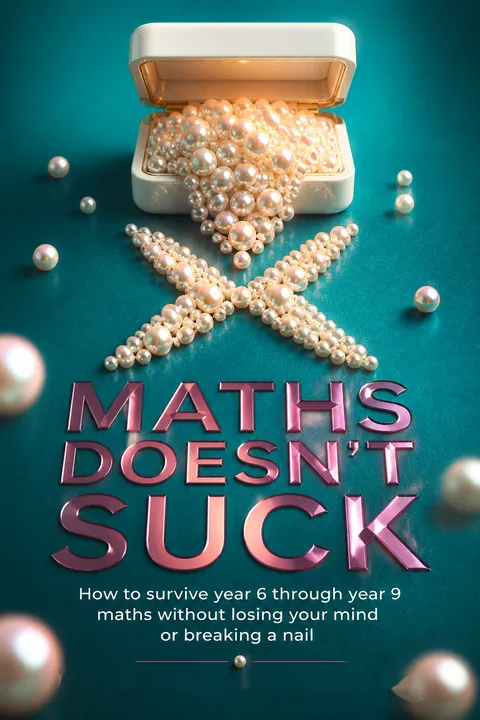
Maths Doesn't Suck is both a compact middle-school reference and an argument against a damaging identity claim: that a student who struggles with maths is inherently bad at it. Its structure moves from number foundations through fractions, decimals, percentages, word problems, and algebra, while personal stories keep returning to the emotional conditions under which learning happens. The result is not simply a list of rules. It is a sequence for making rules less mysterious: attach an idea to a familiar situation, name the mathematical relationship, show the steps, and give the learner a way to check the result.
The strongest teaching choice is the repeated connection between representations. A fraction can be a division problem, a decimal can be a fraction in place-value clothing, and a unit conversion can be multiplication by one expressed differently. These links help students build a coherent map rather than memorise isolated tricks. The book is also unusually direct about classroom behaviours that affect performance: ask questions, write intermediate steps, make room on the page, and scan a test before attempting its first problem.
Its lively metaphors and coined mnemonics lower the social temperature around maths, particularly for girls facing the stereotype that being stylish and being intelligent are incompatible. Yet humour is a doorway, not a proof. A student can remember a memorable label without understanding why the procedure works, so conceptual explanations and practice remain essential. Likewise, the author's account of maths as general brain training is more expansive than the evidence presented in the text can establish. The durable promise is narrower and more useful: mathematical fluency can improve through patient teaching, effort, and repeated engagement with ideas that once seemed inaccessible. The book's central achievement is helping a learner move from “I cannot do this” to “I can identify the next step.”
Review Summary
Math Doesn't Suck receives mostly positive reviews, with readers praising its accessible approach to math concepts. Many find it helpful for middle school girls, adult learners, and math teachers. The book's girly style is both appreciated and criticized. Reviewers highlight its clear explanations, real-world examples, and confidence-boosting content. Some note it's best for basic math review rather than advanced topics. Overall, readers appreciate McKellar's ability to make math less intimidating and more relatable, though a few find the gendered approach unnecessary.
Glossary
Birthday Cake method
Finds shared factorsA visual procedure for finding the highest common factor of numbers. Write the numbers together, repeatedly divide them by a factor they share, and multiply the shared divisors used along the way. The book also adapts the layout to find the lowest common multiple of two numbers by multiplying the values around the resulting L-shaped outline.
MAD Face method
Converts mixed numbersA mnemonic for changing a mixed number into an improper fraction. Multiply the denominator by the whole-number part, add the numerator, and place that result over the original denominator. The denominator stays unchanged, and the resulting fraction has the same value as the mixed number.
Copycat fractions
Fractions equal to oneThe author's informal name for fractions with the same nonzero number in the numerator and denominator, such as 4/4. Each equals 1, so multiplying another fraction by one of these does not change its value. This explains why multiplying or dividing the numerator and denominator by the same nonzero number creates an equivalent fraction.
Means and Extremes
Simplifies stacked fractionsA shortcut for dividing one fraction by another when they are stacked as a complex fraction. Multiply the outer numbers, called the extremes, to form the new numerator, and multiply the two inner numbers, called the means, to form the new denominator. Mixed numbers and whole numbers must first be rewritten as fractions.
Divide and Conquer method
Simplifies by shared factorsA way to simplify a fraction by repeatedly finding a common factor of its numerator and denominator and dividing both by it. Continue until no common factor remains. The approach can be easier to begin than immediately finding the highest common factor, especially when the numbers are large.
unit multipliers
Convert units without changing amountFractions built from equivalent quantities expressed in different units, such as 100 centimetres over 1 metre. Because the amounts are equivalent, the fraction represents 1 when units are considered. Multiplying by a unit multiplier changes the unit in which a quantity is expressed; arranging units to cancel helps guide the calculation.
BIDMAS
Orders calculation stepsThe order-of-operations mnemonic for Brackets, Indices, Division and Multiplication, then Addition and Subtraction. Division and multiplication share priority and are completed from left to right; addition and subtraction also share priority and are completed from left to right. The book supplies a longer phrase about a bear's meal to make the sequence memorable.
Highest Crush Factor
Lists common factorsThe author's playful name for finding the highest common factor by listing the factors of each number, identifying those they share, and selecting the largest shared value. The method is straightforward for small numbers, but listing every factor becomes cumbersome as numbers grow.
FAQ
What is Math Doesn't Suck by Danica McKellar about?
- Middle-school math focus: The book is a comprehensive guide for middle-school girls to understand and excel in math topics like fractions, decimals, percentages, ratios, and introductory algebra.
- Empowerment and confidence: Danica McKellar aims to break math stereotypes, especially for girls, and shows how math builds confidence and sharpens the mind.
- Engaging and relatable style: The author uses real-life examples, humor, testimonials, and quizzes to make math approachable and fun.
- Practical learning tools: The book offers troubleshooting guides, step-by-step explanations, and motivational advice to support different learning styles and real-life applications.
Why should I read Math Doesn't Suck by Danica McKellar?
- Breaks down math anxiety: The book addresses common fears and misconceptions about math, encouraging readers to embrace challenges and develop a positive mindset.
- Builds lasting confidence: Danica emphasizes that intelligence and math skills are lasting assets, more valuable than beauty or fame, and shares her own journey from math fear to success.
- Practical strategies and tools: Readers get clear, step-by-step methods for tricky topics, making it a valuable resource for homework, tests, and everyday math.
- Motivational and supportive: The book includes testimonials, personal stories, and advice on learning styles and study habits to keep readers motivated.
What are the key takeaways from Math Doesn't Suck by Danica McKellar?
- Math is for everyone: The book challenges stereotypes and encourages girls to see themselves as capable mathematicians.
- Step-by-step problem solving: It provides clear methods for understanding and solving math problems, making complex topics accessible.
- Confidence through practice: Consistent practice and a positive mindset are emphasized as keys to overcoming math anxiety and building confidence.
- Real-life relevance: Math skills are shown to be useful not just in school, but in everyday life and future careers.
What are the best quotes from Math Doesn't Suck by Danica McKellar and what do they mean?
- “Maths keeps your brain energized. And smart people can do a lot more with their lives than people who don’t exercise their brain.” —Geena, 12. This highlights the importance of using math to unlock your potential.
- “Being smart is something no one can ever take away from you.” —Jessica Tan. Intelligence is a lasting asset that empowers life choices.
- “Maths isn’t easy for anyone. It takes time and persistence to understand this stuff, so don’t give up on yourself just because you might feel frustrated.” Encourages perseverance and patience in learning math.
- “Maths really is power, and freedom.” Emphasizes that mastering math opens doors to opportunities and independence.
How does Danica McKellar explain factors, multiples, and prime factorization in Math Doesn't Suck?
- Prime numbers as "monkeys": Prime numbers are likened to monkeys swinging on the lowest branches of factor trees, making the concept memorable and fun.
- Factor trees method: The book teaches breaking down numbers into their prime factors using factor trees, ensuring the same prime factors are found regardless of the starting point.
- Divisibility tricks: Danica provides divisibility rules for numbers like 2, 3, 4, 5, 6, 8, 9, and 10 to quickly identify factors and speed up prime factorization.
- Practical application: These methods help students understand the building blocks of numbers and prepare for more advanced math topics.
What methods does Math Doesn't Suck by Danica McKellar teach for finding the Highest Common Factor (HCF) and Lowest Common Multiple (LCM)?
- Highest Crush Factor method: List all factors of both numbers, underline common ones, and pick the largest; best for small numbers.
- Multiplying Monkeys method: Use factor trees to find prime factors, underline common ones (including repeats), and multiply them for the HCF.
- Birthday Cake method: Write numbers side-by-side, divide by common factors layer by layer, and multiply the side numbers for the HCF; this is Danica’s favorite for larger numbers.
- LCM strategies: The book also covers finding the LCM using similar step-by-step approaches, making these concepts accessible and visual.
How does Math Doesn't Suck by Danica McKellar teach fractions, including operations and conversions?
- Understanding fractions: The book covers mixed numbers, improper fractions, equivalent fractions, and simplifying fractions with clear explanations.
- Adding and subtracting: It teaches finding the Lowest Common Denominator (LCD) using the LCM, and using "copycat fractions" to rewrite fractions with the same denominator before adding or subtracting.
- Multiplying and dividing: The book explains multiplying numerators and denominators directly, and for division, flipping the second fraction and multiplying.
- Converting between forms: Danica shows how to convert fractions to decimals (by dividing) and to percentages (by multiplying by 100), and vice versa.
What is the "Means and Extremes" method for simplifying complex fractions in Math Doesn't Suck by Danica McKellar?
- Complex fractions defined: These are fractions where the numerator and denominator are themselves fractions, often appearing tangled or complicated.
- Means and Extremes shortcut: Multiply the very top and very bottom numbers (extremes) for the new numerator, and the middle two numbers (means) for the new denominator, then simplify.
- Preparation step: Convert any mixed or whole numbers to improper fractions first, so the complex fraction is "tall and skinny" and ready for the shortcut.
- Simplification focus: This method streamlines what can otherwise be a confusing process, making it accessible for middle-schoolers.
How does Danica McKellar explain converting between decimals, fractions, and percentages in Math Doesn't Suck?
- Decimals to fractions: Count the digits after the decimal to set the denominator (10, 100, etc.), drop the decimal for the numerator, and simplify.
- Recurring decimals: For repeating decimals, use a denominator of 9s equal to the number of repeating digits, then simplify.
- Percentages to decimals and fractions: Drop the % sign and move the decimal two places left for decimals; write the percentage over 100 and simplify for fractions.
- Fractions to percentages: Divide numerator by denominator to get a decimal, then move the decimal two places right and add a % sign.
How does Math Doesn't Suck by Danica McKellar teach ratios, rates, and proportions?
- Ratios explained: Ratios compare two quantities with the same units and can be written as fractions, with colons, or in words; always simplify.
- Rates and unit rates: Rates compare quantities with different units (like miles per hour), and unit rates have a denominator of 1.
- Proportions as equivalent ratios: Proportions state that two ratios are equal, and the book teaches solving them using cross multiplication.
- Real-life examples: Danica uses relatable scenarios to help readers understand and apply these concepts in everyday situations.
What advice does Danica McKellar give in Math Doesn't Suck for overcoming math anxiety and building confidence?
- Recognize common feelings: The book normalizes feelings of fear, frustration, or confusion about math, showing that many students experience them.
- Positive mindset and practice: Danica encourages pretending enthusiasm, facing fear competitively, and practicing regularly to build confidence.
- Relaxation and test tips: She suggests skimming tests first, tackling easy problems, and using calming mental images or songs to reduce anxiety.
- Seek help and use resources: The author advises asking teachers or friends for help and using the book’s troubleshooting guide and website for extra support.
What learning styles and study tips does Math Doesn't Suck by Danica McKellar address?
- Auditory learners: Benefit from reading problems aloud, recording notes, and creating songs or dialogues to remember concepts.
- Visual learners: Prefer color-coding notes, making index cards, and rewriting key points to create mental images.
- Tactile/kinesthetic learners: Learn best through hands-on activities, acting out concepts, and using movement while studying.
- Personalized strategies: The book encourages readers to identify their learning style and use tailored study techniques for better understanding and retention.
Download PDF
Download EPUB
.epub digital book format is ideal for reading ebooks on phones, tablets, and e-readers.








