

Key Takeaways
Babur turned exile from Samarqand into an Indian empire.
A lost throne redirected ambition. Babur repeatedly seized and lost Samarqand, the prestigious Timurid capital, before Uzbek power pushed him toward Kabul. He captured Kabul in 1504, then gradually shifted his ambitions toward India, where political divisions and his own need for resources created an opening. At Panipat in 1526, his smaller force used careful positioning, artillery, and flanking attacks to defeat Ibrahim Lodi. But victory did not mean control: Babur still had to defeat Rana Sanga and contain Afghan resistance.
Conquest needed construction. Humayun later lost the empire to Sher Khan, known as Sher Shah, whose short rule strengthened roads, communications, currency, and revenue administration. Their careers show that Mughal rule emerged through several rulers’ efforts, not a single decisive battle.
What's striking is how geography turns defeat into opportunity. Kabul gave Babur a defensible base between Central Asia and India, while access to the Punjab offered wealth and a route into the plains. Military technology mattered, but it worked alongside intelligence, logistics, and the ability to exploit political fractures. The sequence also resists the familiar conqueror’s tale: Sher Shah’s administrative work mattered even though his dynasty did not last. A durable state can inherit useful machinery from a rival, even when its founding story celebrates victory over him.
Akbar made former Rajput rivals partners in imperial rule.
Alliance widened the ruling elite. Akbar’s agreements with Rajput rulers brought their territories and military service into the empire without abolishing their local dynasties. Many received mansabs, or official ranks, and served as commanders and provincial governors. Their ancestral lands could remain watan jagirs, meaning hereditary holdings within the imperial system. Marriage alliances reinforced some relationships, but they were not required of every Rajput ruler. Mewar resisted Akbar’s demand for personal submission, and Rana Pratap continued fighting after Haldighati in 1576.
Partnership had limits. Akbar’s policy helped create a composite ruling class, an elite drawn from different regional, religious, and ethnic communities. The emperor nevertheless claimed authority over succession and expected service. The arrangement offered local rulers security and access to imperial office, while giving the Mughals military and administrative reach.
This was not modern equality, but it was a sophisticated way to govern a large, diverse territory without trying to erase every local authority. It resembles indirect rule: local elites retain status and some autonomy, while the centre secures loyalty, taxes, and military support. Such bargains can be more resilient than uniform administration, but they depend on credible reciprocity. When succession rights or local standing seem threatened, an alliance built on mutual advantage can become a source of resistance.
Keep a vast empire governable by ranking service and splitting authority.
Rank linked status to service. The mansabdari system assigned each official a mansab, or rank, that determined personal status and salary, as well as the cavalry contingent he was expected to maintain. Under Akbar, the system developed into a hierarchy rather than a loose collection of military titles. Later, a noble’s zat rank indicated personal standing, while sawar specified the cavalry obligation. Payment often came through a jagir, an assignment of state revenue rather than ownership of the land itself.
Checks restrained officials. Akbar’s provincial system gave governors, revenue officers, military officials, and judges separate responsibilities. They were appointed by the centre and could report beyond the governor. This division aimed to prevent any one official from becoming too powerful, while connecting provincial administration to the emperor.
The system joined bureaucracy and military service in one institution. That made it flexible: a ranked official could be assigned administrative or military work as needs changed. Splitting authority also resembles a checks-and-balances design, though its effectiveness depended on the ruler’s ability to receive reliable reports and enforce decisions. The central tension is clear: the empire needed capable intermediaries to govern distant regions, yet those intermediaries could turn local resources into personal power.
Measure land for predictable revenue, while remembering who bore the risk.
Assessment made production legible. Sher Shah developed a system based on measuring cultivated land, and Akbar’s revenue officials refined it. The dahsala, or ten-year assessment, used average crop yields and local prices to set cash rates. Within the broader zabt system, land was measured and classified by cultivation history and productivity. The state’s standard share was often one-third of the average produce, though rates varied by region and crop. Cultivators could also encounter crop-sharing or estimation when measurement was impractical.
The burden stayed local. Zabt did not make the state a direct landlord or remove village headmen and zamindars from collection. Local intermediaries remained essential, and the tax system could impose hardship when harvests failed or officials pursued arrears. The method improved predictability for the treasury, but it did not eliminate unequal power within villages.
The system illustrates a lasting trade-off in public finance: measurement can make taxation more predictable, but a stable assessment is not automatically a fair one. A state gains information about production, while cultivators still face weather, local power, and collection practices. Its limits also matter. The book stresses that measurement did not cover every province or every field, so the ideal of a uniform fiscal system should not be mistaken for uniform practice.
India's towns and merchants linked village output to global trade.
A connected economy took shape. About 85 percent of the population lived in rural areas, yet towns grew as markets, administrative centres, and manufacturing hubs. Merchants moved grain and raw materials from villages, while textiles and other goods travelled between regions and overseas. Indian traders used hundis, bills of exchange that allowed money to be transferred without carrying coins over long distances. Indian merchants and shipowners remained central to trade, even as Dutch and English companies expanded their presence.
Exports reached far beyond India. Cotton textiles, indigo, silk, saltpetre, and other goods moved through ports such as Surat, Masulipatam, and Bengal’s coastal centres. European companies bought into existing Indian commercial networks rather than creating trade from scratch. The period’s economic growth did not mean equal prosperity, but it did produce busy ports, skilled artisans, and wealthy merchant houses.
The contrast between a predominantly rural population and an extensive trading network is important: urban growth did not require most people to live in cities. Villages could feed markets and manufacturing centres through layers of intermediaries. This is a useful corrective to accounts that treat European companies as the sole engines of long-distance trade. Their advantage grew over time, but Indian merchants, financial practices, and production networks were already well established. Commercial vitality, however, should not be confused with broad material equality.
Akbar's religious openness strengthened rule without abolishing social hierarchy.
Pluralism became statecraft. Akbar’s principle of sulh-i-kul meant peace among all religions. He abolished the pilgrimage tax and jizya, welcomed religious discussion, commissioned Persian translations of Hindu works, and admitted Hindus to high office. His experiments grew from both personal curiosity and a political need to govern a population with many faiths. He challenged the authority of the orthodox ulama when their claims conflicted with imperial policy.
Tolerance was not equality. Akbar remained an absolute ruler, and the society around him was sharply hierarchical. His reforms, including measures concerning marriage and widow remarriage, were not always followed in practice. Religious accommodation helped bind different elites to the state, but it did not erase caste distinctions or give ordinary people equal political power.
Akbar’s policy is best understood as a governing principle with ethical consequences, not as a modern secular constitution. It allowed diverse communities to serve the state without requiring uniform belief, a form of pluralism that can reduce the political cost of religious difference. Yet tolerance from above remains vulnerable to a ruler’s preferences. The contrast between broad religious inclusion and persistent social hierarchy also warns against treating one kind of openness as proof that a society has resolved other forms of exclusion.
Aurangzeb expanded the map as alliances and consent narrowed.
Conquest carried political costs. Aurangzeb ruled for nearly fifty years and brought the empire to its greatest territorial extent. He also imposed jizya again in 1679, ordered the destruction of particular temples, and fought prolonged conflicts with Rajput rulers, Sikhs, Jats, Satnamis, and Afghan groups. These episodes had different causes, so they cannot be reduced to one religious conflict. Hindus still formed about 32 percent of the high nobility between 1679 and 1701, according to the book’s figures.
The coalition weakened. Aurangzeb’s religious policies alienated some subjects and rulers, while military and political disputes drove resistance. The breach with Marwar and Mewar damaged relations with important Rajput houses. His attempt to win Muslim support through orthodoxy did not prevent opposition or secure lasting unity.
The reign resists a single-cause verdict. Religious policy mattered because symbols such as jizya and temple destruction shaped how imperial power was experienced, but political disputes, regional ambitions, and fiscal pressures also drove conflict. The continued presence of many Hindu nobles complicates any claim that Aurangzeb simply excluded them from power. A useful distinction is between representation at court and consent across society: a diverse elite can coexist with policies that alienate communities beyond it.
The Deccan consumed a century because sovereignty could not be imposed by capture.
The south resisted quick settlement. Mughal expansion into the Deccan lasted roughly from 1596 to 1687. Akbar seized territory in Ahmadnagar and Khandesh; Jahangir faced Malik Ambar, who used Maratha light cavalry and raids to frustrate consolidation. Shah Jahan’s 1636 settlement recognized Mughal supremacy while leaving Bijapur and Golconda in place. Aurangzeb later abandoned that balance and annexed both states.
Capitals were not the whole country. The Marathas continued to fight through mobile forces, forts, and local alliances after Bijapur and Golconda fell. Their resistance spread across the Deccan and into the Karnataka. Capturing royal centres did not automatically secure the countryside, collect revenue, or win over local powers. The effort tied down Mughal armies and administrators for years.
This is a classic problem of asymmetric warfare: a large state may win set-piece battles and still struggle to control routes, forts, and local populations. The treaties of 1636 offered a cheaper way to manage competing powers, but their eventual abandonment destroyed confidence in Mughal promises. The deeper lesson is that sovereignty is more than possession of territory. It depends on whether officials can govern, collect revenue, and persuade local actors that cooperation is safer than resistance.
A jagir crisis made service obligations exceed the state's real income.
Revenue on paper was not revenue collected. The jagirdari system assigned state income from land to officials to cover salaries and military obligations. Under Aurangzeb, the number of mansabdars and the costs of war placed growing pressure on available assignments. In the Deccan, assessments could greatly exceed actual collections, while armed zamindars and Maratha raids made revenue harder to obtain. Contemporary observers complained that officials often maintained far fewer troops than their ranks implied.
The bargain stopped working. Jagirdars competed for productive assignments, while soldiers and officials faced arrears and uncertainty. The centre could demand service, but could not reliably supply the resources that made service worthwhile. This weakened loyalty and encouraged nobles to pursue independent power. The crisis was not simply too many officials; it grew from the mismatch between fiscal claims, military costs, and local control.
A jagir functioned as both compensation and an incentive: the official had a stake in collecting the revenue needed to sustain state service. Once the assignment’s assessed value diverged from what could actually be collected, the incentive became a source of conflict. This resembles a principal-agent problem: the centre depended on intermediaries it could not fully monitor, while those intermediaries depended on resources the centre could not guarantee. Military expansion intensified a structural weakness rather than creating it alone.
After Aurangzeb, regional power rose before the economy simply collapsed.
Political authority fragmented. After 1707, Bengal, Awadh, Hyderabad, and other regions gained practical independence, while the Marathas expanded their claims across much of India. Court factions weakened the centre, and Nadir Shah’s invasion in 1739 exposed the empire’s military vulnerability. The Maratha bid for supremacy culminated in the Third Battle of Panipat in 1761, beyond the book’s main 1526 to 1748 frame.
Economic life continued unevenly. The loss of imperial authority did not instantly extinguish trade, cities, or manufacturing. New regional capitals grew, commerce shifted between centres, and Indian merchants continued to operate. Political fragmentation was real, but it was not identical to economic collapse. The Mughal court lost control faster than Indian society lost its commercial connections.
The closing distinction is between the breakdown of an empire and the disappearance of the systems beneath it. Regional states could inherit administrative routines, revenue practices, and commercial networks even while fighting over sovereignty. That helps explain why political decline and economic activity do not move in lockstep. The account also leaves a useful question: how much resilience came from institutions built under the Mughals, and how much from local networks that had always operated beyond the court’s direct control?
Analysis
The book’s deepest argument is that Mughal power depended on a negotiated system, not simply on military superiority. Babur supplied a dynasty and a strategic base; Sher Shah and Akbar helped build governing machinery; Rajput alliances, ranked service, revenue assessment, and commercial networks made expansion possible. The same arrangements generated vulnerabilities. Jagirs tied military service to revenue collection, but the centre could not always measure or collect the income it promised. Zamindars were necessary intermediaries and potential rivals. Regional rulers could be incorporated as partners, yet coercive demands or unreliable treaties could turn them into opponents.
This interpretation makes the history more than a sequence of rulers. It links political choices to fiscal capacity, social structure, and the movement of goods. It also explains why territorial growth could coexist with institutional strain. The conquest of a capital did not guarantee control over its countryside, and a court’s claim to authority did not ensure that its officials could pay soldiers or secure roads.
The account is strongest when it resists monocausal explanations. Akbar’s accommodation cannot be reduced to personal kindness, and Aurangzeb’s crises cannot be explained by religion alone. Military competition, succession politics, regional ambitions, and revenue pressures all mattered. Still, the narrative relies heavily on court chronicles and administrative records. These reveal the intentions and conflicts of rulers more clearly than the lived experience of cultivators, artisans, and women. Its portrait of popular resistance is therefore less complete than its account of elite politics.
The final picture is not a simple rise and fall. Imperial authority fractured, but commerce and local administration proved more durable than the dynasty. The distinction matters: losing political unity is not the same as losing economic capability. The Mughal legacy survives most clearly in the institutions, alliances, and regional arrangements that continued to shape India after the court ceased to command them.
Review Summary
Medieval India receives mixed reviews, with an overall rating of 3.97/5. Many praise it as a comprehensive work on medieval Indian history, filling a gap in quality Indian-authored texts on the subject. Readers appreciate its depth, use of sources, and challenge to the "dark age" narrative. However, some criticize it as biased or Marxist. The book is noted for its difficulty due to the vast history covered and similar names. Despite criticisms, it's generally regarded as a valuable resource for those interested in medieval Indian history.
People Also Read




Glossary
Mansabdari system
Ranked imperial serviceThe Mughal system for ranking officials and military commanders. A mansab determined a person’s status and salary, and specified the cavalry force he was expected to maintain. Mansabdars could receive administrative or military assignments. Their pay often came through a jagir, an assignment of state revenue, rather than ownership of the land.
Jagirdari system
Revenue-funded serviceThe system of assigning state revenue from a territory to an official, usually in place of a cash salary. A jagirdar was expected to collect the assigned revenue and meet the costs of service, including maintaining troops when required. A jagir conveyed a claim to revenue, not private ownership of the land itself.
Zabt
Measured land assessmentA land-revenue system based on measuring cultivated fields and assessing payment according to the crops and rates applicable to the area. It helped the state estimate what cultivators owed without relying entirely on dividing each harvest. Its reach was uneven, and local officials, village headmen, and zamindars remained involved in assessment and collection.
Dahsala
Ten-year revenue assessmentAkbar’s revenue arrangement based on average crop yields and prices over ten years. Those averages were used to establish cash rates for different crops and regions. Dahsala was not a ten-year guarantee that the same amount would be collected regardless of conditions. It was a method for setting assessments, with practice varying across the empire.
Sulh-i-Kul
Peace among religionsAkbar’s principle of maintaining peace and fair treatment among the empire’s different religious communities. It supported policies such as abolishing jizya, employing people of varied faiths, and encouraging discussion and translation across traditions. It was a governing ideal, not a modern guarantee of equal rights or an end to social hierarchy.
Chauth
One-quarter revenue claimA demand for one-quarter of revenue. In Gujarat, chauth had existed as a zamindari charge. Shivaji and later Maratha rulers used the claim more broadly, often demanding payment from territories outside their direct control in return for protection from Maratha raids. It became both a revenue claim and an instrument of political expansion.
Sardeshmukhi
Ten-percent superior claimA claim amounting to one-tenth of assessed revenue, based on the idea that the Maratha ruler was the superior head of the local deshmukhs. Like chauth, it could be demanded from territories not directly ruled by the Marathas. Its grant signified recognition of Maratha authority as well as a source of income.
Zamindar
Local landed intermediaryA broad term for a rural holder of hereditary rights, local authority, or a share in land revenue. Zamindars could collect revenue, maintain armed followers, and exercise influence over villages. Their precise rights varied by region. They were not simply private landowners, and Mughal rulers both relied on them and tried to limit their power.
Hundi
Transferable credit instrumentA bill of exchange used by merchants to transfer money or settle payments across distance without physically transporting coins. Hundis could be cashed in another town, often after goods had been sold, and could include insurance arrangements. They helped finance long-distance trade and formed part of India’s established commercial networks.
FAQ
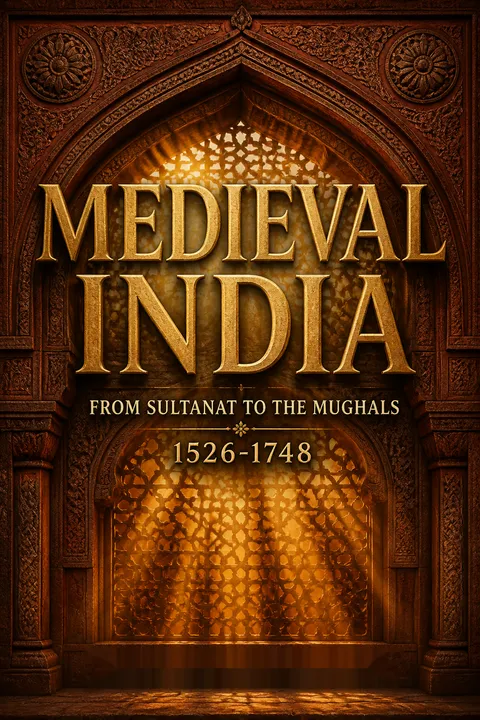
What's Medieval India: From Sultanat To The Mughals 1526-1748 about?
- Historical Overview: The book provides a detailed history of India from the Sultanate period to the Mughal Empire, focusing on political, social, and economic changes.
- Key Figures: It discusses significant rulers such as Babur, Akbar, Aurangzeb, and Shivaji, highlighting their policies and impacts on Indian society.
- Cultural Dynamics: The text explores interactions between different religious and cultural groups, particularly Hindus and Muslims, during this transformative period.
Why should I read Medieval India: From Sultanat To The Mughals 1526-1748?
- In-depth Analysis: The book offers a comprehensive examination of the complexities of medieval Indian history, making it valuable for students and history enthusiasts.
- Contextual Understanding: It helps readers understand the socio-political landscape of India, which is crucial for comprehending contemporary issues.
- Rich Source Material: Authored by Satish Chandra, the book utilizes a variety of primary sources, providing a well-rounded perspective on historical events.
What are the key takeaways of Medieval India: From Sultanat To The Mughals 1526-1748?
- Mughal Administration: The book emphasizes the administrative strategies employed by the Mughals, including the mansabdari system and revenue collection methods.
- Cultural Synthesis: It highlights the cultural synthesis that occurred during this period, blending Persian, Indian, and Islamic influences in art, architecture, and literature.
- Decline and Legacy: The text examines the decline of the Mughal Empire and its legacy, setting the stage for the rise of regional powers and the eventual colonial period.
What are the best quotes from Medieval India: From Sultanat To The Mughals 1526-1748 and what do they mean?
- "Justice is the most excellent of religious rites": Reflects Sher Shah's belief in justice as a foundation for governance, transcending religious boundaries.
- "Royalty is a light emanating from God": Emphasizes the divine right of kingship, suggesting rulers are chosen by God to lead and protect their subjects.
- "The arms of Cambay stretches two arms - one towards Aden and one towards Malacca.": Highlights India's central role in the Indian Ocean trade, connecting East and West.
How did Akbar's policies shape the Mughal Empire?
- Religious Tolerance: Akbar's sulh-i-kul policy fostered an environment of religious harmony, allowing for the coexistence of various faiths within the empire.
- Administrative Reforms: He implemented the mansabdari system, organizing military and civil administration for effective governance across vast territories.
- Cultural Patronage: Akbar's support for the arts and literature led to a flourishing of culture, with significant contributions in painting, poetry, and architecture.
What was the significance of the Battle of Panipat in Medieval India: From Sultanat To The Mughals 1526-1748?
- Decisive Victory: The Battle of Panipat (1526) was a decisive victory for Babur, marking the beginning of Mughal rule in India.
- Military Tactics: Babur's innovative use of artillery and strategic formations showcased a shift in military tactics that influenced future battles.
- Political Implications: The battle effectively ended the Lodi dynasty and opened the way for the establishment of a new political order under the Mughals.
How does Medieval India: From Sultanat To The Mughals 1526-1748 address the role of trade in medieval India?
- Trade Networks: The book details the extensive trade networks established by Indian merchants, including connections to Southeast Asia and the Middle East.
- Merchant Classes: It discusses various classes of merchants, from large-scale traders to small-scale pedlars, and their contributions to the economy.
- Impact of European Companies: The text analyzes how European trading companies disrupted traditional trade practices and influenced market dynamics in India.
What are Aurangzeb's religious policies as described in Medieval India: From Sultanat To The Mughals 1526-1748?
- Orthodox Approach: Aurangzeb is depicted as an orthodox ruler who reversed Akbar's policies of religious tolerance, leading to increased tensions.
- Jizya Re-imposition: The book explains how Aurangzeb re-imposed jizya on non-Muslims, seen as discriminatory and leading to widespread resentment.
- Temple Destruction: Aurangzeb's orders to destroy certain Hindu temples are discussed, illustrating his use of religion as a political tool.
How did the Mughal Empire manage its diverse population?
- Cultural Integration: The Mughals promoted a syncretic culture, blending elements of Hindu and Islamic traditions, which helped in managing a diverse populace.
- Religious Policies: Policies like Akbar's sulh-i-kul encouraged tolerance and respect for different religions, reducing sectarian conflicts.
- Administrative Representation: The inclusion of various communities, including Rajputs and Afghans, in the administrative framework ensured broader representation and loyalty to the empire.
What impact did the Marathas have on the Mughal Empire as described in Medieval India: From Sultanat To The Mughals 1526-1748?
- Resistance Movement: The Marathas are portrayed as a significant resistance force against Mughal authority, particularly under leaders like Shivaji and Sambhaji.
- Political Fragmentation: Their rise contributed to the political fragmentation of the Mughal Empire, as they carved out their own territories and challenged Mughal dominance.
- Cultural Identity: The book discusses how the Maratha movement fostered a sense of regional identity and autonomy, which had lasting implications for Indian history.
What role did the economy play in the Mughal Empire as discussed in Medieval India: From Sultanat To The Mughals 1526-1748?
- Agricultural Base: The economy was primarily agrarian, with land revenue being the main source of income for the empire, as detailed in the book.
- Trade Networks: The text describes the extensive trade networks that developed, both inland and overseas, contributing to the empire's wealth.
- Jagirdari System: The jagirdari system is analyzed as a crucial economic structure that linked the nobility to land revenue collection, impacting governance.
How does Satish Chandra evaluate Aurangzeb's reign in Medieval India: From Sultanat To The Mughals 1526-1748?
- Complex Character: Chandra presents Aurangzeb as a complex figure whose orthodox beliefs conflicted with the practical needs of governance in a diverse empire.
- Administrative Efficiency: While acknowledging his administrative capabilities, the author critiques Aurangzeb's rigid policies that ultimately led to discontent and rebellion.
- Legacy of Decline: The book concludes that Aurangzeb's reign, marked by religious intolerance and military overreach, set the stage for the empire's decline in the 18th century.
Download PDF
Download EPUB
.epub digital book format is ideal for reading ebooks on phones, tablets, and e-readers.








