

Key Takeaways
Treat rags-to-riches stories as possibility, not proof of a fair system
Success had a backstory. Andrew Carnegie arrived in Pittsburgh from Scotland at twelve and began as a mill worker earning $1.20 a week. A telegraph job brought him into contact with railroad executives, investment opportunities, and the business knowledge that helped him build a fortune. His rise was real, but it depended on more than grit: access to information and influential mentors mattered enormously.
Frick’s path differed. Henry Clay Frick endured family hardship and worked his way into the coke business, but an inheritance from his grandfather helped him buy into his first company. He expanded by acquiring competitors’ land and equipment during downturns. Their stories show genuine talent and risk-taking, but they were not identical tales of starting with nothing.
The book’s paired biographies complicate the familiar American success story without denying individual skill. Carnegie and Frick were unusually capable, yet their trajectories also relied on networks, capital, timing, and access to opportunity. That distinction matters because exceptional examples can make a system look more open than it is. Social scientists describe this problem as survivorship bias: visible winners are easier to study than the many people who worked hard and took risks without becoming tycoons. The lesson is not that ambition is futile, but that a person’s rise cannot, by itself, prove that everyone had a comparable chance.
Win through lower costs, then control more of the supply chain
Costs drove the strategy. Carnegie learned to track production expenses closely, then use that knowledge to underbid competitors. During the depression that followed the 1873 financial panic, construction and labor costs fell, helping him complete the Edgar Thomson steel works when rivals hesitated. The mill began producing steel rails in 1875 and quickly became profitable. Carnegie focused less on a single year’s price than on reducing the underlying cost of every ton.
Control strengthened the advantage. Steel required iron ore, coke, transport, and increasingly sophisticated machinery. Carnegie secured access to key inputs and partnered with Frick, whose coke business supplied the fuel. New processes, including open-hearth steelmaking, offered further savings. Together, tight accounting, technical change, and supply control made Carnegie Steel a powerful industrial system rather than just a successful mill.
Carnegie’s edge came from combining operational discipline with strategic patience. A downturn that threatened competitors became an opportunity to build more cheaply, while investment in process improvements kept lowering costs after the immediate crisis passed. This resembles modern operations strategy, where control of bottlenecks can matter as much as control of final products. Yet efficiency is not a neutral measure of success. The same accounting that reveals waste in fuel or machinery can reduce human beings to adjustable inputs. The story makes a useful distinction: cost control can build durable capacity, but its social value depends on who shares the gains.
Share ownership with executives, and notice who remains outside the partnership
Ownership tied leaders to results. Carnegie often gave senior managers shares in the businesses they ran. Frick eventually became chairman of Carnegie Brothers, and rising managers such as Charles Schwab also gained a stake. This arrangement helped retain talent and gave executives a direct claim on the enterprise’s success. Carnegie’s own experience had taught him that ownership could create far greater wealth than a salary.
The wider workforce stood apart. Carnegie Steel carefully measured output and labor costs, while most workers had no comparable share in profits or decision-making. In Frick’s coke operations, workers could be required to use company stores or accept company scrip, which could only be spent there. Carnegie publicly defended workers’ right to organize, yet his companies resisted union power. The language of partnership covered a sharply unequal distribution of authority and reward.
Equity incentives can align managers with a company’s long-term performance, but they do not automatically align the company with everyone who creates its output. Here, ownership was a selective instrument of loyalty, concentrated among senior figures, while laborers were managed through measurement, wage scales, and discipline. The contrast anticipates a continuing governance question: who counts as a stakeholder when a firm says its interests are shared? Broad-based ownership could distribute risk and reward differently, but the book’s example shows that the word partnership can also describe a relationship in which one side has almost all the power to set the terms.
At Homestead, the fight was over collective power, not one dollar
The contract dispute became a test. In 1892, Carnegie Steel and the Amalgamated Association of Iron and Steel Workers argued over wages, the date used to reset the wage scale, and the union’s role in the plant. The company wanted a wage floor of $23 per ton; the union insisted on $24, while the existing agreement had set a $25 minimum. The date mattered too: the company wanted negotiations tied to winter prices, when steel demand was often lower.
Recognition was the core issue. Although the changes directly affected only some of Homestead’s 3,800 employees, workers understood that accepting individual contracts would weaken their union’s bargaining authority. Frick rejected further dealings with the association. Carnegie had already declared that the merged steel company would be nonunion. What looked like a narrow wage negotiation had become a struggle over who could speak for workers at all.
The small numerical gap can obscure the larger institutional conflict. A wage floor determines immediate pay, but collective bargaining determines whether workers can negotiate as a group in future disputes. That is why the union treated the contract’s procedural details as central rather than incidental. The episode illustrates a basic insight from collective-action theory: individuals may have little leverage alone, while coordinated workers can exert pressure, provided they can maintain solidarity. The company understood that same leverage and treated union recognition as a precedent to prevent. The conflict was therefore about future authority as much as current compensation.
Armed guards turned a contract dispute into a deadly battle
The preparations invited confrontation. Frick had a tall, barbed-wire-topped fence built around the Homestead works and secretly arranged for about 300 Pinkerton guards to arrive by river on July 6. The plan was to secure the plant and allow replacement workers to enter. The union had organized watches along the river and around the mill, expecting an attempt to break the strike.
The landing became a battle. Workers and townspeople gathered as the barges reached the plant. Accounts disagree about who fired first, but sustained gunfire followed, with deaths and injuries on both sides. After hours of fighting, the Pinkertons surrendered. Some guards were then beaten as they were marched through the crowd, while union leaders worked to protect captives and secure their departure. The violence gave the dispute a national audience and made a peaceful settlement far less likely.
The decision to hire private guards may have seemed to management like a practical way to protect valuable property. But in a community where thousands feared losing both work and collective voice, the arrival of armed outsiders was read as an attack. Each side’s preparations made the other’s fears more credible, a familiar escalation pattern in conflict studies: defensive measures can look offensive to the people facing them. A careful account also needs to preserve uncertainty. The first shot was disputed, and later witnesses had strong reasons to frame the event in ways favorable to their side.
A defeated union can lose decades of bargaining power
State force changed the balance. After the Pinkertons withdrew, Pennsylvania governor Robert Pattison sent the National Guard to Homestead. The troops occupied the area, protected the works, and made it possible for the company to bring in replacement labor. The strike continued until November 1892, when workers returned or sought other employment. The Amalgamated’s bargaining position at Homestead was broken.
The damage outlasted the stoppage. Skilled workers were blacklisted, while many unskilled laborers, unable to afford a prolonged strike, returned sooner. The company resumed production without recognizing the union. The Amalgamated lost ground across the steel industry, and the last union lodge in a U.S. steel plant surrendered its charter in 1903. The text describes no steel union reappearing until 1937. The defeated strike had consequences far beyond one mill or one contract.
The outcome shows how bargaining power depends on more than the determination of workers. It also depends on access to money during a stoppage, public support, political decisions, and the employer’s ability to replace labor. The unequal capacity to endure a shutdown made the contest structurally lopsided: a worker living from payday to payday faced a different risk than an owner with substantial assets. At the same time, the solidarity of skilled and unskilled workers was fragile because their pay and prospects differed. The episode is a reminder that collective action needs both shared purpose and institutions that can sustain participation.
Philanthropy can widen opportunity without repairing how wealth was made
Carnegie gave on a vast scale. After selling his steel holdings, he funded roughly 2,800 public libraries and gave away hundreds of millions of dollars. His donations also supported education, scientific research, music, and efforts to prevent war. Frick, too, left major gifts: his art collection and New York home became a public museum, and his estate supported universities, hospitals, and a Pittsburgh nature preserve.
The gifts did not settle the labor dispute. In Homestead, wages for many skilled workers fell sharply after the strike, shifts returned to twelve hours, and the mill operated seven days a week. Carnegie’s libraries offered real access to learning, but some workers asked what use a library was to someone working twelve hours a day. The book holds both facts together: philanthropy created lasting public institutions, while the conditions that generated the fortunes remained contested.
Public giving can create goods that markets and governments fail to provide, and Carnegie’s library program made learning spaces available to communities around the world. But philanthropy is not a substitute for fair labor conditions or a public accounting of how wealth accumulated. The two operate at different points in the distribution of resources: one gives back after profits have been made, while the other shapes how income and power are allocated in the first place. That distinction avoids a false choice between celebrating useful gifts and examining the costs of production. Both questions deserve attention.
When trust collapses, contracts become weapons
Business disputes turned personal. In the late 1890s, Carnegie and Frick clashed over coke prices, the value of their companies, and a proposed sale involving financiers whom Carnegie distrusted. Carnegie believed Frick and Henry Phipps stood to profit as brokers; Frick later disputed that account. The failed sale deepened suspicions between men who had once relied on each other’s judgment.
A contract became leverage. Carnegie then invoked the Iron Clad Agreement, which allowed partners to be forced out at book value. He sought to buy Frick’s shares for roughly $1.5 million, far below the value Frick claimed. Frick sued. In 1900, they reached a settlement that valued Carnegie Steel at $250 million and Frick Coke at $70 million. Frick left management with about $31 million in stock and bonds, but the partnership and friendship were over.
The dispute reveals a weakness in governance built around personal loyalty. Informal understandings may work while partners trust one another, but once incentives diverge, ambiguity becomes a resource for whoever controls the formal machinery. The Iron Clad Agreement had been created to protect the business from disruption, yet its book-value rule became a tool in a power struggle. Strong contracts can reduce uncertainty, but they cannot replace credible commitment or transparent valuation. The text’s disputed accounts of the proposed sale also matter: a historical narrative should distinguish what one party alleged from what the other denied.
The steel empire made them rich, but could not reconcile them
Their partnership built an industrial giant. Carnegie sold his steel company to J. P. Morgan’s new U.S. Steel in 1901 for a total price of $480 million. Frick received a stake valued at $61.4 million and remained influential in the corporation, though Carnegie had opposed making him its chief executive. The business arrangement had ended; the rivalry had not.
The final exchange stayed bitter. In 1919, as both men neared death, Carnegie sent Frick a message proposing that they meet and set aside old grievances. Frick refused, saying they could meet after death. Carnegie died in August; Frick died in December. Their fortunes went on to support libraries, museums, universities, and other institutions, but their story leaves no simple verdict. Industrial achievement and public generosity coexisted with labor conflict, lasting resentment, and radically unequal power.
The ending is memorable because the men’s financial success could not purchase reconciliation. Their feud was not merely a private quarrel: it grew from different styles of power, conflicting claims about responsibility, and the public meaning of the Homestead conflict. The title’s dark humor captures the distance between them without resolving the moral questions their lives raise. A balanced reading need not reduce either man to hero or villain. It can recognize industrial innovation and enduring gifts while asking whose labor, security, and voice paid for the system that made those gifts possible.
Analysis
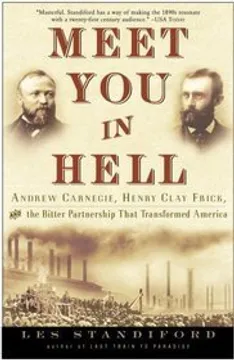
Meet You in Hell is a narrative history organized around a partnership that first powered an industrial transformation and then became a vehicle for mutual grievance. Its scale is large, spanning the rise of American steel, the Homestead conflict, the creation of U.S. Steel, and the men’s final years. Its organizing question is intimate: how did Andrew Carnegie and Henry Clay Frick move from indispensable allies to lifelong enemies, and what does that fracture reveal about the costs of their success?
The strongest explanatory thread is the collision between operational efficiency and human claims. Carnegie and Frick built advantage through careful cost accounting, control of raw materials, technical investment, and disciplined management. These methods made their steel company formidable. They also encouraged a view of labor as a cost to be optimized, even while Carnegie publicly praised workers’ rights and the shared interests of capital and labor. At Homestead, the conflict was not simply over a wage figure. It concerned whether workers could retain an institution capable of bargaining with management.
The book also resists a tidy division between a genial Carnegie and a brutal Frick. Carnegie’s public benevolence and labor rhetoric sat beside his support for the nonunion outcome; Frick’s hard-line management coexisted with private grief and later public philanthropy. Their differences in temperament mattered, but both operated within a business culture that rewarded expansion and treated organized labor as a threat to managerial control.
The narrative’s dramatic scenes make these tensions vivid, while the disagreements among witnesses over the Homestead violence caution against treating any single account as definitive. The larger lesson is not that industrial growth was inherently illegitimate or that philanthropy was meaningless. It is that material progress and social justice are separate achievements. A firm can revolutionize production, its owners can fund lasting public institutions, and workers can still bear severe costs while having little say over how the gains are divided.
Review Summary
Most reviewers rated Meet You in Hell highly, praising its engaging account of Carnegie and Frick's tumultuous partnership and the Homestead Strike of 1892. Pittsburgh-area readers found particular personal resonance with the story. Many appreciated Standiford's balanced portrayal of both men's complex characters — Carnegie's people-pleasing duplicity versus Frick's brutal honesty. Some critiques noted the writing occasionally felt textbook-like, with overly specific details slowing the narrative. Overall, readers found it a compelling, thought-provoking exploration of Gilded Age capitalism, labor relations, and the lasting legacies of two deeply flawed industrial titans.
Glossary
Iron Clad Agreements
Partner succession and buyout rulesAgreements used by Carnegie’s firms to manage ownership if a partner died or withdrew. They provided time for the company to buy a partner’s shares, generally at book value, and included a provision allowing other partners to require a sale. The rules were intended to protect the enterprise, but Carnegie later used them to seek Frick’s removal at a low valuation.
Amalgamated Association of Iron and Steel Workers
Steelworkers’ bargaining unionA national labor organization formed in 1876 from several iron and steel workers’ groups. It emphasized negotiation and collective bargaining rather than revolutionary action. At Homestead, it represented the skilled workers whose contracts were at issue and whose bargaining status Carnegie Steel sought to end. The defeat of the union there weakened organized labor across the steel industry.
sliding scale
Wages linked to steel pricesA wage arrangement that adjusted workers’ pay according to the market price of steel. At Homestead, the company argued that wages should move downward when steel prices fell, while the union defended a minimum wage floor and other contract terms. The scale made pay responsive to market conditions, but disputes over its floor and reset date also became contests over union authority.
Bessemer process
Rapid mass steelmaking methodA method for converting molten iron into steel by forcing air through it, which removes excess carbon and impurities. Developed in the nineteenth century, the process sharply reduced the time and cost required to make steel in large quantities. Its adoption helped steel replace iron in rails and other infrastructure, and helped create the conditions for the rapid expansion of Carnegie’s industry.
Social Darwinism
Evolution applied to societyA way of interpreting social and economic competition through the language of biological evolution and survival. The book describes how Carnegie drew on these ideas to view competition and business success as evidence of social progress. That outlook could justify relentless expansion and the exclusion of those who lost, while allowing its adherents to overlook how unequal starting conditions shaped who succeeded.
Fort Frick
Homestead mill’s barricaded perimeterThe nickname workers gave the Homestead steel works after management surrounded it with a high wooden barrier, barbed wire, and other security measures during the 1892 labor dispute. The fortifications made visible that the company expected a confrontation and intended to control access to the plant. They became a symbol of the conflict between management and the locked-out workers.
Download PDF
Download EPUB
.epub digital book format is ideal for reading ebooks on phones, tablets, and e-readers.








