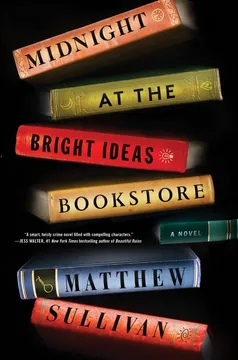


Plot Summary
The Photograph in Joey's Pocket
Near closing time at Bright Ideas, Lydia hears books falling upstairs and finds Joey, a young BookFrog she has quietly looked after, hanging in the History section. As her coworker Ernest tries to help, Lydia notices a photograph in Joey's pocket and slips it away before anyone sees. It shows her at ten, celebrating a birthday with her old friends Raj and Carol.
The image makes Joey's death impossible to treat as an isolated tragedy: Lydia has never seen this picture, and it connects him to the childhood she has kept hidden. She returns home to David, concealing the photograph from him, while the question of how Joey obtained it begins to pull her toward a past she has spent years avoiding.
The opening turns grief into investigation through an object that is intimate before it is informative. Lydia's first response to Joey's body is practical and bodily: she tries to lift him, then gathers and reshelves the fallen books. That reflex suggests a mind reaching for order when faced with an unbearable event. Yet she hides the photograph, preserving a private boundary even as the picture breaches it. The book's mystery therefore begins not with a puzzle detached from character, but with a conflict between Lydia's practiced concealment and an image that makes concealment harder to sustain.
Colfax Before the Blood
Lydia's childhood begins in a Denver library, where her widowed father, Tomas, raises her among books and worries that she has no friends. At Gas 'n Donuts, she meets Raj Patel, whose parents run the shop, and their daily walks between school, doughnuts, and Tomas's library become a steady refuge. Their small circle changes when Carol O'Toole arrives with her plumber father, Bart, to fix a flood beneath the shop.
Bold and unruly, Carol draws Lydia and Raj into dares, including a dangerous trick with burning creamer. Tomas dislikes Carol's influence, but her company gives lonely Lydia a new kind of companionship. The birthday photograph Joey carried comes from this brief period, when the children still shared an ordinary life together.
The childhood strand establishes the relationships that later make the mystery emotionally legible. Lydia's social world is built from repeated routes and shared spaces, not grand declarations: a doughnut booth, a library aisle, the walk between them. Tomas's care is genuine, but his instinct to manage danger makes him anxious about the very friendships that ease Lydia's isolation. Carol introduces risk and appetite for spectacle, while Raj offers constancy. Their trio is neither idyllic nor simple; it is a child's improvised family, vulnerable to adult secrets and the violence already present on Colfax.
The Night Under the Sink
During a snowstorm, Tomas has to drive the library's Bookmobile to a mountain festival, so Lydia sleeps at Carol's home. After midnight, an intruder enters with a hammer and attacks Carol's family. Carol runs toward her parents, while Lydia crawls through the dark and hides beneath the kitchen sink. She hears the assault continue, then stays cramped there through the night, injured and terrified.
In the morning, Tomas finds the O'Tooles dead and Lydia alive beneath the cabinet. He carries her out through the snow, then moves with her to a remote cabin near Rio Vista, where he tries to keep the murders and their aftermath out of sight. Lydia's survival becomes the secret around which their new life hardens.
The sink is both a literal hiding place and the architecture of Lydia's later psychology: safety means becoming unseen, even when invisibility costs her contact with other people. Her survival is not framed as triumph. It is a child's forced adaptation to terror, followed by an adult's habit of treating the past as private property. Tomas's flight protects Lydia from public exposure, but it also traps them inside an unspoken event. The childhood section makes the later mystery more than a search for a killer. Lydia must test whether looking directly at the past will endanger the fragile life she has assembled.
Pages Cut Into Windows
After Joey's funeral arrangements begin, his landlady directs Lydia to the sparse apartment he left behind. He has burned papers in a trash can, and the surviving scraps include letters that point toward a Colorado state records office.
His small collection of books looks ordinary until Lydia notices tiny rectangles cut from their pages and blood on the paper. The books also carry Bright Ideas labels that belong to other titles. When Lydia pairs a cut book with the book named on its label, the uncut pages fill the missing spaces and reveal words.
Joey has left a message for her, along with fragments that suggest he was trying to reach someone from his past. His apparent silence begins to take the form of a deliberate, difficult communication.
Joey's cipher makes reading a physical act of reconstruction. The message does not sit intact on a page; Lydia must align two books, accept incompleteness, and supply attention before language emerges. That process echoes her position in the story: she has fragments of Joey, fragments of childhood, and no reliable account that can restore either person whole. His bloody cuts also prevent the puzzle from becoming a clever diversion. The code is made by a vulnerable body, with injury as its cost. Books function as both shelter and evidence, carrying the private history Joey could not deliver directly.
Raj Returns, Lyle Grieves
A newspaper photograph of Joey's death brings Raj back into Lydia's life after nearly twenty years apart. Their reunion awakens the childhood friendship they lost when Tomas moved them from Denver, though Lydia keeps their meeting brief while she pursues Joey's clues.
Lyle, Joey's older friend and companion at the store, eventually returns after arranging Joey's cremation. He describes the boy's foster-care childhood, his years without money for books, and the argument that drove Lyle away on the day Joey died.
Lydia shows him the cut pages, and together they read messages about prison, loneliness, and a longing to belong. Lyle recognizes that Joey had felt excluded even among people who cared for him. His account gives Lydia context for the code, but not yet the identity of the person Joey wanted to find.
Raj and Lyle offer two distinct forms of witness. Raj restores Lydia's childhood self, while Lyle restores Joey's social history, especially the difference between being cared for and feeling securely claimed. Lyle's guilt matters because he interprets Joey's suicide through their last quarrel, but the messages complicate blame: Joey's loneliness predates that rupture by years. Lydia, usually content to listen without exposing herself, becomes an interpreter between the living and the dead. Her work does not erase responsibility or grief; it gives both men a way to remain connected to Joey without pretending they could have controlled his choices.
A Mother Behind the Cipher
As Lydia aligns more pages, Joey's messages describe a woman who once rescued him emotionally, a broken heart, and a wish to become part of a family. The clues send her toward the Colorado Department of Vital Records, where she learns that sealed adoption files require legal standing and mutual consent.
Her application to access Joey's records is uncertain, and the state liaison cannot simply open them for a bookseller. At the store, Hi Guy supplies another clue: Joey called the black suit in his closet his adoption suit and planned to wear it to meet his mother.
The woman never appeared. Lydia realizes Joey had pursued a reunion shortly before his death, but she still cannot determine whether the woman was his birth mother or what made the meeting collapse.
The suit transforms an apparently practical object into a record of anticipated belonging. Joey prepared to meet someone who might recognize him as a son, yet the clothes remain unused, suspended between hope and refusal. The bureaucratic barrier is not merely an obstacle in a mystery plot. It reproduces the instability Joey experienced in the care system, where access to family depends on documents controlled by institutions. Lydia's effort to obtain those records is partly investigative and partly ethical: she wants the person who might have reached for Joey to learn what happened, even though his own attempts at contact may have ended in rejection.
Moberg Reopens the House
Retired detective Harry Moberg invites Lydia to his mountain cabin after recognizing her in the newspaper. He reviews the O'Toole murders and points to details that have long troubled him: Tomas arrived at the scene with the victims' blood on him, handled the hammer, had no firm alibi for the night, and had visited the O'Tooles shortly before the killings.
Moberg also shows Lydia a real-estate listing for the Rio Vista cabin, found in their bathroom, suggesting Tomas had business there beyond returning Carol's mittens.
He argues that the killer may have known the house and may have deliberately spared Lydia. Lydia rejects his accusation, but the evidence unsettles her. Moberg's call later connects Joey to the same Rio Vista prison where Tomas once worked.
Moberg's case destabilizes Lydia's most essential defense: her belief that her father could not be implicated in the violence that shaped her. His evidence is circumstantial, but its force lies in how it reorganizes familiar memories. The cabin listing, the blood, and Tomas's strange flight from Denver turn his protective decisions into possible signs of guilt. Moberg also insists that survival may have been granted, not achieved through hiding. This interpretation threatens Lydia's sense of agency, because it suggests that the moment she has treated as pure chance may have involved a choice made by the person who spared her.
A Brother in the Records
While Lydia wrestles with Moberg's suspicions, she learns that David already recognized her as the child in the famous photograph and had quietly met Tomas. Lydia feels exposed by both men's secrecy and leaves David after ordering him to stop contacting her father.
Meanwhile, the adoption liaison Irene tells Raj that Lydia's request has been denied, then signals that he may be eligible to seek Joey's records as a sibling. Raj files his own request and persuades Lydia that Tomas is the only person linked to everyone involved.
His connection to Joey would explain why the dead BookFrog carried Lydia's birthday photograph, but no one yet knows what that connection means. Raj asks Lydia to go to Rio Vista with him; she refuses his company, but agrees to face her father alone.
This section makes secrecy relational rather than abstract. David's knowledge of Lydia's childhood was intended as care, but his private alliance with Tomas repeats the pattern that has left her excluded from decisions about her own life. Raj's possible kinship with Joey creates another breach in an apparently settled family history. Irene's hint is powerful precisely because she cannot openly disclose the file; institutional restraint becomes a coded invitation. Lydia's choice to visit Tomas is not a sudden reconciliation. It is a reluctant recognition that protecting herself from the past has also prevented her from asking the people closest to it what they know.
The Ring and the Cell
At Tomas's isolated cabin, Lydia finds him living among thousands of discarded books, which he collects from the prison where he once worked. He admits he was infatuated with Dottie O'Toole and visited her two days before the murders with Rose's ruby wedding ring and a listing for a cabin where they might live together.
Dottie rejected him, and he punched a hole in her wall. On the morning after the killings, he found the bodies, cut his hand on glass, and removed the ring from Dottie's finger before police arrived, fearing his affair would make him look guilty.
He concealed evidence and misled investigators. Tomas also explains that Joey was his inmate: on Christmas Eve he showed him photographs of Lydia and her friends, and Joey later took the birthday picture from his desk.
Tomas's confession separates two truths that Lydia has struggled to keep apart: he did not claim to be the Hammerman, but he did compromise the investigation to protect himself. His desire for Dottie grew out of loneliness and romantic fantasy, yet the ring makes that fantasy materially consequential. The books filling his home reveal another version of grief: instead of reading or sharing them, he preserves volumes that have been discarded. Joey's photograph now has a mundane origin, but that explanation does not make Joey's attachment to it simple. Tomas's recollection offers a line of human contact between the two men without resolving what Joey later did with that knowledge.
Bart O'Toole's Name
After Raj's application reaches a judge, the state releases Joey's adoption file to him. Lydia and Raj examine the certificate together in the snow outside Raj's apartment. It records Joey's birth father as Bartholomew Edward O'Toole, Carol's father, the plumber who once repaired the Patels' shop.
The document also shows that Raj's mother, Maya, gave birth to Joey before adopting him into another family, making Raj his half brother. The discovery reframes Joey's search for his birth mother, his unannounced appearance at Gas 'n Donuts, and his longing for family.
It also gives Moberg's old real-estate clue a new context: Bart and Tomas were connected through the O'Tooles, while the Patels' home contained a secret that could explain the original murders.
The certificate turns genealogy into plot evidence, but its emotional force comes from making an absent person newly present. Raj does not simply learn that he has a brother; he learns that the brother lived nearby, endured foster care and prison, and died before Raj knew he existed. For Lydia, the record links the murdered O'Toole family to the Patel household and confirms that Joey's messages were aimed at a real family history. The state's grid of fields resembles Joey's cut pages, yet the official document cannot supply affection or repair lost time. It names relations; the living must decide what those relations require.
The Hammerman's Real Face
Lydia confronts Maya at Gas 'n Donuts after Mr. Patel leaves. Maya recounts that Bart became her lover while repairing the shop, and she became pregnant with Joey. When Rohan discovered the affair and pregnancy, he threatened her, then left with Bart's hammer and returned after killing Bart, Dottie, and Carol. Lydia now understands that Rohan, not Tomas, was the Hammerman, and that he spared her beneath the sink.
Maya later contacted Joey through prison adoption records, exchanged letters, then repeatedly delayed meeting him. When she finally saw him in a restaurant, she turned away; after Rohan drove him from the doughnut shop, she told Joey to stay away to protect the family she had chosen. He died believing his mother had rejected him.
The revelation does not offer a clean villain isolated from ordinary life. Rohan's violence grows from possessiveness and fear, but Maya's silence also helps preserve the household that produced it. Her motives are protective and self-protective at once: she fears her husband, yet repeatedly asks Joey to accept a life outside hers. Joey's final crisis is therefore not a single rejection but the collapse of a promise sustained just long enough to intensify his hope. Lydia's own survival is recast as an act of the killer's restraint, forcing her to confront a terrible dependence on someone she had never seen clearly.
A Truth Left Unburied
After Maya finishes, she insists she will somehow make things right with Joey, but Lydia tells her that he is dead and that his suicide followed the rejection she has just described. Maya cannot accept the news at first. Lydia refuses to comfort her or promise secrecy, then leaves the shop through the alley, determined to tell Raj what she has learned before deciding what to do about her father and the police.
The story's immediate mystery is solved, but its relationships remain damaged: Raj must absorb a brother's existence and death, Tomas must live with his interference in the murder inquiry, and Lydia must decide what justice means when the truth implicates people she still loves.
Lydia's refusal to absolve Maya marks a change in her form of care. Earlier, she habitually listened, softened conflict, and kept other people's discomfort from becoming her responsibility. Here she gives Maya the fact she has been avoiding: Joey cannot be reclaimed or compensated. Yet Lydia does not turn disclosure into a simple moral victory. She leaves with unresolved duties toward Raj, Tomas, and the law. The ending places her between competing loyalties, asking whether truth can be offered without becoming another weapon. Her movement out of the shop matters: she no longer hides beneath the structure of someone else's silence.
Epilogue
Ten months later, Rohan is shot outside Gas 'n Donuts after making his bank deposit. Maya admits to police that she used the old rifle kept beneath the counter, and Raj tells Lydia that his mother has finally confessed what happened. By Thanksgiving, Lydia and David have separated, while Tomas has begun calling her regularly and is preparing to visit Denver.
Raj, who has learned that his brother existed only after Joey's death, joins Lydia and her father for the holiday. A Spanish ghost-hunting program then tours the O'Toole house and stages the sink where Lydia hid as a child. Raj turns off the television and embraces her. Lydia knows the past has not vanished, but for once she can look beyond its image toward the people beside her.
The epilogue refuses the easy promise that solving a mystery cures trauma. Rohan's death closes the immediate threat but cannot return the O'Tooles, Joey, or the years Raj lost with his brother. Maya's confession and arrest make consequences public, while Lydia's separation from David shows that intimacy cannot survive indefinitely on withheld knowledge. Her renewed ties to Tomas and Raj are modest rather than restorative: a weekly call, a shared meal, a hand held after a televised reenactment. The ghost program turns Lydia's childhood terror into entertainment, but Raj's response restores her personhood. She is not free of the past; she is no longer alone with it.
Analysis
The novel builds its mystery through overlapping forms of erasure. Joey is made nearly invisible by foster care, poverty, prison, and the ordinary neglect that lets a person disappear in a crowded city. Lydia responds to childhood violence by concealing her history, while Tomas tries to preserve the past in photographs, discarded books, and eventually an entire house crowded with unread volumes. These strategies differ, but each substitutes objects and routines for direct speech.
Books matter because they offer refuge without guaranteeing rescue. Joey survives prison partly through reading, then uses books as a code when ordinary contact has failed him. Lydia can interpret his messages only by joining fragments, a method that resembles responsible memory: no single piece is enough, and the reader must remain alert to what lies between the pieces. The official adoption record provides names, but it cannot restore the relationships those names expose.
The novel also treats protection as morally unstable. Tomas flees Denver to shield Lydia, yet his silence deprives her of a shared account of her childhood. Maya tries to protect Raj and preserve her marriage by refusing Joey, while her husband turns protection into domination. David's secrecy is motivated by care, but it still leaves Lydia outside the truth. In each case, love becomes dangerous when one person decides that another cannot bear knowledge.
Lydia's development is not a clean recovery from trauma. She remains affected by the sink, the violence, and the people who kept secrets, but she begins to distinguish privacy from enforced silence. She asks questions, confronts her father, and refuses to reassure Maya at the cost of denying Joey's death. The book's final comfort is deliberately limited: family cannot be restored as it was, and revelation cannot undo harm. What changes is that Lydia no longer has to carry the story alone.
Review Summary
Midnight at the Bright Ideas Bookstore receives mostly positive reviews, with readers praising its unique plot, atmospheric setting, and well-developed characters. Many appreciate the book-centric theme and the clever mystery. Some reviewers found the story slow-paced or predictable, but most were captivated by the intertwining past and present narratives. The novel is frequently described as emotional, intriguing, and suspenseful, with many readers impressed by Sullivan's writing style, especially for a debut novel. Overall, it's recommended for fans of literary fiction and mysteries.
Characters
Lydia Smith
The listening booksellerLydia works at Bright Ideas Bookstore and has built an adult life around books, a small circle of coworkers, and her relationship with David. Observant and unusually patient, she makes room for people who are often ignored, especially the store's unhoused regulars. Her restraint is not simply shyness: it protects a childhood history she has never shared, even with the man she loves. Lydia is drawn to other people's stories partly because listening lets her stay outside her own. When Joey's death connects to her past, she must decide whether privacy still protects her or merely keeps her isolated. Her care is genuine, but it can slide into avoidance and self-erasure.
Joey Molina
The book-haunted regularJoey is a young, brilliant, troubled regular at Bright Ideas, where books offer him both refuge and a way to make contact with other people. He has spent much of his life in state care and carries the shame of a reckless act committed as a teenager. He is wary of intimacy, but the few relationships he forms matter intensely to him. His curiosity ranges widely, and his speech can be halting until a subject opens a door. Joey's devotion to reading is not an intellectual pose. Books give shape to experiences he cannot easily explain and offer a place where he can imagine belonging.
Raj Patel
Lydia's childhood anchorRaj grows up helping his parents at Gas 'n Donuts and spending his afternoons with Lydia in the shop and library. As a boy he is thoughtful, loyal, and inclined to follow stronger personalities, though his steadiness makes him an important companion. As an adult he works at a copy shop while trying to establish himself as a graphic designer. His reunion with Lydia reveals that their closeness survived distance, even if neither knows what shape it should take now. Raj is affectionate and sensitive to exclusion, and his humor often covers uncertainty. His strong attachment to family makes questions about his parents especially difficult.
Tomas Gladwell
Lydia's guarded fatherTomas is a librarian and single father who raises Lydia after the death of his wife, Rose. He is tender in practical ways, attentive to books and routines, and so anxious about keeping his daughter safe that he can mistake control for protection. His grief and isolation make him vulnerable to romantic fantasy and later reshape his relationship with Lydia. Tomas is not an easy man to know: he retreats into silence when overwhelmed and often acts first to contain a crisis, then struggles to explain himself. His bond with books reflects both his former vocation and his effort to preserve a life that time has taken from him.
David
Lydia's inventive partnerDavid is Lydia's boyfriend, an IT worker who enjoys repairing machines, solving problems, and approaching life through practical experiments. His missing fingers, the result of a childhood accident, are part of his distinctive physical presence, but his defining trait is his buoyant curiosity. He is kind and attentive, often offering care through food, help, or a plan. That instinct can become intrusive when he decides what Lydia needs to know or when he quietly acts on her behalf. David's relationship with Lydia is loving, but it is strained by the difference between wanting to protect someone and allowing them to choose what they share.
Lyle
Joey's steadfast friendLyle is an older, fastidious BookFrog who has supported Joey for years with books, food, companionship, and practical help. His refined clothes and manner contrast with his precarious life among the bookstore regulars. He is generous but not immune to pride or hurt, and his dependence on Joey's friendship leaves him vulnerable when their bond falters. Lyle's grief gives Lydia a fuller account of Joey's past and helps her recognize that care can be sincere without being sufficient to cure loneliness.
Plath
The bookstore truth-tellerPlath is a veteran bookseller with silver hair, a taste for eccentric gifts, and a blunt, comic way of caring. She notices when Lydia is withdrawing and tries to keep her connected to the bookstore and its people. Plath's humor can sound irreverent, but it often gives others room to grieve without forcing them into solemnity. She is independent and difficult to approach, yet more emotionally perceptive than she admits.
Harry Moberg
The retired homicide detectiveMoberg investigated the O'Toole murders and has spent decades living with a case he could not close. Blunt, solitary, and committed to physical evidence, he is willing to voice suspicions that other people would rather leave alone. His persistence comes from professional conviction, but also from the unease of believing the investigation missed something essential. He offers Lydia a disturbing framework for understanding the crime, though his certainty can outrun what the evidence proves.
Maya Patel
Raj's loving, divided motherMaya helps run Gas 'n Donuts and gives the shop a warmth that contrasts with its demanding routines. She is attentive to Raj and skilled at smoothing tensions, but her gentleness exists alongside a deep fear of conflict and a tendency to accommodate the strongest person in the room. Her hopes for independence are real, even when she cannot sustain them against family pressure. Maya's identity as a mother is central to her, but the demands of loyalty, safety, and love pull her in opposing directions.
Rohan Patel
The guarded shop patriarchRohan runs Gas 'n Donuts with hard work, vigilance, and a forceful sense of authority. He protects his business and his family, but his protectiveness can become control, especially in his marriage. Customers know him as a formidable neighborhood presence, a man who is quick to confront danger and slow to show tenderness. His pride and fear of losing control shape the tense atmosphere of the shop and the choices made around him.
Carol O'Toole
The fearless childhood instigatorCarol is a red-haired classmate whose dares and appetite for mischief make her both intimidating and magnetic to Lydia and Raj. She resists adult expectations and treats rules as material for invention. Her confidence draws the quieter children into adventures, though her boldness can carry real risks. Carol's family life is part of the neighborhood Lydia remembers, and her presence helps define the brief period when the three children felt inseparable.
Bart O'Toole
Carol's plumber fatherBart is a plumber whose work brings him into the Patels' shop and whose easygoing manner appeals to people around him. He is Carol's father and appears more relaxed than Rohan, with an instinct for charm and physical confidence. His job places him in the middle of the neighborhood's domestic and practical life, where private tensions can gather unnoticed beneath ordinary repairs.
Dottie O'Toole
Carol's vivid motherDottie is Carol's mother, a striking and flirtatious woman whose presence unsettles the reserved Tomas. She is restless within her marriage and enjoys attention, but her confidence can obscure how little control she has over the people and circumstances around her. To Tomas, she becomes the focus of a fantasy of renewed family life, a role she does not share in the same way.
Ernest
The weary booksellerErnest works at Bright Ideas and is present when Lydia discovers Joey. A former soldier with a sad, unassuming manner, he responds to crisis by acting, even when he is shaken by what he has seen.
Wilma
The veteran children's librarianWilma is an elderly bookseller and former grade-school librarian who notices how customers use the store. Her memories of Joey in the children's section help Lydia see the tenderness beneath his awkward presence.
Hi Guy
The silent store regularHi Guy is a gentle, mostly nonverbal BookFrog who spends long hours in Bright Ideas and greets passersby with a familiar, repeated salutation. His quiet presence allows him to notice details others overlook.
Irene
The adoption records liaisonIrene works with sealed adoption records at the state office. She is compassionate but constrained by law, and she tries to guide Lydia and Raj through a process that cannot be made simple by sympathy alone.
Plot Devices
The cut-out books
Joey's paper cipherJoey cuts small windows into the pages of books, then mismatches their bookstore labels with other volumes of the same dimensions. When Lydia aligns the damaged pages with the indicated books, the text underneath supplies fragments of a message. The method turns reading into a physical act of matching, and its scattered clues reveal Joey's loneliness, his search for family, and his effort to reach Lydia after death. The bloody cuts also make the cipher evidence of the time and distress he invested in making himself understood.
The birthday photograph
A bridge into the pastThe photograph shows ten-year-old Lydia with Raj and Carol at her birthday party. Joey carries it when he dies, though Lydia has never seen it before. It connects the present-day bookstore mystery to the childhood friendships and the O'Toole murders, and it raises the question of how Joey learned about Lydia. Tomas's later account gives the picture a concrete path into Joey's possession, while Raj's presence in the frame makes it emotionally significant to more than one person.
Sealed adoption records
Kinship behind bureaucracyState rules require legal standing and mutual consent to open adoption files. Lydia's relationship to Joey is not enough to grant her access, so she must rely on the records liaison and Raj's separate request. The procedure slows the investigation but also dramatizes how families can be hidden behind official categories. Once a judge approves Raj's petition, the certificate supplies the relationships that personal memory and Joey's coded messages could not establish with certainty.
Rose's ruby ring
A trace of compromised evidenceTomas gives Dottie his late wife's ring as part of his fantasy that they might build a life together. After the murders, he retrieves it from Dottie's hand, fearing investigators will discover their affair. The ring explains why he concealed his connection to the crime scene and why his blood appeared on Dottie, while also exposing how a private longing helped distort a homicide investigation. Its history links Rose, Tomas, Lydia, and Dottie without making Tomas the killer.
The sink cabinet
Shelter and traumatic memoryLydia survives the attack on the O'Toole family by hiding beneath the kitchen sink. The confined space becomes the defining image of her childhood trauma and later returns through Moberg's crime-scene analysis, Lydia's recurring memories, and a television ghost program filmed in the house. The cabinet's significance changes as evidence suggests that the killer may have known she was there. It remains a physical hiding place, but also a symbol of the secrecy that has shaped Lydia's relationships.
Download PDF
Download EPUB
.epub digital book format is ideal for reading ebooks on phones, tablets, and e-readers.








