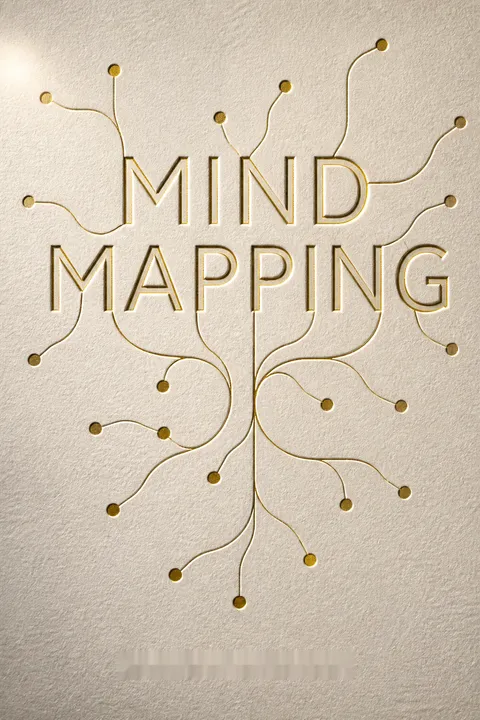


Key Takeaways
Make relationships visible, and information becomes easier to understand and retrieve.
A map shows connections. A mind map is a diagram that begins with a central subject and groups related ideas on branches. Smaller branches add detail. Its purpose is not simply to shorten notes, but to show how facts belong together. The book illustrates associative memory with a familiar kind of moment: a scent can suddenly bring back a vivid childhood scene. A mind map gives new information visible connections to other information, much as a memory cue can call up related experiences.
Pictures and structure help. Branches can make relationships easier to follow than a block of prose, while images can make an idea more concrete. Keywords strip away explanatory sentences once the key point is understood. A map of the planets, for instance, can link each planet directly to details such as its atmosphere or rings, making both the subject and its categories visible at once.
What's powerful here is the map's role as external memory: relationships that would otherwise need to be held in working memory are put on the page. That can make it easier to compare, reorganize, and revisit ideas. The image-making claim deserves some restraint, however. A visual display is not automatically memorable or clear; a dense, poorly labeled map can be harder to use than prose. The tool works best when its layout makes meaningful connections easier to inspect, not when decoration substitutes for understanding.
Build maps from a center outward, using position and visual cues deliberately.
Start with the hierarchy. Put the subject in the center, add its major components as subtopics, then attach supporting details to the right component. The book calls these layers the main topic, subtopics, and lower-level topics. A fact should sit under the idea it describes, so a reader can trace its branch back to the center. More important ideas generally belong closer to the center.
Use visual signals consistently. Short keywords keep the map compact. Thicker branches can signal higher-level ideas, while different colors can distinguish branches. Images, shapes, and type size can add further cues. These choices are useful only if their meanings stay clear. A map can be built one major branch at a time, or one layer at a time; the creator can follow the order that best suits the task and the flow of ideas.
A good map is a small information-design system. Position, color, and line weight act as visual signals, reducing the effort required to locate a point and understand its category. This resembles interface design, where consistent visual conventions help people navigate complex screens. The caution is that the map's hierarchy expresses the maker's judgment, not an objective ranking of truth. A misplaced branch or an overly prominent color can quietly distort the message, so reviewing the structure matters as much as making it attractive.
Preview first, then map the reading's hierarchy instead of copying sentences.
Build a rough overview. The book's reading method moves through four stages: preview, read, mind map, and review. Preview by scanning headings, summaries, emphasized text, illustrations, and, in longer works, chapter openings and endings. The suggested preview lasts about 45 seconds to 5 minutes, depending on the length of the material. It gives the reader a preliminary structure before the details arrive.
Read actively, then check. While reading, look for major points, their connections, and keywords that can summarize them. For longer sessions, the book suggests breaks of 5 to 10 minutes after roughly 20 to 25 minutes of reading, while acknowledging that individuals differ. Make a map from the material's main ideas, then compare it with the source. Correct missing points and misplaced branches. Rereading or redrawing is part of making sense of the material, not necessarily wasted effort.
Previewing gives the mind a structure against which to interpret details, much like an outline can help a reader understand where an argument is headed. The active work of choosing and grouping ideas also forces decisions that passive highlighting can avoid. Still, a preliminary structure can bias what a reader notices: a heading may suggest one interpretation while the evidence complicates it. The final comparison with the source is therefore essential. A map should summarize what the text says, not merely confirm the reader's first impression.
In lectures, capture signposts and structure before chasing every sentence.
Listen for changes. A live talk cannot be paused for note-takers, so trying to record every sentence can turn listening into transcription. Instead, identify the subject, prepare any outline the speaker provides, and listen for verbal transitions that signal a new point or a contrast. These transitions can become new branches; supporting facts belong beneath them. Keep the map rough enough to follow the speaker rather than aiming for a polished diagram in real time.
Repair the notes promptly. After the lecture, check whether each detail sits under the right topic, add important points that were missed, and clarify abbreviations or rushed writing. Comparing notes with another attendee can help reveal gaps. If making a map during the talk is too demanding, the book suggests taking conventional notes first and organizing them afterward. The aim is to understand the talk's structure, not to make a perfect page while it is happening.
This advice addresses a real tradeoff: note-taking can support attention, but verbatim capture competes with comprehension. A structured map encourages listeners to decide what matters and how points relate. That resembles active listening in conversation, where tracking the speaker's argument is more useful than memorizing each phrase. The method also acknowledges that live events have constraints. A tidy map is not worth missing the talk; post-event editing is a sensible division of labor between capturing information and organizing it.
Use one map to turn scattered research into a defensible argument.
Plan where to look. Research starts with a topic and a map of possible source types, such as books, reference works, interviews, journals, and websites. Choose sources to fit the question: current trends may require recent material, while historical research calls for sources suited to the past. The book cautions readers to check reliability and verify facts rather than treating every online source as authoritative.
Compare, then compose. As sources are read or viewed, their information can be mapped separately and combined, or gathered directly into a single map. Repeated themes may deserve major branches; disagreements and distinctive claims deserve attention too. In its example on Alexander the Great, the book organizes material on campaigns, cultural influence, achievements, and criticisms. Once the research is arranged, its branches can become the points of a written piece. The map provides a structure, but the writer still chooses what to include and in what order.
A research map can do more than store facts. By placing agreement, disagreement, and source-specific claims side by side, it can help expose where an argument is strong and where evidence is thin. This is close to the logic of a literature review, which synthesizes studies rather than summarizing them one by one. The risk is that a visually coherent map may make weak evidence look settled. Keeping track of which source supports each claim, and distinguishing evidence from interpretation, protects the synthesis from false certainty.
Brainstorm without censoring, then judge the ideas in a separate pass.
Generate before editing. The book's brainstorming method begins with a problem in the center of a page. Write down related thoughts as they arise, then use each thought to prompt more. At this stage, include awkward, off-topic, or unpromising reactions rather than stopping to grade them. The goal is to create material to work with, not to produce a polished solution immediately.
Shape the useful ideas. Next, review the scattered notes, group related possibilities, discard weak ones, and develop promising ideas into branches with practical details. For a hotel trying to improve customer experience, associations around family, relationships, leisure, and inconvenience can suggest possible services to examine. Two other techniques can restart a stalled session: reverse brainstorming asks how to worsen the problem, then considers the opposite actions; starbursting builds ideas by asking questions about the problem and possible solutions.
Separating idea generation from evaluation is a practical way to protect divergent thinking. When people judge each suggestion as soon as it appears, they can shut down lines of thought before those lines connect to anything useful. A later sorting phase restores standards of feasibility and relevance. This is not a guarantee of originality, and an unfiltered page can become noise. Its value depends on the second pass: clustering, testing, and selecting ideas turns a pile of associations into options that can actually be compared.
Convert goals into targets, actions, and deadlines you can track.
Turn an aim into parts. A goal map starts with a specific desired result, then divides it into manageable areas. A goal to open a restaurant, for example, might separate the business work from the kind of restaurant the owner wants to create. The map can then distinguish targets, which mark progress; action items, which describe tasks; and deadlines, which set when work should be done. A target might be securing a business license; its action items would spell out what must happen to reach it.
Choose a useful structure. For broader plans, the book recommends asking who, what, where, when, why, and how, or dividing the project into functional components and a timeline. Lists can use the same logic: group errands by category, store, day, or project. A categorized map can show where work is concentrated and let large tasks break down into smaller steps.
The map converts an abstract intention into visible commitments, making it easier to notice missing steps and overloaded parts of a plan. This is a form of external project management: deadlines and substeps no longer depend solely on memory. The format is flexible, but flexibility can also invite endless planning. A useful map should clarify the next action and the sequence of dependencies, not become a more colorful way to postpone beginning. Milestones are valuable when they guide work and provide feedback on progress.
Choose the map by the job: branches, processes, relationships, or free association.
Use the right structure. A mind map expands one central idea into a hierarchy of related points. A flow chart shows the steps and decisions in a process, such as diagnosing why a lamp does not work. A concept map connects ideas with labeled lines that explain how they relate, often moving from broad concepts toward specific ones. These formats answer different questions, so they are not interchangeable.
Leave room for complexity. A cognitive map is a flexible diagram that can show several starting ideas, overlapping relationships, or a stream of thoughts that has not yet been organized. It can even include media such as images, links, audio, or video. The book's practical rule is to use a mind map for exploring one topic, a flow chart for following a process, a concept map for explicit relationships, and a cognitive map when a more formal structure does not fit.
The choice of diagram is a choice about what kind of complexity to make visible. A process has sequence and branching decisions; a relationship map may have many cross-links; a mind map emphasizes hierarchy. Selecting the wrong form can hide the very feature that matters. These boundaries are helpful but not absolute: real problems often combine sequence, hierarchy, and networks. A hybrid can work, provided its visual conventions remain legible and readers can tell which lines indicate sequence, category, or connection.
Let groups contribute without confusing consensus with a coherent plan.
Fit the method to the team. In project-lead mapping, one person guides discussion and decides what enters the map, which can keep work coordinated when a clear leader exists. Consensus mapping asks group members to discuss and agree on each layer, making it suitable for small groups that can compromise. Individual-input mapping collects suggestions from everyone, then uses discussion or votes to resolve disagreements and revise the result.
Make disagreement visible. A group map can put participants on the same page and draw on knowledge no single member holds. But different people may interpret the same connection differently, and the group may disagree about what belongs at the center or beneath it. The book's methods address this by giving the group a decision process, whether a lead selects branches, members negotiate, or votes settle unresolved choices. The method should match the group's size and working relationships.
Collaborative mapping can reveal distributed expertise by letting each participant add associations before the group's understanding hardens around one person's framing. Yet a shared page is not the same as shared understanding. A leader can make decisions efficiently while suppressing minority knowledge; consensus can consume time or favor the easiest agreement. The most useful group process makes both contributions and decision rules explicit. The diagram records a team's current model, not proof that everyone interprets it identically.
Adapt the map to the learner, then choose paper or software accordingly.
Make the idea tangible. For children, the book recommends showing a map being built and connecting it to something familiar, such as a school project or a daily routine. Young children who cannot yet read can use pictures to organize chores, shapes, numbers, or a holiday schedule. The book also suggests adapting instruction through seeing, hearing, speaking, or tracing and making the map. These are options for varying a lesson, not reasons to label a child permanently.
Choose a practical medium. Paper offers direct drawing and fewer editing distractions; software makes maps easier to revise, share, add files to, and collaborate on. The best choice depends on how the map will be used. A simple hand-drawn schedule may be enough at home, while a team project with frequent changes may benefit from a shared digital map. In either case, the map should remain understandable to the people who need it.
The emphasis on adapting a representation to the learner is valuable, especially for children who benefit from visible routines and hands-on participation. The fixed learning-style categories deserve caution: research does not strongly support the idea that matching instruction to a declared style reliably improves learning. A stronger principle is to match the representation to the content and vary modes when useful. Paper and software also shape the work itself: one encourages immediate sketching, while the other makes revision and collaboration easier.
Analysis
The book's central contribution is not the claim that one diagram improves every kind of thinking. It is a practical argument for moving information out of prose and into a form that makes relationships inspectable. A page of branches can support several distinct activities: remembering what was read, collecting research, generating options, planning work, and coordinating a group. The recurring method is to make an initial structure, add detail, and revise the structure when it no longer fits.
That flexibility is also the method's chief limitation. A map compresses, and compression involves judgment. What becomes a central branch may appear more important than what is omitted; a tidy hierarchy can make uncertain evidence seem settled. Maps are therefore best treated as working models, not neutral records. In research, source labels help preserve provenance. In planning, milestones should expose dependencies rather than merely decorate an intention. In teams, disagreement should be recorded before it is smoothed away.
The distinction among mind maps, flow charts, concept maps, and cognitive maps is especially useful because it links form to task. A process needs sequence, a concept map needs explicit relationships, and open-ended exploration may need a less constrained form. The same person can move between these representations as a problem changes. The broader lesson is not to think visually at all times, but to select a representation that makes the current problem easier to inspect, discuss, and revise. Maps work best as bridges between scattered thought and deliberate action, with prose, evidence, and judgment still doing their own jobs.
Review Summary
Mind Mapping by Kam Knight receives mixed reviews, with an average rating of 3.66/5. Many readers find it helpful as an introduction to mind mapping techniques, praising its clear explanations and practical examples. The book covers various applications of mind mapping, including note-taking, brainstorming, and planning. Some readers appreciate its transformative impact on their cognitive skills and productivity. However, critics argue that the information is basic and readily available online, with some finding the book repetitive or poorly edited. The audiobook version is not recommended due to its reliance on visual elements.
People Also Read



Glossary
Mind map
A branching idea diagramA visual diagram organized around a central topic, with major related ideas branching outward and supporting details attached beneath them. Its hierarchy shows which ideas belong together. Keywords, color, branch width, and images can distinguish or emphasize information. The book applies mind maps to note-taking, research, brainstorming, writing, planning, lists, goals, teaching, and group work.
Flow charts
Visual process instructionsDiagrams that represent a process as connected steps, questions, and outcomes. Shapes often indicate different functions, such as a decision or an instruction, while lines show where to proceed next. Flow charts are useful for procedures with multiple choices or endpoints, but poorly designed ones can create confusing paths or loops.
Concept maps
Labeled links between ideasDiagrams that show how concepts relate, using lines labeled with verbs or short phrases to state the connection. They commonly begin with a broad idea and extend toward more specific concepts. Unlike a mind map, which relies chiefly on hierarchy and branching, a concept map makes the relationship between connected ideas explicit.
Cognitive maps
Flexible maps of thoughtA broad category of diagrams shaped around the mapper's purpose rather than a fixed set of rules. A cognitive map may begin with multiple ideas, show complex relationships, record a stream of associations, or combine words with images, sound, and video. Its flexibility makes it useful when a more formal diagram does not fit, though it may be harder for others to interpret.
Reverse brainstorming
Find ways to worsen problemsA brainstorming technique that asks how to make a problem worse rather than how to solve it. The resulting ideas are then reversed to suggest possible improvements. For instance, identifying ways to make a service inconvenient can point toward ways to make it easier to use. The technique is offered as one way to prompt ideas when direct solutions are hard to generate.
Starbursting
Question-driven brainstormingA technique for exploring a problem or possible solution by generating questions about it and answering them. Questions can examine causes, surrounding issues, available resources, affected people, and prior approaches. Each answer may prompt further questions. The repeated questioning helps uncover practical considerations and can lead toward workable ideas.
Questionary Pronouns
Six questions for planningA planning framework built around who, what, where, when, why, and how. The questions identify participants, required decisions and resources, locations, dates and milestones, the purpose of the plan, and ways to carry it out. Mapping the answers provides a broad checklist of issues to consider before putting a plan into action.
Project Lead Mind Mapping
Leader-guided group mappingA group mapping method for teams with a recognized or appointed leader. The project lead sets the central topic, invites suggestions for branches, guides discussion, and decides which ideas enter the map. The approach can keep a large group's work coherent and ensure suggestions are heard, while placing final selection responsibility with the leader.
Consensus Mind Mapping
Agreement-based group mappingA group mapping method in which participants discuss and agree on the central topic, branches, and details. When members disagree, they seek a compromise or an alternative everyone can accept. It uses contributions from the group and creates a map based on shared decisions, making it most suitable for small groups able to reach agreements.
Individual Input Mind Mapping
Round-based group contributionsA group mapping method that gathers suggestions from each participant in rounds, then evaluates proposed branches through discussion or votes. Members can also suggest edits, such as removing duplicates or moving an idea to a different branch. It can capture extensive input for complex work, though it may take more time and produce a less coherent map.
FAQ
What's "Mind Mapping: Improve Memory, Concentration, Communication, Organization, Creativity, and Time Management" by Kam Knight about?
- Overview: This book is a comprehensive guide to mind mapping, a technique that organizes information visually to enhance learning and memory.
- Purpose: It aims to teach readers how to use mind maps to improve various cognitive skills such as memory, concentration, and creativity.
- Structure: The book is divided into sections that cover the basics of mind mapping, its benefits, and practical applications in different areas like note-taking, research, and planning.
- Audience: It is suitable for anyone looking to improve their cognitive abilities, from students to professionals.
Why should I read "Mind Mapping" by Kam Knight?
- Skill Enhancement: The book provides tools to improve essential skills like memory, concentration, and organization, which are valuable in both personal and professional settings.
- Practical Applications: It offers practical advice on how to apply mind mapping in everyday tasks, making it a useful resource for problem-solving and planning.
- Comprehensive Guide: With detailed instructions and examples, the book serves as a thorough guide for both beginners and those familiar with mind mapping.
- Innovative Learning: It introduces an innovative learning technique that mimics the brain's natural way of processing information, making learning more efficient.
What are the key takeaways of "Mind Mapping" by Kam Knight?
- Mind Mapping Benefits: Mind mapping improves learning and memory by aligning with the brain's associative nature, making information easier to process and recall.
- Visual Learning: The technique incorporates visual elements, which are processed faster and remembered longer than text alone.
- Organizational Tool: Mind maps help in organizing information hierarchically, making it easier to see relationships and connections between ideas.
- Creativity and Brevity: The method stimulates creativity by allowing free flow of ideas and thrives on brevity by focusing on keywords and essential concepts.
How does Kam Knight define mind mapping in his book?
- Diagrammatic Tool: Mind mapping is described as a note-taking tool that organizes words, thoughts, and ideas in a diagram form.
- Central Idea Focus: It starts with a main idea in the center, with subtopics branching out radially, mimicking a tree structure.
- Associative Nature: The technique mirrors the brain's associative nature, connecting new information to existing knowledge.
- Historical Context: Mind mapping is not new; it has been used by intellects like Leonardo da Vinci and was popularized by Tony Buzan in the 1960s.
What are the benefits of mind mapping according to Kam Knight?
- Improved Memory: Mind maps enhance memory by organizing information in a way that aligns with the brain's natural processes.
- Enhanced Creativity: The technique encourages free-flowing ideas and allows for creative problem-solving.
- Better Organization: It provides a clear structure for organizing information, making it easier to understand and recall.
- Visual Processing: By incorporating visual elements, mind maps make information quicker to process and easier to remember.
How can I create and enhance a mind map as per Kam Knight's advice?
- Start with a Main Topic: Place the main idea in the center of the page to serve as the focal point.
- Add Subtopics: Branch out with subtopics that represent key components or characteristics of the main idea.
- Use Visual Elements: Enhance the map with colors, images, and varying branch widths to make it more engaging and memorable.
- Focus on Keywords: Use concise keywords or phrases to summarize information, keeping the map brief and to the point.
How does Kam Knight suggest using mind maps for note-taking?
- Preview the Material: Before taking notes, preview the content to get an overview and identify key points.
- Read and Analyze: While reading, think about how the information can be organized into a mind map.
- Create the Map: Start with the main topic and add subtopics and lower-level details as you go.
- Review and Revise: After creating the map, review it to ensure accuracy and completeness, making adjustments as needed.
What are Kam Knight's tips for using mind maps in research?
- Gather Information: Use mind maps to outline potential sources and organize gathered data.
- Assemble Content: Create separate maps for each source and then merge them into a comprehensive diagram.
- Identify Patterns: Look for repeated information across sources to define main branches and subtopics.
- Highlight Differences: Note where sources diverge to explore different perspectives and insights.
How can mind maps aid in brainstorming according to Kam Knight?
- Collect Thoughts: Use mind maps to jot down all initial thoughts and ideas related to a topic.
- Develop Solutions: Organize these thoughts into a coherent structure to identify potential solutions.
- Encourage Creativity: The non-linear format allows for free association, leading to more innovative ideas.
- Refine Ideas: Use the map to evaluate and refine ideas, focusing on those with the most potential.
How does Kam Knight recommend using mind maps for writing?
- Non-Fiction Writing: Use mind maps to outline the main topic, subtopics, and supporting details for structured writing.
- Fiction Writing: Organize literary elements like character, plot, and setting to develop a cohesive story.
- Paragraph Structure: Break down writing into paragraphs with introductory, body, and concluding sentences.
- Creative Exploration: Use mind maps to explore themes and ideas, enhancing the depth and richness of the writing.
What are Kam Knight's strategies for planning with mind maps?
- Questionary Pronouns: Use who, what, where, when, why, and how to outline all aspects of a plan.
- Component Breakdown: Divide the plan into smaller, manageable components for detailed organization.
- Timeline Creation: Set tasks and activities into a timeline to ensure timely completion of the plan.
- Comprehensive Approach: Combine different strategies for a thorough and effective planning process.
What are some advanced applications of mind maps mentioned by Kam Knight?
- Goal Setting: Use mind maps to outline goals, set targets, and identify action items and deadlines.
- Thematic Projects: Apply mind maps to explore themes and ideas in creative projects like art and music.
- Group Collaboration: Use mind maps in group settings to facilitate collaboration and idea sharing.
- Software and Apps: Explore digital mind mapping tools for enhanced functionality and ease of use.
About the Author


Download PDF
Download EPUB
.epub digital book format is ideal for reading ebooks on phones, tablets, and e-readers.








