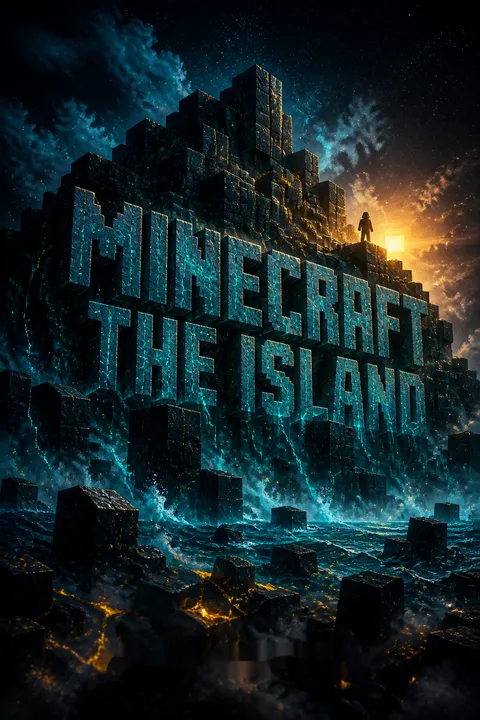


Plot Summary
Prologue
The narrator presents the account as a guide for whoever arrives next. A newcomer may be as frightened and disoriented as he was, he suggests, but the strange world can teach survival through its challenges. He has left a record of what he learned, turning a private ordeal into a handhold for an unknown reader.
The introduction casts survival as a lesson passed between strangers. The narrator cannot explain why he entered this world, but he can give the next arrival something he lacked: evidence that confusion can become knowledge. This frame also makes the account more than a diary. Its practical purpose hints at the narrator's growing need to help someone else, even before he has found anyone who can answer his own questions.
The Square-Sun Shore
He wakes underwater with no memory of how he got there and claws toward a square sun. After reaching an island built from cubes, he discovers that his own body has the same blocky shape and that he cannot remember his name or former life. Panic loosens its grip only when hunger gives him a practical problem.
Punching grass first frustrates him, then breaks a dirt block he can pick up, store, and replace. Striking leaves finally produces an apple he can eat. Its familiar taste steadies him, while the discoveries teach him that persistence and observation may matter more than understanding where he is.
The first crisis is not simply the island's strangeness. It is the loss of a self who could place that strangeness in context. Hunger interrupts the narrator's spiraling questions with a bodily need he can act on. The apple matters because it restores more than strength: a recognizable taste gives him one point of continuity between his missing past and his new surroundings.
Night Finds Its Prey
As evening falls, he finds cows, sheep, and chickens, then encounters a green, rotting figure that strikes him and pursues him up a hill. He injures his ankle in a fall and escapes the zombie by digging into the cliff, only to hit solid rock and seal himself inside with dirt.
In the darkness, the creature's groans leave him convinced that escape is impossible. He stops treating the place as a dream and begins reasoning about its rules. At daylight, the zombie is gone, leaving rotten flesh behind. He tests how dirt blocks stay in place, then carves a help sign into the hill while still hoping rescue might come.
The attack forces acceptance through bodily evidence: pain, injury, and a predator that does not vanish when he tries to wake. His improvised grave is both protection and a frightening loss of agency. Daylight gives him relief, but not an explanation. By turning the episode into a problem of rules and consequences, he begins replacing denial with a rudimentary form of control.
The Boat That Vanished
On the beach, he learns that logs can become planks, sticks, buttons, doors, chests, and other objects through a strange hand-held crafting grid. Excitement repeatedly distracts him from building a secure home. He eventually makes a boat and launches from the island, imagining escape, but soon sees only open water.
Panic returns until he uses the sun and drifting clouds to orient himself and find the shore again. The boat breaks apart as it lands, but he has recovered the island and learned that invention without a plan can be dangerous. He resolves to secure food, shelter, and safety before pursuing the larger question of getting home.
Crafting offers agency, but the boat episode exposes the gap between making a tool and understanding its consequences. The narrator's excitement briefly recreates the helplessness he had begun to escape. His return depends not on a new invention but on attention to environmental clues. The result is a shift from improvisation as thrill toward planning as responsibility.
Tools Against the Dark
Back on shore, he tries to dig into the cliff with his bare hands and learns that stone needs a proper tool. When another zombie approaches, he throws up a crude wooden shelter and survives behind its door. Studying the zombie's shovel helps him discover how to craft one; a hoe lets him plant the seeds he had been unable to bury, and a pickaxe opens the rock behind his shelter.
He tunnels into the hill before dawn and watches the zombie burn in sunlight. The shelter is still rough, and food remains uncertain, but he now has tools, a place to hide, and the first signs of a renewable crop.
The zombie becomes an unwilling demonstration: by studying its tool, the narrator can infer a craft he could not invent from guesswork alone. Survival begins to depend on distinguishing kinds of work, from forceful breaking to careful cultivation. His shelter protects him, but the farm points toward something more durable: a future not governed entirely by the next night's emergency.
The Creeper's Cost
A silent, green creature approaches while he is showing seeds to the chickens and explodes, throwing him into the lagoon and killing nearby animals. His injuries begin healing rapidly, but the effect fades when he runs out of food. Desperate, he eats raw chicken and becomes violently sick; cooked beef restores him instead.
As darkness approaches, he retreats to his shelter and discovers that a furnace can cook meat and melt sand into glass. Later, while digging outside to collect more sand, he grows overconfident, ignores the dark, and is attacked by a spider. He survives by burying it under falling sand, but the night leaves him short of food and newly wary of his own confidence.
The blast makes the island's economy brutally clear: food, health, and safety are linked, and one careless moment can destroy several at once. Rapid healing looks like invulnerability until hunger interrupts it. His near-mistake with the spider adds a psychological danger to the physical ones. Confidence has become useful, but without attention it can turn a hard-won advantage into another trap.
Behind the Glass
Unable to find a steady food source, he builds a glass-fronted observation chamber using a plan, preparation, priorities, practice, and patience. From safety he watches zombies, spiders, creepers, and skeletons appear after dark. He sees that exposed zombies burn in sunlight, while shaded creatures survive longer, and learns that mobs do not attack him through the barrier.
Mining brings coal and iron, but a test shows that torches do not keep monsters away as he had hoped. Meanwhile, hunger weakens him. His wheat ripens, but he pours water directly onto the crop and washes away the seeds. Searching for another meal, he considers killing the surviving cow, then stops when its familiar presence makes him recognize how alone he is.
The observation room converts fear into evidence, but evidence does not immediately solve the narrator's material problems. His failed irrigation shows the limits of a method when he mistakes a correct principle for a correct procedure. The near-attack on the cow marks a different threshold: he understands that companionship has become part of survival, not an optional comfort. The animals give his self-talk an audience and his choices a moral witness.
Milk, Silk, and Fish
The cow he names Moo provides milk, which helps him endure the sickness brought on by eating rotten zombie flesh. He regains strength but remains dependent on a grisly food source. Determined to find something better, he faces a spider in daylight and kills it for its silk. Using the strand, he crafts a fishing rod.
The first fish leaps into his pack, and cooked fish restores his health; he also learns to turn ripe wheat into bread. Fishing supplies him with reliable meals, while shearing the sheep gives him wool for a bed. After a proper night's sleep, the mental fog he had mistaken for some other illness lifts, and he can plan clearly again.
This section links practical recovery to social and cognitive recovery. Moo's milk keeps him alive, while the sheep provide material for sleep, a need he had overlooked because he did not feel conventionally tired. The spider fight is not a conquest of fear so much as a decision to act while afraid. With food and rest, the narrator regains the mental capacity to make less desperate choices.
Iron Below the Island
With fish, bread, and a bow, he mines for iron and makes armor and a sword. Skeleton archers attack from a cave, so he lures them into a narrow passage where his blade can reach them. Following a fight into a vast underground canyon, he is shoved into lava by a zombie, escapes through a waterfall, and learns to watch the openings around him.
Cooling lava with water exposes gold and diamonds, but greed carries him toward a witch. She poisons him with bottles while he has no food packed for the trip. He barely reaches his supplies and recovers with fish. The encounter proves that a new enemy can punish old habits, even after he has made himself stronger.
The narrator's expanding competence does not remove uncertainty; it increases the range of risks he can choose to take. Armor and weapons solve specific problems, not the general problem of being unprepared. The witch's poison is especially consequential because he has left his healing food behind while chasing treasure. The canyon and witch both reward vigilance, while exposing how easily achievement can be mistaken for safety.
The Shield and the Flock
After a week of mining, breeding chickens for feathers, and repairing his gear, he notices his hand tingling and finds that familiar zombies and skeletons now take more punishment. He adapts by crafting a shield. It blocks arrows, but slows him and prevents him from striking at the same time, so he learns to alternate defense with attack.
He also feeds wheat to the sheep, and a lamb named Rainy joins the island's small community. The new routine makes him feel powerful, and he begins treating the flock as a source of free food. His growing confidence carries into his next project: building a large, comfortable house on the hill.
The changed enemies make adaptation concrete: a shield only works when the narrator changes his timing and accepts a slower, more deliberate style of combat. Yet his increasing control brings a separate risk. He begins describing living creatures in terms of resources, a habit that will test the relationship he has built with Moo and the sheep. The contrast between tactical learning and ethical blindness gives his success an uneasy edge.
A House With a Price
After once burning oak saplings for fuel and realizing that the island's apple trees are gone, he divides the land between his building work and a protected stretch he intends to restore. He spends weeks constructing a four-story mansion, complete with kitchens, bedrooms, a workshop, and a lava-lit entrance.
To celebrate, he slaughters nearly all his chickens for dinner, then feels sick with guilt and releases the last chicks. The next morning a creeper explodes inside the house, setting off its lava and igniting the structure. He escapes through the bathroom's water chute, digs a trench to divert the flow, and risks the flames to release water from the hot tub. The animals survive, but his home is destroyed.
The mansion is both a triumph of ingenuity and a record of what the narrator has taken from the island. His promise to preserve part of the land does not erase the destruction of the oaks, and his treatment of the chickens forces him to acknowledge that convenience has a moral cost. When the house burns, the rescue of Moo and the sheep matters more than the building. His priorities have shifted, though the loss leaves him temporarily numb.
Pictures and Old Mines
He recovers from the fire, covers the island with torches, and builds a smaller brick home that will not burn as easily. While making decorations, he discovers that paintings can reproduce images he seems to recognize from another life, including a character from a computer game. The images suggest that his past centered on computers, but he avoids pressing the question of why he is here.
Instead, he returns underground and finds an abandoned mineshaft with minecarts, supplies, and books. One book teaches music, while others describe food and wildlife. In a deeper cavern, he meets a tall, dark Enderman. When he looks it in the eyes, it attacks with startling speed, and he escapes into a low tunnel.
The paintings transform memory from an abstract absence into a set of recognizable images, but the narrator retreats from the questions they raise. The mineshaft offers a more manageable form of discovery: information he can read, test, and use. The Enderman complicates his old assumption that unfamiliar creatures are automatically hostile, yet his mistake in meeting its gaze also shows that openness without knowledge can be dangerous.
Revenge in the Webs
Further mining reveals manuals about redstone and a passage filled with webs and cave spiders. Their bites poison him, and fear turns into a reckless urge to destroy their nest immediately. He returns without repairing his armor or sword, then pushes deeper after his first plan fails. The diamond blade breaks during another fight, and skeletons drive him away from the route home.
A creeper blast knocks him into an unfamiliar flooded passage, where he finally blocks a tunnel against pursuing zombies. Trapped with little food and almost no equipment, he recognizes that anger has cost him the preparation that once kept him alive. His immediate task is no longer revenge, but finding a way to endure.
Revenge narrows attention to the injury that provoked it, making the narrator ignore the practical knowledge he has earned. The broken sword is more than a lost weapon: it is the consequence of failing to maintain the tools on which his safety depends. His barricade returns him to the conditions of his first night, but he now has a history of solving problems. The danger remains, while the person facing it has changed.
A Cave Becomes Home
In the sealed cave, he uses his remaining tools to reach an underground spring and joins water blocks into a pool. A fishing rod lets him catch salmon, and mushrooms found nearby offer food that does not require killing animals. He makes a bed from collected spider silk and wood, then spends days replacing his armor and weapons.
His first attempt to tunnel home breaks into the sea and floods his route, forcing him to rethink escape. In a minecart he finds a navigation manual, learns to craft a compass, and rereads his redstone books carefully. One overlooked instruction reveals how to make TNT. He spends the following month preparing a deliberate campaign against the spawners and dangerous mobs beneath the island.
The cave stops being only a prison when the narrator builds a repeatable means of feeding and resting there. His recovery depends on applying old knowledge under pressure, especially the lesson that water can generate more water. The navigation book and reread manuals also mark a change in how he learns: he no longer skims for immediate excitement. Careful reading gives him the tools for a planned, rather than impulsive, response.
The Last Explosion
Armed with repaired gear, traps, dispensers, and TNT, he advances through the mineshafts, destroying spider and skeleton spawners and setting defenses against wandering mobs. He reaches the zombie spawner he has reserved for last and surrounds it with glass and water, intending to contain the blast. The explosion destroys the chamber but also breaks through the seabed above him.
Water floods the passage, while gravel collapses behind him and seals the way back. With his air running out, he climbs through darkness toward a distant surface. The struggle repeats the first desperate swim of his arrival, but this time he understands that the end of one ordeal may open another. He reaches the island alive.
The final blast is a victory built from accumulated knowledge, but it also exposes the danger of believing a carefully tested plan accounts for every condition. The ocean floor is the one variable he has not understood. The repeated underwater ascent closes the narrative's physical circle, while his survival depends on something the opening version of him did not possess: experience enough to interpret the crisis without surrendering to it.
Epilogue
Back on the island, the narrator tells Moo and the sheep that he must leave. He has built the safety he once needed, but understands that the questions about his past and the world cannot be answered from behind familiar walls.
After a week of preparation, he leaves food, tools, manuals, and a tended garden for the next visitor, then sets out by boat with a compass and an unfinished map. He still does not know what lies beyond the horizon. This time, uncertainty is the reason to go rather than a reason to freeze.
The departure resolves the narrator's original contradiction: he wants answers, but has repeatedly postponed seeking them whenever safety becomes comfortable. Leaving does not guarantee that he will find people or recover his identity. It does show that he can choose uncertainty rather than be driven by it. By preparing the island for another visitor, he also turns his isolation into a form of care, leaving practical knowledge where he once found none.
Analysis
The novel turns a familiar game structure into a study of how competence is built. The narrator begins with almost no autobiographical memory, so knowledge first appears as bodily feedback: dirt smells familiar, bad food causes sickness, a tool succeeds where a fist fails. Every rule he learns reduces one kind of helplessness, but none can settle the larger questions of identity and purpose. His recurring mistake is to confuse progress with safety. Better weapons invite deeper mines; a comfortable house encourages him to postpone the questions that comfort was meant to make possible. The story gives those errors material consequences, from a washed-out garden to a burning mansion and a flooded tunnel.
The animals provide the novel's strongest counterweight to a purely instrumental view of the world. Moo cannot explain the rules, yet her steady presence helps the narrator see that survival includes attachment and obligation. His treatment of the chickens exposes how readily necessity can become convenience, while the later danger to Moo and the sheep makes care an action rather than a sentiment. He learns that preserving a life can require risk, and that ideals may have to bend under genuine starvation without becoming meaningless.
The repeated cycles of failure are not simply motivational lessons. They show that knowledge often arrives before a person is ready to use it. The narrator finds books, overlooks key instructions, and only later understands their value. His final return to the water where he began does not restore his lost past or explain who placed him on the island. Instead, it marks a change in his relation to uncertainty. He leaves because a safe place cannot answer every question. The island has taught him how to make shelter; the next task is deciding when to step outside it.
Review Summary
Minecraft: The Island received mixed reviews. Many praised its faithful adaptation of the game, with some finding it entertaining and full of life lessons. The audiobook narrated by Jack Black was highly regarded. However, critics felt it lacked depth for adult readers and could be repetitive or boring at times. Some enjoyed the nostalgia and world-building, while others found the writing simplistic. The book seemed to resonate more with younger Minecraft fans, though opinions varied widely on its overall quality and appeal.
Characters
The narrator
Self-taught castawayAn unnamed person who wakes in a block-built world without memories of his identity or arrival. His first response is to search for an explanation, but immediate needs repeatedly force him toward practical experiments. He is inventive and persistent, yet prone to panic, overconfidence, and postponing uncomfortable questions. His conversations with animals and objects reveal how strongly he needs companionship, even before he can remember the people he may have known. As he learns the world's rules, he also has to examine his own: what he consumes, what he risks, and what kind of person he is becoming.
Moo
Steady bovine confidanteThe surviving cow becomes the narrator's most reliable companion. Her lowing cannot answer his questions, but he reads steadiness and judgment in it, especially when fear or hunger clouds his thinking. Moo's presence gives him a reason to consider the welfare of another living creature rather than treating every resource as his own. Their relationship is built from routine, shared space, and the narrator's growing recognition that companionship matters even when it cannot offer verbal reassurance.
Flint
Black-wool companionFlint is the black sheep whose coat provides wool for the narrator's experiments and who later becomes part of the island's small animal community. The narrator's practical need to shear Flint is balanced by his concern for the sheep's comfort. Flint's calm presence helps make the island feel inhabited rather than merely stocked with materials.
Cloud
White-wool companionCloud, the white sheep, shares the meadow with Flint and Moo. The narrator treats Cloud as an audience for his theories and plans, though the animal's grazing offers no confirmation beyond its continued presence. Cloud helps define the ordinary, living world the narrator is trying to protect as his inventions and ambitions grow.
Rainy
Young island newcomerRainy is the lamb born after the narrator feeds wheat to Flint and Cloud. The lamb's arrival makes the island's animal life feel like a community with generations, not just a collection of useful creatures. Rainy also draws the narrator's attention to the limits of his control: living beings do not understand danger simply because he can see it.
The chickens
The seed-following flockThe chickens first attract the narrator's attention by responding to seeds, and their eggs, feathers, and breeding patterns teach him more about the island's living systems. He alternates between seeing them as companions and considering them a source of food. That tension makes the flock important to his understanding of the difference between what he can take and what he believes he should take.
The zombies
Relentless night pursuersThe zombies are slow, persistent attackers who appear in darkness and force the narrator to learn shelter, weapons, and the consequences of hunger. He sometimes treats them as an audience for his reasoning, using their presence to keep himself focused. Their predictable behavior makes them useful subjects of study, but their strength and numbers continue to punish complacency.
The skeletons
Ranged cave attackersSkeletons attack with bows, turning open caves and long corridors into dangerous spaces. Their distance advantage forces the narrator to study positioning and defense rather than relying only on a sword. They are among the creatures that make exploration below the island more than a search for materials.
The creepers
Silent explosive threatsCreepers approach without ordinary warning and explode when close. Their attacks can destroy crops, shelter, and carefully built structures as well as injure the narrator. Because they can turn an unnoticed approach into sudden devastation, they make awareness and preparation central to his efforts to live safely.
The spiders
Webbed night huntersSurface spiders and their smaller cave-dwelling relatives are fast predators that attack at close range. Their silk also has practical uses, which complicates the narrator's desire to avoid them. Encounters with spiders test his ability to distinguish necessary courage from recklessness, particularly when he feels provoked or desperate.
The witch
Poison bottle wielderThe witch is an intelligent, hostile figure encountered underground. She attacks with bottles that poison and weaken the narrator, making her different from creatures that behave according to simpler patterns. Her presence challenges his hope that every threat can be handled by stronger equipment alone.
The Enderman
Teleporting neutral strangerThe Enderman is a tall, dark being found in the deeper cavern. The narrator initially sees a possible person, then mistakes its stillness for safety. Its sudden response teaches him that unfamiliar customs and behavior can carry consequences, and that apparent difference does not by itself reveal whether someone is friend or foe.
Plot Devices
Block-based crafting
Turns materials into optionsThe world allows the narrator to break blocks, carry them in a compact inventory, and combine materials into tools and structures almost instantly. This system makes his experimentation consequential: a log can become planks, a stick, a pickaxe, or a door, but he must learn the right arrangement and use. Crafting provides the practical means to survive, while repeated failures show that access to materials is not the same as understanding their purpose.
Hunger and rapid healing
Makes food a survival clockInjuries heal quickly when the narrator has enough food, but hunger weakens him and eventually interrupts that recovery. Different foods have distinct effects: raw chicken makes him sick, cooked meals restore him, and rotten flesh can help only when followed by milk. This rule ties exploration, combat, farming, and companionship together. A victory that leaves him without food may still become a crisis, while finding a renewable meal changes what risks he can afford.
Light and monster behavior
Makes darkness a changing hazardNight brings hostile creatures onto the island, while sunlight burns some of them or makes others less threatening. Shade, caves, and darkness complicate the apparent safety of daytime. The narrator studies these patterns from behind glass and tries to use torches to control where monsters appear. The rules reward observation but never remove uncertainty, since cave spawners and new creatures keep undermining his belief that he has mapped every danger.
The narrator's survival method
Converts panic into procedureAfter repeated crises, the narrator develops a repeatable way to approach tasks: decide what he wants, gather what he needs, set priorities, practice, and wait when a result takes time. Later setbacks add persistence to the method. It is not a guarantee against error. Rather, it gives him a way to recover from fear, failed experiments, and incomplete knowledge without treating each mistake as proof that he cannot survive.
Books and redstone
Turns reading into machineryManuals found in the abandoned mineshaft give the narrator knowledge that trial and error alone had not supplied. Their lessons reveal new foods, creatures, navigation tools, and the uses of redstone. Because he sometimes skims or overlooks details, the books also make attention part of the plot: rereading an overlooked instruction helps him understand TNT and prepare a deliberate attack on underground spawners. This device links discovery to the dangers of incomplete comprehension.
Download PDF
Download EPUB
.epub digital book format is ideal for reading ebooks on phones, tablets, and e-readers.








