

Key Takeaways
Treat philosophy as a working toolkit for ordinary decisions, not an exam.
Start with live questions. Jonny Thomson’s collection turns philosophy into a set of brief encounters with questions people already ask: Is a choice fair? Can anyone know what another person experiences? Why does a story make us cry? Its sweep runs from ancient ethics to modern technology, using thought experiments, novels, and everyday dilemmas to make difficult ideas approachable.
Keep the questions open. The book is a map into philosophy, not a single theory that settles life. Plato’s invisible ring tests whether morality survives without witnesses; a Zen puzzle makes readers sit with uncertainty rather than rush to an answer. The practical invitation is to notice the assumptions inside ordinary reactions and examine them before treating them as facts.
The book’s most useful design choice is its accessibility: readers meet philosophical problems before they are asked to master technical vocabulary. That resembles good science communication, where a concrete puzzle gives an abstract idea a reason to matter. The short format also encourages comparison across traditions. Its trade-off is that compression can make long-running disputes look cleaner than they are. The best use of these miniatures is as prompts for further thought, not final verdicts.
Choose your moral lens deliberately, because outcomes, duties, and character can conflict.
Different tests yield different answers. Bentham’s utilitarianism judges actions by their consequences, asking which choice produces more overall pleasure and less suffering. His hedonic calculus weighs factors such as duration, likelihood, and how many people are affected. Kant offers a different test: could the rule behind an action work if everyone followed it? Aristotle asks whether the action expresses a cultivated virtue, such as courage between recklessness and cowardice.
No single shortcut solves every case. Abelard emphasizes intention, while Peter Singer asks whether moral concern should extend beyond family, nation, or species. A decision that maximizes total benefit may violate a person’s dignity; a good intention may still cause preventable harm. These approaches are tools for clarifying what matters, not a machine that guarantees an easy answer.
The clash between these theories is productive because it exposes the hidden premise in moral arguments. A person who says a choice is right because it helps the most people is already privileging consequences; another who insists that some acts are forbidden is giving duties priority. This is similar to multi-criteria decisions in public policy, where values cannot always be reduced to one score. The limitation is that calculation can disguise uncertainty: predicted happiness and suffering are rarely measurable with Bentham’s apparent precision.
Audit power and social pressure before trusting claims about good character.
Ask what changes when nobody is watching. In Plato’s ring of Gyges story, a person gains invisibility and can act without fear of being caught. The challenge is whether justice is a real commitment or merely a response to scrutiny. Philip Zimbardo’s Stanford Prison Experiment seemed to show how quickly roles and permission could encourage abuse, but the study was criticized for researcher influence and for uncertainty about how many guards behaved sadistically.
Build safeguards, not just hopes. Kant’s rule against treating people solely as tools gives a standard for everyday respect. Foucault’s account of discipline adds that observation, judgment, and examinations can shape behavior without visible force. Together, these ideas suggest checking how institutions distribute power and how their routines teach people what is considered normal.
The strongest lesson is not that people are secretly wicked, but that character is tested within settings that reward some actions and discourage others. This connects moral philosophy to institutional design: transparency, accountability, and limits on authority make ethical conduct easier to sustain. Yet the Stanford study cannot support a sweeping claim that anyone would become cruel under the right conditions. Its disputed methods are a useful reminder that evidence about human nature needs the same scrutiny as the moral conclusions drawn from it.
Use mortality to make choices vivid, not to make life bleak.
A finite life gives choices weight. Montaigne’s memento mori is the practice of remembering death, not as a fixation but as a way to distinguish passing irritations from what deserves attention. Heidegger argues that avoiding mortality can make life feel like an endless rehearsal, because people postpone decisions as if every path will remain available. Each choice closes off alternatives.
Meaning does not require certainty. Camus’s Sisyphus pushes a rock that repeatedly rolls back down, a picture of effort without a final cosmic reward. Camus argues that confronting this absurdity can make life more affirmable, not less. Viktor Frankl adds that people can sometimes endure suffering by finding a personal meaning in it. This does not erase pain, but can change how a person carries it.
Mortality can act as a focusing device: it makes attention a scarce resource and asks whether a worry deserves the time it consumes. That is a powerful correction to the fantasy of unlimited deferral. Still, the idea must be handled carefully. For someone in acute grief or depression, reminders of death may intensify distress rather than restore perspective. The useful principle is not to minimize suffering, but to let awareness of finitude clarify priorities when reflection is safe and genuinely helpful.
Build identity with others, while resisting roles that shrink you.
The self is socially formed. Hegel argues that people understand themselves through recognition and relationships, not in isolation. Yet unequal relationships can deform both sides: a dominant person depends on recognition from someone they refuse to regard as an equal. Simone de Beauvoir applies this problem to gender, arguing that society pressures women into a role called ‘The Woman’ rather than allowing them to define themselves freely.
Labels can impose real costs. W. E. B. Du Bois’s double consciousness describes the strain of seeing oneself through one’s own perspective and through the judgment of a society that treats Black people as outsiders. Frantz Fanon similarly examines how racism turns a person into an object defined by others. These accounts do not claim all identities are equally constrained. They show why freedom depends partly on changing the conditions in which people are seen.
These thinkers make identity more than private self-description: recognition, social expectations, and power shape which versions of a person are permitted to appear. That insight helps explain why telling someone to simply ignore a stereotype is inadequate when institutions keep enforcing it. At the same time, social roles are not only cages. Shared identities can offer solidarity and belonging, as well as pressure. The task is to distinguish relationships that support agency from roles that demand self-erasure.
Treat every confident explanation as provisional until it survives serious testing.
Observation can correct intuition. Francis Bacon’s scientific method begins with a hypothesis, gathers relevant evidence, and checks whether the claim fits the observations, including evidence against it. David Hume’s problem of induction warns that repeated past patterns cannot logically guarantee what will happen next. A person who has seen only white swans cannot prove that every swan is white.
Prefer claims that risk being wrong. Karl Popper’s falsification approach asks what evidence could disprove a theory. A claim that can explain every possible outcome may offer no meaningful test. Thomas Kuhn adds that science works within paradigms, shared frameworks that guide ordinary research, until unresolved anomalies help produce a paradigm shift. These ideas support confidence in careful inquiry without pretending that current explanations are beyond revision.
This is a disciplined middle ground between blind trust and blanket skepticism. Scientific knowledge is dependable not because researchers never err, but because methods create ways to expose and correct errors. The same logic applies to personal beliefs: identify what would change a mind, then seek that evidence rather than only confirming examples. Popper’s criterion is not a complete description of how every science operates, however. Complex theories are often assessed through many kinds of evidence, not a single decisive experiment.
Remember that the mind shapes experience and borrows tools beyond the skull.
Experience is not a raw copy of reality. Kant argues that the mind organizes what it receives, helping us perceive objects and events as ordered in space and time. Hume challenges the idea of a fixed inner self, describing mental life as a changing collection of perceptions. These views raise a practical caution: the world as experienced is not necessarily the world as it exists independently of us.
Thinking can extend into the environment. Clark and Chalmers argue that a tool may perform part of a cognitive task when people reliably use it. A phone that stores directions or contact details can function like external memory. This does not mean every device is literally part of a person, but it invites questions about dependence, identity, and what is lost when access to a tool disappears.
The extended-mind idea is useful because it shifts attention from where thought happens to what work cognition performs. A notebook can support memory, a map can support navigation, and a familiar interface can reduce mental effort. That functional view also makes technology’s design ethically important: tools can enlarge a person’s abilities while creating new dependencies. The harder question is how much reliability and integration are required before an external aid counts as part of thinking rather than merely a convenient accessory.
Use art, stories, and silence to notice what argument alone misses.
Art makes experience available for inspection. Aristotle’s idea of catharsis explains why audiences seek tragedy and fear in controlled settings: experiencing intense emotion through a play may help release or organize it. Joseph Campbell sees recurring story patterns in myths and popular narratives, often tracing a hero’s departure, trials, and return. Stories can therefore help people recognize patterns in their own lives, even when the comparison is imperfect.
Meaning also lives in form and absence. Japanese aesthetics presents wabi-sabi as an appreciation of imperfection and impermanence, while ma names the meaningful space between things. A cracked object or a pause in conversation can invite attention to what a polished surface or constant speech obscures. Art is not merely decoration here. It is a way of making human experience visible, felt, and open to interpretation.
The arts can engage emotion and perception before a person has a tidy argument for what they feel. That is a genuine form of understanding, especially for experiences that are difficult to state directly. Silence and negative space also challenge the assumption that more information is always better. Still, catharsis should not be treated as a guaranteed cure, and recurring story patterns can flatten cultural differences if applied too broadly. Their value lies in opening interpretation, not dictating it.
Distinguish evidence for God from the human need for comfort.
Arguments for belief answer different questions. Al-Kindi’s cosmological argument reasons from the universe’s beginning to a cause. William Paley’s watchmaker analogy infers a designer from apparent complexity. Pascal’s wager argues that belief is a rational bet if its possible reward is infinite. These arguments are not interchangeable: one concerns origins, another design, and another practical choice under uncertainty.
Explaining belief is not disproving it. Freud interprets religion as a response to vulnerability, offering a protective father figure against nature, suffering, and death. David Hume’s problem of evil asks how an all-powerful, wholly good God can permit terrible suffering; his discussion of miracles weighs testimony against established experience. Psychological comfort may help explain why a belief is compelling, but by itself it does not settle whether the belief is true.
Keeping psychological explanations separate from truth claims prevents a common mistake: assuming that because a belief meets an emotional need, it must be false. The reverse mistake is equally tempting, treating comfort or social value as evidence that a doctrine is true. Pascal’s wager makes the decision problem vivid, but its calculation depends on uncertain assumptions about which God, which afterlife, and what counts as belief. Philosophy helps clarify these assumptions, even when it cannot remove the uncertainty.
Protect democracy through norms and institutions, not laws alone.
Political order depends on bargains and habits. Hobbes’s social contract presents government as an exchange: people surrender some freedom for security and coordinated life. Adam Smith argues that decentralized exchange can coordinate supply and demand, while Marx warns that markets can reduce human relationships to profit and commodities. Their disagreement is about more than economics. It concerns which kinds of coordination serve people and who bears the costs.
Rules need civic support. Edmund Burke sees manners and inherited practices as supports for law, while Alexis de Tocqueville fears a majority that overrides minority rights. Hannah Arendt’s account of totalitarianism shows the danger of reducing people to replaceable units and denying meaningful public action. Institutions matter, but so do restraint, participation, and everyday respect for opponents and outsiders.
This collection resists the comforting idea that political outcomes follow automatically from a constitution or an economic mechanism. Formal rules depend on people who interpret them, enforce them, and choose not to exploit every available loophole. Burke’s respect for inherited practice usefully tempers revolutionary confidence, while Paine’s defense of revolt reminds readers that tradition can preserve injustice. The balance is not simple moderation for its own sake: it is a demand to ask whether stability protects human dignity or merely preserves existing power.
Analysis
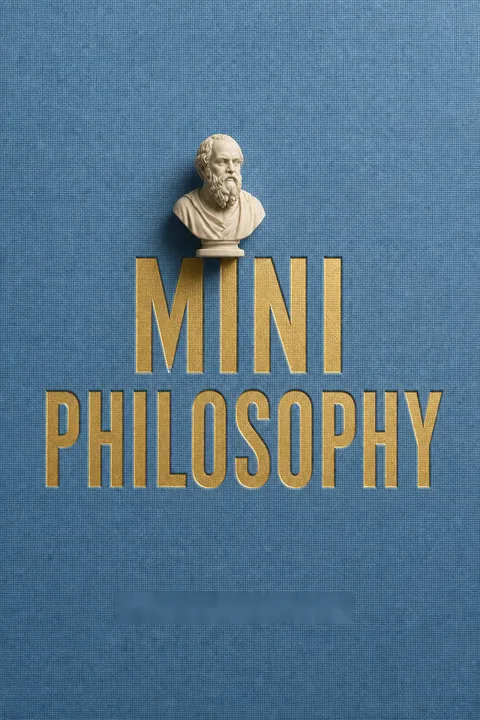
Mini Philosophy is best read as a guided tour through questions, not as a unified doctrine. Its structure moves among ethics, existence, art, religion, science, relationships, and politics, but its deeper continuity is methodological: familiar experiences become strange enough to examine. An invisible ring tests the motives beneath respectable behavior; a changing ship challenges the idea of a permanent self; a theatrical tragedy asks why people seek difficult emotions. The recurring move is to turn an intuition into a problem.
That breadth is the book’s chief strength and its central risk. The compressed portraits make unfamiliar philosophers legible without demanding specialist knowledge. They also invite readers to compare positions that would otherwise remain in separate academic rooms. Yet any short account can make a theory appear more settled, universal, or internally consistent than it is. The discussion of Zimbardo’s experiment acknowledges this danger directly, but other historical claims and philosophical disagreements also deserve the same caution. A miniature is an entry point, not a substitute for the argument in full.
The collection is especially useful when two lenses are held together. A reader can ask what an action produces, as a utilitarian would, while also asking whether it respects people as agents, as Kant would. One can recognize that identity is shaped by social roles without denying individual agency. One can value scientific evidence while acknowledging that scientific frameworks change. Philosophy here is not a technique for eliminating disagreement. It is a way to locate what disagreement is really about, and to notice when a persuasive answer depends on an assumption that has not yet been defended.
The result is less a list of solutions than a habit of intellectual attention. The book suggests that big philosophical questions are already present in routine decisions, relationships, art, institutions, and the stories people tell about themselves. Its strongest invitation is to keep asking clearer questions after the page ends.
Review Summary
Mini Philosophy receives overwhelmingly positive reviews, with readers praising its accessible approach to complex philosophical ideas. Many appreciate the book's structure, organized by topic rather than chronology, and its concise explanations of diverse philosophical concepts. Readers find it engaging, thought-provoking, and suitable for both beginners and those with some philosophy background. The book's format is lauded for its convenience, allowing for quick reading sessions. Some minor criticisms include occasional translation issues and the lack of an index in certain editions.
Glossary
Golden mean
Virtue between extremesAristotle’s account of virtue as a fitting response between excess and deficiency. Courage, for example, lies between recklessness and cowardice. The mean is not a fixed midpoint that applies identically in every situation. It requires practical judgment, experience, and repeated practice.
Categorical imperative
Reason-based moral dutyImmanuel Kant’s principle for identifying moral obligations through reason. One formulation asks whether the rule behind an action could be adopted universally without contradiction. Another says people must be treated as ends in themselves, not merely as instruments for someone else’s purposes.
Bad faith
Denial of personal freedomJean-Paul Sartre’s term for pretending that social rules, circumstances, or roles entirely determine one’s actions. Sartre argues that people retain some freedom to choose, even when choices are constrained. Bad faith hides that agency and the responsibility that accompanies it.
Memento mori
Remembering one’s mortalityA philosophical practice of keeping death in view. In the book’s account, Montaigne and Stoic thinkers use awareness of mortality not to encourage obsession with death, but to put minor anxieties into perspective and direct attention toward what matters during a limited life.
Amor fati
Affirmation of one’s fateNietzsche’s idea of loving one’s fate. It goes beyond accepting that past events cannot be changed: it asks a person to affirm the life they have lived, including its hardship and mistakes, as part of their particular existence rather than wishing it away.
Expanding circle
Widening moral concernPeter Singer’s account of how moral concern can extend beyond oneself and close relations to include wider communities and, in principle, all people. Singer argues that reason can enlarge natural sympathies rather than leave ethical concern confined to family or genetic kin.
Speciesism
Bias favoring one's speciesA bias that gives preference to the interests of one’s own species over those of other species. Peter Singer argues that the capacity to suffer should matter morally, and that custom or human membership alone does not justify ignoring animal pain.
Double consciousness
Seeing oneself through othersW. E. B. Du Bois’s term for the divided experience of Black people in a society that judges them through a dominant white perspective. A person must negotiate both their own sense of self and the view imposed by a society that treats them as outsiders.
Ma
Meaningful interval or spaceA Japanese aesthetic concept describing the interval, pause, or negative space that allows things to relate and make sense. It applies not only to visual design but also to silence, conversation, and reflection. The space is not simply empty; it can shape what is present.
Social contract
Exchange of freedom for orderA political idea describing an agreement between people and governing authority. In Hobbes’s version, individuals surrender some freedom to a sovereign in return for security and social order. Other contract theories give people stronger grounds to resist rulers who break their obligations.
Falsification
Testing claims for failureKarl Popper’s approach to scientific reasoning. A theory gains scientific strength by making claims that could be disproved by evidence. Repeatedly surviving attempts at falsification supports a theory, but does not prove that it can never be wrong.
Paradigm shift
Change in scientific frameworkThomas Kuhn’s term for a major change in the shared framework that guides scientific work. Most research solves problems within an accepted paradigm. When important anomalies accumulate and resist explanation, scientists may adopt a different framework that reorganizes what questions and answers make sense.
Extended mind
Cognition using external toolsAndy Clark and David Chalmers’s proposal that cognitive processes can extend beyond the brain when external tools reliably perform mental functions. A phone used as dependable memory is one example. The theory raises questions about where cognition ends and how tools relate to personal identity.
Gaia hypothesis
Earth as a regulating systemJames Lovelock’s view of Earth as an interconnected system in which living organisms and environmental processes interact through feedback loops. These interactions can help regulate conditions such as temperature and atmospheric composition. The hypothesis shifts attention from humans alone to the larger system that sustains life.
Download PDF
Download EPUB
.epub digital book format is ideal for reading ebooks on phones, tablets, and e-readers.








