

Key Takeaways
A viral outburst can conceal the grief and loyalty that gave it meaning
The clip stripped away its occasion. In May 2002, Allen Iverson entered a Philadelphia press conference expecting to reassure fans that he and coach Larry Brown would stay with the 76ers. Instead, reporters pressed him about missed practices. His angry response became a lasting public shorthand for laziness and defiance.
Grief was in the room. Iverson says his best friend, Rahsaan Langford, had been murdered months earlier, and the team had just suffered a painful playoff loss. He tried to explain that he felt his life was unraveling, but questions returned to practice. He does not deny being late or absent. His point is that the press focused on a small professional grievance while ignoring the losses he believed mattered most.
What's striking is how a short clip can become a complete character judgment. Repetition makes a vivid moment easy to recall, while its surrounding context fades. That is a media problem, but not only a media problem: audiences often prefer a clean label to a complicated person. Context can explain an outburst without making it harmless or wise. Iverson's account asks readers to hold both truths: he failed to meet some expectations, and the public caricature left out grief, uncertainty, and loyalty that shaped his reaction.
Belief becomes practical when mentors turn talent into a route forward
Support took many forms. Iverson was born in Hampton, Virginia, to a fifteen-year-old mother. His great-grandmother, Nana, helped raise a crowded family with little money, while his mother kept insisting that sports could be a future. At eight, Iverson caught the attention of coach Gary Moore, known as Mo, who found a way to put the small boy on an older football team.
Mentors made belief concrete. Basketball coach Bob Barefield collected Iverson and a friend from their neighborhood, while high school coach Mike Bailey searched for him when he skipped school. After Iverson missed sixty-nine school days, Mo brought him to live with his family and repeat eighth grade. Their care did not erase instability, but it gave him another chance to enter high school and keep playing.
Developmental research often treats resilience not as a fixed inner quality, but as something built through relationships, resources, and repeated chances to recover. Iverson's story gives that idea a vivid shape: a coach offers transportation, a safer home, and a route back to school, not merely a pep talk. The account also resists the myth of the solitary prodigy. Talent mattered, but adults had to notice it and make room for it. Such support is powerful, yet unevenly available, which makes access to committed mentors a social question, not just a personal one.
A dangerous hustle can look like rescue until the gun appears
Quick money felt like safety. As a young teenager, Iverson sold crack in Newport News, drawn less by the drug than by the money and the things his family lacked. He describes receiving a hundred dollars' worth of product, returning seventy dollars to older dealers, and keeping the rest. On weekends, when the senior dealers left for clubs, he says he could make as much as a thousand dollars.
The risk was immediate. A customer once dragged Iverson down a block rather than pay him. Another time, a gun was pressed against his head during a robbery. His mother asked him to stop when school began, and his friends and Mo urged him toward sports. He says he kept that promise. Basketball did not make the danger imaginary, but it gave him a future he was willing to protect.
The memoir shows how illicit work can appear rational inside scarcity: money arrives quickly, visible rewards follow, and a teenager can help relatives who need things now. That helps explain the attraction without romanticizing the cost. A gun at the back of the head collapses the fantasy of control into a life-or-death choice. The broader lesson is not that sport reliably rescues young people. It is that credible alternatives need to compete with immediate economic pressure, and that mentors matter most when they stay present in the places a young person actually spends time.
A celebrated athlete can still be judged through a system's racial lens
The bowling-alley case changed everything. In 1993, seventeen-year-old Iverson was arrested after a fight at a Hampton bowling alley. He says he was pulled away from the scene and did not attack anyone. Four Black teenagers, including Iverson, were charged under a felony called maiming by mob. The law had originally been designed to protect Black people from mob violence. Iverson's lawyer did not make a camcorder recording of the brawl part of the trial evidence.
The consequences were enormous. Tried as an adult, Iverson received fifteen years in prison. Governor Douglas Wilder granted clemency after about four and a half months, though Iverson remained under restrictions. In 1995, an appeals court reversed the conviction, finding insufficient evidence of a mob and of Iverson's participation. The prosecution later dismissed the case.
This episode places individual biography inside institutional power. The same young athlete could be celebrated for his talent and treated as a threat by authorities, with race shaping how his actions were interpreted. Procedural justice research emphasizes that people judge institutions not only by outcomes, but by whether rules are applied consistently and participants are heard. The reversal is central to Iverson's account, but it is useful to distinguish his retrospective narrative from a complete case record. That caution does not require dismissing his experience; it clarifies what the memoir can and cannot establish on its own.
Loyalty meant carrying the people who carried Iverson before fame
Success did not sever the old ties. Iverson says his friends helped his family survive before he earned an NBA salary, including while he was incarcerated and could not provide for them. He wanted to bring that same circle with him when his life changed. Critics called his friends an entourage, but he saw people who had stood by him when he had little to offer.
That loyalty became an obligation. After Ra, his closest friend, was murdered, Iverson took financial responsibility for Ra's wife and three children, including their home, car, and schooling. He also describes how Ra had once helped steer him away from street life and supported his family before his career took off. In Iverson's telling, loyalty is not a slogan. It is remembered help repaid, even when the cost is high.
The story illuminates mutual aid: when formal safety nets are weak, friends and extended family can become the infrastructure that keeps people afloat. Iverson's sense of debt reflects an ethic of reciprocity, not simply a taste for spending. It also reveals a tension. A public figure's generosity can protect people he loves while making boundaries and long-term financial planning harder. The memoir honors loyalty without proving that every obligation must be accepted. Readers can respect the bond and still ask how care can be shared sustainably rather than resting on one person's income.
Style became a public argument over who gets to look professional
Clothes carried more meaning than Iverson intended. He says he dressed like people around him in Virginia: oversized clothes, jewelry, and sneakers that showed his personality. He did not think of his choices as a campaign. Yet reporters criticized his appearance and his friends, while the NBA eventually introduced a dress code restricting players' off-court clothing at arenas.
Reebok saw an opening. When the company asked what Iverson wanted, he said he wanted to remain himself. Reebok built his image into its marketing and released The Question, his first signature shoe. He also describes wearing cornrows at a time when few NBA players did. By his 2022 appearance on the league's seventy-fifth anniversary team, tattoos and individual style were far more common. What had once been treated as a threat to professionalism had become part of basketball culture.
Appearance is often mistaken for character because dress codes convert cultural preferences into apparently neutral standards. Iverson's experience shows how a young Black athlete's clothes and social circle could be read as evidence about his discipline, even when his on-court performance was extraordinary. The Reebok partnership complicates the story productively: self-expression became both personal agency and a commercial asset. That does not make the expression less authentic, but it shows how institutions can profit from styles they once resisted. The central question is who gets to define professionalism, and whose ordinary self-presentation is treated as a problem.
Talent grows fastest when freedom and demanding coaching work together
John Thompson offered a rare balance. Georgetown's coach took Iverson seriously after his conviction and insisted on academic work and behavioral standards. At the same time, Thompson gave him unusual freedom on the court, trusting his instincts to break pressure and attack. He protected Iverson from intrusive press questions and created a demanding environment focused on basketball and life.
Larry Brown taught a different lesson. Brown's practices were full of drills and corrections, which Iverson initially resisted. Over time, Brown helped move him away from carrying every possession as the point guard. Teammates Aaron McKie and Eric Snow could initiate the offense, while Iverson received the ball in more advantageous positions. The Iverson cut, a cross-court route using screens to free him for a pass, grew from that tactical adjustment.
Good coaching is not a choice between control and freedom. It sets boundaries around conduct while leaving room for an athlete's distinctive strengths. Thompson's trust and Brown's detailed instruction served different needs: one protected Iverson's initiative, the other helped channel it into a team structure. This resembles a useful principle in education: autonomy is more productive when paired with clear standards and specific feedback. The memoir also hints at the cost of resistance. Iverson says he sometimes wishes he had listened sooner, a reminder that feeling constrained and being helped can be true at the same time.
Treat practice as the rehearsal that lets game-day instinct survive
Instinct was trained, not simply given. Iverson disliked repetitive drills and prized games, where competition made the court feel quiet and controllable. But one of his most famous skills required patient work. At Georgetown, walk-on guard Dean Berry repeatedly beat him with a crossover. Iverson swallowed his pride, asked Berry to teach him, and stayed after practice to work on the move.
Repetition made the move personal. Iverson learned to read a defender's balance, keep the ball high and away from his body, and choose between crossing over or accelerating past. The move became a signature because it combined technique with timing and showmanship. His conflict with Brown over practice was real, and Iverson admits that he sometimes missed sessions. Yet this story shows that the court's freedom depended on hours of deliberate rehearsal before the crowd arrived.
Motor learning helps explain why a move that looks spontaneous can depend on repetition: practice lets the body recognize cues quickly, freeing attention for decisions under pressure. Berry also represents a useful challenge to status. A walk-on exposed a weakness that a star could have ignored, but Iverson learned by asking the less celebrated player for help. Still, practice works best when its purpose is visible. Endless drills can feel detached from competition; rehearsal that connects movement to real defensive choices is more likely to make discipline feel like preparation rather than punishment.
An MVP's greatest season was built on defense, roles, and trust
Philadelphia became a team before it became a contender. After nearly being traded in 2000, Iverson committed to the 76ers and arrived on time for training camp. The team won its first ten games through defensive pressure, even while his shooting struggled. Eric Snow helped put Iverson in scoring positions, while Aaron McKie and the rest of the roster supplied roles the team needed.
The playoff run combined individual force with collective work. Iverson won the 2001 league MVP and scored 54 points in a crucial playoff win over Toronto, then Philadelphia survived the series in seven games. He and his teammates also beat Milwaukee in a seventh game to reach the Finals. Iverson famously led Philadelphia to a win over the Lakers in the Finals opener, but Los Angeles won the next four. The achievement was enormous, and it was never his alone.
The season resists two familiar sports stories: the lone genius who wins everything, and the system that makes individual brilliance irrelevant. Philadelphia needed Iverson's extraordinary scoring, but the early defensive streak and playoff survival depended on teammates filling complementary roles. In organizational terms, a star's output rises when the surrounding structure reduces friction and distributes responsibility. The Finals loss also matters. A peak season can be historic without ending in a championship, and treating the outcome as the only measure would erase the work that made the run possible.
Legacy includes the culture changed by refusing to disappear into respectability
Recognition arrived after years of resistance. At the 2022 NBA seventy-fifth anniversary celebration, Iverson expected the Cleveland crowd to remember the boos he received there as a rookie. Instead, he was greeted warmly among the league's celebrated players. He also found that tattoos and personal style no longer drew the scrutiny they had in his early career.
He remembers the cost of public judgment. Iverson says he does not want to become the kind of retired player who humiliates younger athletes for how they dress or play. Earlier generations had criticized him as a symbol of disrespect, yet he became one of the league's defining players. His memoir closes on the idea that his achievements belonged to coaches, family, friends, teammates, and fans as well as to him. The legacy is both personal success and a wider permission to be seen differently.
Cultural change often becomes visible only after the style that once provoked anxiety has been absorbed into the mainstream. Iverson's career makes that shift unusually concrete: the league that challenged his clothing later presented him as one of its defining players. His refusal to attack younger athletes is also a form of historical memory. It recognizes how criticism can masquerade as concern for standards while enforcing one generation's tastes. The caution is that later acceptance does not undo earlier penalties, nor does an icon's story represent every player who faced similar scrutiny. Recognition can honor change without pretending the transition was fair.
Analysis
Misunderstood is a memoir of two courts. On the basketball court, Iverson could make decisions, test himself, and quiet the disorder around him. In the legal and media arenas, other people interpreted his actions, often with consequences he could not control. The contrast gives the book its engine: he describes a life repeatedly narrowed into labels, from street kid to criminal to selfish star, then argues for the larger human story behind them.
The memoir's strongest insight is not that Iverson was always right. He admits missed practices, stubbornness, and choices that strained relationships. Instead, he asks readers to separate explanation from absolution. His loyalty to friends and family gave him belonging and purpose, but also complicated money, boundaries, and his working relationship with coaches. His competitive independence made him electrifying, yet team success required learning when to distribute, defend, and accept structure. These tensions make the portrait more persuasive than a simple redemption story.
The account also shows how institutions shape reputations. A seventeen-year-old's criminal case, an NBA dress code, and a press conference become episodes in a continuing argument over which forms of behavior count as respectable. The same attributes could be framed as danger, marketing, or cultural influence depending on who was looking. That is a sharp contribution to sports memoir: fame magnifies a person while simplifying him.
Readers should remember that this is Iverson's retrospective account, not a neutral transcript of every dispute. Memory selects, interprets, and repairs. That limitation is not a reason to discard the book. It is a reason to read it as testimony about lived experience and public meaning, while keeping factual claims distinct from independently established records. Its central achievement is making the famous sound bite intelligible without asking it to stand for an entire life.
Review Summary
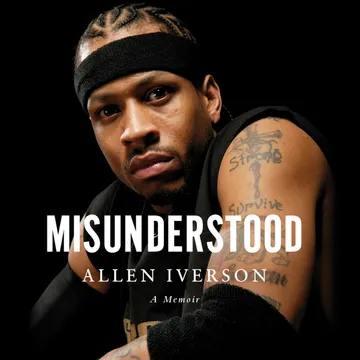
Misunderstood receives an overall rating of 4.18/5, with readers praising its raw, authentic storytelling and Iverson's candid voice. Many fans appreciate the detailed coverage of his early life, the bowling alley incident, his time at Georgetown, and his relationship with Coach Thompson. However, a common criticism is that the book moves too quickly once he reaches the NBA, skipping significant portions of his career. Readers frequently wished for more personal insight — covering family, post-retirement life, and inner struggles — and many felt the narrator should have been Iverson himself.
Glossary
maiming by mob
felony mob assault chargeA Virginia felony charge used against Iverson and three other Black teenagers after a 1993 bowling-alley fight. The statute required prosecutors to show that the accused belonged to a group assembled with a shared purpose to commit assault or battery. Iverson's conviction was later reversed because the appeals court found insufficient evidence of a mob and of his participation.
The Answer
Iverson's basketball nicknameA nickname Iverson adopted before entering the NBA. He and friends discussed how the league needed a new figure as established stars were changing or leaving the game, and the name captured the role he imagined for himself. He had the words tattooed on his arm before joining Georgetown, making the nickname part of both his public identity and personal ambition.
The Question
Iverson's first signature shoeThe name of Iverson's first Reebok signature sneaker, released during his rookie season. Its red, white, and blue design included visual references to his number and the nickname The Answer. The shoe linked his style and biography to a new kind of athlete marketing, presenting Iverson's identity as part of the product rather than asking him to adopt a conventional image.
Iverson cut
screen-assisted cross-court routeA basketball action in which Iverson runs across the court, usually using one or more teammate screens near the foul line, to receive a pass on the opposite side. The route can leave his defender trailing or off balance, giving him room to shoot or drive. The play emerged from coach Larry Brown's effort to get Iverson the ball in scoring positions without making him initiate every possession.
Cru Thik
Iverson's friends' music crewThe name Iverson and his friends used for their circle in Virginia, which included people interested in making hip-hop. They imagined that success in music or sports could help the group escape the circumstances of their neighborhood. Iverson pursued basketball while friends pursued music, but he understood the ambition as shared and remained committed to bringing his close circle with him.
Download PDF
Download EPUB
.epub digital book format is ideal for reading ebooks on phones, tablets, and e-readers.








