

Key Takeaways
Make etiquette a practice of care, not a display of social rank
Care comes before polish. Meier defines etiquette less as memorizing table rules than as showing consideration, kindness, and respect. Her example is a village in Zambia where local hosts anticipated her needs with a path over muddy ground, shelter from dew, and help stepping from her tent. Their hospitality, not wealth or formal training, became her model of excellent manners.
Learning changes the learner. Meier grew up in a casual Florida household, then felt lost at a formal dinner after moving to London. Etiquette lessons gave her practical skills and confidence, eventually helping her build an etiquette business. The book organizes that journey into five steps: Transform, Attract, Empower, Thrive, and Practice.
What's striking is the book's effort to detach etiquette from wealth and relocate it in attention to other people. That makes manners less a test of insider knowledge and more a form of social care. The distinction matters: a perfectly placed fork cannot compensate for ignoring a lonely guest. At the same time, etiquette codes are not neutral. They can signal class membership, and unfamiliar rules can make outsiders feel scrutinized. The most useful test is therefore not whether a gesture looks refined, but whether it helps people feel respected without demanding that everyone perform the same cultural style.
Treat every entrance as a coordinated message, not a fashion show
First impressions have several channels. Meier's 7-in-7 Theory groups seven elements of an entrance: where a person positions themselves, facial expression, appearance, posture, voice, body language, and charisma. Her practical point is that a polished outfit alone cannot carry the impression if the person avoids eye contact, slouches, or speaks in a way that seems disengaged. She recommends preparing for the people and setting involved, then matching the room's level of formality.
Preparation beats panic. Meier suggests keeping a door in view while entering, greeting people with an open expression, and putting the phone away. She also argues that impressions can be refreshed: familiar colleagues or neighbors can encounter a changed, more engaged version of someone at the next meeting.
The framework is useful because it treats an entrance as a bundle of signals rather than a single styling decision. It also invites rehearsal, which can reduce the cognitive load of unfamiliar situations. The often-repeated claim that people form a first impression in seven seconds should not be treated as a universal scientific clock. Likewise, the 7-38-55 communication percentages cited in the book are commonly overgeneralized: they concern judgments of feelings under specific conditions, not the share of meaning carried by body language in every conversation. The practical value lies in noticing congruence, not in worshipping a number.
Build a personal style that fits the room and still feels yours
Make presentation deliberate. Meier treats appearance as a form of communication: clothing, grooming, and the small objects carried into a meeting all contribute to how prepared and attentive someone appears. Her Branding Board is a collage of images that helps clarify a desired style. She also proposes a simple fallback for rushed days: keep at least two of hair, skin, and clothing presentable. The aim is not luxury, but intentionality and fit.
Consistency makes style credible. After pitching a fashion company in a polished outfit, Meier once ran into its CEO the next morning while dressed for a quick errand. The mismatch taught her that a public image cannot be switched on only for important occasions. A reliable accessory, her so-called right-hand ring, is another tactic: one item that helps someone feel composed when the rest of the outfit feels uncertain.
The Branding Board turns an abstract idea, personal image, into a visible decision aid. In that sense, it resembles design practice: define the effect, examine examples, and edit toward coherence. Yet the book's suggestion to remain consistently polished can become expensive or exhausting if taken literally. Appearance norms also vary by workplace, disability, gender expression, and income. A more durable interpretation is to make choices that are clean, suitable, and self-respecting, while refusing the idea that every public errand is an audition.
Practice charisma by making each person feel genuinely noticed
Charm is a behavior, not a birthright. Meier argues that charisma can be learned by creating positive feelings in others. Her example contrasts Claire, a capable and respected colleague, with Mackenzie, whose warmth makes people feel unusually welcome. The difference is not greater expertise, but attentive connection: open posture, eye contact, genuine questions, well-judged humor, and compliments that do not feel like a transaction.
Warmth needs restraint. Meier recommends staying constructive when asked how things are going, showing interest in other people, and receiving compliments with gratitude rather than dismissing them or boasting. She also emphasizes humility and kindness. The goal is not to dominate the room or entertain constantly; it is to help conversations feel easier and more human for the people in them.
This account of charisma aligns with a relational view of social skill: people often remember how an interaction made them feel, not a speaker's inventory of accomplishments. Curiosity is particularly powerful because it shifts attention from self-presentation to mutual discovery. Still, the instruction to conceal a bad day risks turning warmth into compulsory cheerfulness. Genuine connection allows for tactful honesty, too. A person can acknowledge difficulty briefly without making strangers responsible for resolving it. The distinction is between sharing in proportion and making every exchange a performance of positivity.
Act before hesitation grows, then rehearse confidence until it feels usable
Confidence can be practiced. Meier distinguishes confidence, what a person projects in a situation, from self-esteem, a deeper sense of personal worth. Her Win an Oscar technique asks someone to imagine playing a confident character on a film set, then behave as that character would. A Love List, by contrast, is a private list of qualities or role models to review before a demanding moment. Both create a cue for action rather than waiting for anxiety to disappear.
Small acts interrupt avoidance. Meier describes approaching a man at brunch after a friend urged her forward, despite feeling nervous. Her Four-Second Rule is to start moving toward a conversation before extended self-doubt takes over. These methods do not promise an easy outcome; they make the first step more likely, so experience can gradually replace imagined catastrophe.
The strongest element here is the separation between feeling ready and taking a useful action. Role rehearsal resembles techniques used in performance training, where a practiced script can stabilize attention under pressure. The book's emphasis on doing something quickly can be helpful for ordinary social anxiety, but it is not a substitute for support when anxiety is severe or disabling. Nor does boldness guarantee success. A sounder aim is behavioral flexibility: choosing an approach when it serves one's goals, and recognizing that declining, pausing, or leaving can also be confident choices.
Enter social rooms with a plan, and leave space for others
Networking can be made less mysterious. Meier's TASK method means Target, Approach, Start, and Keep conversation. Target an open group rather than interrupting a closed circle, approach with a simple introduction, start with an open-ended question, and keep the exchange moving by listening and following up. She recommends preparing three topics in advance, such as a local event or a shared interest, so silence does not feel like a crisis.
A short reminder helps. ADBA stands for Approachable, Drink, Brave, and Around: put the phone away, hold any beverage, initiate contact, and move through the room instead of staying fixed in one spot. Meier also offers W-W-H-C, a prompt to ask about what, why, and how, then add a sincere compliment. She advises avoiding sensitive topics with new acquaintances and making introductions that include a conversational bridge.
These tools lower the entry cost of networking by turning an amorphous task into observable moves. Prepared topics can work like conversational scaffolding, especially for people who freeze under social pressure. The key ethical distinction is whether questions express interest or merely extract useful contacts. Meier's emphasis on bringing an isolated person into a group is a strong corrective to networking as self-promotion. Her suggested topic restrictions are cautious defaults, not universal laws: trusted relationships can support deeper subjects, while even apparently safe questions may feel intrusive in particular contexts.
Use your voice and posture to make competence easy to recognize
Presence is communicated, not announced. Meier's formula for authority emphasizes a steady voice, open and upright posture, relevant contributions, decision-making, confidence, and acting despite fear. She draws on the 4 P's, a vocal training method credited in the book to Diana Mather: pitch, pace, pause, and passion. The point is not to speak loudly, but to vary tone, avoid rushing, leave room for others, and sound engaged.
Clarity beats ornament. Meier also recommends enunciating clearly and choosing precise words. She calls this sophisticated verbiage, and suggests that a surprising word can bring fresh attention to conversation. More broadly, she urges people to speak up with useful examples or evidence, rather than agreeing automatically or talking merely to fill silence.
The practical strength of this advice is its focus on controllable behaviors. A steady pace and a real pause can help listeners process a point, while an upright stance can make a speaker easier to hear and follow. The idea that certain vocabulary sounds inherently more sophisticated deserves caution. Speech standards are shaped by class, region, accent, and institutional power, so enunciation should not become a demand to imitate a prestige dialect. Authority is more durable when clarity and sound judgment support it, rather than when polish is mistaken for expertise.
Let the host and local culture guide dining formality
Rules depend on the setting. Meier's Pyramid of Western Dining Etiquette distinguishes American, Continental, and British styles, with differing levels of formality. She teaches Continental dining as a broadly useful approach, but stresses adapting to the country and following the host's lead. That principle also applies at an informal barbecue: using elaborate formal manners when everyone else is eating casually may make others uncomfortable rather than respected.
A few basics prevent distraction. At a formal meal, place the napkin in the lap, keep a phone off the table, and use utensils from the outside inward. Meier's IWT method, Index, Wrap, and Twist, helps position a fork and knife. She also advises pacing bites, treating service staff respectfully, and pausing to observe when an unfamiliar dish or utensil appears.
Dining etiquette works best as a shared coordination system. When everyone knows what a gesture means, less attention is spent worrying about utensils, leaving more room for conversation. The book's strongest guidance is to observe local practice and the host, because dining rules are cultural conventions, not universal truths. A detailed pyramid can still give readers false confidence if they assume Western customs travel unchanged or that every household follows formal protocol. Courtesy is better measured by responsiveness to the people present than by technical perfection.
Make generosity visible through preparation, hospitality, and specific thanks
Good hosting starts before arrival. Meier recommends planning backward from the event, preparing food and drinks in advance, and asking guests about allergies or dietary restrictions when they RSVP. A welcoming host helps people feel comfortable, introduces guests who do not know one another, and stays engaged rather than disappearing into the kitchen. For a private dinner, she suggests arriving about ten minutes after the stated time, not early enough to interrupt final preparations.
A gift should not create work. Meier advises guests not to arrive empty-handed, but cautions that flowers may require the host to find a vase and wine may not suit the meal. A small, thoughtful item is often easier to receive. After a formal dinner, a handwritten note with a specific detail about the evening makes gratitude personal; the format should match the occasion.
The underlying principle is unusually practical: hospitality includes managing the labor a social event creates. Asking about dietary needs and preparing ahead are forms of inclusion, not decorative gestures. The gift advice makes the same point from the guest's side: generosity should reduce, not add to, the host's burden. These customs remain context-sensitive, since some hosts welcome flowers or shared food. The best version of etiquette asks what will be useful and fitting, rather than treating a rule about gifts or timing as more important than the relationship.
Analysis
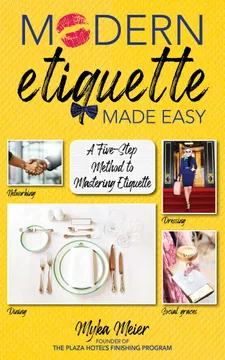
Modern Etiquette Made Easy is part memoir, part social-skills manual, and part procedural reference. Its organizing arc traces Meier's movement from feeling unprepared at formal dinners to teaching etiquette as an accessible tool for confidence and connection. The transformation story gives the advice a human stake: etiquette is not merely a catalogue of fork positions, but a learned vocabulary for navigating unfamiliar situations.
The book's most durable contribution is its ethical definition of manners. Attention, consideration, and making room for other people recur beneath the appearance advice, networking scripts, and dining rules. That foundation can help readers distinguish useful formality from status display. Its acronyms and named techniques also make recall easier, although the sheer number of labels can make ordinary social judgment seem more complicated than it is. Most readers need a few adaptable principles, not a complete inventory of poses and protocols.
The main tension is between context sensitivity and the prescriptive details. The author repeatedly says to follow local customs and avoid making others uncomfortable, yet some recommendations, particularly around gendered presentation, polished appearance, and speech, reflect narrow professional and class norms. They may serve readers entering formal environments, but they should not be mistaken for universal measures of character. The book is strongest when rules reduce uncertainty or protect another person's comfort, and weakest when conventions are presented as if they reliably predict competence or likability.
Its practical method is therefore best read as a toolkit rather than a code. Prepare for a setting, notice how others behave, choose actions that communicate respect, and practice until anxiety no longer monopolizes attention. That approach preserves the book's central promise while leaving room for cultural variation, personal boundaries, and the possibility that genuine warmth matters more than flawless execution.
Glossary
The Five-Step Meier Method
Etiquette learning sequenceThe book's overall learning structure: Transform, Attract, Empower, Thrive, and Practice. It moves from personal presentation and first impressions to charisma, confidence, networking, dining, and daily application. Meier presents etiquette as a set of learnable social skills whose purpose is to help people feel more confident while treating others with consideration.
7-in-7 Theory
Seven entrance signalsMeier's framework for preparing a first impression. It asks readers to consider seven elements of an entrance: physical placement, facial expression, personal presentation, posture, voice, body language, and charisma. The name reflects the author's claim that these cues matter in the first moments of meeting, and the framework's practical emphasis is on preparing several signals together.
Branding Board
Visual personal-style guideA collage of images representing the appearance and impression a person wants to cultivate. Meier suggests collecting achievable looks, digitally or on paper, and using the board as a reference when choosing clothes. It is intended to make personal presentation more deliberate and consistent, rather than leaving each outfit to impulse or the pressure of a particular occasion.
ADBA
Four social-entry cuesAn acronym for Approachable, Drink, Brave, and Around, used as a reminder for entering a social event. The person puts away their phone and appears open, holds a beverage, initiates conversation instead of waiting indefinitely, and moves around the room to meet people. The drink need not contain alcohol.
TASK
Networking conversation sequenceA networking acronym meaning Target, Approach, Start, and Keep conversation. Readers first identify an open group or approachable person, then introduce themselves, begin with an engaging question, and sustain the exchange through listening and follow-up questions. The method is meant to turn networking into a sequence of manageable decisions.
W-W-H-C
Open-question promptA conversation technique whose letters stand for What, Why, How, and Compliment. After an opening question, the speaker asks questions beginning with what, why, and how, then offers a relevant compliment before restarting the sequence. Meier presents it as a way to encourage fuller answers, provided the listener pays attention and responds to what is actually said.
4 P's
Four vocal qualitiesA vocal training method credited in the book to Diana Mather. Its elements are Pitch, Pace, Pause, and Passion. The framework asks speakers to vary their tone, choose a suitable speed, leave space for responses, and communicate engagement. Meier uses it to help readers develop a voice that sounds clear and assured without relying on volume.
Win an Oscar
Confidence role-play exerciseA confidence exercise in which a person imagines acting in a scene and adopts the behavior of a confident character suited to the situation. Meier uses it before nerve-racking moments such as public speaking. The technique is intended to help someone act despite discomfort, rather than require anxiety to disappear first.
IWT
Cutlery-holding reminderAn abbreviation for Index, Wrap, and Twist, Meier's method for holding a fork and knife in the Continental style. The utensils rest along the index fingers, the remaining fingers wrap around their handles, and the wrists turn toward the plate. The steps are meant to make the grip easier to remember and repeat.
Swivel-and-Pop
Modest car exit techniqueA movement sequence Meier recommends for getting out of a car while wearing a skirt, dress, or similar clothing. The person moves close to the edge of the seat, keeps the knees together while turning the legs outward, places both feet on the ground, and uses the arms to rise. The technique aims to make the exit controlled and preserve modesty.
Download PDF
Download EPUB
.epub digital book format is ideal for reading ebooks on phones, tablets, and e-readers.








