

Key Takeaways
Let time, not a lucky stock pick, do the heavy lifting
A modest start can grow. Grace Groner began with three Abbott Laboratories shares, bought for $180 in total while working as a secretary. She held them through decades of upheaval, reinvested dividends, and left a $7.2 million estate when she died in 2010. The point is not that one company is a reliable path to wealth. It is that time and reinvestment can magnify an early investment.
Compounding rewards patience. Compounding means growth builds on earlier growth. In the book's illustration, $1,000 growing at 10% annually becomes about $45,259 after 40 years. The author uses 9.7% as a historical stock-market assumption, not a promise. Starting early gives investment growth more time to accumulate, but returns vary and losses are possible.
What's compelling about Groner's story is the contrast between an ordinary salary and an extraordinary outcome. It makes patient investing imaginable without suggesting that wealth requires a high income. The caution is equally important: her fortune depended heavily on one company's shares, a concentrated bet that could have ended very differently. Her story illustrates time and reinvestment, not a repeatable stock-picking formula. Broad diversification carries the general lesson forward while reducing dependence on any single company's fate.
Give every paycheck a destination before temptation does
Make money visible. A budget records income and expenses, then compares the plan with what actually happened. A balanced budget leaves income minus expenses at zero because savings are assigned a place too. The author suggests trying to spend 80% or less of income, while recognizing that a tight budget may require either higher earnings or lower costs.
Automate the priority. Paying yourself first means moving money into savings soon after payday, ideally through an automatic transfer. Track bill due dates as well as totals: a rent payment and a credit-card payment landing before the next paycheck can create a cash-flow squeeze even when the monthly budget balances. Separate needs from wants, review actual spending, and adjust the next month's plan using recent history.
A budget works less like a test of character than a feedback system. It turns vague discomfort about spending into information: which categories exceed expectations, and when cash is likely to be tight. Automatic saving also changes the decision environment. Instead of repeatedly resisting a purchase, the saver makes the choice once by setting a transfer. The 80% target, however, is not equally feasible for everyone. Housing costs, income, and caregiving obligations can leave little discretionary room, so the useful measure is progress against one's actual circumstances.
Keep one month of essentials between you and expensive panic
Build a first buffer. The book recommends an initial emergency fund of $1,000 or one month of living expenses, whichever is greater. Include essentials such as housing, food, utilities, and necessary transportation. A Bankrate survey cited in the book found that 56% of Americans could not cover a $1,000 emergency from savings, a reminder that even a modest reserve can matter.
Make it accessible, not tempting. Keep the fund in a separate savings account or clearly labeled account bucket. Use it for essential unexpected costs, such as a car repair, urgent veterinary care, or lost income, not routine wants. After paying off high-interest debt, the book recommends expanding the reserve to three to six months of expenses, with the appropriate amount depending on personal obligations and circumstances.
The emergency fund is more than a pile of cash. It is a form of self-insurance that prevents one unexpected bill from forcing a costly decision, such as carrying a credit-card balance. Separating the account creates useful friction without making the money unreachable. The right reserve is not identical for every household: job stability, dependents, health needs, and access to other support all affect how much protection is useful. The book's staged approach makes the first milestone feel achievable while keeping a larger cushion in view.
Take the full employer match, then invest broadly and cheaply
Claim the match. If an employer contributes when an employee saves, contributing enough to receive the full match captures compensation that would otherwise be missed. In one example, an employer matches a worker's 3% contribution with another 3%, effectively adding an immediate 100% to that contribution before investment growth. Match formulas and vesting schedules differ, so check when the employer's contributions become yours.
Mind the investment settings. Contributions do not necessarily invest themselves. The book favors diversified stock funds for young long-term savers, or a target-date fund that adjusts its mix as retirement approaches. Fees matter: its illustration estimates that paying a 1% annual fund expense instead of 0.05% can cost more than $500,000 over a long career. Historical market averages do not guarantee future returns.
The match is powerful because it is a benefit with an unusually clear, immediate value. Yet the account setup deserves attention too: a contribution sitting in cash may not serve the long-term purpose the saver intended. Broad funds reduce reliance on picking individual winners, and low fees preserve more of the market return for the investor. A simple portfolio is not automatically suitable for every time horizon or risk tolerance, however. The useful principle is to understand what the plan owns, what it costs, and what conditions govern the match.
Attack expensive debt before it compounds against you
Interest can reverse compounding. Investment growth builds on itself, but unpaid debt can do the same in the wrong direction. The book cites credit-card rates as high as 24% APR; in its example, a $1,000 balance at that rate paid off over five years costs $1,726 in total. It recommends prioritizing debt around 10% interest or higher.
Choose a payoff route. The snowball method targets the smallest balance first, which can deliver early wins. The avalanche method targets the highest interest rate first, typically reducing total interest. Both methods require minimum payments on other debts and stopping new borrowing. After high-rate debts, the book suggests building a larger emergency reserve, then addressing moderate-rate debts. Credit cards can still be useful when the full statement balance is paid on time.
The choice between snowball and avalanche is a useful example of mathematics meeting motivation. Avalanche usually favors lower interest costs, while snowball may help someone stay engaged by producing visible account closures. A plan that is abandoned is less useful than one that can be sustained. The book's labels of good and bad debt also need context: education, housing, and a vehicle can have real value, but none is automatically a sound loan. Borrowing decisions depend on total costs, expected benefits, and the borrower's ability to withstand setbacks.
Automate a Roth IRA into diversified funds, not idle cash
Use the account deliberately. A Roth IRA takes contributions after income tax, while qualified retirement withdrawals of contributions and investment growth are generally tax-free. The book argues that this can suit young workers who expect to earn more later, though future tax rates and income are uncertain. Its 2023 example gives a $6,500 annual contribution limit. Contributions also require earned income and cannot exceed the amount earned that year.
Build a repeatable routine. Set recurring transfers and confirm that the money is actually invested. The book recommends diversified mutual funds or exchange-traded funds, attention to fees, and reinvesting dividends. Regular contributions are called dollar cost averaging: investing at set intervals rather than all at once. This creates a steady process and avoids making every investment decision depend on current headlines. Account rules change, so readers should verify current eligibility and limits.
The strongest feature of this approach is the handoff from intention to routine. Regular transfers remove the need to decide afresh each payday, while diversified funds make participation possible without researching individual companies. Tax treatment is less certain than the habit itself: choosing Roth or traditional depends on present and future circumstances, which no young worker can predict perfectly. Regular investing can make the process more manageable, but it does not guarantee a lower purchase price or protect against market declines.
Price financial independence at 25 times annual expenses
Set a measurable target. The book defines a financial independence number, or FI number, as 25 times annual living expenses. Someone spending $50,000 a year would target $1.25 million. This is linked to a 4% annual withdrawal rule of thumb, not a guarantee that a portfolio will support every person indefinitely. The book also recommends saving 15% of pre-tax income for retirement as a broad target.
Plan for access. Retirement accounts offer tax advantages but can restrict early withdrawals. A taxable brokerage account is more accessible, though investments and dividends may be taxable. In the book's hypothetical example, Jonah saves half his income and reaches a modeled $966,178 in a brokerage account at age 42, above his $875,000 FI target. The projection depends on strong assumed returns and steady expenses, so it is an illustration, not a forecast.
The FI number translates an abstract wish to stop working into a target that can be recalculated as spending changes. Linking the target to expenses also shows why lifestyle costs matter as much as portfolio size. The 25-times formula is a planning shortcut, not a personal guarantee: taxes, inflation, investment performance, and lifespan can all affect what a portfolio supports. The distinction between retirement accounts and taxable investments is especially useful for early-retirement planning, because access rules can matter as much as the account balance.
Match each goal's timeline to its account and investment risk
Protect near-term money. For goals expected within three to five years, the book favors cash or money-market accounts, where funds are accessible and less exposed to short-term market drops. For goals farther away, it suggests considering a cautious mix of investments. A house purchase also requires looking beyond the mortgage to debt payments, credit, maintenance, insurance, and other costs.
Use specialized accounts carefully. A Health Savings Account can offer tax advantages on contributions, growth, and qualified medical withdrawals, but requires an eligible high-deductible health plan. A Flexible Spending Account can help with predictable medical costs, but unused funds may be forfeited. A 529 plan can support qualified education costs with tax-free growth and withdrawals. For people with financial dependents, the book favors term life insurance over treating costly permanent policies as investments.
This section's central strength is matching financial tools to the job they are meant to do. Money needed soon has little time to recover from a market decline, while long-term money can tolerate more fluctuation. Specialized accounts can improve tax efficiency, but their rules and eligibility conditions matter as much as their advertised benefits. The same logic applies to homeownership and insurance: neither a house nor a policy is inherently a good investment. A decision should be evaluated against the household's actual needs, costs, and time horizon.
Track net worth, not salary, to see financial progress
Count the whole balance sheet. Net worth is the value of assets minus debts. A high salary alone does not reveal whether someone is building wealth: a person can earn more while accumulating little if spending and liabilities rise alongside income. The author recommends checking net worth periodically, such as monthly, to see whether savings, investments, and debt are moving in the intended direction.
Pay attention to costs. An advisor can help when finances become complicated, during major life changes, or when a person does not feel equipped to manage decisions alone. But fees deserve scrutiny. The book warns that recurring advisory and fund expenses can substantially reduce long-term growth. For simpler situations, it presents low-cost diversified funds and regular contributions as a manageable do-it-yourself alternative.
Net worth is a more complete scorecard than income because it includes both what a person owns and what they owe. Reviewing it periodically can reveal whether financial choices are changing the overall picture, rather than merely increasing visible consumption. Still, it is a lagging measure, and short-term fluctuations in investments do not necessarily indicate a plan is failing. Advisors can add value through judgment, coordination, and support, not only investment selection. The sensible question is whether that service addresses a real need at a clearly understood cost.
Raise earnings when thrift alone cannot move your plan forward
Savings capacity changes over time. Early on, cutting avoidable spending can create room to save. But expenses cannot always be reduced much further, while income can grow through raises, promotions, or side work. The book suggests looking first for opportunities at an existing job, then considering paid work that fits one's skills and interests. Building a business or other income source can also help, though it takes effort and carries risk.
Make freedom useful. The author describes passive income as money from investments, property, or work that has been scaled or automated. Financial independence can provide more control over how time is spent, including pursuing meaningful work or giving time and money to causes. The aim is not to postpone all enjoyment until a distant milestone. Budget for valued experiences while avoiding choices that undo essential savings or leave expensive debt behind.
This is a helpful correction to the idea that frugality can solve every financial problem. Raising income can expand the amount available for savings without requiring every pleasure to be cut away, although new earnings can also disappear into higher spending if no plan exists. The book's emphasis on passive income usefully asks how today's effort might create future flexibility, while its examples still involve substantial setup and risk. Money is most powerful here as an option: it can buy time, support a project, or fund generosity, rather than serve as an end in itself.
Analysis
This book is best understood as a practical sequence for directing a paycheck, rather than a collection of isolated tips. Its order is the argument: make cash flow visible, create a buffer, capture employer contributions, remove costly debt, use tax-advantaged accounts, then decide how to fund early independence and other goals. That progression translates a daunting subject into a series of manageable next actions. Grace Groner's story gives the sequence an emotional anchor, while the recurring examples make abstract concepts such as compounding, fees, and withdrawal targets easier to picture.
Its most valuable through-line is behavioral. Automatic transfers, separate accounts, regular reviews, and simple diversified investments reduce the number of decisions that must be made under pressure or temptation. The book treats money management as an operating system, not merely a matter of financial literacy. Its emphasis on emergency reserves also recognizes that a plan is only robust if it can survive ordinary shocks.
The largest caution concerns the numerical projections. Historical market returns are not dependable forecasts, and the book's examples use a 9.7% annual growth assumption that can make long-term outcomes look unusually smooth. The FI calculation and 4% withdrawal rule are useful planning heuristics, but they do not settle questions about inflation, taxes, changing family costs, market timing, or lifespan. The book does disclose uncertainty, yet readers should keep that uncertainty central when interpreting its large future-value examples.
The advice is also rooted in US accounts and rules, with limits and eligibility figures tied to the book's 2023 publication. Its seven-step waterfall is a strong default map, not a universal law. Income instability, expensive housing, medical needs, or high-interest debt can change priorities. The most durable lesson is therefore not to follow every figure literally, but to build a repeatable system that directs current resources toward security, future choice, and a life the saver actually wants.
Review Summary
Money Management for Young Adults receives high praise from readers for its comprehensive and accessible approach to financial education. Reviewers appreciate the practical advice, clear explanations, and actionable steps provided. The book covers essential topics like budgeting, investing, and debt management, making it valuable for young adults entering the workforce. While some readers note its focus on an American audience, many find it useful regardless of location. The book's emphasis on developing healthy financial habits and long-term planning is particularly commended, with readers feeling more confident in managing their finances after reading.
Glossary
Pay yourself first
Save before discretionary spendingA saving technique in which money is transferred to savings or investments soon after income arrives, before the remainder is spent on other expenses. The book recommends making this automatic where possible. The goal is to treat saving as a planned priority rather than relying on whatever money happens to remain at the end of the month.
Snowball method
Pay smallest debts firstA debt repayment strategy that orders balances from smallest to largest, regardless of interest rate. The borrower makes minimum payments on all debts and directs extra money toward the smallest balance. Once it is paid, that payment is added to the next target. The method emphasizes early, visible wins that may help sustain motivation.
Avalanche method
Pay highest rates firstA debt repayment strategy that orders debts by interest rate, from highest to lowest. Minimum payments continue on all debts, while extra money goes to the highest-rate balance. After it is cleared, the payment moves to the next rate. This approach generally reduces interest costs compared with paying the smallest balance first, assuming it is followed consistently.
Dollar cost averaging
Invest at regular intervalsAn investing approach in which a person contributes a set amount on a regular schedule rather than investing all available money at once. Because the market price changes, regular purchases occur at different prices. The book presents this as a way to make investing more systematic and less dependent on trying to predict short-term market movements.
FI number
Target savings for independenceThe book's shorthand for a financial independence target, calculated as 25 times annual living expenses. The calculation is connected to the rule of thumb that withdrawing 4% of the portfolio per year may provide ongoing spending money. It is a planning estimate, not a guarantee, and depends on factors such as investment returns, taxes, inflation, and future expenses.
Target-date fund
Retirement fund that adjusts riskA fund selected according to an intended retirement year. It holds a diversified mix of investments and automatically changes that mix over time, generally shifting toward more conservative assets as the target date approaches. The book presents it as a simplified option for people who prefer not to select and rebalance investments themselves.
Dividend Reinvestment Plan (DRIP)
Automatically reinvest dividendsA brokerage feature that uses dividend payments to purchase additional shares of the investment that paid them, sometimes including fractional shares. Instead of leaving dividends as idle cash, the investor puts them back to work. Reinvested dividends can contribute to compounding, although investment values and future payouts are not guaranteed.
FAQ
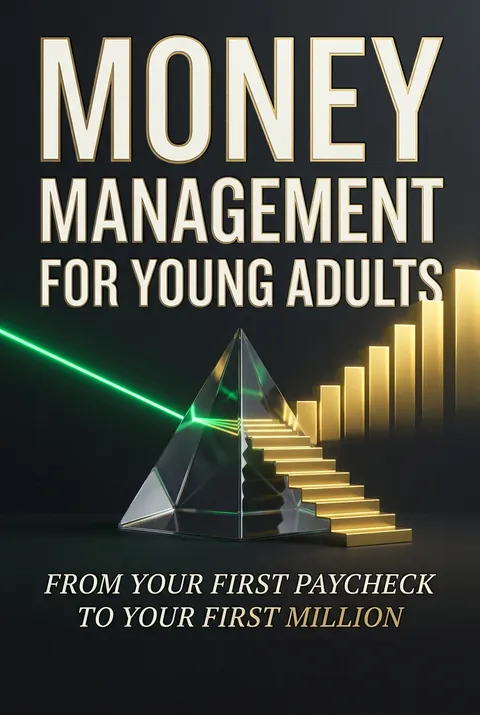
What is "Money Management for Young Adults: From Your First Paycheck to Your First Million" by Luke Villermin about?
- Comprehensive Personal Finance Guide: The book is a step-by-step guide for young adults to manage their money, starting from their first paycheck and aiming to build wealth up to their first million dollars.
- Sequential Financial Roadmap: It outlines a seven-step process covering budgeting, emergency funds, employer-matched savings, debt repayment, retirement accounts, financial independence, and advanced savings strategies.
- Focus on Education and Habits: The author emphasizes the importance of financial education, building good money habits, and leveraging time and compounding to achieve long-term financial goals.
- Accessible and Actionable: The book is designed to be practical, with worksheets, real-life examples, and clear explanations of financial concepts tailored for beginners.
Why should I read "Money Management for Young Adults" by Luke Villermin?
- Targeted for Young Adults: The book addresses the unique financial challenges and opportunities faced by people just starting their careers or managing money independently for the first time.
- Step-by-Step Action Plan: It provides a clear, actionable sequence of steps, making it easy to know what to do next with your money.
- Focus on Long-Term Wealth: The advice centers on building sustainable wealth through proven methods, not get-rich-quick schemes.
- Mental Health and Relationships: The book highlights how good money management can reduce stress and improve relationships, not just financial outcomes.
What are the key takeaways from "Money Management for Young Adults" by Luke Villermin?
- Start Early, Compound Wealth: Beginning to save and invest as soon as possible leverages the power of compounding, which is more important than the amount you start with.
- Budgeting is Foundational: Creating and sticking to a budget is the first and most crucial step in taking control of your finances.
- Prioritize Emergency Funds and Debt: Build an emergency fund and pay down high-interest debt before focusing on investing.
- Maximize Employer Benefits: Take full advantage of employer-matched retirement plans for immediate returns and long-term growth.
- Automate and Diversify Investments: Use automation and diversified, low-fee index funds or ETFs to build wealth steadily and minimize risk.
How does Luke Villermin define and recommend budgeting in "Money Management for Young Adults"?
- Track Income and Expenses: Villermin stresses the importance of knowing exactly how much money comes in and goes out each month, using categories like housing, transportation, food, and savings.
- Pay Yourself First: He recommends setting up automatic transfers to savings or investment accounts before spending on wants or even some needs.
- Use Tools and Systems: The book suggests using budgeting apps, spreadsheets, or even paper to track spending, and emphasizes the need for regular review and adjustment.
- Needs vs. Wants: Villermin encourages readers to distinguish between essential expenses and discretionary spending, prioritizing savings and needs over wants.
What is the "Magic of Compounding" as explained in "Money Management for Young Adults" by Luke Villermin?
- Exponential Growth Over Time: Compounding means your money earns returns, and those returns then earn more returns, leading to exponential growth, especially over long periods.
- Time is More Important Than Amount: Starting early is more impactful than starting with a large sum, as compounding accelerates wealth in later years.
- Illustrated with Examples: The book provides clear examples showing how small, regular investments can grow into significant sums over decades.
- Applies to Both Savings and Debt: Compounding works for investments but also against you with high-interest debt, making early action critical.
What is Luke Villermin’s recommended order of financial steps in "Money Management for Young Adults"?
- Step 1: Budget and Set Goals: Start by tracking your money, reducing expenses, and setting specific, measurable financial goals.
- Step 2: Build an Emergency Fund: Save at least $1,000 or one month’s living expenses to cover unexpected costs.
- Step 3: Max Out Employer-Matched Savings: Contribute enough to your 401(k) or similar plan to get the full employer match.
- Step 4: Pay Down High-Interest Debt: Use the snowball or avalanche method to eliminate debts with high interest rates.
- Step 5: Save for Retirement in an IRA: Open and contribute to a Roth IRA, prioritizing tax-advantaged growth.
- Step 6: Accelerate Retirement Savings: Increase retirement contributions to 15% of your salary and plan for financial independence.
- Step 7: Advanced Savings and Goals: Use HSAs, 529s, and taxable accounts for additional goals and optimize your financial strategy.
How does "Money Management for Young Adults" by Luke Villermin advise handling debt, especially high-interest debt?
- Identify and Prioritize: Focus on paying off debts with interest rates above 10% first, as these are the most damaging to your finances.
- Snowball vs. Avalanche Methods: Choose between paying off the smallest debts first for psychological wins (snowball) or the highest-interest debts first for maximum savings (avalanche).
- Avoid New Debt: Stop accumulating new debt, especially on credit cards, while working through your repayment plan.
- Good vs. Bad Debt: Understand the difference—good debt can increase your net worth (like student loans or mortgages), while bad debt (like credit cards) should be avoided or paid off quickly.
What investment strategies does Luke Villermin recommend in "Money Management for Young Adults"?
- Start with Employer Plans: Max out employer-matched 401(k) or similar plans for immediate returns and tax benefits.
- Open a Roth IRA: Contribute to a Roth IRA for tax-free growth, especially if you expect to be in a higher tax bracket later.
- Use Low-Fee Index Funds and ETFs: Invest primarily in diversified, low-cost index funds or ETFs rather than trying to pick individual stocks.
- Automate and Reinvest: Set up automatic contributions and enable dividend reinvestment to maximize compounding and minimize emotional investing.
How does "Money Management for Young Adults" by Luke Villermin address financial independence and early retirement?
- Calculate Your FI Number: Multiply your annual living expenses by 25 to find the amount needed to retire and live off investments indefinitely.
- Save 15% of Income: Aim to consistently save and invest at least 15% of your pre-tax income for retirement.
- Use Taxable Accounts for Flexibility: After maxing out retirement accounts, invest in taxable brokerage accounts for liquidity and early access.
- Develop Passive Income Streams: Explore ways to generate passive income, such as dividend portfolios, rental properties, or side businesses, to accelerate financial independence.
What advanced financial tools and strategies are covered in "Money Management for Young Adults" by Luke Villermin?
- Health Savings Accounts (HSAs): Use HSAs for triple tax benefits if you have a high-deductible health plan.
- 529 College Savings Plans: Save for education expenses with tax-advantaged 529 plans, especially if you have or plan to have children.
- Flexible Spending Accounts (FSAs): Consider FSAs for healthcare expenses if you don’t qualify for an HSA, but be aware of the “use it or lose it” rule.
- Net Worth Tracking: Regularly track your net worth to monitor progress and inform financial decisions.
What are the best quotes from "Money Management for Young Adults" by Luke Villermin and what do they mean?
- "You do not rise to the level of your goals. You fall to the level of your systems." — James Clear, quoted in the book: Emphasizes that consistent habits and systems are more important than lofty goals for financial success.
- "An emergency fund turns a crisis into an inconvenience." — Dave Ramsey, quoted in the book: Highlights the importance of having savings to prevent financial setbacks from becoming disasters.
- "Don’t look for the needle in the haystack. Just buy the haystack!" — John Bogle, quoted in the book: Advocates for investing in broad index funds rather than trying to pick individual winning stocks.
- "It’s not your salary that makes you rich, it’s your spending habits." — Chuck Jaffe, quoted in the book: Reminds readers that wealth is built through disciplined spending and saving, not just high income.
- "If your net worth isn’t changing, change your network." — Grant Cardone, quoted in the book: Suggests that surrounding yourself with financially savvy people can help you improve your own financial situation.
What makes "Money Management for Young Adults" by Luke Villermin different from other personal finance books?
- Stepwise, Sequential Approach: The book provides a clear, prioritized order of financial actions, making it easy for beginners to follow.
- Focus on Young Adults: It addresses the specific needs, challenges, and opportunities of people in their late teens and twenties.
- Emphasis on Mindset and Psychology: Villermin discusses the psychological aspects of money, including habits, biases, and the influence of upbringing.
- Practical Tools and Worksheets: The book includes downloadable worksheets and practical exercises to help readers implement the advice.
- Balanced, Realistic Advice: It avoids get-rich-quick schemes and instead promotes slow, steady, and proven methods for building wealth.
What are the most important actions to take after reading "Money Management for Young Adults" by Luke Villermin?
- Create and Stick to a Budget: Track your income and expenses, prioritize needs and savings, and regularly review your spending.
- Build an Emergency Fund: Save at least one month’s living expenses (or $1,000 minimum) in a separate, easily accessible account.
- Maximize Employer Retirement Benefits: Con
Download PDF
Download EPUB
.epub digital book format is ideal for reading ebooks on phones, tablets, and e-readers.








