

Plot Summary
Prologue
On a night of two full moons, NightWing Secretkeeper6 finds her hidden egg transformed from black to silver and watches it hatch into a healthy dragonet. She names her Moonwatcher,1 then hides the newborn again when a NightWing guard calls for her.
Secretkeeper6 returns to her tribe alone, leaving Moon1 among the rainforest ferns with only her mother’s6 warning to stay hidden. The opening establishes both Moon’s1 unusual birth and the fear that shapes her childhood: Secretkeeper6 believes that keeping her daughter1 safe means keeping her secret, even when safety leaves the hatchling alone.
Moon’s birth makes secrecy an act of love with a cost. Secretkeeper has good reason to fear the volcanic NightWing tribe’s hardship, but her protection depends on denying her daughter ordinary care and community. The silver egg and moonlit hatching mark Moon as exceptional before she can choose what that means. Her first lesson is not how to use her gifts, but how to conceal them. That distinction drives the novel’s central conflict: Moon must decide whether protection means hiding from other dragons or taking the risk of trusting them.
Moon Leaves the Rainforest
Years after her mother6 brought her back into NightWing society, Moonwatcher1 is sent to Jade Mountain Academy, where dragons from all seven tribes are meant to learn together. Secretkeeper6 urges her to hide her mind-reading gift and leave the rainforest behind, though Moon1 can hear that her mother6 is anxious too. Before they part, Moon1 sees a sudden vision of SeaWing Turtle7 attacking his sister20 Anemone.20
The image gives her a new fear to carry into school, where she already expects other dragons to reject her as an outsider. Fatespeaker welcomes Moon,1 and she finds her assigned sleeping cave. There, she meets cheerful RainWing Kinkajou4 and hostile SkyWing Carnelian,18 while an unknown voice5 speaks directly into her mind.
Moon’s first school day turns a private problem into a social one. Her mother has taught her that concealment is the price of belonging, but the academy requires shared caves, mixed tribes, and conversation. Moon arrives already reading the room more deeply than anyone knows, yet that knowledge makes connection harder rather than easier. The vision of Turtle attacking Anemone also shows that her gift is not simply access to present thoughts; it can burden her with futures she cannot yet interpret. The voice in her mind offers the possibility of companionship, but its secrecy echoes the very conditions Moon is trying to escape.
The Scavenger Between Them
When a dispute erupts in the prey center, Moon1 struggles to separate the dragons’ thoughts from the noise around her. A terrified scavenger bolts through the crowd, and Moon1 catches it before the other students can seize it as food. Its owner, IceWing Winter,3 threatens her, while SandWing Qibli2 steps between them and admits he accidentally let the animal escape.
Once they discover that the scavenger, Bandit, is Winter’s3 pet, Moon1 returns him and realizes he has not eaten. Kinkajou4 offers him fruit, and he finally takes a berry. Winter3 notices that Moon1 guessed what Bandit needed, and Qibli2 begins wondering what else she knows. Moon1 retreats from the attention, but her first act of compassion has made her secret harder to hide.
Bandit’s rescue gives Moon a first chance to act on empathy, but the scene also exposes the danger of untrained perception. She reads Winter’s fury more easily than his concern, so his threat overwhelms the quieter fact that he wants his pet safe. Qibli’s intervention gives her a potential ally who observes behavior rather than relying on tribal suspicion. Yet Moon’s accurate guess about Bandit turns kindness into evidence. The academy’s promise of cross-tribal understanding meets the habits students bring with them: Winter distrusts NightWings, while Moon must decide whether to speak from what she knows or hide how she knows it.
Voices After Midnight
That night, Moon1 dreams that Jade Mountain collapses and dragonets die beneath falling rock. The unknown mind-reader5 pulls her out of the nightmare into a silent mental refuge, then challenges her to control the voices and visions she has never been taught to manage. Moon1 searches the mountain for Stonemover, hoping he is the speaker, but finds an aging NightWing whose animus power has left him trapped and turning to stone.
On her way back, Moon1 overhears two minds using a dreamvisitor to discuss killing someone at the school. She does not know who is speaking or whom they plan to target, but the threat changes her choice: instead of keeping her head down, she begins searching for a way to learn what dreamvisitors can do.
The night links Moon’s inner danger to an external one. Her nightmare may be prophecy, but without training she cannot tell whether it warns her or merely magnifies her fears. The stranger’s help feels intimate while remaining ethically uncertain: he can enter her mental world, yet she has no way to inspect his. Stonemover supplies a counterexample to the glamour of power, embodying its bodily and emotional cost. Then the overheard murder plan makes passivity morally consequential. Moon’s gift is no longer only a source of embarrassment; withholding what she hears could leave another dragon in danger.
The Legend Speaks Back
At the library, Moon1 asks Starflight13 about dreamvisitors and learns that the exiled Queen Scarlet16 possesses one, another is at the academy, and a third vanished during the NightWing volcano’s eruption. Reading the history of animus magic, Moon1 discovers that the ancient NightWing Darkstalker5 created the dreamvisitors and was supposedly defeated by his friend Fathom.
The voice identifies itself as Darkstalker,5 still alive but imprisoned beneath stone after an enchanted bracelet broke. He says he transferred his animus power into a hidden scroll, his talisman, and asks Moon1 to find it so he can escape. Moon1 cannot verify his version of history, but his loneliness and apparent helplessness make his request difficult to dismiss.
The revelation turns a comforting mystery into a problem of judgment. Darkstalker’s story gives Moon someone who understands her gifts, but it also asks her to trust a dragon described by history as dangerously powerful. His account of betrayal and imprisonment may be sincere, self-serving, or both; Moon has no independent witness and no way to meet him. The talisman sharpens the dilemma because finding it could free a prisoner while also restoring immense power. Moon’s loneliness makes the appeal emotionally potent, which is precisely why the novel asks whether compassion can remain clear-eyed when a powerful stranger frames himself as its sole beneficiary.
A School Under Siege
Before the history lesson, SkyWing Peril15 arrives at the academy searching for the missing Queen Scarlet.16 The students recoil from the dragon whose fireproof scales once made her a weapon of the SkyWing queen,16 while Clay14 welcomes her because she has nowhere safe to go.
The argument over whether Peril15 deserves a place at school gives Moon1 a close look at how badly the war has damaged trust. Later, Moon1 speaks with NightWing Mightyclaws, who describes the tribe’s old training in false prophecies and insists its lost powers may return.
His painting of the volcano, covered in watching eyes and teeth, reminds Moon1 of her own birth. She realizes that hatching beneath full moons may explain her gifts, and that the NightWings may have abandoned moonlit hatchings to prevent another powerful dragon like Darkstalker.5
Peril’s arrival tests the academy’s promise of amnesty against the vivid memory of harm. Clay treats the school as a place where a dragon might begin again; Winter and others see the past as evidence that danger must be kept outside. Moon’s conversation with Mightyclaws narrows the mystery of her own powers, but it also makes her birth part of a collective history shaped by fear of Darkstalker. The old tribe may have chosen ignorance as a safeguard. That choice resembles Secretkeeper’s secrecy, yet its scale is larger: a whole people may have sacrificed a source of power rather than risk repeating one dragon’s choices.
The History Cave Explodes
A sharp vision shows Moon1 the history cave engulfed in fire, so she races to stop her winglet from entering. Winter,3 Qibli,2 Turtle,7 and Kinkajou4 hear her panic, but none can reach the room before Carnelian18 steps inside. A hidden bomb explodes. Peril15 and Clay14 enter the burning cave and pull survivors out, but Carnelian18 and NightWing Bigtail are dead; blind RainWing Tamarin17 survives, badly injured.
Winter3 then drags Moon1 away from the others and demands to know how she knew. Turtle7 recognizes that she saw the future, and Moon1 admits that she can also read minds. Kinkajou4 feels betrayed, and Qibli2 withdraws, leaving Moon1 to face both grief for the dead and the cost of telling the truth.
The explosion makes Moon’s secrecy impossible to maintain, but revelation does not instantly create trust. Her vision saves some students from entering the cave, yet it cannot save those who do, and that limit matters: prophecy gives warning, not control. The deaths also convert a private gift into public responsibility. Moon’s friends must reconsider every conversation they have had with her, while she must absorb their fear and anger without retreating behind her mother’s rule. The scene refuses the fantasy that truth automatically heals. Moon tells the truth because danger demands it, then discovers that honesty can still wound the people she hopes to keep.
A Bomb Made of Cactus
The next day, Moon1 and Turtle7 return to the burned history cave and find Sunny11 and Tsunami12 examining sharp pods scattered through the ash. Turtle7 recognizes them as dragonflame cactus seeds, which explode when exposed to fire and had been used as weapons in the Summer Palace attack.
The evidence points toward a SkyWing connection, while Moon1 remembers a dreamvisitor conversation demanding that one student be killed. At the school assembly, she and Qibli2 quietly test possible suspects.
Pike,22 Icicle,10 and Flame each carry anger and grudges, but Moon1 hears no sign that any of them planted the bomb. The teachers keep the school open while families decide whether to withdraw their students, and Moon1 and Qibli2 agree to keep searching despite their strained trust.
The cactus turns an apparently supernatural catastrophe into a material crime with a traceable method. That shift matters because it gives the students something to investigate together rather than leaving them trapped in rumor. Moon’s mind-reading helps eliminate suspects, but it does not deliver a clean verdict: anger is common, and violent thoughts are not proof of action. Qibli’s practical reasoning complements her access to inner life, while their collaboration remains fragile after her confession. The assembly exposes the school’s institutional stakes too. Keeping the academy open is not simply optimism; it is a decision to protect a new experiment in coexistence without pretending that its students are already safe.
The Skyfire Silence
Searching among the SandWings, Moon1 watches Qibli2 question the older student Onyx19 about her past and the black stone in her amulet. Onyx19 says the rock fell from the comet that crossed the sky at the war’s end, killing her mother.
When Moon1 briefly holds the amulet, every mind around her vanishes from perception, including Darkstalker’s.5 She returns it at once, shaken by the silence, then hears enough of Onyx’s19 thoughts to conclude that she did not plant the bomb.
The discovery explains why Onyx19 and Turtle7 have seemed unreadable: both possess pieces of skyfire, a strange stone that blocks Moon’s gift. Darkstalker5 warns Moon1 not to reveal the stone’s power, but she now understands that her friends could have a way to keep their thoughts private.
Skyfire changes the meaning of privacy from a fear Moon imposes on others into a choice they can make for themselves. When she holds the stone, she experiences the isolation ordinary dragons inhabit every day, and her first response is not relief but alarm. The moment complicates Darkstalker’s claim that her power makes her exceptional and entitled to use it. He sees skyfire as a threat to his kind of access; Moon sees a possible safeguard for her friends. Onyx’s unreadability also warns that absence of evidence is not evidence of innocence, even as her thoughts clear her of this particular crime.
Sora’s Buried Grief
At the prey center, a stalactite falls toward Icicle,10 who escapes at the last instant. Claw marks show it was weakened deliberately. Icicle10 suspects the earlier bomb was meant for her too, and Moon1 hears that Sora8 was the only dragon told of her plans to visit the history cave. Moon1 and Qibli2 find Sora8 beside injured Tamarin.17
Sora8 admits she planted the cactus bomb to kill Icicle,10 whom she believes murdered their sister Crane during the war; she had expected Icicle10 to be alone. Umber9 chooses to leave with Sora8 rather than surrender her to a justice system that may deliver her to Icicle10 or the queens’ revenge. Moon1 lets the siblings flee, then connects Icicle’s10 threat to the dreamvisitor plot with Queen Scarlet.16
Sora’s confession does not excuse the bomb; it reveals how private grief can reproduce the violence it claims to answer. She intended one death and treated the other students as collateral, repeating the logic of wartime commanders. Umber’s choice to protect his sister places loyalty against accountability, while Moon’s decision to let them flee rejects both immediate revenge and easy innocence. Icicle is also more than a suspect: her own grief and ambition have made her available to Scarlet’s manipulation. By connecting the dream conversation to Icicle, Moon recognizes that the school’s violence is not a single incident but part of a larger effort to keep old hatred active.
The Brother in Prison
Moon and Qibli2 race to the library, where Icicle10 has cornered blind NightWing Starflight13 and uses him as a shield. Winter3 arrives and learns that his sister10 has been working with Scarlet16 to kill the academy’s founders in exchange for their brother21 Hailstorm.21
Icicle10 insists that Hailstorm21 survived the NightWing raid on Scarlet’s16 prison, which Winter3 had believed killed him. Moon1 confirms that Icicle10 believes Scarlet’s16 promise, though she cannot prove Scarlet16 is telling the truth.
When Icicle10 threatens Moon1 and Starflight,13 Winter3 finally attacks his sister10 rather than the NightWings he has blamed for years. Qibli2 joins the struggle, and Icicle10 escapes through a window, still free to pursue Scarlet’s16 plan. Winter3 is left with hope for Hailstorm21 and fresh uncertainty about what happened to him.
Winter’s choice is the emotional climax of his conflict. His hatred of NightWings has been organized around Hailstorm’s presumed death, but Icicle reveals that Scarlet has used that grief as leverage. Winter cannot resolve his brother’s fate in the library; he can only decide whether to obey the promise of reunion at the cost of more killing. By defending Starflight and Moon, he separates responsibility from inherited guilt and refuses to let Scarlet define what strength requires. Icicle’s escape prevents the choice from becoming a neat victory. Winter has changed, but the truth he wants remains uncertain and the danger remains mobile.
Moon Stops Hiding
After the fight, Moon1 tells Sunny11 that she can read minds and see the future, explaining how the visions exposed the bomb plot and Icicle’s10 conspiracy. Sunny11 believes her and takes comfort in Moon’s1 insistence that the school is worth defending. Kinkajou4 also returns to Moon,1 admitting that her anger has passed and renewing their friendship.
Moon1 reveals that skyfire can block her mind-reading and gives pieces of Turtle’s7 armband to Kinkajou4 and Qibli2 so they can choose privacy. She plans to offer a stone to Winter,3 but Qibli2 reports that Winter3 has left the academy with Bandit’s cage. Moon1 learns from Turtle7 that he flew northwest, and decides to find him despite the storm gathering over the mountain.
Moon’s openness becomes meaningful when she offers others the same agency she lacks. She cannot switch off her own gift, but she can give Qibli and Kinkajou a means to control access to their thoughts. Sunny’s response also contrasts with Moon’s old expectation of rejection: belief does not require complete certainty, only a willingness to listen. Kinkajou’s return is similarly practical, not sentimental. She chooses friendship again after seeing the breach clearly. Winter’s departure leaves reconciliation unfinished, so Moon’s next action is not a victory lap but a pursuit. Trust has begun to grow, and it now obliges her to follow through.
A Prophecy in the Storm
Moon,1 Qibli,2 Kinkajou,4 and Turtle7 fly through the storm until they find Winter3 beside Bandit’s open cage in the forest. He has left to search for Hailstorm,21 and the others offer to help. As Moon1 begins to explain what she knows, the vision that has haunted her becomes a spoken prophecy: Jade Mountain will fall unless the lost city of night is found.
The words frighten the group, but Moon1 cannot yet explain what they mean. Darkstalker5 shows her another possible future, one in which the academy flourishes and its founders raise a new generation in peace. Moon1 decides to tell Winter3 everything about her powers and the hidden threats around them. She ends not cured of fear, but committed to acting openly despite it.
The prophecy gives the novel an ending that is both a resolution and a new obligation. Moon has stopped treating her gifts as a private defect, but speaking the warning does not make its meaning clear or its danger avoidable. The future she glimpses offers a concrete counterweight to catastrophe: children learning together in the very school now under attack. That vision does not guarantee success; it gives Moon a reason to accept uncertainty and keep choosing. Her promise to explain herself to Winter completes the emotional movement begun at the academy gates. She no longer asks whether she can be normal, but what responsibility she will take for being different.
Epilogue
On a mountain ledge, Queen Scarlet16 uses a dreamvisitor to question Peril15 about the deaths and disappearances at Jade Mountain. Peril15 reports that no one else has died, frustrating Scarlet’s16 attempt to learn whether the attack succeeded. Scarlet16 considers killing Hailstorm,21 her prisoner and leverage over Icicle,10 then decides to keep him alive for now.
Her unidentified companion taps a scroll while Scarlet16 fumes about how to reach Queen Glory. When Scarlet16 asks about the object, the companion dismisses it as unimportant. The scene reveals that the academy’s threat has not ended and leaves the scroll’s purpose unexplained.
The epilogue widens the conflict without resolving it. Scarlet’s use of a dreamvisitor mirrors the secret mental communication Moon overheard, but now the reader sees the antagonist using the tool deliberately and strategically. Peril’s refusal to confirm further deaths frustrates Scarlet, while Hailstorm’s captivity shows how she turns family bonds into instruments of control. The companion’s quiet attention to the scroll creates a new uncertainty rather than a payoff. After Moon’s choice to speak openly, the final image returns to secrecy and unseen power, reminding us that truth revealed in one room does not make the larger world transparent.
Analysis
Moon Rising makes the academy’s promise of peace concrete by placing dragonets from formerly hostile tribes in shared caves, meals, and classes. The school does not dissolve prejudice on arrival. Winter3 carries grief that has hardened into suspicion; Carnelian18 relies on a military identity; Sora’s8 fear turns vengeance into a plan. Their conflicts show that peace is not the absence of anger but the difficult work of keeping anger from becoming policy or action.
Moon’s1 gifts make that work intimate. She can hear what dragons conceal, but she cannot reliably distinguish passing thought from intention, nor can she escape the ethical problem of knowing what was never offered to her. Her fear of exposure resembles the academy’s larger fear of renewed war: both tempt characters to seek safety through withdrawal. When Moon1 gives her friends skyfire stones, she makes privacy a choice rather than a secret she controls. That act marks a more mature use of power than simply discovering what others think.
The novel also resists easy moral sorting. Sora8 is frightened and grieving, yet her bomb kills dragons who were not her target. Peril15 has been used as a weapon, but still needs the chance to choose a different life. Icicle’s10 desire to recover Hailstorm21 is emotionally legible, but her alliance with Scarlet16 turns family love into leverage. Darkstalker’s5 loneliness invites sympathy without proving his innocence. Each case asks whether understanding a motive should change how we respond to harm. The book’s answer is neither blanket forgiveness nor permanent condemnation. It favors responsibility, evidence, and choices made in the present.
Moon1 ends by speaking rather than hiding, but the prophecy leaves her without certainty. Her courage is not a sudden escape from fear; it is the decision to act while the future remains unclear. The imagined thriving academy offers a goal, not a guarantee. Peace, like trust, must be repeatedly made.
Review Summary
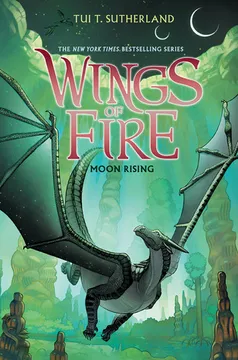
Moon Rising is the sixth book in the Wings of Fire series and the start of a new arc, receiving an overall rating of 4.55/5. Readers praise its compelling new protagonist, Moonwatcher, whose mind-reading abilities offer unique character insights. Many feel the second arc surpasses the first, highlighting strong worldbuilding, humor, and themes of prejudice and healing. The character Darkstalker is frequently noted as a standout. Minor criticisms include underdeveloped side characters and some plot conveniences.
Characters
Moonwatcher
The secret-born listenerMoon is a young NightWing whose mind-reading and prophetic visions make ordinary school life feel crowded and perilous. Raised in the rainforest and taught to conceal what makes her different, she arrives at Jade Mountain expecting rejection and often mistakes silence for safety. Her sensitivity is not passive: she notices fear, grief, and contradiction in other dragons, then struggles to decide when that knowledge gives her a duty to act. Moon wants friendship without surrendering her inner life, a tension that makes her cautious but not indifferent. Her growth comes through choices rather than mastery. Each time she risks telling the truth or intervening for another dragon, she becomes more willing to treat her gifts as responsibilities she can shape.
Qibli
The quick-minded SandWingQibli is a clever SandWing student and former Outclaw, trained by a hard childhood to read a room, assess danger, and make himself useful. His quick humor can soften conflict, but it also hides how carefully he measures whether others will accept him. He is loyal to Queen Thorn and instinctively protects vulnerable dragons, yet his strategic mind can turn people into problems to solve. Moon’s1 gift unsettles him because it exposes thoughts he has never chosen to share. He is drawn to her intelligence and compassion, but trust must compete with his fear of losing control over his private self. His best quality is practical courage: when danger arrives, he tends to move before self-doubt can stop him.
Winter
The guarded IceWing princeWinter is a proud IceWing prince who uses rank, rules, and a cultivated severity to keep uncertainty at a distance. He arrives at school believing other tribes are unreliable, especially NightWings, and his grief over his family makes that suspicion personal. His concern for Bandit complicates the cold image he presents: he can be devoted and tender, but rarely knows how to show care without turning it into command. Winter wants to be seen as strong and worthy of his royal family, which makes shame particularly difficult for him to admit. His clashes with Moon1 expose the gap between what he says he believes and what his actions reveal. He is capable of revising a conviction when loyalty and conscience demand it.
Kinkajou
The bright RainWing friendKinkajou is an exuberant RainWing student whose shifting colors often reveal excitement before she has found the words for it. She greets new experiences as invitations, eager to explore the academy, learn to read, and collect friends from every tribe. Her optimism is genuine, though not weightless: she remembers being imprisoned by NightWings and can feel wary even while choosing to forgive. Kinkajou gives Moon1 a first experience of friendship that is openly offered rather than cautiously negotiated. She is also direct enough to challenge Moon1 when secrecy damages trust. Her warmth does not mean she accepts every hurt without protest; she can be angry, ask for honesty, and then decide to begin again.
Darkstalker
The voice beneath stoneDarkstalker is an ancient NightWing remembered in stories as a dragon of extraordinary power and dangerous ambition. His history is bound up with the tribe’s fear of mind-reading, prophecy, and animus magic, making him a figure Moon1 encounters first through inherited accounts rather than firsthand knowledge. He is intelligent, persuasive, and acutely aware of how isolation shapes a listener’s choices. His appeal rests not only on power but on his claim that he has been misunderstood and left alone. That combination makes him difficult to judge: sympathy may be warranted, yet sympathy does not remove the need for caution. Darkstalker represents the question of whether exceptional ability can be separated from the desire to direct other dragons.
Secretkeeper
Moon’s protective motherSecretkeeper is Moon’s1 NightWing mother, shaped by life among dragons who fear scarcity, exposure, and the volcanic danger of their former home. She hides Moon’s1 egg in the rainforest because she wants her daughter1 to have a healthier beginning, then raises her to keep her unusual gifts secret. Her love is real, but it arrives wrapped in rules that leave little room for Moon’s1 own judgment. Secretkeeper believes safety can be planned through concealment, a belief that protects her daughter1 while also teaching her to fear connection. Her relationship with Moon1 gives the novel its first intimate version of a wider question: how much freedom can a guardian surrender in the name of protection?
Turtle
The quiet SeaWing princeTurtle is a gentle SeaWing prince who appears content to stay in the background, even in a family where his royal sisters command attention. He is thoughtful, observant, and more comfortable exploring than competing for status. His quiet presence gives Moon1 respite from the constant clamor of other minds, and his calm support helps her think when fear takes over. Turtle is not simply timid; he can notice practical details and offer useful advice without making himself the center of the room. His relationship with his sisters and his fellow students suggests a dragon still deciding how much of himself he wants others to see.
Sora
The anxious MudWingSora is a MudWing student whose quiet manners conceal deep anxiety and painful memories of war. She tries to manage fear by imagining it buried beneath mud, a private ritual that helps her function but also keeps others from seeing how distressed she is. Her bond with her siblings, especially Umber9, is a source of safety and identity. Sora is not naturally cruel, but fear can narrow her attention until she sees only the danger she expects. Her presence challenges Moon’s1 assumption that shared shyness means shared experience. Sora needs care, yet the harm she can cause when overwhelmed cannot be ignored.
Umber
The loyal MudWing brotherUmber is a warm, unassuming MudWing who values family loyalty and the chance to learn now that the war has ended. He misses his siblings and carries their bond with him into the academy, where he tries to make new companions feel included. His gentleness does not mean he is unaware of danger; he is attentive to the people he loves and willing to make difficult choices for them. Umber’s instinct to protect family can place him in conflict with broader ideas of justice, but it comes from care rather than ambition. He offers Moon1 a picture of closeness built through daily loyalty.
Icicle
The formidable IceWing sisterIcicle is Winter’s3 older sister, a disciplined IceWing who expects deference and regards the mixed-tribe school with suspicion. She is sharp, competitive, and accustomed to measuring worth through rank and strength. Her confidence can make her seem composed, but it also leaves little space for vulnerability or disagreement. Icicle’s relationship with Winter3 is complicated by the expectations of their royal family and by their shared history of loss. She believes she understands what survival requires, a conviction that makes compromise look like weakness. Her presence tests whether family loyalty can withstand opposing ideas about what strength means.
Sunny
The hopeful school founderSunny is a small SandWing and one of the academy’s founders, guided by a stubborn belief that dragons from opposing tribes can learn to live together. She is attentive to students’ needs and willing to welcome dragons others find frightening or inconvenient. Her optimism is not ignorance; she worries about whether the school can survive its first crisis and whether she is capable of leading it. Sunny’s warmth makes her approachable, but she sometimes hesitates to claim authority. She represents a practical hope: not the belief that conflict has vanished, but the decision to keep building a place where it can be confronted differently.
Tsunami
The forceful head of schoolTsunami is a bold SeaWing princess who becomes head of Jade Mountain Academy and approaches leadership as a problem best met directly. She is protective of students and quick to challenge threats, though her impatience can make diplomacy feel like an obstacle. Her confidence is genuine, but it does not prevent her from avoiding questions that touch her own family or the damage left by war. Tsunami values action and clear rules; the school forces her to make room for discussion, forgiveness, and uncertainty. Her fierce presence gives the academy structure, even as she learns that command alone cannot make students trust one another.
Starflight
The blind NightWing librarianStarflight is a blind NightWing, scholar, and one of the academy’s founders. He organizes the library around careful systems that allow him to locate and lend scrolls, turning a personal challenge into an accessible institution. Thoughtful and conscientious, he often worries about whether he is helping enough, but he continues working rather than letting anxiety define his role. His history with the war and the prophecy makes him wary of returning violence, while his work at the school reflects a commitment to knowledge over manipulation. Moon1 trusts him because his actions and intentions usually align.
Clay
The patient MudWing teacherClay is a large MudWing teacher and academy founder, known for his patient manner and instinct to look after hungry or frightened students. He tries to defuse conflicts before they become fights, sometimes with more kindness than authority. His limp and his history in the war mark him as a survivor, but he does not define students by the worst things they have done. Clay’s care for his siblings and his willingness to risk himself for others make him a steady presence in a school built on second chances. He believes safety is created through relationships as much as rules.
Peril
The fireproof SkyWingPeril is a SkyWing whose scales burn anything they touch, leaving her physically dangerous and socially isolated. She has been used as a weapon, and she carries the shame and confusion of actions performed under another dragon’s command. Her devotion to Clay14 gives her a rare point of emotional safety, but she remains wary of affection and unsure that others can accept her. Peril’s presence forces the academy to confront a difficult distinction: a dragon can have caused terrible harm and still need the chance to choose what she does next.
Queen Scarlet
The exiled SkyWing queenScarlet is a former SkyWing queen who rules through fear, spectacle, and the strategic use of other dragons’ vulnerabilities. She is theatrical and quick to anger, but beneath the performance lies a calculating instinct for leverage. Scarlet understands that family bonds, old grudges, and a promise of reunion can turn another dragon into a weapon. Her continued interest in the academy makes her a threat beyond the battlefield: she tries to damage the trust the school is meant to build. She views restraint as weakness and other dragons as pieces to move.
Tamarin
The observant blind RainWingTamarin is a blind RainWing student who navigates the academy through careful attention, confidence, and familiarity with its spaces. She is Kinkajou’s4 close friend and shares her tribe’s color-changing scales, but her temperament is quieter and more deliberate. Tamarin does not need sight to be capable or self-sufficient; she learns the school by touch and memory. Her presence expands the novel’s interest in different ways of perceiving the world, complementing Moon’s1 unusual mental awareness without making either dragon’s experience interchangeable.
Carnelian
The battle-scarred SkyWingCarnelian is a hardened SkyWing who has fought in the recent war and remains devoted to Queen Ruby. She expects discipline and military purpose, so the academy’s discussions and mixed company strike her as distractions from real training. Her bluntness can look like contempt, but beneath it sits a fear of being judged incapable. Carnelian feels most secure when she can measure herself through combat and loyalty. She embodies the difficulty of bringing young veterans into a school whose lessons depend on questioning the very divisions that once gave them a role.
Onyx
The watchful SandWing studentOnyx is an older SandWing student with a composed manner, dark ornamentation, and a strong belief that beauty should carry an edge of danger. She grew up outside the main desert settlements and relies on self-possession to keep others from probing too far into her past. Onyx is observant and guarded, quick to turn questions back on the dragon asking them. Her independence makes her difficult to place within the academy’s social groups. She represents a student whose history does not fit neatly into the school’s tribal categories.
Anemone
The proud SeaWing princessAnemone is a young SeaWing princess raised under close royal protection and accustomed to being treated as important. She wants room to make choices beyond her mother’s reach, but her confidence can shade into entitlement when other dragons refuse her. Her relationships with Tsunami12 and Turtle7 reveal a family in which rank has shaped who receives attention and freedom. Anemone is clever and forceful, though she is still learning what responsibility means when her wishes affect others.
Hailstorm
Winter’s missing brotherHailstorm is Winter3 and Icicle’s10 IceWing brother, whose presumed fate shapes their loyalties and their view of the NightWings. He is absent from the academy, but the possibility of finding him exerts a powerful pull on his siblings3.
Pike
The hot-tempered SeaWingPike is a SeaWing student protective of Princess Anemone20 and quick to take offense on her behalf. His temper makes him an obvious suspect after the attack, but his loyalty is chiefly directed toward his royal family.
Plot Devices
Moonlit NightWing gifts
A power and a burdenMoon’s1 mind-reading and visions are tied to her hatching beneath two full moons. Mind-reading lets her hear thoughts and emotions, while prophecy gives her sudden glimpses of possible future events. The gifts are not simple tools: other dragons’ thoughts can overwhelm her, visions bring pain, and neither ability supplies a reliable explanation of what she sees. Moon1 learns to quiet the mental noise by imagining thoughts as raindrops, a technique Darkstalker5 teaches her. The powers drive the plot by letting her detect a murder scheme and anticipate the explosion, but they also force her to confront privacy, trust, and the difference between knowing a thought and knowing what a dragon will do.
The dreamvisitors
A bridge into dreamsThree enchanted sapphires allow their holders to enter other dragons’ dreams and communicate there. Moon1 learns that Queen Scarlet16 has one, another is at Jade Mountain, and a third was lost when the NightWing island was destroyed. Their history links Darkstalker5 to his former friends, while their present use gives Scarlet16 a hidden channel for recruiting and pressuring students. Moon1 overhears a dream conversation about murder before she knows who is speaking, and later connects the threat to Icicle10. The objects make private dreams vulnerable to outside influence, echoing Moon’s1 own fear that her mind-reading violates boundaries even when she does not choose to listen.
Darkstalker’s talisman
Power held outside its ownerDarkstalker5 says he placed his animus power in a scroll so that using magic would not consume his soul. The talisman is a black-cased scroll that can enchant objects through written commands, and he claims it is the only way he can free himself from his stone prison. Its existence gives Moon1 a concrete task and forces her to weigh compassion against the danger of restoring immense power to a dragon whose history is disputed. Darkstalker5 tells her that the scroll could be used by anyone who finds it and urges her to destroy it if it falls into dangerous claws. The epilogue shows an unidentified companion handling an ancient scroll, leaving its connection unresolved.
Skyfire stones
A shield for private thoughtBlack rock fallen from the comet, called skyfire by Onyx19, blocks Moon’s1 mind-reading when she holds it. Turtle7 wears pieces in his armband, which explains why Moon1 cannot hear his thoughts; Onyx19 has a separate fragment in her amulet. The stone gives Moon1 a direct experience of the silence other dragons live with and a way to offer her friends control over their privacy. Darkstalker5 fears that widespread access would make mind-readers powerless, while Moon1 sees the stones as a fair protection. The device turns an abstract ethical question into a physical choice: a dragon can decide whether Moon1 may listen.
Dragonflame cactus
A bomb hidden in seedsDragonflame cactus seed pods explode when exposed to fire, scattering sharp fragments and seeds that can produce new cacti. Turtle7 recognizes them from an earlier attack on the SeaWing Summer Palace, which gives the academy’s investigators a specific weapon and a SkyWing lead. Sora8 uses a pod to target Icicle10 in the history cave, but expects her revenge to harm only one dragon. The device makes her plan lethal to bystanders and helps show how violence justified as a single necessary act can spread beyond its intended target. Its seeds remain in the ashes as evidence of both the attack and the danger of treating collateral harm as abstract.
Download PDF
Download EPUB
.epub digital book format is ideal for reading ebooks on phones, tablets, and e-readers.








