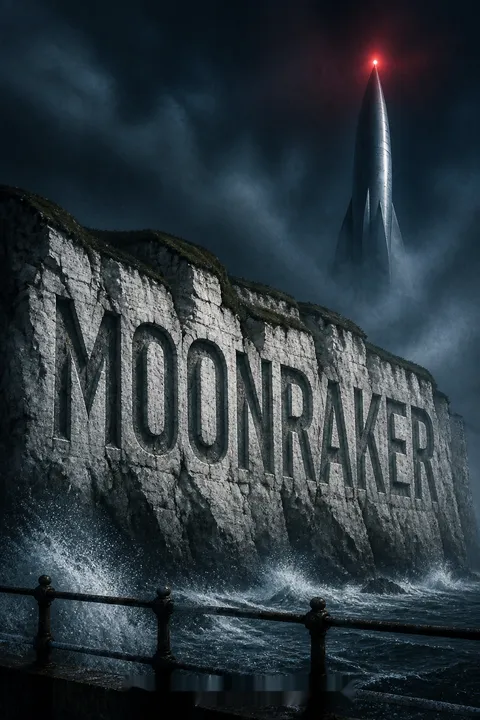


Plot Summary
A Hero Under M's Eye
James Bond spends his Monday at Secret Service headquarters, moving from difficult shooting practice to the routine paperwork he resents. Then M summons him for a seemingly private favor: Sir Hugo Drax, the celebrated millionaire behind Britain’s new Moonraker rocket, has been winning too consistently at cards.
Bond recounts Drax’s public story: a badly injured, amnesiac war veteran who made a fortune in Columbite, then gave money and expertise to build a weapon meant to deter attacks on Britain. M adds that Drax has never lost a weekly settlement at the exclusive Blades club. Bond is asked to observe him there, quietly determine whether he cheats, and prevent a scandal that could damage both Drax and the rocket project.
The story begins with a contrast between Bond’s trained capacity for violence and his bureaucratic idleness. M’s request appears modest because it concerns a card table, yet its subject is a man whose wealth and public reputation have already been converted into national security. The apparent mismatch is the narrative’s first warning: a private vice can matter when the person indulging it holds public power. Bond’s assignment also places him in a moral gray zone. He is not asked to expose Drax, but to contain the consequences, making discretion, rather than simple truth-telling, the initial measure of service.
The Cardsharp's Silver Mirror
At Blades, Bond watches Drax play bridge with his broker, Max Meyer, and the club’s chairman, Lord Basildon. Drax sorts his cards only by color, then deals with his hands positioned over a polished silver cigarette case. Bond realizes the case reflects each card as Drax distributes it, giving him a private view of every deal.
Drax’s noisy jokes distract the table while his memory turns that reflection into an advantage. Bond tells M and Basildon what he has seen. A formal accusation would risk a public scandal, especially with the Moonraker nearing its test, so Basildon accepts Bond’s proposed alternative: expose Drax by defeating him at his own game. Bond prepares two prearranged card packs in case he gets the deal.
Drax’s method is revealing because it is neither elaborate nor technically impressive. The silver case belongs naturally on a card table, and the trick succeeds because the other players read it as decoration. Bond’s work depends on watching behavior that convention has rendered invisible. The episode also makes gambling a miniature model of the novel’s larger problem: power is not always exercised through force, but through control of what others can see. Basildon’s willingness to authorize a counter-cheat shows how institutions preserve their reputation by managing misconduct privately, a response that becomes increasingly inadequate as the stakes expand.
The Grand Slam Trap
Bond and M join Drax and Meyer for a high-stakes rubber. Bond raises the stakes beyond his comfortable means, then pretends to become drunk as the early hands leave him losing money. When Drax deals, Bond signals M that the prepared hand is coming. He deals Drax nearly every top card, then bids a grand slam in clubs with a weak hand of his own.
Certain that Bond has blundered, Drax doubles and accepts a further side bet. Bond’s contract succeeds because Drax’s powerful cards are useless against the distribution Bond has arranged. Basildon sees the trap and confirms the result. Drax loses roughly fifteen thousand pounds, leaves with his composure restored but his hostility unmistakable, and warns Bond to spend the winnings quickly.
Bond wins by making Drax’s confidence do the work of the trick. The planted hand matters less than the antagonist’s conviction that he can read and dominate every situation. Drax’s loss is therefore not simply financial; it exposes the fragility beneath his public mastery. Yet the victory does not settle the moral problem. Bond has answered cheating with deception, and the club’s response remains contained within its own walls. The parting warning gives the scene an aftertaste of menace: Drax can absorb humiliation without becoming harmless, and his private grievance is now attached to Bond personally.
Two Bodies at Dover
The next morning, M reports that Major Tallon, a Ministry of Supply security officer, and Egon Bartsch, a German electronics expert, are dead after Bartsch shot Tallon in a nearby inn and then killed himself. Bartsch had apparently become obsessed with Gala Brand, a Special Branch agent working undercover as Drax’s secretary.
Tallon had recently told the Ministry that something at the site troubled him, but disclosed no details before his death. Because the Moonraker is scheduled to launch within days and the Service had cleared the German technicians, M sends Bond to replace Tallon.
Bond learns that the guarded complex holds a rocket capable of reaching European capitals, and that Drax’s team includes dozens of German specialists. The official explanation for the killings seems plausible, but Tallon’s warning makes it hard to dismiss.
The assignment brings state security, personal violence, and technical secrecy into the same confined space. Bartsch’s apparent motive offers an easy explanation, while Tallon’s final warning points toward a larger one. The timing makes uncertainty dangerous: an inquiry could delay a launch the government considers essential, but proceeding could leave a security breach untouched. Bond enters the case with limited authority and little time, a structure that forces him to distinguish evidence from instinct. Gala’s presence also complicates the mission. She is not merely a source to question, but an agent already embedded in the daily life and loyalties of the project.
Fingerprints in the Chart
At the guarded compound, Drax greets Bond warmly and introduces Dr Walter, his technical deputy, and Willy Krebs, his household aide. Bond sees the Moonraker in its underground shaft and is impressed by the scale of the work, even as the shaven heads and conspicuous moustaches of the German crew strike him as an odd uniform.
In Tallon’s former bedroom, Bond studies an Admiralty chart and finds two faint lines scratched from the house toward a point offshore. Fingerprint powder reveals marks from Tallon and Krebs, with Krebs’s impressions laid over the earlier ones.
Bond also notices that the technicians’ official photographs show no moustaches. These clues do not prove sabotage, but they suggest someone examined Tallon’s observations after he made them and that the team’s identities may conceal more than their appearance explains.
The chart turns a dead man’s private observation into a material clue, but it does not yet tell Bond what the observation means. This preserves the distinction between noticing and knowing, a central tension in investigation. The discrepancy between the men’s photographs and their current appearance likewise resists immediate interpretation. Drax’s polished welcome and the rocket’s impressive engineering encourage Bond to admire the enterprise before he can judge its purpose. The scene suggests that technical competence can coexist with deception, and that visible order may serve not only efficiency but concealment.
Krebs at the Case
Bond returns to his room and catches Krebs kneeling over his leather case, working the combination lock. He knocks the aide down, finds a set of keys, a concealed knife, and a cosh, then demands to know who sent him.
Krebs refuses to answer and escapes before Bond can get a clear confession. Drax reacts with anger and admits that he has previously suspected Krebs of snooping through private papers. He agrees to keep the aide away from the rocket site, though he resists having him formally detained before launch.
Gala confirms that Krebs has searched her room and opened her letters. Bond and Gala begin comparing their impressions, but neither can yet tell whether Krebs is acting for Drax, for himself, or for a wider group inside the compound.
Krebs’s intrusion offers Bond a concrete suspect, but the evidence does not resolve the larger case. Drax’s quick agreement to restrict his aide can read as sensible security management or convenient misdirection. This ambiguity keeps Bond from treating a guilty-looking man as a complete explanation. Gala’s confirmation matters because it links separate acts of surveillance, while her willingness to share it marks the beginning of practical cooperation between the agents. The scene’s central psychological pressure is the temptation to stop investigating once a suspicious person has been found. Bond resists that closure, recognizing that one operative may be a clue rather than the whole conspiracy.
The Cliff Comes Down
Bond and Gala inspect the coast below the launch site, where the Moonraker’s exhaust tunnel opens through the cliff. During their walk, their guarded working relationship softens; they swim, and Bond impulsively kisses her. As they rest beneath the chalk face, an explosion above them loosens a vast section of cliff.
Bond throws himself over Gala and digs them out before the falling rubble can suffocate them. Once clear, he identifies the collapse as deliberate, not a natural fall, and concludes that organized attackers watched them from above.
Their return to the house unsettles Drax, Walter, and Krebs, who had apparently assumed they were dead. Bond and Gala now know that someone is willing to kill them before the scheduled launch, though they still do not know whether the attack connects directly to the rocket.
The cliff attack converts vague suspicion into a bodily fact. Bond and Gala are no longer observers who can report uncertain clues; they are targets whose survival depends on one another. Bond’s instinctive act of shielding Gala makes their new intimacy inseparable from professional danger, while her recovery of composure signals that she is not merely being protected. The attack’s setting is significant: the landscape that once seemed open and restorative becomes a weapon when someone uses explosives against it. Their survival does not supply an answer, but it changes the cost of waiting for certainty.
The Notebook's False Course
On Thursday, Drax drives Gala toward London with Krebs in the car. She steals the small black notebook from Drax’s pocket and slips out at a hotel, where she compares its figures with the weather and gyro calculations she has prepared for the rocket.
Drax’s settings differ by about ninety degrees. At first she thinks her own work must be wrong; then she realizes his course would bring the Moonraker down near London, not into the North Sea. She secretly removes a page as proof.
Krebs catches her trying to return the notebook, and Drax turns the car onto a quiet road. He strikes Gala, and the two men take her to a hidden London room filled with radio and radar equipment. There, bound to a chair, she understands the rocket is meant to destroy the capital.
Gala’s discovery is the novel’s decisive shift from suspicion to knowledge. Her expertise, previously confined to routine calculations, becomes the means by which she recognizes that the official plan has been falsified. The crisis also exposes the costs of a role built on compartmentalization: she has served the project long enough to care about its success, yet that same closeness nearly makes her doubt her own data. Drax’s violence strips away the genial public manner that has helped him command loyalty. The hidden transmitter makes the conspiracy spatially precise, linking the rocket’s trajectory to a target inside London.
A Chase Through Kent
When Gala fails to meet him in London, Bond learns from Ronnie Vallance that Drax claims to have left her at Victoria Station. Bond spots Drax leaving Blades, follows the white Mercedes, and sees Krebs help a bundled figure into the car. Bond gives chase in his Bentley. A young driver in a red Alfa Romeo joins the pursuit and tries to pass Drax; Drax deliberately forces the Alfa off the road, killing its driver.
Bond continues after him. On a hill, Drax orders Krebs to cut loose the enormous newsprint rolls on a lorry, sending them down across the road. Bond’s Bentley crashes through the wreckage. Drax and Krebs find Bond alive, bind him, recover his weapon, and load him beside Gala in the Mercedes, taking both agents back to the site.
The chase makes Drax’s willingness to kill undeniable, and it removes the last possibility that his violence is limited to private games or intimidation. The Alfa driver’s death is not a tactical necessity; Drax turns an ordinary act of passing into a lethal contest because he cannot tolerate being challenged. Bond’s pursuit is courageous but costly, demonstrating the limits of speed and individual skill against a prepared enemy. The newsprint ambush literalizes the danger of information becoming a weapon, while Bond’s capture reunites him with Gala at the point when their separate knowledge can finally be combined.
The Name Beneath Drax
In the rocket complex, Drax ties Bond and Gala to chairs and explains that he is Graf Hugo von der Drache, a German officer who assumed the identity of a wounded English casualty during the war. He built his postwar fortune through Columbite trading, then used his respectable public image to fund a revenge scheme.
With Soviet assistance, he replaced the Moonraker’s instrument payload with an atomic warhead and installed a radar beacon in London. The men around him are former German comrades working under false identities; their shaven heads and moustaches were meant to disguise them.
Tallon was killed after noticing the offshore supply operation, and Bartsch volunteered to die after shooting him. Drax plans to escape with his team by submarine after the rocket strikes London. He leaves Bond and Gala restrained with Krebs’s blowtorch as the launch approaches.
Drax’s confession reveals how public gratitude has been converted into camouflage. His identity, fortune, engineering project, and charitable image are not separate facts but mutually reinforcing instruments: each makes the next deception easier to believe. His revenge is framed as national grievance, yet its actual logic is personal domination, with an entire city reduced to proof of his superiority. The moustaches and false names embody the plot’s concern with legibility: people can be made socially recognizable while remaining historically unrecognizable. Bond’s earlier suspicion about Drax’s psychology was incomplete, but his attention to small inconsistencies helped keep the case open long enough for this revelation.
Steam in the Vent
After Drax leaves, Bond rocks his chair to the desk and uses its lighter to ignite the blowtorch, then cuts the flex binding Gala before freeing himself. Gala realizes that Drax must set the gyros before launch and that they can restore her original North Sea course.
With no safe exit, they climb a narrow ventilation shaft using rough concrete and exposed reinforcement rods for handholds. Drax and Walter discover the escape attempt and order guards to force steam through the vents.
Bond and Gala brace themselves together as scalding steam floods their shaft, burning their skin but failing to kill them. The guards search elsewhere and leave. The agents remain trapped and injured, but the danger has shifted: if they can reach the gyro chamber before launch, they can still prevent the strike on London.
The escape depends on cooperation rather than a sudden rescue. Bond’s use of the lighter is an improvised tool, while Gala supplies the crucial technical insight about the gyros. Their cramped climb and shared endurance make vulnerability operational: each has to trust the other’s judgment in conditions where neither can see the whole danger. The steam attack also reveals the antagonists’ assumptions. Drax’s guards expect pain to produce surrender or silence, but the agents’ survival keeps the decisive possibility alive. The sequence turns the rocket’s architecture, designed to contain dangerous force, into both prison and potential route to intervention.
The Rocket Turns North
As officials gather for the launch, Bond and Gala descend the ventilation shaft, enter the launch chamber, and reach the gyro compartment while Drax prepares the firing sequence. Bond resets the controls to Gala’s original calculations, then they retreat into Drax’s office and brace themselves beneath the sound of the launch.
The Moonraker rises successfully, but its corrected course sends it toward the North Sea rather than London. From the radio, Bond and Gala hear that Drax’s submarine has entered the target area and is challenged by the British patrol.
The rocket strikes the sea near the submarine, producing a huge explosion and tidal wave that overturns vessels and kills people along the coast. Bond and Gala survive the blast inside the damaged complex. Drax’s intended attack is stopped, but the victory brings a heavy human cost.
The climax resolves the central technical puzzle through the very expertise that the conspiracy tried to exploit. Gala’s calculations, once treated as routine clerical work, become the instrument that redirects a national catastrophe. Bond’s physical action matters, but he cannot solve the problem without her knowledge; their partnership is therefore structural, not decorative. The successful launch remains horrifying because preventing a direct strike does not make the weapon harmless. Its impact kills and injures people, and the submarine’s presence turns the sea into a battlefield. The novel refuses a clean triumph: survival and strategic success arrive alongside irreversible damage.
A Medal, A Goodbye
The next day, M briefs Bond on the casualties, the wrecked Soviet submarine, and the government’s decision to conceal the real plot behind a safer public account. Bond and Gala are to leave the country while officials manage the diplomatic fallout.
Gala will receive the George Cross at the Palace, a recognition she has earned through her role in stopping the attack. Bond meets her before departure and imagines taking her to France, but she tells him she will marry Detective-Inspector Vivian the next afternoon. Her engagement ring had signaled a commitment he chose not to read.
Bond accepts the news without pressing her, gives her a warm farewell, and heads toward the ferry in a new Bentley. He returns to solitude, carrying both the physical injuries and the private disappointment of an assignment that brought him close to someone he cannot keep.
The resolution separates public recognition from private consequence. Gala’s courage is formally honored, while the truth of what she and Bond prevented is buried to protect political stability. Bond’s disappointment is quiet because he understands that danger created intimacy without guaranteeing a future. Gala’s existing engagement was visible, but he had mistaken a temporary emotional bond for a shared plan. The ending therefore resists the fantasy that saving someone entitles the rescuer to their affection. Bond departs not unchanged, but still shaped by the professional habit of leaving before a connection can become a claim.
Analysis
Moonraker builds its suspense by making apparent competence and actual trust difficult to distinguish. Drax has earned admiration through wealth, technical accomplishment, and an ambitious gift to Britain; the same public virtues make his deception credible. The novel’s first clue is not a weapon but a card trick, a private violation of agreed rules. Bond’s discovery at Blades establishes the pattern that later governs the larger plot: an observer notices a small discrepancy, but institutions hesitate to act because the cost of being wrong appears greater than the cost of waiting.
The story also contrasts two forms of expertise. Bond reads behavior, fingerprints, and physical space; Gala reads the flight calculations that others treat as routine administration. Neither discipline is sufficient alone. Their cooperation prevents the rocket from reaching its intended target, and the plot thereby makes intelligence a shared practice rather than a solitary heroic gift. Gala’s work is especially significant because her long immersion in the project gives her both knowledge and emotional investment. She must recognize that her loyalty to the Moonraker’s success has been redirected against the people it was supposed to protect.
Drax’s conspiracy turns national gratitude into strategic cover. His public identity is not simply a disguise placed over a villain; it is a social achievement that recruits institutions, workers, and citizens into believing in the project. The eventual launch cannot be made harmless by Bond and Gala’s intervention. The redirected rocket still causes a devastating explosion and civilian losses, so survival does not erase the consequences of the weapon itself. The political cover-up extends this moral unease: governments suppress the truth to prevent a wider conflict, trading public knowledge for short-term stability. Bond’s final separation from Gala echoes that restraint on a smaller scale. He accepts a boundary he would prefer to cross, leaving the story with a victory that is real, costly, and emotionally incomplete.
Review Summary
Moonraker receives mixed reviews, with an average rating of 3.81 out of 5. Readers appreciate the character development, especially of M and Gala Brand, but some find the plot slow-paced. The novel's setting in England and focus on card games divide opinions. Many note the stark differences between the book and the film adaptation. Some praise Fleming's writing style and Bond's more human portrayal, while others criticize the dated elements and lack of action. Overall, it's considered an improvement over the previous Bond novels.
Characters
James Bond
The watchful field agentBond is a senior British intelligence officer trained to kill, observe, and improvise, but his ordinary days are often spent reading files and waiting for an assignment. He enjoys gambling, fine food, fast cars, and measured competition, and his confidence can turn into dangerous impulsiveness when pride is engaged. His strongest professional quality is attention to small behavioral details: he notices what others dismiss, then tests his suspicions rather than treating them as proof. In relationships he is attracted to independence but often assumes he can control the terms of intimacy. The case forces him to rely on another agent’s specialized knowledge and to accept that courage does not guarantee either certainty or emotional reward.
Gala Brand
The undercover specialistGala is a Special Branch agent posing as Drax’s private secretary. She is disciplined, observant, and technically skilled, with a strong sense of responsibility toward the Moonraker project she has watched grow over many months. Her cover has required her to inhabit the role so fully that professional detachment and genuine investment begin to overlap. She dislikes being patronized or treated as a conventional romantic accessory, and she evaluates colleagues by competence rather than reputation. Gala’s composure is not the absence of fear; it is the capacity to keep thinking while afraid. Her relationship with Bond develops through shared work and danger, but she retains her own commitments and judgment.
Sir Hugo Drax
The celebrated rocket patronDrax is a wealthy public benefactor whose gift to Britain is the Moonraker, a powerful rocket intended to strengthen national security. He is physically imposing, socially loud, and demanding with the people who work for him, yet his confidence and technical fluency make him an effective leader. Drax is intensely competitive and appears to treat success as something that must be demonstrated repeatedly, even in settings where his status makes ordinary victory unnecessary. His public image mixes generosity, eccentricity, and hard-driving competence. The people around him respond to both his authority and the scale of his project, making it difficult to separate genuine admiration from the pressure of working under a celebrated employer.
M
Bond's exacting chiefM directs the Secret Service with reserve, economy, and a sharp sense of institutional responsibility. He rarely wastes words and expects Bond to distinguish what is known from what is merely suspected. His request concerning Drax begins as a discreet favor, but M recognizes that the rocket’s security could have consequences far beyond the club where the investigation starts. He respects Bond’s abilities while remaining willing to question his judgment. Their relationship is built on trust expressed through assignments, practical support, and the things neither man needs to say aloud.
Loelia Ponsonby
Bond's steady secretaryLoelia is Bond’s principal secretary, a capable Service professional whose care for her colleagues sits beneath a cool, authoritative manner. She manages messages and confidential paperwork while carrying the emotional burden of working beside people who may be sent into danger. Her loyalty to the Service is strong, but she understands the personal cost of a career that leaves little room for an ordinary life. She provides Bond with practical assistance without becoming merely an extension of his work.
Miss Moneypenny
M's trusted secretaryMoneypenny works as M’s private secretary and shares an easy, teasing rapport with Bond. She is observant and discreet, comfortable within the rhythms of a headquarters where personal affection must coexist with secrecy and professional boundaries.
Ronnie Vallance
The Special Branch allyVallance is an Assistant Commissioner in the Special Branch, a tactful administrator who knows how to work across departments without turning cooperation into a contest of authority. He trusts Gala’s abilities and wants to protect her while also containing the political and press consequences of the case. His careful manner reflects years of dealing with police, intelligence officers, and government figures whose interests do not always align.
Lord Basildon
Blades' cautious chairmanBasildon chairs the exclusive Blades club and is an experienced bridge player. He admires Drax but recognizes that the suspected cheating threatens the club’s reputation and its members. His instinct is to prevent a public scandal, which makes him willing to authorize Bond’s private countermeasure. Basildon represents an old institution trying to protect its codes without exposing its own vulnerabilities.
Max Meyer
Drax's bridge partnerMeyer is Drax’s metal broker and a skilled bridge player who often partners with him at Blades. He is quieter and more cautious than Drax, and his anxiety rises when the stakes become unusually high. His position beside Drax gives him access to the card games without making him the source of Drax’s methods.
Willy Krebs
Drax's watchful aideKrebs serves as Drax’s household aide and is an unsettling presence around the rocket compound. He is physically slight beside Drax, but his attention is persistent and his manner shifts between ingratiating politeness and menace. Bond and Gala both distrust his interest in private rooms and papers. Krebs’s role places him close to Drax’s daily routines and gives him opportunities to monitor people without drawing the same attention as a uniformed guard.
Dr Walter
The guarded technical deputyWalter is Drax’s senior technical deputy, a precise and irritable specialist responsible for aspects of the rocket’s engineering. He is deeply invested in technical details and quick to challenge decisions he considers unsafe. His expertise earns him a central place in the project, though Drax often manages him as if he were an obstacle to be controlled rather than an equal colleague.
Major Tallon
The uneasy security officerTallon is the Ministry of Supply security officer assigned to the Moonraker site. His professional record is solid, and his late concern about something suspicious at the compound gives Bond the first reason to look beyond the official account of events.
Egon Bartsch
The troubled electronics expertBartsch is a German electronics specialist working on the Moonraker. Colleagues describe him as increasingly moody and emotionally unsettled, and his apparent fixation on Gala Brand becomes part of the first explanation offered for the violence at the site.
Professor Train
The rocket authorityProfessor Train is a leading guided-missile specialist at the Ministry of Supply. He explains the Moonraker’s design to Bond in practical terms, emphasizing how its materials and guidance systems make the rocket unusually powerful.
Detective-Inspector Vivian
Gala's police fiancéVivian is a Detective-Inspector in the Special Branch and Gala’s fiancé. He remains outside Bond’s investigation, but his presence makes clear that Gala has a personal life and commitments independent of her work.
Plot Devices
The silver cigarette case
Hidden card advantageDrax’s polished cigarette case acts as a small mirror beneath his hands during bridge deals. It lets him see cards as he distributes them, then use his memory to bid and play with knowledge unavailable to the other players. Because the case looks like an ordinary accessory and Drax fills the table with banter, the cheating can pass as luck. Bond’s recognition of the reflection establishes his skill at reading overlooked details and begins the story’s movement from a private card scandal into a national security crisis.
The Moonraker
Rocket as false shieldThe Moonraker is a long-range rocket built with Drax’s Columbite and presented to Britain as a defensive deterrent. Its advanced engine, gyroscopes, and radar guidance make the launch credible to officials and technicians who believe the project is legitimate. The same precision makes it useful as a weapon of deception: whoever controls the payload and course settings can redirect its enormous destructive force. Its public promise attracts political support, while its technical complexity gives the conspiracy room to hide changes from those who trust the project.
Drax's black notebook
False course in figuresThe small notebook holds Drax’s private weather readings and gyro settings for the rocket. Gala knows the official calculations intimately because she prepares daily flight plans, so the difference between her figures and Drax’s reveals that the rocket is being aimed somewhere else. Her brief theft of a page gives her evidence and allows her to understand the threat before launch. The device turns technical paperwork into both a clue and a contest of expertise, showing how a seemingly clerical role can carry decisive knowledge.
The moustache disguise
False faces, false historiesThe German technicians shave their heads but grow distinctive moustaches, a combination Drax presents as a practical way to tell workers apart. Their official photographs show them without facial hair. The mismatch initially registers as an oddity, then becomes part of the larger scheme of disguising identities. The device emphasizes that concealment depends not only on masks or false documents, but on manipulating the expectations of people who believe they already know what a person looks like.
The London radar beacon
A homing signal as trapA radar transmitter hidden in a London safe house is designed to attract the Moonraker after launch. It gives the rocket a precise target beyond what its ordinary guidance would provide, turning a supposedly protective test into an attack on the capital. Gala recognizes the equipment while imprisoned and understands why Drax’s altered settings matter. The beacon connects the distant launch site to the intended destination and makes the conspiracy dependent on both the rocket’s altered course and a hidden signal close to its target.
FAQ
Synopsis & Basic Details
What is Moonraker about?
- British Missile Threat: James Bond is initially tasked by M to investigate Sir Hugo Drax, a national hero and industrialist, for cheating at cards at the exclusive Blades club. Drax is funding and building the "Moonraker," Britain's first nuclear missile, intended to secure the nation's defense.
- Uncovering Deception: Bond's investigation at Blades reveals Drax's cunning and ruthless nature, leading to a deeper suspicion when a security officer at the Moonraker site is murdered. Bond is assigned to replace him, uncovering a web of German scientists and a secretive aide, Krebs.
- Race Against Time: Bond and Special Branch agent Gala Brand discover Drax's true identity as a former Nazi officer, Graf Hugo von der Drache, who plans to use the Moonraker, armed with a Soviet atomic warhead, to destroy London as an act of revenge. They must race against time to sabotage the launch and save the city.
Why should I read Moonraker?
- Intense Psychological Thriller: Moonraker delves deep into the psychology of its villain, Sir Hugo Drax, presenting a complex portrait of megalomania and pathological hatred, making for a compelling antagonist. The novel explores the dark side of heroism and the insidious nature of revenge.
- Classic Cold War Espionage: It offers a quintessential Ian Fleming experience, blending high-stakes espionage with detailed descriptions of technology, card games, and luxurious settings, all set against the backdrop of post-WWII anxieties and the burgeoning Cold War.
- Bond's Vulnerability & Growth: Readers witness a more human side of James Bond, grappling with personal emotions, physical pain, and the moral ambiguities of his profession, particularly through his evolving relationship with the capable and independent Special Branch agent, Gala Brand.
What is the background of Moonraker?
- Post-War British Anxiety: The novel is set in a post-World War II Britain grappling with its diminished global standing and the emerging threat of the Cold War. The Moonraker missile symbolizes Britain's desperate attempt to regain military independence and deter nuclear aggression, reflecting real-world concerns about national security and technological advancement.
- German Resentment & Re-armament: A significant background element is the lingering resentment and unaddressed Nazi ideology from WWII, personified by Drax and his German team. The narrative touches on the controversial topic of German rearmament and the potential for old hatreds to resurface, making the villain's motivations deeply rooted in historical conflict.
- Technological Race & Nuclear Threat: The story is steeped in the early atomic age and the race for guided missile technology. Professor Train's explanations of rocket science, though simplified, highlight the cutting-edge (for the 1950s) and terrifying potential of such weapons, underscoring the existential threat that Drax's plot poses to London.
What are the most memorable quotes in Moonraker?
- "Sir Hugo Drax cheats at cards.": This seemingly mundane revelation by M (Chapter III) serves as the pivotal turning point, shifting the narrative from a personal favor to a national security crisis, encapsulating the subtle beginnings of a grand deception.
- "HELL is HERE… HELL is HERE… HELL is HERE.": Bond's misreading of the "SUMMER SHELL is HERE" sign (Chapter III) is a stark and chilling piece of foreshadowing, directly preceding his encounter with Drax and hinting at the inferno that Drax intends to unleash upon London.
- "I loathe and despise you all. You swine! Useless, idle, decadent fools, hiding behind your bloody white cliffs while other people fight your battles.": Drax's furious outburst (Chapter XXII) vividly articulates his deep-seated, pathological hatred for England, revealing the core of his vengeful motivations and the extent of his psychological damage.
What writing style, narrative choices, and literary techniques does Ian Fleming use?
- Sensory Immersion & Detail: Fleming's writing is characterized by rich, precise sensory details, from the smell of cordite and cigar smoke to the taste of Bond's vodka martini with black pepper, immersing the reader in Bond's world and enhancing the realism of his experiences. This meticulous attention to detail extends to descriptions of luxury, technology, and violence.
- Internal Monologue & Fatalism: The narrative frequently employs Bond's internal monologue, revealing his thoughts, anxieties, and a pervasive sense of fatalism about his dangerous profession and the fleeting nature of life. This provides psychological depth, allowing readers to understand his coping mechanisms and the emotional toll of his assignments.
- Pacing & Escalation: Fleming masterfully builds tension through a deliberate, almost journalistic pacing in the initial chapters, detailing Bond's routine and the card game, before rapidly accelerating into a high-octane thriller as the true nature of Drax's plot is revealed, creating a palpable sense of urgency and a "countdown" structure.
Hidden Details & Subtle Connections
What are some minor details that add significant meaning?
- Bond's Weapon Choice: The initial mention of Bond's .25 Beretta and his mental note to discuss carrying it (Chapter VIII) subtly foreshadows the need for a more powerful weapon, which he later retrieves (the .45 Colt Army Special, Chapter XX), symbolizing his shift from discreet investigation to open warfare against Drax.
- Loelia Ponsonby's Unseen Life: Bond's secretary, Loelia Ponsonby, is described as having "no intention of becoming emotionally involved with any man who might be dead next week" (Chapter I), highlighting the profound personal sacrifices and emotional detachment required of those in the Secret Service, subtly mirroring Gala Brand's own guardedness and eventual choice for a stable life.
- The "Powder-Vine" Intelligence Network: The girls' rest-room, known as "The powder-vine," is explicitly called "the only leak in the building" (Chapter I), revealing a crucial, informal intelligence network within the rigid structure of the Secret Service, emphasizing that vital information often flows through unexpected, overlooked channels.
What are some subtle foreshadowing and callbacks?
- M's "Puritan and Jesuit" Comment: M's disapproval of Bond's sunburn (Chapter II), attributing it to a "Puritan and Jesuit" streak in leaders, subtly foreshadows his own moral rigidity and the institutional pragmatism that will later lead to the government's decision for a massive cover-up, prioritizing national stability over absolute truth.
- The "Morphy Look": Bond's internal reference to the chess player Morphy's intense gaze (Chapter VII) as he delivers the final blow to Drax at the card table is a callback to a master strategist's psychological dominance, subtly linking Bond's card-sharping skills to his lethal professional capabilities and foreshadowing his ultimate intellectual victory over Drax.
- Drax's "Murder of Our Child": Drax's bizarre comment about firing the Moonraker being "like committing murder... Child murder. Murder of our child" (Chapter XII) is a chilling piece of foreshadowing, revealing his twisted paternalism towards the missile and hinting at the destructive, infanticidal nature of his ultimate plan against London.
What are some unexpected character connections?
- Loelia Ponsonby and Gala Brand's Parallelism: Beyond their roles as secretaries, both women exhibit a deep-seated loyalty to their respective services and a guarded emotional core. Loelia's internal conflict about a career versus a personal life (Chapter I) subtly mirrors Gala's eventual decision to marry Detective-Inspector Vivian, highlighting the shared sacrifices of women in intelligence.
- Krebs as Drax's "Executioner": Krebs's role as "the Persuader" (Chapter XXI) and his shared Nazi past with Drax ("Kommando 'Drache'") reveals a deep, almost familial connection rooted in shared ideology and sadism. Their relationship is not merely employer-employee but a bond forged in wartime atrocities, making Krebs a direct extension of Drax's cruelty.
- The RAF Hot-Rod Driver's Tragic Mirror: The unnamed young man in the Alfa Romeo (Chapter XX) who challenges Drax on the road serves as an unexpected, tragic mirror to Bond's own recklessness and love for speed. His impulsive, fatal challenge highlights Drax's ruthlessness and the collateral damage of his schemes, while also subtly reflecting Bond's own near-death experience.
Who are the most significant supporting characters?
- Loelia Ponsonby: As Bond's secretary, she provides a crucial humanizing element, revealing Bond's rare moments of warmth and offering insight into the emotional toll of Secret Service life, particularly for women. Her loyalty and quiet competence underscore the unsung heroes of the intelligence world.
- Assistant Commissioner Vallance: He acts as a pragmatic and essential ally, bridging the gap between MI6 and Scotland Yard. Vallance's trust in Bond and his concern for Gala Brand demonstrate the importance of inter-agency cooperation and personal integrity in navigating complex national security threats.
- Krebs: Drax's sadistic aide, Krebs is more than a mere henchman; he embodies the lingering Nazi fanaticism and cruelty that fuels Drax's plot. His "Persuader" role and his past with Drax make him a direct, physical threat and a chilling reminder of the villain's true nature.
Psychological, Emotional, & Relational Analysis
What are some unspoken motivations of the characters?
- Drax's Need for Absolute Control: Beyond revenge, Sir Hugo Drax's cheating at cards (Chapter III) and his meticulous planning of the Moonraker's destruction stem from a deep-seated psychological need for absolute control and dominance, a compensation for his own disfigured past and perceived humiliation. This is his core motivation, driving his megalomania.
- M's Paternal Concern for Bond: M's initial "personal" request to Bond (Chapter II) and his later willingness to bend rules for him (Chapter IX) reveal a paternal concern that transcends professional duty. He trusts Bond implicitly, not just for his skills, but for his character, subtly testing him while also protecting him.
- Gala Brand's Quest for Normalcy: Gala's initial aloofness and her eventual engagement to Detective-Inspector Vivian (Chapter XXVI) are driven by an unspoken desire for a stable, "normal" life away from the constant danger and emotional detachment of espionage. Her professionalism is a shield, but her choice reflects a longing for peace after trauma.
What psychological complexities do the characters exhibit?
- Bond's Fatalistic Detachment: James Bond exhibits a complex blend of professional competence and personal fatalism, often engaging in "cold passion" (Chapter I) and accepting the inevitability of his own death. This detachment is a coping mechanism for the constant danger, allowing him to perform his duties without crippling emotional baggage, yet it also highlights his profound loneliness.
- Drax's Paranoia and Grandiosity: Sir Hugo Drax's psychology is a textbook case of galloping paranoia and megalomania (Chapter XXII). His belief that England "betrayed" him and his country, coupled with delusions of grandeur ("I am almighty-the man in the padded cell who is God," Chapter VIII), drives his elaborate, destructive plot, rooted in childhood trauma and wartime fanaticism.
- Gala Brand's Split Identity: Gala Brand lives with a "truly split" personality (Chapter XIV) due to her deep cover, passionately dedicated to both her Special Branch duties and the success of the Moonraker project. This internal conflict creates emotional complexity, as she struggles to reconcile her professional persona with her personal feelings and the shocking reality of Drax's betrayal.
What are the major emotional turning points?
- Bond's Confrontation with Drax's Cheating: The moment Bond exposes Drax's "shiner" at Blades (Chapter IV) is a crucial emotional turning point. It shifts Bond's perception of Drax from a boorish national hero to a dangerous, vindictive man, igniting a personal rivalry that fuels Bond's subsequent investigation and determination.
- The Cliff-Fall and Shared Vulnerability: The near-fatal cliff collapse (Chapter XVI) forces Bond and Gala into extreme physical and emotional intimacy. This shared trauma breaks down Gala's professional reserve and solidifies their partnership, transforming their relationship from wary colleagues to deeply trusting allies.
- Gala's Discovery of the True Flight Plan: Gala's realization that Drax intends to drop the Moonraker on London (Chapter XVIII) is a moment of profound horror and emotional clarity. It transforms her mission from routine security to a desperate, personal fight for survival and the fate of millions, galvanizing her resolve.
How do relationship dynamics evolve?
- Bond and M: From Professional to Paternal Trust: Their relationship deepens from a formal agent-chief dynamic to one of profound trust and almost paternal concern. M's willingness to involve Bond in a "personal matter" (Chapter II) and later to cut through red tape for him (Chapter IX) demonstrates a rare level of confidence and affection, culminating in M's "little memento" (Chapter XXV) and unspoken understanding.
- Bond and Gala Brand: From Antagonism to Intimate Partnership: Their initial interactions are marked by professional wariness and subtle antagonism (Chapter XI), but shared danger and mutual respect forge a powerful bond. The cliff-fall (Chapter XVI) and their subsequent escape create a deep, albeit temporary, intimacy, transforming them into a highly effective and emotionally connected team.
- Drax and His Team: Absolute Loyalty through Fear and Ideology: Drax maintains absolute control over his German scientists and henchmen like Krebs through a combination of shared Nazi ideology, fear, and his charismatic, albeit terrifying, leadership. Their loyalty is not based on affection but on a twisted sense of duty and the promise of a vengeful triumph, as seen in Krebs's unwavering obedience (Chapter XX).
Interpretation & Debate
Which parts of the story remain ambiguous or open-ended?
- The Extent of the Cover-Up's Success: While M outlines a comprehensive government cover-up (Chapter XXV), the long-term effectiveness and public acceptance of "the big lie" remain ambiguous. The novel leaves open whether the truth about Drax's treachery and the near-destruction of London will ever truly surface, or if the official narrative will hold indefinitely.
- The Psychological Aftermath for Bond and Gala: Despite their physical recovery and M's offer of a "pure holiday" (Chapter XXV), the lasting psychological impact of their ordeal is left largely unexplored. The ending suggests a return to their professional shells, but the depth of their trauma and how it will shape their future emotional lives remains an open question.
- The "Pattern of Chance" vs. Fate: Bond reflects on the "whole pattern of tiny circumstances, a whole pattern of chance" (Chapter XXV) that saved London. This raises a philosophical ambiguity: was their
Synopsis & Basic Details
What is Moonraker about?
- British Missile Threat: James Bond is initially tasked by M to investigate Sir Hugo Drax, a national hero and industrialist, for cheating at cards at the exclusive Blades club. Drax is funding and building the "Moonraker," Britain's first nuclear missile, intended to secure the nation's defense.
- Uncovering Deception: Bond's investigation at Blades reveals Drax's cunning and ruthless nature, leading to a deeper suspicion when a security officer at the Moonraker site is murdered. Bond is assigned to replace him, uncovering a web of German scientists and a secretive aide, Krebs.
- Race Against Time: Bond and Special Branch agent Gala Brand discover Drax's true identity as a former Nazi officer, Graf Hugo von der Drache, who plans to use the Moonraker, armed with a Soviet atomic warhead, to destroy London as an act of revenge. They must race against time to sabotage the launch and save the city.
Why should I read Moonraker?
- Intense Psychological Thriller: Moonraker delves deep into the psychology of its villain, Sir Hugo Drax, presenting a complex portrait of megalomania and pathological hatred, making for a compelling antagonist. The novel explores the dark side of heroism and the insidious nature of revenge.
- Classic Cold War Espionage: It offers a quintessential Ian Fleming experience, blending high-stakes espionage with detailed descriptions of technology, card games, and luxurious settings, all set against the backdrop of post-WWII anxieties and the burgeoning Cold War.
- Bond's Vulnerability & Growth: Readers witness a more human side of James Bond, grappling with personal emotions, physical pain, and the moral ambiguities of his profession, particularly through his evolving relationship with the capable and independent Special Branch agent, Gala Brand.
What is the background of Moonraker?
- Post-War British Anxiety: The novel is set in a post-World War II Britain grappling with its diminished global standing and the emerging threat of the Cold War. The Moonraker missile symbolizes Britain's desperate attempt to regain military independence and deter nuclear aggression, reflecting real-world concerns about national security and technological advancement.
- German Resentment & Re-armament: A significant background element is the lingering resentment and unaddressed Nazi ideology from WWII, personified by Drax and his German team. The narrative touches on the controversial topic of German rearmament and the potential for old hatreds to resurface, making the villain's motivations deeply rooted in historical conflict.
- Technological Race & Nuclear Threat: The story is steeped in the early atomic age and the race for guided missile technology. Professor Train's explanations of rocket science, though simplified, highlight the cutting-edge (for the 1950s) and terrifying potential of such weapons, underscoring the existential threat that Drax's plot poses to London.
What are the most memorable quotes in Moonraker?
- "Sir Hugo Drax cheats at cards.": This seemingly mundane revelation by M (Chapter III) serves as the pivotal turning point, shifting the narrative from a personal favor to a national security crisis, encapsulating the subtle beginnings of a grand deception.
- "HELL is HERE… HELL is HERE… HELL is HERE.": Bond's misreading of the "SUMMER SHELL is HERE" sign (Chapter III) is a stark and chilling piece of foreshadowing, directly preceding his encounter with Drax and hinting at the inferno that Drax intends to unleash upon London.
- "I loathe and despise you all. You swine! Useless, idle, decadent fools, hiding behind your bloody white cliffs while other people fight your battles.": Drax's furious outburst (Chapter XXII) vividly articulates his deep-seated, pathological hatred for England, revealing the core of his vengeful motivations and the extent of his psychological damage.
What writing style, narrative choices, and literary techniques does Ian Fleming use?
- **Sensory Imm
James Bond - Extended Series Series

Download PDF
Download EPUB
.epub digital book format is ideal for reading ebooks on phones, tablets, and e-readers.








