

Key Takeaways
An ordinary journalist can win a memory championship with focused training
A year changed the score. Joshua Foer begins as a reporter who forgets names, errands, and even where he parked. After a year of training with memory athletes, he wins the U.S. Memory Championship and sets a national record by memorizing a deck of cards in one minute and forty seconds. His achievement is not a sudden discovery of hidden genius. It comes from practicing specific techniques, tracking mistakes, and learning from expert coaches.
The victory has limits. Foer later finishes thirteenth at the world championship, and his extraordinary recall for cards does not make everyday forgetfulness disappear. His journey demonstrates both that memory can improve and that improvement is not automatically universal.
The story works because it replaces the fantasy of innate brilliance with a visible learning process. Foer’s win is a persuasive demonstration of trainability, but not evidence that anyone can reach any level in any domain. He has unusual motivation, expert help, and time to practice. That distinction matters: a useful model of growth should make skill-building seem possible without pretending that effort erases differences in opportunity, aptitude, or circumstance.
Store difficult information in vivid scenes along familiar mental routes
Build a memory palace. The method of loci, also called the memory palace, links information to a sequence of familiar places. First, imagine a route you know well, such as moving through a home. Then place a distinct mental image at each stop. To remember a list, mentally revisit the route and retrieve each item from its location.
Foer learns this method by placing exaggerated images from a to-do list around his childhood home. The images need to be unusual enough to stand apart from ordinary experience, and the route needs to be clear enough to follow in order. The technique draws on spatial memory, which people use constantly to navigate real environments, and repurposes it to organize material that would otherwise feel arbitrary.
The method is a clever form of cognitive scaffolding: instead of holding a loose string of items in mind, the learner borrows structure from a well-known environment. Its strength is also its boundary. A palace makes ordered recall easier, but building one takes attention and setup. It is most useful when the material matters enough to justify that effort, such as a speech, names, or a sequence that cannot simply be looked up.
Give new information more meaningful connections to make it easier to retrieve
Meaning creates retrieval routes. The Baker/baker paradox describes why a person may remember that someone is a baker more easily than that the person’s surname is Baker. The occupation connects to a network of familiar ideas, such as bread and baking. The surname, by itself, has fewer useful associations. A memory with several connections has more ways to be recalled.
Memory athletes deliberately create those connections. They turn unfamiliar words, numbers, or names into images tied to sounds, meanings, or known people. This is a form of elaborative encoding: adding meaningful associations to new information so it becomes easier to store and retrieve. A striking image is not decoration. It gives the brain more than one possible route back to the original fact.
This principle explains why memorizing can involve creative interpretation rather than passive repetition. It also clarifies why a technique can fail: an image that is vivid but disconnected from the target may be memorable for the wrong reason. Strong encoding needs both distinctiveness and a reliable link to what must be recalled. The same principle applies to learning from books: a new claim sticks better when connected to an existing idea, example, or question.
Experts remember patterns because their experience gives details a meaningful context
Experience changes perception. A trained chicken sexer can identify a chick’s sex in seconds, even when unable to explain the subtle cues being recognized. Researchers estimate that becoming proficient can require examining at least 250,000 chicks. Chess masters show a similar advantage: they rapidly recognize familiar arrangements of pieces, but lose much of that advantage when pieces are placed randomly.
Experts use chunking, the process of grouping separate details into larger, meaningful units. A chess master may perceive a board as familiar patterns and tensions, not as thirty-two unrelated pieces. In a different experiment, a student improved at remembering numbers by grouping them into running times, drawing on knowledge he already had. Prior knowledge makes new information easier to organize and recall.
Expert intuition is often compressed experience, not mysterious instinct. Once a field supplies reliable patterns, the expert can recognize situations quickly without consciously inspecting each detail. This is powerful, but it can also mislead: familiar patterns are helpful only when they fit the current case. In high-stakes work, expertise benefits from checks that expose assumptions, especially when a new situation resembles an old one superficially but differs in an important way.
Escape the OK plateau by practicing just beyond your current accuracy
Practice must keep demanding attention. The OK plateau is the point at which someone becomes good enough to perform a task automatically and stops improving. Psychologists describe skill learning as moving from conscious problem-solving, to greater efficiency, to an autonomous stage. Autopilot is useful in daily life, but it can halt progress.
Ericsson calls focused, goal-directed practice with immediate feedback deliberate practice. Foer hits a plateau memorizing cards, then follows advice to use a metronome and try recalling cards faster than feels comfortable. He records errors, identifies troublesome images, and adjusts his approach. The point is not to repeat what already works. It is to attempt a difficult version, see exactly where performance breaks down, and correct that weakness.
The crucial ingredient is informative failure. A vague sense of effort does not tell a learner what to change, while a quick, specific correction can. This explains why years of routine activity may produce little improvement: repetition without feedback can simply automate existing habits. The approach also requires restraint. Pushing beyond comfort is useful when errors can be noticed and corrected, not when speed or strain makes performance careless or unsafe.
Forgetting filters experience, while memory gives the self continuity
Memory is not a perfect recording. Foer contrasts the Russian mnemonist S, who retained enormous amounts of information but struggled to ignore trivial details, with EP, who could no longer form new conscious memories after brain damage. S’s vivid mental imagery could obstruct abstraction. EP, by contrast, repeatedly forgot conversations and could not build a continuing account of his life.
EP still showed unconscious learning. He could follow a familiar neighborhood route and respond to people with whom he had developed a habitual sense of comfort, despite not consciously remembering them. This distinction between declarative memory, which can be consciously recalled, and nondeclarative memory, which shapes skills and habits without conscious recollection, shows that memory is not one single faculty. Forgetting can protect thought, but severe memory loss disrupts a person’s ability to connect experiences across time.
The contrast resists two tempting extremes: remembering everything is not an ideal, and forgetting everything is not liberation. A functioning mind must preserve enough history to guide future choices while discarding detail that does not help. EP’s case also suggests that identity is supported by more than explicit recollection. Habits and emotional responses persist, even when a person cannot explain their origins. The self is continuous, but not reducible to a searchable autobiography.
Add memorable landmarks to your life if you want time to feel fuller
Routine makes time blur. In 1962, French chronobiologist Michel Siffre spent two months isolated in a cave without clocks, calendars, or sunlight. With few new events to mark one day from another, his sense of time deteriorated. By the end, he believed only about a month had passed. The experiment illustrates how psychological time depends partly on the memories that divide experience into landmarks.
Foer connects this to everyday life: repeated days can become difficult to distinguish in retrospect, while unfamiliar experiences create more memorable reference points. New places, changing routines, and distinct events give the mind more material with which to organize a life story. The suggestion is not to make every day dramatic. It is to notice when weeks have become so alike that they leave little trace.
This is a useful distinction between clock time and remembered time. A calendar measures duration; autobiographical memory gives duration texture. Novelty can make a period easier to recall, but constant novelty is neither practical nor necessary. Familiar routines support stability and leave attention available for other tasks. The point is to create occasional contrast, not to treat ordinary days as failures or to assume that a fuller memory always means a happier life.
Use external memory, but build enough knowledge to make it useful
Storage changes how people learn. Before books were easy to navigate, readers often had to know a text well to find anything in it. The development of pages, indexes, and tables of contents made information easier to consult and reduced the need to memorize entire works. Digital search extends that shift. Foer meets computer scientist Gordon Bell, who records documents, photographs, conversations, and other parts of daily life in a searchable digital archive.
External memory is a remarkable cultural tool, not simply a mistake. It preserves information beyond one person’s lifetime and makes vast bodies of knowledge accessible. But access is not the same as understanding. A search engine can retrieve a fact; a mind needs relevant knowledge to judge what the fact means, connect it to other ideas, and decide whether it matters.
The history of memory technologies is not a simple story of decline. Writing and digital archives let knowledge accumulate across generations, while also changing what individuals need to retain. The practical question is which information should live in the head and which can safely live elsewhere. Facts that support judgment, interpretation, and connection deserve deeper internal learning. Exact details that must be preserved but are rarely used may be better stored externally.
Teach facts as scaffolds for analysis, not as substitutes for understanding
Knowledge makes comprehension possible. At Samuel Gompers Vocational High School, history teacher Raemon Matthews taught students memory techniques alongside course material. His students memorized quotations, dates, and concepts, then used those facts in essays and exams. All members of the selected Talented Tenth passed the New York State Regents history exam; 85 percent earned a score of 90 or higher. These results are promising, though the students were already honors students, so the figures alone cannot show that memory methods caused the outcomes.
Foer argues that memorizing facts and understanding them are not opposing goals. Without background knowledge, learners may not recognize which details matter or how new information fits together. But rote repetition by itself does not reliably improve unrelated abilities. The educational challenge is to secure useful knowledge and then ask students to interpret, compare, and apply it.
The strongest case for memorization is not that recall proves intelligence, but that analysis needs material to work on. A learner cannot detect a historical pattern without knowing the events, or test an argument without grasping its claims. At the same time, assessment can reward recall while leaving understanding untouched. Good teaching makes the transition explicit: first establish a shared base of knowledge, then require students to use it in ways that cannot be answered by recitation alone.
Train memory as a specific skill, not as a universal mental muscle
Improvement has a domain. Memory athletes showed no unusual brain structures or general cognitive scores compared with control subjects. During memorization, however, they recruited visual and spatial-navigation systems, using learned strategies to turn information into images and place those images along familiar routes. Their extraordinary performance came from a different method, not a photographic memory.
Foer’s own testing makes the limits clear. After a year of training, his digit span doubled, and he could memorize cards, names, and other structured material far better. Yet he remained ordinary at remembering information that did not fit his techniques, and still forgot everyday things. The lesson is neither that memory is fixed nor that one trick upgrades the whole mind. Train a particular kind of remembering, and expect gains chiefly where that training applies.
This is the book’s most useful correction to motivational overreach. A trained skill can look like a transformed faculty from the outside, even when the gain is narrow and method-dependent. That does not diminish the achievement. It makes the achievement intelligible and reproducible. It also offers a practical test for memory advice: ask what kinds of information were trained, under what conditions, and whether improvement transfers beyond those conditions.
Analysis
Foer’s book succeeds because it uses a personal wager to investigate a broader question: what does it mean to remember in a culture increasingly built to store information outside the brain? The narrative begins with a journalist’s ordinary lapses and ends with a national memory title, but the championship is not the real resolution. The more consequential result is a clearer account of how memory works, and what training can and cannot change.
The book joins three levels of inquiry. At the practical level, mnemonic techniques exploit imagery, association, and spatial knowledge. At the psychological level, expertise emerges as stored patterns that shape perception, rather than as a mysterious general talent. At the cultural level, writing, indexes, and digital archives redistribute the work of remembering. This structure lets Foer show that personal memory is not isolated from education or technology. How people remember affects what they notice, what they can learn, and what knowledge a society preserves.
The strongest claim is also the most carefully bounded: ordinary people can acquire impressive memory skills, but improvement is specific. Foer’s competition results do not establish that memory training broadly increases intelligence, attention span, or everyday reliability. His testing instead shows how effectively a practiced system can transform a defined task. That limitation strengthens the argument by replacing magical promises with a plausible account of trained performance.
The book’s treatment of forgetting adds needed complexity. External records prevent loss and support collective knowledge, while internal memory supplies context, association, and lived continuity. Neither is sufficient alone. A society that remembers everything externally may still fail to understand what it has stored; a mind that tries to retain everything becomes cluttered and loses the ability to prioritize. The book’s lasting contribution is therefore not a case for memorizing every fact. It is a case for choosing what deserves to become part of one’s working knowledge, and for treating attention as the first act of remembering.
Review Summary
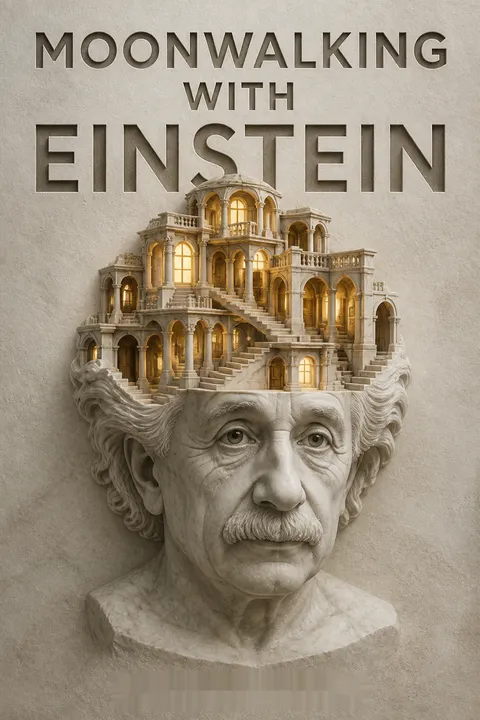
Moonwalking with Einstein recounts Joshua Foer's journey to become a memory champion, exploring techniques like memory palaces. Readers found it engaging and informative, praising Foer's writing style and insights into memory's history and potential. Some felt the book lacked practical applications, while others were inspired to try the techniques. Critics noted the book's broad scope, covering history, science, and personal narrative. Overall, reviewers appreciated the book's blend of entertainment and education, though opinions varied on its lasting impact.
People Also Read





Glossary
Method of loci
Spatial memory techniqueA mnemonic method in which a person imagines a familiar route or place and assigns information to specific locations along it. To recall the information, the person mentally retraces the route. The technique uses strong spatial memory to organize material, such as words, numbers, or a speech, that may otherwise be difficult to remember in order.
Elaborative encoding
Adding memorable associationsA way of learning that connects new information to vivid images, sensory details, or existing knowledge. The added associations create more cues for later retrieval. Memory athletes use elaborative encoding to make arbitrary material distinctive, then place the resulting images in a structured sequence such as a memory palace.
Chunking
Grouping details meaningfullyA strategy for remembering multiple details by organizing them into larger units that already have meaning. A string of digits, for example, may be grouped into familiar dates or times. Experts use knowledge built through experience to recognize meaningful patterns, allowing them to process a complex situation as fewer, larger units.
Working memory
Temporary active informationThe limited mental workspace that holds information currently in awareness, such as a short sequence of numbers or the beginning of a sentence. It acts as a temporary buffer between perception and longer-term memory. Without rehearsal or meaningful organization, information in working memory can quickly disappear.
Skilled Memory Theory
Memory shaped by expertiseA theory associated with psychologist K. Anders Ericsson that explains how memory performance can improve through domain-specific strategies and experience. People who seem to have exceptional memories often organize information using knowledge they have built in a particular field. Their abilities do not necessarily reflect a larger general memory capacity.
Deliberate practice
Focused, feedback-driven trainingA demanding form of practice organized around specific goals, close attention to technique, and timely feedback. Rather than repeatedly performing only what is already comfortable, the learner works on weaknesses, notices errors, and adjusts. The aim is to keep improving after routine performance has become automatic.
OK plateau
A comfortable skill plateauThe point at which someone can perform a task adequately and begins doing it automatically, with little further improvement. The plateau does not necessarily mark an innate limit. Progress may resume when practice becomes more deliberate, includes immediate feedback, and challenges the learner to improve specific parts of the performance.
Major System
Number-to-sound mnemonic codeA mnemonic code that converts digits into consonant sounds, which can be turned into words and then images. Vowels can be added freely to make pronounceable words. A person can then store those images in a memory palace. The method is relatively easy to learn, though memory athletes use other systems for faster competition performance.
person-action-object
Three-part image encodingA memory-athlete system, commonly abbreviated PAO, that assigns a person, an action, and an object to each number or playing card. Several pieces of information can be combined into one image by using different parts of the assigned codes. The unusual resulting scenes are then placed in a memory palace.
Priming
Unconscious influence of prior exposureA form of implicit memory in which earlier exposure to information affects a later response, even when the person cannot consciously recall seeing it. Foer describes an amnesic patient who could identify previously presented words more easily than new ones, despite having no conscious memory of the earlier test.
FAQ
What's Moonwalking with Einstein about?
- Memory Techniques Exploration: The book follows Joshua Foer's journey to enhance his memory, leading to his participation in the U.S. Memory Championship. It focuses on memory techniques like the method of loci, or memory palace.
- Personal and Historical Insights: Foer combines his personal experiences with historical anecdotes, such as the story of Simonides of Ceos, who is credited with inventing the memory palace technique.
- Cultural Commentary: The narrative examines how modern technology affects our memory, arguing that reliance on external devices has diminished our natural memory capabilities.
Why should I read Moonwalking with Einstein?
- Engaging Narrative: Foer's writing is both informative and entertaining, making complex memory concepts accessible to a general audience.
- Practical Techniques: The book offers practical memory techniques, like the memory palace method, which can be applied in everyday life to enhance learning and retention.
- Thought-Provoking Themes: It raises questions about the nature of memory and its role in our lives, encouraging readers to reflect on their own memory practices.
What are the key takeaways of Moonwalking with Einstein?
- Memory is Trainable: Foer demonstrates that memory can be improved with practice and the right techniques, transforming from an average memorizer to a champion.
- Memory Palace Technique: The method of loci is a central theme, involving visualizing a familiar place and associating items to remember with specific locations.
- Cultural Shift in Memory: The book discusses how writing and technology have changed our relationship with memory, leading to a decline in natural memory abilities.
What are the best quotes from Moonwalking with Einstein and what do they mean?
- “Memory is the mother of all wisdom.”: This quote highlights the foundational role of memory in acquiring knowledge and wisdom.
- “The brain is like a muscle.”: This analogy suggests that mental exercises can enhance memory, similar to how physical exercise strengthens muscles.
- “The art of memory is the art of attention.”: It emphasizes that effective memorization requires focus and mindfulness.
What memory techniques does Joshua Foer discuss in Moonwalking with Einstein?
- Method of Loci: This technique involves visualizing a familiar space and placing items to remember along a mental journey through that space.
- Chunking: Foer explains how chunking information into manageable units can improve memory retention by grouping related items together.
- Elaborative Encoding: Transforming mundane information into vivid, memorable images by engaging multiple senses and creating emotional connections.
How does technology affect our memory, according to Moonwalking with Einstein?
- Reliance on External Aids: Foer argues that modern technology, like smartphones, has led to a decline in our natural memory abilities.
- Cultural Shift: The shift from oral to written culture has changed our relationship with memory, making us less reliant on our own memories.
- Memory as Identity: Memory is integral to our sense of self, and its erosion due to technology raises questions about our understanding of ourselves.
What is the memory palace technique mentioned in Moonwalking with Einstein?
- Visualizing Locations: The technique involves associating information with specific locations in a familiar place for easier recall.
- Creating Vivid Images: By placing memorable images in these locations, one can navigate through the palace to retrieve stored information.
- Historical Roots: This method has been used by orators and scholars for centuries to enhance memory.
How does Foer describe the process of memorizing a deck of cards?
- Using the PAO System: Foer uses the Person-Action-Object system, where each card is represented by a unique image of a person performing an action on an object.
- Memory Palaces for Recall: He places these images in a memory palace, allowing him to visualize the sequence of cards.
- Practice and Speed: Through rigorous practice, he improves his speed and accuracy, eventually breaking the U.S. record for memorizing a deck of cards.
How does Foer’s personal journey reflect the themes of Moonwalking with Einstein?
- Transformation Through Practice: Foer’s journey from an average memorizer to a U.S. Memory Champion exemplifies the theme that memory can be trained and improved.
- Exploration of Identity: His quest to enhance his memory becomes a metaphor for understanding oneself and one’s place in the world.
- Cultural Commentary: Foer critiques modern society's relationship with memory, highlighting the tension between technological reliance and personal memory.
What challenges does Foer face in improving his memory?
- Initial Struggles: He encounters difficulties in mastering memory techniques, particularly when trying to memorize poetry.
- Time and Effort: Training his memory requires significant time and dedication, which can be exhausting.
- Self-Doubt: Foer grapples with self-doubt and the fear of not measuring up to elite memory competitors.
How does Moonwalking with Einstein connect memory to broader cultural themes?
- Memory and Identity: Foer argues that memory is fundamental to our sense of self and cultural identity.
- Historical Context: The narrative situates memory techniques within a historical framework, illustrating their evolution over time.
- Critique of Modernity: The book critiques the impact of technology on memory, suggesting that reliance on external aids has diminished our natural abilities.
What does Joshua Foer ultimately conclude about memory and its importance?
- Memory Shapes Identity: He emphasizes that memory is integral to our sense of self and how we navigate the world.
- Need for Mindfulness: Foer advocates for a mindful approach to memory, encouraging readers to engage with their experiences.
- Resistance to Forgetting: The book calls for embracing the art of memory as a vital human skill in a technology-driven world.
Download PDF
Download EPUB
.epub digital book format is ideal for reading ebooks on phones, tablets, and e-readers.








