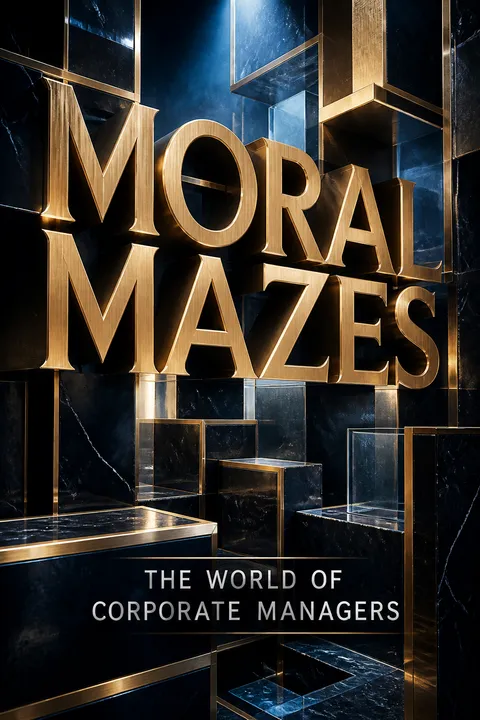


Key Takeaways
In corporations, survival rules can replace the moral code managers bring from home
A different moral economy. Robert Jackall studies occupational ethics: the practical rules managers follow at work, rather than an ideal code of right and wrong. His fieldwork drew on 143 interviews, observation, and documents from three organizations. He contrasts this workplace morality with the older Protestant ethic, which linked disciplined work, success, and moral worth. In large corporations, that link weakens: effort does not reliably produce advancement, and the judgment of superiors and the market can matter more than achievement.
Context changes the verdict. Managers still have personal beliefs, but the organization shapes which beliefs can safely guide action. They learn to prioritize loyalty, career survival, and what powerful colleagues regard as reasonable. The book describes this shift, not as proof that managers are uniquely corrupt, but as a way bureaucratic conditions reshape ordinary moral judgment.
The book’s sharpest move is to treat morality as something people do in specific settings, not merely something they profess. That approach helps explain how decent people can act differently at work without deciding that they have become villains. It also prevents easy absolution: if organizational routines repeatedly produce harmful choices, the routines themselves deserve scrutiny. The analysis is strongest as a description of a particular corporate world, rather than a claim that every manager or workplace follows the same rules.
Map loyalties as carefully as reporting lines to see where corporate power sits
Hierarchy has two faces. Corporations formally distribute responsibility, but managers experience authority through personal ties to bosses, patrons, and allies. A reporting system carries commitments and targets upward, while subordinates are expected to protect their immediate boss from surprise or public embarrassment. These relationships create fealty: practical loyalty to a superior who may control assignments, protection, and advancement.
Upheaval redraws the map. At Covenant Corporation, a new chief executive reorganized the business in 1979. Alchemy’s new president, Smith, elevated former colleagues and displaced managers associated with rival groups. After the company missed financial targets, Smith lost power; in 1982, Brown, once moved aside, returned as president with a mandate to cut costs. The org chart showed positions, but personal histories helped explain who gained or lost them.
Formal charts reveal who can authorize a decision, while relationship maps reveal whose judgment is likely to prevail. This distinction extends beyond corporations: in any institution, informal trust can coordinate work faster than procedure, but it can also turn access into favoritism. Jackall’s account is valuable because it shows both sides at once. The personal network is not merely a corrupt overlay on bureaucracy. It is also the channel through which protection, information, and cooperation travel.
Promotion rewards social fit as much as measurable performance
Competence is only a threshold. Early in a career, education, training, and basic ability matter. Beyond a certain level, managers describe peers as broadly competent and advancement as dependent on less measurable judgments: style, confidence, adaptability, and whether influential people feel comfortable with someone. A polished presentation or a reputation for being dependable can help a manager stand out, while being labeled difficult or inflexible can close doors.
Fit takes daily work. Managers cultivate an acceptable public face through dress, self-control, tact, optimism, and visible participation in the group. They also seek patrons who can give them exposure and advocate for them. Teamwork, in this setting, can mean genuine coordination, but it can also mean accepting a group’s decision without making dissent costly to a superior.
The account helps explain why performance reviews often feel weakly connected to actual performance: organizations evaluate not only outputs but also whether a person is easy to place within a network of trust. Social fit can support coordination, yet it can reward similarity and penalize useful dissent. The book also shows that the standard is not applied evenly. Women may be judged as lightweight when warm or as abrasive when assertive, revealing that supposedly practical style tests can carry unequal expectations.
When choices threaten careers, managers look upward before acting
Decisions carry political risk. Jackall calls the habit of checking superiors and colleagues before committing to a difficult choice looking up and looking around. Managers may delay, seek group agreement, or wait for clearer signals because the cost of being wrong is not just financial. A decision can be interpreted as disloyal, reckless, or an effort to exceed one’s authority.
Delay can become expensive. In 1975, managers at Alchemy faced a roughly $6 million repair to a failing coke-plant battery. The company was conserving cash, so they patched the equipment rather than commit to a large repair. When the battery collapsed in 1979, contract and regulatory consequences drove the eventual cost above $100 million. Once the breakdown removed meaningful alternatives, managers could describe action as unavoidable. Earlier, acting carried personal risk; later, inaction did.
Deferring a decision is not always cowardice. Consultation can surface missing information and prevent one person from imposing a bad plan. The danger appears when consultation is mainly a way to spread blame or avoid contradicting authority. The coke-plant example shows how a system can be locally rational for each manager and collectively ruinous over time. Organizations need ways to protect early warnings, not just procedures for responding once failure has made the choice unavoidable.
Short-term targets can turn neglected maintenance into tomorrow’s catastrophe
The metric shapes the work. Managers are often judged on near-term profit and return on assets, while the costs of deferred maintenance may arrive under someone else’s watch. Jackall describes milking a plant: limiting maintenance and investment to improve immediate financial results, even as the operation becomes less reliable. Frequent job changes and weak tracking of responsibility make this strategy easier to pursue.
A future-facing gamble. At Covenant, Young tried to modernize a chemical plant by replacing an older production process. The conversion was expected to reduce costs and address possible health and waste problems, but a crucial process design failed at full scale. The company lost about $27 million, and Young believed the failure damaged his career. Some managers argued that earlier underinvestment had left the plant in poor condition. A long-term improvement effort collided with short-term pressures and inherited weakness.
This case resists a simple lesson that managers should always think long term. Young’s project was meant to prepare the business for the future, yet its technical uncertainty and political exposure made it dangerous. The deeper problem is the mismatch between who receives credit for near-term savings and who bears the cost of later breakdowns. Better investment review and maintenance tracking can reduce that mismatch, though neither can eliminate uncertainty or guarantee that a promising technology will work.
Protect procedural dissent before urgency turns caution into disloyalty
A safety dispute became a loyalty test. At Three Mile Island, Joe Wilson managed site operations during the cleanup after the 1979 reactor accident. When Bechtel took a larger role, Wilson objected to shortcuts and questioned whether a polar crane had been adequately tested before lifting heavy equipment inside the reactor building. He worried that unclear authority would leave his team responsible if the work went wrong.
The findings mattered. Wilson repeatedly documented his concerns and was suspended, then fired. The company said the reason was a conflict of interest; managers interviewed by Jackall focused instead on Wilson’s challenge to the cleanup schedule and his unwillingness to accept prevailing decisions. A Nuclear Regulatory Commission investigation later supported key allegations about procedural shortcuts and weak oversight. The case shows how an organization can describe caution as obstruction when speed and authority dominate.
The cleanup had a real need for progress, and procedures can sometimes become burdensome rituals. Yet in high-risk work, a process for testing assumptions is part of the result, not an obstacle to it. Wilson’s case illustrates the value of independent review and protected channels for technical dissent. It also cautions against treating every dissenter as a hero: the quality of the evidence matters. Here, the later investigation strengthens the case that the objections deserved serious examination.
Treat corporate language as a way to shape reality, not merely describe it
Words manage exposure. Managers use indirect, provisional language because relationships and organizational facts can shift. A phrase such as a release beyond a plant boundary can make a pollution event sound technical and contained; euphemisms also leave room to revise an explanation later. Public relations specialists extend this practice by building persuasive accounts for customers, regulators, and the public.
A manufactured coalition. When rules on chlorofluorocarbons were proposed, Alchemy and another producer helped create the Alliance for Responsible CFC Policy. It appeared to represent industrial users of the chemicals, while the major producers funded and directed its work. The campaign emphasized scientific uncertainty and the burden of regulation. The point was not necessarily to convert opponents, but to make the company’s position look credible to audiences whose support could affect policy.
Framing shapes which facts become salient: a debate can center on uncertain science, public health, jobs, or who should bear the cost of prevention. This is why transparent sponsorship matters. Advocacy is a legitimate part of public debate, but a coalition presented as independent can distort how audiences assess its evidence. The book’s account invites a practical question for readers: who is speaking, who benefits from the chosen framing, and what relevant facts are being left outside the frame?
Read financial crises as failures of incentives, not isolated bad decisions
Risk travelled through the system. In the afterword on the Great Recession, Jackall links mortgage securitization and derivatives to incentives that let lenders and investors transfer risk to other institutions. Banks could make loans, package them into securities, and sell them onward, weakening the connection between originating a loan and bearing its long-term consequences. Deregulation, political pressure to expand homeownership, and poor oversight contributed to the environment in which standards weakened.
Losses became public. When defaults rose and financial firms faltered in 2007 and 2008, government support helped prevent further institutional failures. Meanwhile, some executives received bonuses even as their firms collapsed or relied on public funds. Jackall uses the crisis to extend his argument about organized irresponsibility: many actors can profit from a system while no single actor accepts responsibility for its full consequences.
The afterword’s value lies in connecting familiar organizational behaviors to a system-wide crisis: short horizons, dispersed responsibility, and rewards detached from lasting outcomes. The connection is illuminating, but it is a broader interpretive synthesis than the book’s interview-based studies of corporate managers. Financial regulation, housing policy, and market design also shape outcomes. Keeping those levels visible strengthens the argument: organizational culture matters, but it operates inside rules created by political and economic institutions.
Analysis
Moral Mazes is best read as a field study of how institutions make practical morality, not as a manual for ethical leadership. Its central contribution is to shift attention from personal character to the working conditions that shape judgment: dependence on superiors, unstable alliances, short evaluation cycles, fragmented knowledge, and weak accountability. These conditions do not force every manager to behave identically. They make some choices safer, more legible, and more rewarding than others, then allow those patterns to feel like common sense.
The book’s strongest narrative evidence comes from cases where small decisions accumulate into structural harm. The delayed repair of a coke battery, Wilson’s safety objections at Three Mile Island, and the failed conversion of Young’s plant show different versions of the same tension: the organization prizes controllable results, yet its work is full of uncertainty. Blame avoidance and short-term incentives can make postponement seem prudent until the cost becomes impossible to evade. The accounts are persuasive because Jackall shows how colleagues explain events, not simply what happened.
Its method also sets limits. The research relies on access to a small number of large organizations, and managers’ accounts are shaped by memory, self-interest, and the same political pressures the book analyzes. The patterns should not be treated as universal laws. Nor does explaining behavior through organizational incentives settle questions of individual responsibility. Instead, the framework clarifies why appeals to personal virtue alone often fail: a lone conscientious employee cannot easily correct systems that punish candor or reward passing costs onward.
The Great Recession afterword extends the framework from managerial circles to financial institutions and public policy. That extension is suggestive, though less ethnographically grounded than the core study. Overall, the book remains valuable because it asks a harder question than whether managers are good people: what kinds of people and decisions does a particular organization reliably produce?
Review Summary
Moral Mazes offers a bleak portrayal of corporate bureaucracy, based on Jackall's fieldwork in the 1980s. Readers find it eye-opening and still relevant, describing a world where managers prioritize self-interest, short-term thinking, and image over ethics. The book reveals how corporate culture shapes decision-making, often leading to moral compromises. While some find the writing dense or dated, many praise its insights into organizational behavior. Critics note its small sample size and potential bias, but overall, it's considered a unique and valuable perspective on corporate life.
People Also Read







Glossary
occupational ethics
Workplace rules of rightThe practical moral rules people create and follow in a particular occupation. For Jackall, the term describes managers’ actual judgments about proper conduct toward bosses, peers, subordinates, customers, and the public. These rules can differ from the principles a person follows at home or in a religious community.
institutional logic
How an organization worksThe shared, learned understanding of how a particular organization operates: which goals matter, what behavior receives rewards or penalties, and which explanations are accepted. It is not an automatic law of organizations. People construct and reproduce it through everyday decisions, relationships, and interpretations.
circles of affiliation
Informal managerial relationshipsJackall’s umbrella term for the overlapping networks, social groups, alliances, and power cliques through which managers build trust and influence. Formal rank still matters, but access to these circles can affect whose information is believed, whose career is supported, and whose interests are protected.
self-rationalization
Reshaping oneself for advancementThe deliberate adjustment of one’s appearance, conduct, attitudes, and self-presentation to meet an organization’s expectations and advance personal aims. Managers learn to treat their own public identity as something to assess and modify. This discipline can make them more adaptable while distancing them from private convictions.
alertness to expediency
Reading practical advantageA manager’s ability to assess immediate demands, organizational rules, political relationships, and personal consequences together. It means recognizing what can be done, what powerful colleagues will tolerate, and what outcome is advantageous. Jackall presents it as a survival skill that can displace reflection on abstract principles.
looking up and looking around
Checking others before decidingThe tendency to seek cues from superiors and colleagues before making consequential decisions. Managers use others’ reactions to gauge acceptable action and reduce the personal risk of being blamed. The habit can improve consultation, but it can also delay action or spread responsibility until nobody clearly owns the choice.
organized irresponsibility
Responsibility dispersed by systemsA condition in which organizational structures separate decisions from their consequences and make it difficult to identify who is accountable. Managers can move between jobs, rely on incomplete records, or pass decisions through layers of authority. The result is not simply personal carelessness, but a system that lets responsibility diffuse.
public-relations-mindedness
Managing public interpretationsA habit of approaching events chiefly through the stories and explanations that will make them acceptable to important audiences. It treats public perception as a practical force to shape, often using selective facts, euphemism, or carefully framed accounts. In Jackall’s analysis, this mindset can make credibility more important than establishing truth.
FAQ
1. What is Moral Mazes: The World of Corporate Managers by Robert Jackall about?
- Sociological study of managers: The book explores how corporate managers construct and navigate occupational ethics within large bureaucratic organizations.
- Focus on moral ambiguity: Jackall examines the complex, often contradictory moral rules-in-use that guide managerial behavior and decision-making.
- Fieldwork-based insights: Drawing on interviews and observations, the book reveals the realities of managerial life, including the pressures, dilemmas, and social structures that shape their actions.
- Metaphor of "moral mazes": The title refers to the intricate, shifting organizational and ethical challenges managers must continually navigate.
2. Why should I read Moral Mazes by Robert Jackall?
- Understand corporate morality: The book provides a nuanced look at how managers reconcile personal integrity with the demands of bureaucracy.
- Insight into organizational behavior: It offers valuable perspectives on how power, alliances, and impression management drive success in large organizations.
- Relevance to modern issues: Jackall’s analysis helps explain contemporary phenomena like corporate scandals, the erosion of traditional ethics, and the role of public relations.
- Applicable to professionals and scholars: The book is essential reading for anyone interested in business ethics, organizational sociology, or leadership.
3. What are the key takeaways of Moral Mazes by Robert Jackall?
- Bureaucracy shapes morality: Organizational structures create a distinct "bureaucratic ethic" centered on survival, expediency, and impression management.
- Social skills over competence: Advancement depends more on political savvy, alliances, and managing appearances than on technical ability alone.
- Moral ambiguity is pervasive: Managers operate in a world of shifting rules, where ethical standards are situational and often at odds with conventional ideals.
- Anxiety and self-rationalization: The emotional toll of managerial life includes uncertainty, fear of blame, and the need for continual adaptation.
4. How does Robert Jackall define the "bureaucratic ethic" in Moral Mazes?
- Pragmatic moral code: The bureaucratic ethic is a set of moral rules developed by managers to navigate dilemmas and challenges in large organizations.
- Loyalty and political maneuvering: It emphasizes loyalty to superiors, managing ambiguity, and balancing personal ambition with organizational demands.
- Organizationally defined right and wrong: Managers often bracket conventional morality, adopting rules shaped by authority relationships and organizational needs.
- Survival and advancement: Mastery of this ethic is essential for success and survival within the corporate hierarchy.
5. What is the "institutional logic" described in Moral Mazes by Robert Jackall?
- Socially constructed rules: Institutional logic refers to the contingent, negotiated set of norms and sanctions that regularize behavior in corporations.
- Objective experience for managers: Managers perceive this logic as an external reality that shapes their actions and perspectives.
- Expediency and adaptation: Success depends on accurately reading institutional logic and aligning one’s actions with organizational exigencies and personal advantage.
- Foundation for managerial behavior: This logic underpins the pragmatism and moral flexibility required in bureaucratic life.
6. How does Moral Mazes explain the transformation from the Protestant ethic to modern managerial ethics?
- Historical roots: Jackall traces managerial ethics to the Protestant ethic, which emphasized hard work and self-discipline as moral virtues.
- Impact of bureaucratization: The rise of large organizations fragmented the old ethic, introducing hierarchical authority, standardized procedures, and political rivalries.
- Hybrid bureaucracy: American corporate bureaucracy blends formal rationality with personal loyalty, creating a new, situational managerial ethic.
- Loss of moral certainties: Bureaucracy severs the link between work and personal salvation, replacing it with dependence on superiors and market forces.
7. What are the key social structures of managerial work in Moral Mazes by Robert Jackall?
- Hierarchical authority: Managers experience power through personal relationships with immediate bosses, with authority centralized but also decentralized downward.
- Fealty and patronage: Loyalty to superiors and the cultivation of patrons are crucial for career advancement and organizational dynamics.
- Political struggles: Managerial life is marked by constant competition, alliances, and conflicts within complex social networks.
- Organizational upheaval: Frequent reorganizations and shifting alliances create ongoing uncertainty and probation for managers.
8. How do managers survive and succeed in corporate bureaucracies according to Moral Mazes?
- Mastering social codes: Success relies on fitting in, managing impressions, and playing the political game rather than just technical competence.
- Team play and style: Managers must be flexible, optimistic, and socially adept, aligning their style with top management.
- Patronage and alliances: Building relationships with mentors and allies is essential for visibility and advancement.
- Navigating ambiguity: Managers must continually adapt to shifting expectations and organizational changes.
9. What are the main moral dilemmas and anxieties faced by managers in Moral Mazes?
- Conflicting loyalties: Managers must balance loyalty to superiors with personal ambition and ethical considerations.
- Managing appearances: They are required to control their public image, suppress emotions, and adapt their style to different contexts.
- Organizational upheaval: Frequent changes and political struggles create a sense of continuous probation and self-rationalization.
- Fear of blame and isolation: Failure is often socially defined, with blame diffused or scapegoated, leading to anxiety and uncertainty.
10. How does Moral Mazes describe the role of "doublethink" and symbolic dexterity in managerial and PR work?
- Doublethink as virtue: Jackall uses Orwell’s term to describe the ability to hold and voice contradictory realities, essential for managers and PR professionals.
- Enables moral flexibility: Doublethink allows managers to reconcile personal beliefs with organizational demands, inventing rationales for expedient actions.
- Symbolic manipulation: Mastery of euphemistic, emotionally neutral language helps managers manage impressions and legitimize actions.
- Cynicism and distancing: This skill fosters emotional distance and cynicism, but is professionally valuable for survival in ambiguous environments.
11. What is the "ethos of organized irresponsibility" in Moral Mazes by Robert Jackall?
- Diffuse responsibility: Bureaucracies insulate individuals from accountability, with credit and blame dispersed or arbitrarily assigned.
- Mastering ambiguity: Managers succeed by navigating shifting alliances, managing impressions, and avoiding blame.
- Moral cynicism: The ethos encourages pragmatic compromises and expediency over fixed ethical standards.
- Broader societal impact: This ethos extends beyond corporations, shaping government, academia, and public life.
12. How does Moral Mazes by Robert Jackall portray the role of public relations and management consultants in shaping corporate reality?
- Reality construction: PR professionals craft and project versions of reality that serve corporate interests, often using selective presentation and reinterpretation of facts.
- Relativism about truth: PR and consultants foster a relativistic approach, where multiple perspectives are plausible and honesty is contingent on client needs.
- Instrument of organizational politics: Consultants legitimize changes, divert attention, and help managers navigate political dynamics.
- Quasi-religious function: PR provides vocabularies for confession, repentance, and absolution, reconciling business to the public and maintaining legitimacy.
Download PDF
Download EPUB
.epub digital book format is ideal for reading ebooks on phones, tablets, and e-readers.








