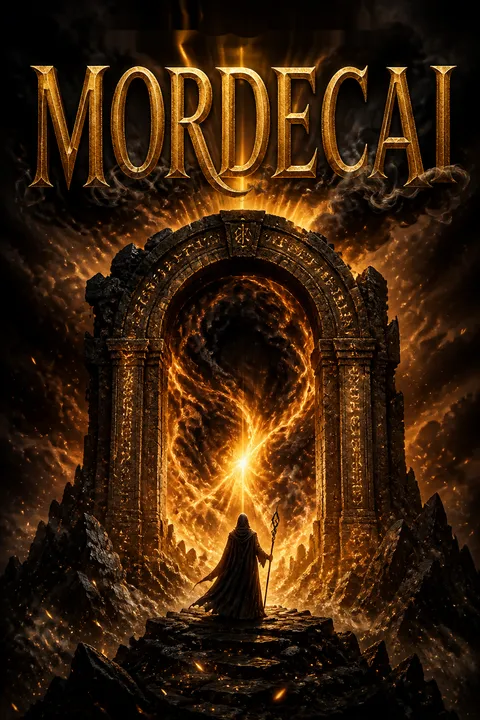


Plot Summary
The Tinker’s Quiet Cure
In Camlin, Mordecai Illeniel travels under the name Tom the tinker, quietly checking villages for ANSIS, machine parasites that can control human hosts. He mends a widow’s broken hip and crooked nose while she sleeps, then repairs a stranger’s iron pot and leaves coins for the family. Her husband died during the recent conflict in Halam, a loss Mordecai connects to the violence his own family helped end.
Back at Castle Cameron, his wife Penelope catches the smell of another woman’s stew and recognizes his disguise’s real purpose. Mordecai admits he healed Suzanne because he cannot stop trying to repair the damage around him, even when Penny warns that public knowledge of his powers would turn their home into a clinic.
Mordecai’s disguise lets him move through the world without the fear his reputation provokes, but it also gives him a way to act on guilt without asking anyone’s permission. His healing is compassionate and secretive at once: he restores bodies while withholding both his identity and the choice to consent. Penny sees the cost before he does. Her concern is not that kindness is wrong, but that Mordecai converts responsibility into an endless private obligation, leaving his family to live with the consequences.
Dorian’s Gate
To reach the new gate at Halam, Mordecai walks the World-Road, the underground network he built to connect distant cities. Its defenses recall the day Dorian Thornbear held one of its crushing stone gates long enough for both families to escape, dying beneath the weight.
Mordecai also remembers the people killed by the shiggreth, the crimes for which the public still fears him, and the shame that drives him to travel disguised. At Halam, workers are building the gatehouse under master mason Angus McElroy.
Mordecai secures the materials Angus needs, then flies to Albamarl instead of returning along the memorial road. There, he visits factor David Summerfield, whose new affection for Sarah Beckins offers a small sign that grief does not forbid life from continuing.
The World-Road embodies Mordecai’s double legacy. It makes trade and travel easier, yet its security features once became instruments of catastrophe, and its most famous gate is also a grave marker. His decision to fly around the memorial suggests avoidance, but his repeated visits to Dorian’s Gate show that remembrance has become a form of self-punishment. David’s tentative new relationship quietly challenges that habit. Mordecai notices it, judges it for a moment, then chooses not to interfere.
A Queen Without Shelter
Mordecai reaches the palace to check whether ANSIS has infiltrated Queen Ariadne’s court, but Carwyn, her dragon, sounds the alarm and the guards surround him. After the Queen’s captain recognizes him, Mordecai shares ale and old memories with the captain before Ariadne receives him privately.
Their talk exposes how isolated she has become: she married a foreign prince to protect her rule, keeps him at a distance, and has no heir or intimate companion. Mordecai realizes he abandoned her after Dorian’s death and offers her a private portal to his family’s mountain home.
Ariadne accepts the invitation, moved by the prospect of being family rather than sovereign for an evening. Mordecai then nearly misses his mother Meredith’s birthday celebration, where he sees how age has begun to weaken her.
Ariadne’s loneliness is political as well as personal. Her marriage protects the monarchy from a domestic power struggle, but that sensible arrangement leaves her with little emotional refuge. Mordecai’s apology matters because he recognizes that his withdrawal punished her for the kingdom’s judgment of him. The portal is a practical offer of rest, but it also proposes a relationship outside rank. His mother’s frailty sharpens the same problem from another angle: Mordecai can perceive decline with magical precision, yet cannot control it.
Two Moiras at Breakfast
The morning after Meredith’s celebration, Mordecai’s children Moira and Matthew bring him a plan to find ANSIS more effectively than his solitary village patrols. Moira reveals Myra, a magical double created during the battle in Dunbar who carries Moira’s memories and considers herself another daughter of the family.
Mordecai struggles with the ethics of Myra’s existence, but Penelope accepts her without delay. Together, Moira and Myra can create more spellbeasts to search for machine-controlled people.
The household has little time to settle into this change: Penelope tells Mordecai that Lynaralla, their foster daughter and a She’Har, will remain with her birth parents. Mordecai decides to visit the island and bring her home, and Penny insists on going with him.
Myra makes the cost of Moira’s wartime choices impossible to keep abstract. A technique used to multiply power has produced a person with memories, attachment, and a claim to family. Mordecai’s hesitation is moral, not merely magical: he must decide whether an origin in copied consciousness invalidates a lived identity. Penelope’s rapid acceptance models a more relational test. She treats Myra as a daughter because Myra reaches for them as parents, while the same instinct to protect family sends her after Lynaralla.
Tyrion’s Island Trial
On the She’Har island, Mordecai and Penelope find Lynaralla injured while her father, Tyrion, forces her through a punishing lesson. Penny attacks him with her sword, and Tyrion traps her in a grip of magical force. Mordecai threatens to tear the island apart if Tyrion harms his family, then asks to take Lynaralla home.
Tyrion insists she belongs to him and proposes a contest: if Mordecai wins, he may keep her until she is ready to return. The bargain turns a family visit into a fight neither visitor wanted. Tyrion bans fire, enchantments, and metamagic, claiming the duel must rely on ordinary force. Mordecai agrees to protect Lynaralla, although Tyrion’s cruelty makes the rules feel less like a test than a trap.
Tyrion frames violence as education and ownership as parental authority. His methods expose a profound confusion between making someone capable of surviving harm and teaching them how to live. Mordecai’s response is shaped by a different model of care: he claims responsibility without claiming possession. Yet Tyrion controls the terms, and Mordecai accepts them partly because he cannot bear to leave Lynaralla in danger. His protective instinct becomes leverage against him.
The Cost of Mercy
Mordecai initially matches Tyrion’s attacks, but fatigue and hesitation turn the duel. When he stops a killing blow to spare his opponent, the sudden reversal of his power causes devastating feedback; Tyrion then breaks his bones and leaves him helpless.
Penelope and Lynaralla carry him home, where Moira and Myra repair the worst injuries. The damage overwhelms Mordecai’s kidneys, and healer Elise Thornbear warns that he has days to live. Rather than accept a dangerous return to the immortality enchantment, he waits while Matthew adapts She’Har healing knowledge into a blood-cleansing method.
Matthew, Gram, Conall, Irene, and Lynaralla each donate compatible blood, becoming sick themselves as they filter Mordecai’s. His body recovers, and he uses metamagic to restore his health.
The duel separates restraint from weakness, then shows how easily Tyrion exploits their overlap in Mordecai’s mind. Mordecai loses not because compassion is inherently ineffective, but because he has not learned how to practice it under an opponent who treats mercy as an opening. His recovery depends on a form of care that is distributed rather than solitary. Each family member gives something physical, and Matthew’s technical problem-solving converts inherited knowledge into immediate aid. The family saves Mordecai by refusing his assumption that he must carry every danger alone.
Lancaster’s Impossible Forest
After Lancaster disappears, Mordecai joins Penelope, Matthew, Gram, and soldiers to investigate the primeval forest that occupies its former site. From above, Mordecai sees that the new territory forms a precise hexagon, and Matthew recognizes traces of dimensional translation and She’Har spellweaving.
Inside, huge spiders erupt from underground and drag soldiers beneath the soil. The party kills them, but one bites Penelope and shatters her arm; Mordecai cuts away the ruined limb and stabilizes her.
He sends her home with Moira, then pushes on alone, entering the mind of the earth to reach Elaine Prathion. Elaine has survived by hiding beneath a tree, but her father Walter and a soldier named Brent are dead. Mordecai brings her and Brent’s body back through a temporary teleport circle.
The forest is both a physical ambush and a breach in the world’s expected order. Its clean geometric boundary makes the landscape feel constructed, while its predators punish the group for assuming that familiar magic will work normally. Penelope’s injury exposes the limits of Mordecai’s preparedness: he can repair the damage in front of him, but cannot undo the decisions that left her without better armor. His rescue of Elaine succeeds only when he accepts the forest’s danger and uses the earth itself, though the rescue comes too late for Walter.
The Signal in Rose’s Room
While the expedition is away, an ANSIS signal reaches Gary, Mordecai’s android ally. He traces a second, short-range transmission to Lady Rose’s apartments and warns Irene, the youngest Illeniel child, that enemies are inside the castle.
Irene orders the guard and chamberlain to follow him upstairs. At Rose’s barred door, they hear her being attacked. Unable to break in, Irene’s fear and anger awaken her magic: she blasts away the door and part of the wall, interrupting the assailants.
Rose survives, but the attack confirms ANSIS can use ordinary people as instruments. Mordecai later finds a small, mobile pool of metallic matter in the wreckage. Gary identifies it as programmable nanomachines, potentially capable of building more machines and spreading beyond the castle.
Irene’s first use of power is not a triumph staged for public recognition. It begins in helplessness, when authority and physical strength cannot open the door quickly enough to reach Rose. Her magic answers an urgent moral perception before she has the skill to control it. Gary’s discovery changes the scale of the threat: ANSIS is no longer only a hidden parasite inside human hosts, but a material that may reproduce itself. The family now faces an enemy that can attack both identity and infrastructure.
Ungol at Washbrook
A force of heavily armored strangers, the Ungol, arrives outside Washbrook, blaming Mordecai’s people for the loss of their land. During the parley, their fighters attack, and their bodies resist ordinary magic. Mordecai is struck through the heart by a crossbow bolt.
The void inside him answers: he rises, drains life from the Ungol, and turns the fallen into undead soldiers who help him kill the rest. When the enemy is destroyed, he cuts those dark bonds and struggles back toward his family, but Penelope will not open the shield until she knows he is himself.
Mordecai replaces the void’s hold by joining his awareness to the earth, then returns to human consciousness. His children and Penny see that the power that saved him may also be able to consume him.
The battle turns Mordecai’s private fear into visible action. The void is not a metaphorical darkness imposed by an enemy; it is a capacity within him that makes survival pleasurable at the expense of other lives. His choice to raise the dead changes the battle’s arithmetic, but also demonstrates how quickly protection can resemble predation. Penelope’s caution matters because love does not require her to trust his self-assessment blindly. She makes him prove that he can return before allowing him back inside.
Brodinton’s Captive Road
After the fighting, Moira examines the captured Ungol commander, Sanger, and learns that his people came from another world where ANSIS has hunted them for generations. She altered Sanger’s loyalties to make him speak, a necessary tactic that troubles Mordecai even as it gives them information.
News arrives that Brodinton’s inhabitants have vanished and that Queen Ariadne’s force is pursuing the attackers. Matthew and Gram ride out with soldiers and dragons, find the Queen’s men fleeing several hundred Ungol, then ambush the pursuers in darkness.
Gram holds the road while Matthew and the dragons strike. They defeat the force and recover Brodinton’s people, though many soldiers die. Ariadne mobilizes reserves, and Mordecai begins extending dragon-bonds to rebuild the kingdom’s defenses.
The Ungol cease to be a faceless invading force once Sanger’s account reveals their history of flight from ANSIS. That does not erase their attack, but it makes the conflict morally harder to flatten into a clean defense of good against evil. Moira’s intervention secures intelligence by manipulating a person’s mind, echoing the very coercion the family opposes. Meanwhile, Matthew and Gram demonstrate that responsibility can be shared: their victory depends on planning, disciplined cooperation, and the willingness to risk themselves for people they do not know.
Roots and Radio Waves
Lynaralla tells Mordecai that her mother, Lyralliantha, has rooted herself above a hidden library of ancient She’Har writings. Mordecai sends Lynaralla, Elaine, Karen, and Myra to ask for access while Elaine conceals them from Tyrion.
Lyralliantha permits them to retrieve the writings, and Lynaralla returns with knowledge of advanced healing and evidence that her parents’ plans remain incomplete. At the same time, Matthew and Gary construct copper antennas connected by ring-gates, allowing Gary to locate ANSIS transmissions across distant sites.
A sample of programmable metal confirms the machines can assemble structures from tiny units. When the signals mark both the former Lancaster site and an area near Cantley, Mordecai concludes that pieces of an infected world are crossing into theirs and orders an immediate strike.
The archive and the antenna array are two forms of listening. The She’Har preserve intention in a language grown into physical sculpture; Gary turns invisible signals into locations on a map. Both systems make hidden histories legible, but neither supplies a complete interpretation. Lynaralla’s discovery confirms that her people have withheld knowledge even from Tyrion, while the signals implicate a dimensional crisis larger than one invasion. Mordecai responds by acting before certainty is available, an increasingly dangerous habit that he mistakes for decisiveness.
The Forest Becomes Slag
Mordecai and Matthew divide the attack. Matthew, Moira, and Gram use the Fool’s Tesseract to destroy the infected Ungol settlement near Cantley, then search for surviving machine clusters. Mordecai enters the forest replacing Lancaster alone.
ANSIS machines bombard the stone shell he builds around himself, so he abandons restraint and draws molten earth upward, burning the forest and its hidden machines into a vast field of slag. The effort pulls him toward the same inhuman state that overtook him at Washbrook; a signal from the others finally tells him to stop, and he forces himself back into human form.
While he is away, tortus war machines attack Castle Cameron and Albamarl. Castle walls collapse, guards die, and Penelope and Irene are left to defend the people trapped inside.
Mordecai treats annihilation as surgery: if ANSIS spreads like infection, he believes a sufficiently violent removal may save the larger world. The plan works tactically, but the cost is not only environmental destruction. To wield enough force, he loosens his hold on human identity and again discovers how satisfying that release can feel. The attacks on his home expose the flaw in his solitary strategy. While he is eliminating one front, his family must withstand another without him, and his absence becomes part of the danger.
Penny’s Last Exchange
During the assault, Irene holds the collapsing keep together long enough for people to escape. Penelope attacks a tortus to protect Irene and Alyssa, but the machine’s weapons batter her body beyond ordinary healing. Mordecai returns, destroys the remaining machines outside the walls, and finds Penny close to death. He merges their minds so she can use his archmage power to rebuild herself.
In that shared state, Penny restores her body but sees that her own life-force is nearly spent and Mordecai’s is damaged by the void. She chooses to strengthen his failing life instead of preserving her own. Mordecai wakes beside her dead body. Her letter tells him to care for their children and continue protecting the people who depend on him.
Penny’s decision is neither a simple sacrifice nor a victory over death. She receives the power to repair her body, but the shared perspective reveals a truth Mordecai had avoided: physical healing cannot replenish her dwindling life-force. Her final act converts their intimacy into a choice about who will remain to carry their obligations. Mordecai’s recurring role as rescuer is reversed. He survives because Penny acts for him, leaving him with a life he did not choose and a responsibility he can no longer share with her.
The Duke Among Ashes
Mordecai returns to a ruined Castle Cameron and tells his children Penny is gone. Matthew blames him for the decision to attack without waiting; Irene and Moira try to hold the family together, while Lynaralla mourns the mother who taught her to love.
Mordecai is too devastated to tell Rose himself, and later lashes out when she urges him to remain connected to their surviving circle. In the aftermath, Tyrion arrives offering specialized krytek to hunt ANSIS and teaches Mordecai enough teleportation magic to report their findings.
He swears loyalty to Ariadne and becomes Duke of the Western Isles, gaining influence at court. The She’Har writings and Cantley mission offer possible paths forward, but Mordecai retreats into grief until Chad draws him back toward his family and unfinished work.
Grief threatens to make Mordecai repeat the isolation that followed Dorian’s death. He mistakes withdrawal for self-control and lashes out when Rose tries to preserve the relationships that remain. Tyrion’s political rise complicates the family’s private loss with a new public danger: Mordecai must cooperate with a man he distrusts because the enemy is larger than either of them. Chad’s rough intervention gives grief a modest counterweight, not a cure. Mordecai can begin again only by accepting that purpose and companionship must be rebuilt together.
Epilogue
At Penny’s funeral, held in the courtyard of the ruined castle, allies and ordinary people gather to honor her and the others lost in the attacks. Queen Ariadne and two neighboring kings speak of Penny’s courage; Rose tries to speak for her closest friend but breaks down, and Mordecai cannot manage a eulogy.
Days later, he pushes Rose away when she says they must still face the future together. Chad finds him alone in a field and coaxes him into drinking, then makes him admit he has work left: protect the people around him, study the She’Har writings, and stop ANSIS. Grief remains, but Mordecai finally turns toward the living.
The funeral gives public scale to a loss Mordecai can barely name. Leaders speak because Penny served them, while her family and friends reveal the private labor behind that reputation. Rose’s collapse interrupts the performance of composure that has long protected her, and Mordecai’s anger at her later is grief trying to reduce the world to what has already been lost. Chad does not offer polished consolation. He uses companionship, humor, and a blunt demand for purpose to keep Mordecai from making isolation permanent. The ending does not resolve the larger war; it restores the smallest condition for facing it: a reason to rejoin the living.
Analysis
Mordecai’s central problem is not a shortage of power but an inability to distinguish care from control. He disguises himself to heal strangers, patrols for ANSIS alone, and repeatedly accepts risks because he believes that responsibility belongs most heavily to the person capable of acting. The story tests that belief by making his survival depend on collective effort, then exposing the cost of his absence when Castle Cameron is attacked. Penelope, Matthew, Irene, and the others do not merely support him; they make consequential decisions that he cannot make for them.
The novel also refuses a clean division between humane action and monstrous means. Moira changes Sanger’s loyalties to obtain intelligence. Matthew uses the Fool’s Tesseract against an infected settlement. Mordecai destroys a forest and briefly becomes a predator who feeds on life. Each act answers a real danger, but each leaves a moral remainder. Tyrion offers the harshest counterexample: suffering can produce an appetite for power, but it does not determine what a person will do with that power. Lynaralla’s questions about wisdom make the distinction explicit. Intelligence calculates outcomes; wisdom must also ask what kinds of people those outcomes create.
Penny’s death makes that ethical conflict intimate. Mordecai can rebuild a body, yet he cannot command life itself to remain. Her final choice saves him, but it does not validate his assumption that every burden can be repaired through sufficient effort. The ending therefore offers no triumph over grief or the still-unresolved war. It offers a smaller, harder task: Mordecai must accept help, keep faith with the living, and continue without pretending that love guarantees rescue.
Review Summary
Mordecai receives high praise from readers, with an average rating of 4.43/5. Fans appreciate Manning's character development, emotional storytelling, and ability to surprise. Many readers have followed the Illeniel family saga and find this continuation engaging. Some criticize pacing issues and plot holes, while others note the book's emotional impact. A few reviewers mention the need to read previous series for full context. Overall, readers find the book captivating, with many eagerly anticipating the next installment.
People Also Read

Characters
Mordecai Illeniel
Guilt-driven archmage fatherMordecai is an archmage, the Count di’ Cameron, a husband, and a father whose power has made him both a celebrated protector and a feared figure. He disguises himself to move among ordinary people, partly because he cannot bear their fear and partly because he wants to repair the damage he sees. His instinct to help often becomes an effort to control every danger alone. He is funny, stubborn, and perceptive about others, but evasive about his own grief and darker impulses. His family gives him a place where he can feel human; his central struggle is learning that protecting them does not mean deciding everything for them.
Penelope Illeniel
Warrior and family anchorPenelope, usually called Penny, is Mordecai’s wife and the Countess di’ Cameron. A commoner by birth, she has become a formidable fighter through her dragon-bond, training, and fierce devotion to her family. She is practical, emotionally perceptive, and willing to challenge Mordecai when his guilt disguises itself as duty. Although others see a powerful noblewoman, she often feels like an outsider performing a role she never expected to occupy. Her greatest strength is not fearlessness but the ability to act while afraid, especially when one of her children is threatened.
Moira
Centyr mind-mage daughterMoira is Mordecai and Penny’s adopted daughter, a Centyr mage with extraordinary abilities to create spell-minds and influence human thought. She is intelligent, inventive, and fiercely loyal, but her wartime choices have made her wary of her own capacity for coercion. She reads emotions and intentions with unsettling accuracy, often seeing what her father is trying to conceal. Moira wants to protect her family without repeating the abuses that shaped her powers. Her decisions force those around her to confront the difference between using power effectively and using it ethically.
Matthew
Inventor with a metal handMatthew is Mordecai and Penny’s eldest biological son, a reserved mage and gifted inventor. He lost his left hand in an earlier ordeal and built a technological replacement, reflecting his habit of meeting emotional problems through practical work. His translation gift lets him travel between dimensions and gives him an unusual relationship to time and danger. Matthew is often more comfortable with plans and mechanisms than with grief, and he can appear cold when he is actually overwhelmed. He respects his father but resists being treated as a child, especially when the family’s safety requires difficult decisions.
Irene
Youngest heir awakensIrene is the youngest Illeniel child, affectionate, spirited, and more socially open than her older siblings. She has lived through a kidnapping and carries the vulnerability of being the family member least experienced in magic and combat. When danger reaches the people she loves, she discovers reserves of power and resolve she did not know she possessed. Irene’s development centers on the uneasy passage from protected child to someone others rely on. Her empathy makes her sensitive to family tensions, but it does not prevent her from taking charge when circumstances leave no safer choice.
Conall
Earnest young Cameron heirConall is the younger son of Mordecai and Penny, a wizard whose humor and good nature sometimes conceal uncertainty about his future responsibilities. He helps his family with demanding magical work and wants to prove himself, even when his father insists that certain techniques are too dangerous. Conall is loyal and earnest, and he is more easily persuaded than his siblings, a quality they sometimes exploit. His place in the family gives him both protection and pressure: he is expected to grow into a role he has not yet chosen.
Myra
Magical sister and doubleMyra is a magical counterpart to Moira who shares many of her memories but has a distinct presence and emotional claim to the Illeniel family. She is gentler in manner than Moira and openly wants to be accepted as a daughter and sister. Her existence challenges the family’s assumptions about individuality, origin, and what makes a person real. Myra is also useful in the family’s efforts to create spellbeasts and interpret other minds, but her significance is not reducible to that utility. She makes the consequences of magical duplication personal.
Lynaralla
She’Har learning humanityLynaralla is a young She’Har raised for a time by Mordecai and Penny. She is observant, analytical, and far less emotionally expressive than the humans around her, which often leads them to mistake restraint for indifference. Her unusual upbringing places her between the She’Har’s long perspective and the intimate human bonds she is learning to understand. Lynaralla is curious about the logic of love, loyalty, and moral choice, and she treats those questions as serious intellectual work. Her connection to both her birth family and foster family makes her a bridge between cultures.
Tyrion
Ancient ruthless progenitorTyrion is Mordecai’s ancient ancestor, the first wizard, and a former She’Har elder who can take human form. He is powerful, strategic, and shaped by suffering into a worldview that prizes survival and strength above tenderness. He treats Lynaralla’s training as preparation for a hostile world, but his methods reveal how easily endurance becomes an excuse for cruelty. Tyrion is not simply a brute: he understands power, politics, and the vulnerabilities of those around him. His uneasy relationship with Mordecai combines kinship, rivalry, and a continuing contest over what it means to protect the future.
Rose Thornbear
Strategist and steadfast friendRose is a noblewoman, political strategist, widow of Dorian Thornbear, and one of Mordecai’s oldest friends. Her composed manner conceals an unusually sharp capacity for reading people and a deep reservoir of loyalty. She manages responsibilities across the capital and Castle Cameron, often noticing what others overlook. Rose values duty and self-command, but she is not untouched by grief or desire; she simply has learned to hide them. Her friendships with Mordecai and Penny give her a chosen family, even as her noble upbringing makes her cautious about where she belongs.
Gary
Android with a human pastGary is an android from another dimension who carries the memories and personality of his human creator. He is curious about human behavior, capable of affection, and aware of the loneliness created by his mechanical body. His unusual senses let him detect ANSIS communications that local mages cannot hear. Gary approaches problems analytically, but his attachment to Karen and the Illeniel family gives his work an emotional purpose. He complicates the boundary between machine and person: the technology that makes him useful does not erase his capacity to care.
Ariadne
Lonely queen and cousinAriadne is Queen of Lothion and Mordecai’s cousin, a capable monarch whose political intelligence has kept her on the throne through years of scrutiny. She is disciplined in public and privately starved for companionship that is not shaped by rank or obligation. Her marriage was arranged to avoid a domestic succession crisis, leaving her with little intimacy at court. Ariadne’s old bond with Mordecai and his childhood friend Marcus gives her a rare connection to her life before sovereignty. She values loyalty, but must balance personal trust against the demands of ruling.
Elaine Prathion
Veil-maker and survivorElaine is a Prathion mage whose family has a gift for concealment and whose knowledge becomes crucial to countering ANSIS signals. She is resourceful and capable, but her confidence does not protect her from fear or loss. Years earlier, she trained under Mordecai, whose mentorship shaped both her magical skills and her complicated respect for him. Elaine’s ability to endure isolation in hostile terrain comes from patience and observation rather than brute force. She remains a vital ally while carrying grief that others cannot solve for her.
Gram Thornbear
Dorian’s disciplined sonGram is the son of Dorian and Rose, a trained knight whose discipline and unusual armor make him a formidable defender. He carries his father’s legacy without simply copying his methods; his movement with the remade sword Thorn is distinctive and highly controlled. Gram is loyal to Mordecai and protective of his family, but his sense of duty can put him at the center of danger. His bond with Alyssa and his close relationship with his mother give his martial life a domestic counterweight.
Chad Grayson
Blunt, watchful huntsmanChad is an experienced hunter and one of Mordecai’s most candid companions. His rough manners and drinking disguise a keen understanding of people, terrain, and the cost of leadership. He is alert to dangers that more powerful characters overlook, especially when they mistake size or magic for certainty. Chad’s loyalty is practical rather than ceremonious: he offers food, a weapon, or an unwelcome truth when those are what the moment requires. His own guarded past gives his advice a harder edge than he usually admits.
Karen
Dimension-hopping courier mageKaren is a young mage from another dimension who has adapted to life in Mordecai’s world by traveling widely and working as a courier. She is curious, independent, and comfortable crossing boundaries that other people regard as fixed. Her connection with Matthew is important to both of them, though neither makes it easy to discuss. Karen also shares a deep bond with Gary, who carries the memories of her deceased father. She brings perspective from another world without treating her own history as a simple answer to the problems here.
Elise Thornbear
Healer who speaks plainlyElise is Dorian’s mother, an experienced healer, and a woman whose life has included dangerous work far beyond polite society. She is direct with patients and families because she has seen how denial prolongs suffering. Her affection for Mordecai is maternal but unsentimental; she will comfort him and still insist he face the facts. Elise’s practical knowledge complements the family’s magic, reminding them that care includes bodily limits, honest prognosis, and the dignity of a clear decision.
Sanger
Ungol captive and informantSanger is an Ungol warrior captured after his people attack Mordecai’s lands. He comes from a tightly controlled tribal society that has been shaped by the threat of the Great Ones and the danger of gathering beyond prescribed limits. His directness and pride reflect the values of his community, though his understanding of the larger conflict is incomplete. Sanger gives Mordecai’s family a way to learn about the Ungol’s origins and situation, while his captivity raises difficult questions about loyalty, consent, and the use of magical interrogation.
Walter Prathion
Prathion mage and fatherWalter is a Prathion wizard, Elaine’s father, and a respected ally of Mordecai’s family. His magical talent and experience make him valuable in dangerous fieldwork, but his importance is equally personal: he is a father who acts to protect the people with him. Walter’s family responsibilities shape Elaine and George’s choices, and his place among the older generation of mages gives the younger characters a model of service grounded in loyalty rather than status.
Dorian Thornbear
The fallen knight rememberedDorian was Mordecai’s closest friend, Rose’s husband, and a renowned knight remembered for extraordinary courage. His sacrifice during the escape through the World-Road made him a legend, but for those who loved him he remains a person rather than a symbol. Mordecai measures himself against Dorian’s selflessness, while Rose and Gram carry different parts of his legacy. The memorial gate named for him keeps his death present in the kingdom’s daily life and in Mordecai’s private conscience.
Cyhan
Veteran swordsman and trainerCyhan is a veteran warrior and mentor whose training shaped several of the kingdom’s strongest fighters. He is disciplined, watchful, and respected for his skill rather than for social rank. His judgment is often practical where Mordecai’s decisions are impulsive, and his presence helps connect the family’s magical resources to ordinary military defense. Cyhan has endured enough conflict to understand that courage is not the same as invulnerability.
Sir Egan
Knight bridging old ordersEgan is one of Mordecai’s former Knights of Stone and a founding member of Ariadne’s Knights of the Thorn. He is a rough, capable soldier with strong personal loyalties to both the Queen and the Illeniel family. His shared history with Penny makes their reunion warm, while his past encounters with Mordecai leave some unease between them.
Sir Thomas
Steady surviving knightThomas is a surviving member of Mordecai’s original Knights of Stone, known for his quiet manner and careful judgment. He serves reliably in the field and offers measured accounts of battle, including the emotional cost of fighting other people. His willingness to take on new responsibilities reflects a soldier’s desire to be useful when peace no longer seems secure.
King Nicholas
Neighboring king and allyNicholas rules Gododdin and maintains a longstanding relationship with Lothion’s royal family and Mordecai. He is connected to the wider political response to the Ungol crisis and is among the leaders who recognize Penelope’s service. His past gratitude toward her gives the alliance a personal dimension beyond treaties and borders.
King Gerold
New king of DunbarGerold is the newly chosen ruler of Dunbar, selected after the kingdom’s recent upheaval. His government supports the opening of trade routes that can bring prosperity to ordinary communities, though Mordecai’s conversations with villagers show that access alone does not guarantee equal benefit. Gerold’s rule marks a political shift toward greater connection with neighboring lands.
Plot Devices
The World-Road and Circles
Fast travel, risky accessThe World-Road is Mordecai’s fortified underground network of gates connecting distant regions. It speeds trade, military movement, and family travel, while teleportation circles and portals provide more direct routes. The system is built with defenses that can seal sections, but its history includes the death of Dorian, and its existence makes remote places accessible to allies and enemies alike. Mordecai’s temporary circles are useful in emergencies, but their short lifespan and the need for exact keys make them tools of both convenience and risk.
Archmage Metamagic
Reality shaped by willMordecai’s archmage abilities let him do more than cast ordinary spells. He can enter the perspective of natural forces such as earth, air, or fire, then shape reality through an intimate understanding of them. The technique can heal his own body, propel him through the sky, or raise the earth against an enemy. It also threatens his identity: the more completely he becomes a force, the easier it is to lose the boundaries of human thought and feeling. The void is especially dangerous because it offers Mordecai power through the consumption of life.
ANSIS Signals and Nanomachines
Invisible invasion networkANSIS is an artificial intelligence that can infiltrate human hosts through tiny machines and coordinate through electromagnetic signals invisible to ordinary senses. Gary can detect those signals, and Matthew’s antenna network lets him estimate where major clusters are located. The programmable metallic sample found in Rose’s apartments suggests ANSIS may be able to assemble more machines from small units, making delayed action dangerous. Its attack methods range from covert control of people to heavily armed tortus machines. The threat therefore operates on two levels: it can turn trusted bodies against the family and build weapons that can destroy their strongholds.
She’Har Spellweaving
Hidden knowledge, altered worldsShe’Har spellweaving structures thought and aythar into precise patterns, often based on hexagonal forms. Their elders preserve records as three-dimensional Erollith sculptures, and Lynaralla discovers a hidden archive beneath her mother’s roots. The technique can support advanced healing and may also explain the geometrically bounded forest that replaces Lancaster. Because the She’Har have concealed parts of their plan from Tyrion and his descendants, the archive supplies both practical knowledge and political danger. It links family history to the larger mystery of how worlds can be moved or altered.
The Fool’s Tesseract
Dimensional weapon, catastrophic storageMatthew’s Fool’s Tesseract creates a six-sided dimensional enclosure that draws matter and energy inward into a pocket space. Designed as a defense and weapon, it can be reversed to release what it has collected in a devastating explosion. The enchantment gives Matthew a way to destroy an ANSIS-infested settlement without relying on ordinary weapons, but its effect depends on how much matter it gathers and how the interior dimension is configured. Gary’s warning that a sufficiently large accumulation could form a destructive micro black hole turns the device into a weapon that demands restraint as well as technical skill.
Download PDF
Download EPUB
.epub digital book format is ideal for reading ebooks on phones, tablets, and e-readers.








