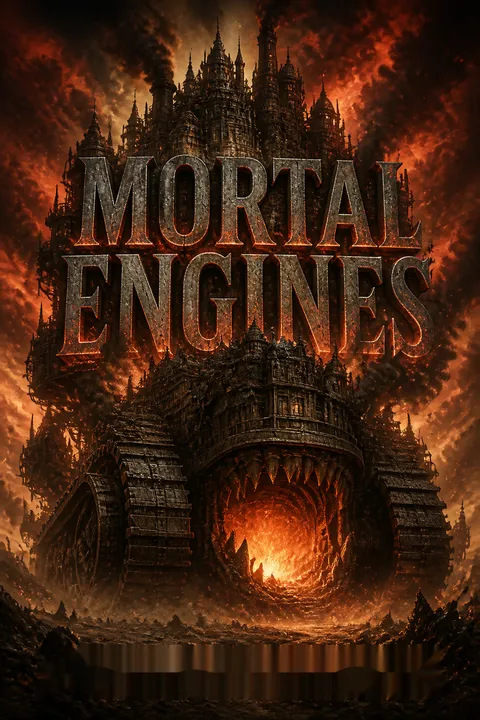


Plot Summary
London Takes Its First Catch
With prey growing scarce, London leaves its western refuge and races east, swallowing the small mining town of Salthook. Fifteen-year-old Tom Natsworthy, a lonely Third Class apprentice in the Museum, sneaks away to watch the hunt. When the bully Herbert Melliphant mocks Tom’s dead parents, Tom hits him and is sent to Gut-duty.
There he meets Thaddeus Valentine, London’s celebrated archaeologist, who treats him with unexpected kindness and introduces him to his daughter, Katherine. Tom hopes the encounter marks the beginning of the adventures he has imagined for years. In the wreckage of Salthook, he finds an ancient computer disc and pockets it, thinking it might one day be a gift for Katherine.
Tom’s first adventure begins as a spectator sport. London’s citizens cheer when Salthook is caught, and Tom’s delight shows how thoroughly his city has taught him to treat predation as civic pride. His outburst at Melliphant, however, exposes a private grief beneath that public certainty: Tom has no family to protect him, and little status of his own. Valentine’s warmth seems to offer both recognition and a future. The discarded disc, an artifact of a dead civilization, quietly places a different value beside London’s appetite: survival across time may matter more than usefulness or profit.
A Name at the Chute
Among the newly captured townspeople, a scarred young scavenger lunges at Valentine with a knife. Tom grabs her arm, then chases her through the Gut as she flees the police. At a waste chute, a dart wounds her leg. Before she leaps into the Out-Country, she identifies herself as Hester Shaw and blames Valentine for destroying her family.
When Tom reports her name, Valentine shoves him over the railing too. Tom survives the fall and wakes in mud beside Hester, who has used his shirt to bandage herself. She says Valentine murdered her parents; Tom resists believing her until he remembers the shove. With London already vanishing across the plain, he chooses to follow the injured Hester rather than face the open country alone.
Tom’s fall breaks more than his physical safety. It dismantles the story he has relied on about Valentine, forcing him to compare a revered public image with the evidence of his own body. Hester’s scar makes the violence visible, while her blunt accusation gives it a name. Yet Tom does not become her uncomplicated ally: he still wants to believe Valentine is good and hopes the law can settle the matter. His decision to stay with Hester grows from mixed motives, fear and guilt as much as moral courage. Their partnership begins in uncertainty, not trust.
The Past in the Mud
As they trail London’s tracks, Hester explains that she grew up on Oak Island with her archaeologist mother, Pandora, and farmer father. She witnessed Valentine kill them while demanding a machine called MEDUSA, and escaped with a sword wound across her face. A scavenger named Shrike later took her in, but she left to hunt Valentine.
Tom recognizes that the murder coincided with Valentine’s rise in London. Before they can reach the city, they find Speedwell, a tiny town stripping London’s discarded slag. Tom trades the ancient disc for food and shelter. Mayor Orme Wreyland then drugs the pair and locks them up, planning to sell them as slaves at a trading cluster. Hester is ill, her injured leg worsening, and Tom must find a way out.
Hester’s account turns her pursuit from apparent savagery into a child’s long effort to restore a broken past. Her memory arrives in fragments, much like the ancient objects Tom values, but the fragments establish a concrete motive: Valentine wanted MEDUSA, and her parents stood in his way. Tom’s decision to trade the disc shows his priorities shifting from pleasing Katherine to keeping Hester alive. Speedwell’s betrayal also punctures his belief that brutality belongs to distant, supposedly uncivilized places. A town too small to hunt safely has learned to prey on vulnerable travelers instead.
The Jenny Haniver
Tom pries a hole in their cell, and Hester kicks the weakened wall open when he cannot widen it himself. They escape into the crowded trading cluster, where Wreyland’s men corner them at an air-harbour. Anna Fang, a sharp-eyed aviatrix, claims the pair as her passengers and knocks down their pursuers. She offers them passage aboard her patched-together airship, the Jenny Haniver, despite their having no useful money.
When the harbour tries to stop her departure, Anna lifts off under fire, carrying Tom and Hester into the night. Tom has now been rescued twice by strangers, but Valentine’s betrayal makes him wary of Anna’s generosity. Hester, exhausted and wounded, accepts the escape because it gives her another chance to reach London.
Escape depends on cooperation rather than strength: Tom finds the weak plank, Hester supplies the force, and Anna risks her ship to keep them from being sold. Their actions create a fragile alternative to the towns’ hierarchy of hunter and prey. Tom’s suspicion is psychologically earned. Valentine’s betrayal has made kindness difficult for him to receive without searching for a hidden price. Hester, by contrast, accepts help while guarding her independence. The Jenny itself embodies their temporary refuge: assembled from salvage, it works because discarded parts can be joined into something no single city could provide.
Shrike Finds Hester
Anna treats Hester aboard the Jenny and shows Tom the starving wreck of Motoropolis, proof that the central Hunting Ground is no rich new hunting ground. At Airhaven, the fugitives meet aviators who know Anna and her history as a former slave. Before they can find passage to London, the lights fail and Shrike enters the inn, sent by Magnus Crome to kill them.
Hester recognizes the Stalker as the machine-man who rescued and raised her after her parents died. While Anna and the aviators fight Shrike, he disables the Jenny. Tom and Hester steal a tethered balloon and escape. Hester tells Tom that Shrike once kept mechanical toys and cared for her, despite his emptied memories and feelings. His airship soon appears behind them.
Shrike complicates the boundary Tom has been taught to draw between human and machine. Hester remembers him not merely as a weapon, but as the closest thing she had to a guardian after her parents’ deaths. His care was constrained and possessive, yet it gave her shelter when no one else would. Tom’s growing sympathy for Hester now includes the loss of that complicated bond. Anna’s past as a slave also reframes her rescue of the pair: she recognizes the danger of being treated as property. Each character’s history makes their present loyalties harder to classify.
MEDUSA Opens Its Eye
While Tom and Hester flee, Katherine searches for the truth in London. Lord Mayor Magnus Crome refuses to explain the assassin, so she enters the Gut and questions apprentice engineer Bevis Pod. She sees a convict die in a sewage-recycling tank and learns that the Engineers may be building Stalkers from the dead.
Bevis reveals that MEDUSA is their secret project. Disguised as an Engineer, Katherine enters Crome’s presentation and hears that the weapon can destroy cities.
Crome fires it at the approaching Panzerstadt-Bayreuth, reducing the conurbation to burning wreckage. Katherine turns to the Historians for help, but they are frightened and divided. She later learns that the assassin’s name, Hester Shaw, connects to Pandora Shaw, an archaeologist her father once knew.
Katherine’s investigation takes her across London’s social strata, and what she sees in the Gut makes the city’s polished prosperity impossible to regard innocently. The dead convict is not an abstraction or a statistic; his death happens in front of her, under a system that calls cruelty efficiency. MEDUSA then extends that logic outward, converting political fear into mass destruction. Katherine responds by seeking knowledge and allies, not by accepting Crome’s claim that the weapon guarantees safety. Her discoveries also begin to unsettle the family story she has trusted, linking a public catastrophe to her father’s hidden history.
A Pirate Town Takes Them
Hester vents the balloon’s gas to hide it from Shrike, and she and Tom crash into the Rustwater Marshes. Shrike tracks them through the fog and corners them, but a fast town ploughs into him.
Tom and Hester seize the chance to leap onto the following vehicle, a heavily armed pirate suburb called Tunbridge Wheels. Its crew captures them and brings them before Mayor Chrysler Peavey. Hester recognizes Peavey from Shrike’s scavenger town and knows he is dangerous.
Tom’s London accent earns him unusual respect: Peavey wants to become a respectable city ruler and asks Tom to teach his pirates etiquette. Tom insists Hester stay with him, and Peavey frees her too. The pirates carry their unwilling guests toward a promised prize beyond the marshes.
The chase turns the mobile world’s central rule into physical comedy and mortal danger: one town runs down another, and Tom and Hester survive by climbing aboard the next predator. Yet Peavey’s ambition reveals that respectability is not the opposite of violence in this society. He wants the manners and status of High London without questioning the enslavement that funds his rise. Tom’s insistence on Hester’s freedom is a modest but real refusal of the market’s logic. His willingness to stay beside her, despite the danger, now exceeds the guilt that first brought them together.
The Sea Eats Tunbridge
Peavey reveals that his prize is Airhaven, forced to land on the Black Island after the damage Shrike caused. He unfolds flotation skirts beneath Tunbridge Wheels and drives the suburb across the Sea of Khazak. Anna’s Jenny Haniver attacks with rockets, warning the islanders, but Peavey continues toward shore. A fishing boat draws the suburb onto a reef, which tears open its hull.
As water floods the decks, Peavey abandons his family and escapes with Tom, Hester, and several lieutenants on a life raft. He still imagines taking Airhaven and becoming a proper Lord Mayor. On the island, he sinks into a bog while chasing the departing town. His men refuse to save him, then shoot him when he appeals to Tom for support.
Peavey’s collapse exposes the poverty of his dream. He has mistaken the appearance of authority for the substance of legitimacy, and when his town sinks, neither his title nor his plans compel loyalty. His crew’s refusal is not justice so much as the same self-preservation he taught them. Tom, who had briefly hoped he could civilize Peavey through manners, sees that etiquette cannot repair a system built on capture and forced labor. The reef gives the islanders a defense grounded in knowledge of place, a sharp contrast with the mobile town’s confidence that every obstacle can be conquered.
Shrike's Last Bargain
As the survivors climb toward Airhaven, Shrike emerges from the sea, damaged but still hunting. He kills Peavey’s remaining pirates and tells Hester that Crome has promised to rebuild her as a Stalker, stripping away the memories and feelings that torment her. Shrike wants her beside him forever. Hester hesitates, drawn to the prospect of escaping her pain, and offers herself if Tom is spared.
Tom grabs a dead pirate’s sword and attacks. Shrike knocks him down, but the sword lodges in the Stalker’s damaged body and destroys him. Hester, furious that Tom has denied her the choice, argues with him over Shrike’s death. Their quarrel ends only when island riders arrive and Anna Fang recognizes the two fugitives.
Shrike’s offer is frightening because it promises relief in the form of erasure. Hester has spent years living with a face and memory shaped by violence; the prospect of losing both can seem like liberation. Tom understands the offer differently, as the destruction of the person who has survived that violence. His intervention is loving, but it is also a choice made for Hester without her consent, which explains her anger. Their conflict marks a change in intimacy: they are no longer merely helping one another survive; they are beginning to matter enough to wound each other.
Behind the Shield-Wall
Anna brings the injured Tom and Hester to Airhaven’s refuge on the Black Island, then persuades them to travel with her to Shan Guo and warn its people about MEDUSA. During the flight, Tom learns more of Anna’s ties to the Anti-Traction League and sees the mountains, villages, and roads of a settled world. Hester thanks him for saving her and admits that her anger often turns against the people who care for her.
At Batmunkh Gompa, the League’s fortress-city behind the Shield-Wall, Anna urges its leaders to attack London before MEDUSA can fire again. Tom objects because London is still his home. Wandering the city afterward, he spots a monk whose face belongs to Valentine, secretly moving toward the League’s air fleet.
The journey eastward changes Tom’s moral map. He has been taught to equate movement with civilization, yet the settled communities beyond the Shield-Wall reveal a life not organized around eating or being eaten. That does not make Tom immediately disloyal to London; his protest against a League strike shows how deeply home remains part of his identity. Hester’s apology offers a smaller counterpoint: she can name the hurtful pattern in her behavior without being cured of it. Valentine’s disguise then makes the conflict personal again. Tom must decide whether loyalty means protecting his city’s actions or warning those endangered by them.
Anna's Last Battle
Tom warns Anna that Valentine has infiltrated Batmunkh Gompa, but the warning comes too late. Valentine plants explosives among the League’s airships, setting the High Eyries ablaze. Anna confronts him on a snowy platform and nearly wins, until a searchlight blinds her and Valentine kills her.
Tom reaches her as the 13th Floor Elevator carries Valentine away. Grief turns Tom’s anger toward London, and he and Hester decide to return there to stop him. Back in London, Katherine learns from historian Dr Arkengarth that Hester is Pandora Shaw’s daughter.
When Valentine comes home, Katherine confronts him; he admits killing Pandora for MEDUSA and wounding Hester to silence her. He insists he acted to secure Katherine’s future, but still supports Crome’s plan to attack the Shield-Wall.
Anna’s death strips away the comforting idea that courage guarantees victory. She is skilled enough to defeat Valentine in combat, yet the environment he controls gives him the opening he needs. Tom’s decision to return to London grows from grief, but also from a new sense of responsibility: the weapon threatens people he has never met, and its maker is no longer a distant villain. Katherine’s confrontation reveals another form of betrayal, one disguised as parental sacrifice. Valentine’s claim that murder protected her future shows how care can become self-justification when a person refuses to imagine a future beyond status and power.
The Museum Takes Arms
Katherine rejects Valentine’s defense and resolves to destroy MEDUSA. With Bevis, she makes a small bomb, but Herbert Melliphant reports their plan to Crome. Engineers raid the Museum, killing Dog and capturing Katherine and Bevis.
Chudleigh Pomeroy and the Historians fight back with weapons taken from their exhibits, buying the pair a route through an old stairway to Top Tier. Meanwhile Tom and Hester reach London aboard the Jenny Haniver. Hester jumps onto the city to find Valentine, while the 13th Floor Elevator attacks Tom.
He fires the Jenny’s rockets through its exposed windows, bringing the airship down onto the Engineerium. The crash kills Bevis and starts fires across Top Tier. Hester is caught by Stalkers and taken into St Paul’s, where the Engineers are preparing MEDUSA.
The Museum’s resistance is both literal and institutional: the Historians turn preserved weapons into tools for defending living people, while the Engineers seek to control history by controlling its artifacts. Katherine’s plan depends on Bevis’s technical knowledge, but their closeness cannot protect them from Melliphant’s ambition or the raid. Tom’s improvised attack similarly saves Hester’s chance to act while producing collateral harm he cannot foresee. The plot refuses a clean opposition between courageous action and consequence. Each character reaches for agency inside a system that turns even rescue, memory, and expertise into dangerous instruments.
The Cathedral Misfires
In St Paul’s, Katherine slips into the Engineers’ control room as Crome prepares to aim MEDUSA at the Shield-Wall. The ancient machine’s core is a computer sphere recovered by Valentine, and its targeting system waits for a clearance code. Hester, captured by Stalkers, is brought before Valentine.
He raises his sword to kill her, but Katherine throws herself between them and is fatally stabbed. Her fall against the controls corrupts MEDUSA’s target input. The weapon begins building power without a valid destination, then releases its energy through London instead.
The city’s engines stop, its upper tiers erupt in fire, and Valentine remains beside Katherine as the cathedral and Engineerium burn. Across the Museum, the Stalkers fail, allowing Pomeroy and the surviving Historians to escape their last stand.
Katherine’s sacrifice is not a planned heroic tactic; it is the final consequence of refusing to let her father repeat his violence against Hester. The revelation of their shared fatherhood gives that choice an intimate shape, but her action also protects people far beyond the family. MEDUSA’s failure is caused by the collision between human intention and a technology its makers only partly understand. Crome believes control is equivalent to mastery; the misdirected weapon exposes that belief as delusion. The city’s destruction is therefore neither a neat punishment nor a simple victory. It is the catastrophic cost of building security from the power to annihilate.
The Bird Roads
Tom returns the damaged Jenny Haniver toward London, but MEDUSA’s energy storm catches the airship and carries it away from the burning city. Hester finds him grieving over the ruin and tells him the disaster was not his sole responsibility. As the weapon’s power fades, she turns the crippled craft toward the Black Island, where they might repair it and rejoin the sky routes.
Tom refuses the thought of being called a hero; too many people, including Anna and Bevis, have died around his choices. Hester accepts that she cannot undo her own losses, but she no longer wants to face the world alone. They leave London behind with no promised home or easy future, choosing instead to travel together wherever the airship can carry them.
The ending replaces the promise of a happy-ever-after with a more credible form of hope: two damaged people make a choice about the next day. Tom’s refusal of heroism acknowledges the difference between intending to help and controlling the consequences. Hester does not absolve him so much as widen the frame of responsibility, refusing to let grief become another instrument of self-punishment. Their departure also reverses the novel’s opening image. Instead of a city devouring smaller settlements, an improvised airship carries people away from the wreckage of that system. Movement remains, but it becomes escape and companionship rather than conquest.
Analysis
Mortal Engines builds its central conflict out of a civilization that has turned hunger into virtue. London’s citizens do not experience the capture of Salthook as an atrocity; they experience it as a communal celebration, because the system has taught them to confuse survival with moral right. The moving cities embody a political economy in which every community fears becoming someone else’s meal. Crome’s solution is not to question that arrangement but to make London powerful enough to dominate it. MEDUSA extends Municipal Darwinism from a brutal practice into a project of mass annihilation.
The novel tests its assumptions through contrasting forms of movement and settlement. Traction cities consume and discard; Airhaven and the Jenny Haniver depend on exchange, repair, and cooperation. Shan Guo’s roads and inhabited mountains challenge Tom’s belief that a stationary society must be backward. These alternatives are not idealized as effortless. The League considers attacking London, and Anna’s resistance has its own costs. Reeve’s moral argument is therefore not that one faction is pure, but that necessity can become an excuse for refusing to imagine another way to live.
The characters make that argument intimate. Tom begins by trusting institutions and heroic reputations, then discovers how easily affection can coexist with complicity. Katherine’s investigation turns inherited privilege into a responsibility to act, while Hester’s wound makes visible the personal cost hidden inside Valentine’s ambition. Their shared father complicates revenge without erasing its cause. Shrike, meanwhile, is a tragic mirror of a society that treats persons as instruments: his machinery preserves just enough attachment to make possession feel like love.
The ending refuses a clean triumph. London is destroyed, but many lives have already been lost, and Tom cannot separate his intervention from its consequences. The surviving pair choose movement without conquest, a tentative freedom rather than a settled moral victory. The story’s enduring question is not whether cities must move, but whether survival requires people to accept the world’s violence as natural.
Review Summary
Mortal Engines receives mixed reviews, with praise for its original world-building and concept of mobile cities in a post-apocalyptic setting. Many readers find the story engaging and fast-paced, appreciating the complex characters and dark themes. However, some criticize the writing style as simplistic or confusing. The book is generally considered suitable for young adult readers, with some finding it more enjoyable at a younger age. While opinions vary, many readers express interest in continuing the series or exploring related works by the author.
People Also Read


Characters
Tom Natsworthy
The apprentice who looks twiceTom is a fifteen-year-old Third Class apprentice in London’s Historians’ Guild, orphaned and accustomed to imagining himself as the hero of someone else’s adventure. His admiration for Thaddeus Valentine makes betrayal especially destabilizing, while his early belief in Municipal Darwinism shows how thoroughly London has shaped his moral instincts. Tom is observant, eager to please, and often frightened; his courage tends to appear as a decision made despite fear rather than an absence of it. His journeys expose him to people and places his education dismissed, forcing him to reconsider what counts as civilized. He is drawn to Hester through loyalty and compassion, even when her anger and his own uncertainty make closeness difficult.
Hester Shaw
The scarred avengerHester is a young Out-Country survivor whose disfigured face bears the history of a childhood attack. She is intelligent, practical, and formidable at reading terrain, but she has learned to treat dependence as danger and tenderness as something likely to be withdrawn. Her pursuit of Valentine gives grief a concrete direction, allowing her to act when memory and loss might otherwise overwhelm her. The harshness she directs at Tom often conceals shame about her appearance and the fear that nobody could choose her freely. Her relationship with Tom unsettles her defenses because he keeps offering care without demanding that she become agreeable or beautiful first.
Katherine Valentine
The mayor's questioning daughterKatherine is Thaddeus Valentine’s daughter, raised in High London with education, comfort, and the assumption that her father is honorable. Her curiosity begins as concern for her father and a need to understand the mysterious attacker, then broadens as she witnesses the suffering hidden beneath the city’s clean upper tiers. Katherine combines social confidence with genuine responsiveness to others; she can use privilege to enter places closed to most people, but she is increasingly unwilling to treat that privilege as proof of virtue. Her bond with Bevis grows through shared risk and intellectual respect. She is motivated by loyalty, but learns to question what loyalty requires when a loved one helps cause harm.
Thaddeus Valentine
London's celebrated archaeologistValentine is London’s Head Historian, a renowned explorer whose polished public identity hides an Out-Country past and a close relationship with Lord Mayor Crome. He is charismatic, physically capable, and skilled at making people feel seen, qualities that make his influence more persuasive than a simple show of authority. His affection for Katherine is real, yet he repeatedly treats security, status, and paternal care as reasons to control or endanger other lives. Valentine’s archaeological work gives him access to powerful remnants of the past, while his ambition encourages him to judge those remnants by what they can buy. He embodies the danger of a person who recognizes the moral cost of his choices but keeps postponing resistance.
Magnus Crome
The engineer mayorCrome is London’s Lord Mayor and the powerful leader of the Engineers’ Guild. Thin, controlled, and emotionally guarded, he regards the city’s survival as a problem to be solved through planning, technology, and force. His fear of dwindling prey is not merely personal; he sees himself as responsible for keeping London moving, and that conviction lets him recast domination as necessity. Crome values secrecy because public consent might obstruct his plans, and he tends to regard dissent as ignorance rather than a legitimate moral objection. His faith in engineering is also a faith in control: if a machine can be built, he assumes its consequences can be mastered.
Anna Fang
The fearless airship captainAnna Fang is a skilled aviatrix who pilots the battered but capable Jenny Haniver. She meets danger with composure and humor, and her generosity toward Tom and Hester reflects a personal understanding of what it means to be powerless in a predatory world. Anna is not politically neutral: she has firm convictions about the violence of traction cities and the people harmed by their expansion. Yet she does not reduce every person to their faction; she treats Tom and Hester as individuals even when their loyalties differ from hers. Her combination of warmth and strategic discipline makes her a natural leader among air-traders and League allies.
Shrike
The mechanical hunterShrike is a Stalker, a half-mechanical being built from a human body and ancient technology. He tracks fugitives for reward and possesses immense strength, endurance, and a chillingly literal way of understanding attachment. Hester’s years with him complicate her view of care: he offered shelter and a kind of guardianship, but his affection is bound to possession and to his fascination with mechanical figures. Shrike’s existence unsettles the boundary between person and weapon, especially because traces of an inner life persist beneath the Engineers’ efforts to erase it. He represents both the terror of being remade by others and the ache of a self that cannot fully disappear.
Bevis Pod
The engineer with a conscienceBevis is a young apprentice Engineer assigned to London’s Deep Gut prison. Loyal to his Guild and technically capable, he is also troubled by the treatment of prisoners and tries to help when he can. His restraint comes partly from fear: he understands the risks of defying supervisors but has not learned to regard obedience as the only possible response. Katherine’s attention gives him an unfamiliar experience of personal intimacy, and their work together lets his ingenuity serve a purpose beyond the Guild’s demands. Bevis brings both scientific knowledge and a quietly compassionate perspective to Katherine’s investigation.
Chudleigh Pomeroy
The fussy historian who actsPomeroy is the Deputy Head of the Historians’ Guild, a curator more concerned with fragile exhibits than London’s engine vibrations. His fussiness can make him seem timid or comic, but his devotion to preserving history includes a practical loyalty to the people who study it. He treats Tom with the authority of a teacher and Katherine with the respect of an adult, even when the city’s rulers would prefer her kept ignorant. Pomeroy’s attachment to the Museum’s artifacts does not prevent him from recognizing that living people matter more than collections.
Chrysler Peavey
The pirate seeking respectabilityPeavey is the mayor of Tunbridge Wheels, a pirate suburb taken over by force. He is boastful, insecure about his rough upbringing, and fascinated by the status symbols of High London. His desire to educate Tom in manners is an attempt to imagine himself as a legitimate ruler, but he never separates respectability from the violence that sustains his power. Peavey can show flashes of generosity toward Tom, yet his treatment of captives and his own crew remains shaped by self-interest. His ambitions make him both ridiculous and dangerous.
Orme Wreyland
The desperate small-town mayorWreyland rules Speedwell, a small town struggling to survive as prey becomes scarce. He is hospitable in manner but willing to drug Tom and Hester and sell them into slavery when he sees a chance to secure parts for his engines. His anxious explanations reveal how scarcity can make exploitation seem like ordinary administration.
Herbert Melliphant
The privileged apprentice bullyMelliphant is a First Class apprentice whose family connections give him status over Tom. He uses that advantage to ridicule Tom’s poverty and the deaths of his parents. His cruelty is calculating rather than impulsive: he searches for the vulnerability most likely to provoke a reaction, then uses institutions to advance himself.
Dog
Katherine's loyal wolfDog is the large white wolf Valentine brought back from an expedition for Katherine. Despite his fearsome appearance, he is gentle with the people he knows and closely attuned to Katherine’s moods. His companionship gives her a source of comfort beyond the guarded world of High London, and his presence often helps her approach strangers with greater confidence.
Captain Khora
The League's welcoming pilotKhora is an airship captain from a League-allied community and a friend within Anna Fang’s circle. He is generous with newcomers and proud of his work as a pilot, but he also understands the military danger facing Shan Guo. His warmth helps Tom see that League members are not the caricatures London’s lessons taught him to expect.
Dr Arkengarth
The absent-minded curatorArkengarth is an elderly Museum curator who frets over fragile ceramics and has a habit of lecturing about historical details. His disorganized memories nonetheless preserve a clue that helps Katherine understand the connection between the Shaws and her father.
Dr Vambrace
The Engineers' security chiefVambrace leads the Engineers’ security forces and favors intimidation, surveillance, and severe punishment. He regards Katherine and Bevis as problems to be contained rather than young people with reasons to challenge the Guild. His presence gives Crome’s political authority a physical, coercive edge.
Plot Devices
Municipal Darwinism
Predation as civic orderMunicipal Darwinism is the belief that mobile towns and cities must hunt and consume smaller settlements to survive. It supplies the world’s economic structure and London’s moral vocabulary: citizens celebrate a catch as proof that their city is healthy. The practice also creates the pressure behind Crome’s expansion, Peavey’s piracy, and Wreyland’s attempted enslavement of Tom and Hester. As Tom encounters static communities and sees the costs of capture, the doctrine becomes less like an inevitable law of nature and more like a political system people have chosen to defend.
MEDUSA
Ancient power without restraintMEDUSA is an experimental energy weapon from the Sixty Minute War, recovered in fragments and reconstructed by London’s Engineers. Its computer core and surviving plans connect Valentine’s secret archaeological work to Crome’s political ambitions. The weapon changes the balance between cities because it can destroy a target from far beyond ordinary artillery range. Its existence turns the novel’s central question from whether London can survive hunger to what it is willing to do in order to secure survival. The Engineers’ incomplete understanding of the ancient technology makes their confidence especially dangerous.
The Stalkers
A human body made weaponStalkers are Resurrected Men, dead bodies reanimated through machinery and ancient technology. Their strength and endurance make them effective hunters and guards, while the traces of human memory beneath their metal systems make them disturbing rather than merely monstrous. Shrike’s pursuit of Hester gives the device an emotional dimension: the Stalker is not only an instrument of Crome’s power but also a figure who once offered her shelter. London’s Engineers hope to reproduce the technology, treating death as a labor problem that can be solved by manufacturing obedient workers.
The Jenny Haniver
A refuge between worldsAnna Fang’s airship is assembled from components salvaged from vessels built in different regions. It carries Tom and Hester between the mobile Hunting Ground, Airhaven, and the settled lands beyond the mountains. The ship’s patched construction makes it a practical alternative to the cities that survive by consuming others: it connects people without needing to swallow them. Its controls also become a test of Tom’s growing capacity, as he moves from passenger to pilot. The Jenny holds the memory of Anna’s care even after the characters must act without her.
The Ancient Computer Core
A buried past with consequencesThe recovered computer core is the crucial component that allows the Engineers to reactivate MEDUSA. Pandora Shaw found it, and Valentine’s decision to take it binds the Shaws’ tragedy to London’s technological future. The core shows how archaeological discovery is never neutral in this world: an object rescued from the past can become evidence, a commodity, or a weapon depending on who controls it. It also exposes a mismatch between the confidence of the Engineers and the limits of their knowledge. They can operate the machine without fully mastering what it can do.
FAQ
Synopsis & Basic Details
What is Mortal Engines about?
- Mobile City Predators: In a post-apocalyptic future, humanity lives on colossal moving cities called Traction Cities, which hunt and consume smaller towns in a system known as Municipal Darwinism. London, a massive Traction City, is the primary setting.
- Unlikely Alliance Forms: The story follows Tom Natsworthy, a naive apprentice historian from London, who is cast out into the dangerous "Out-Country" after witnessing an assassination attempt on his idol, Thaddeus Valentine, by the scarred Hester Shaw.
- Quest for Truth & Survival: Tom and Hester are forced to navigate the perilous world outside London, encountering various mobile settlements and uncovering dark secrets about Valentine, London's leadership, and an ancient weapon that threatens to reshape their world.
Why should I read Mortal Engines?
- Unique World-Building: Dive into a truly original dystopian vision where entire cities are mobile predators, offering a fresh take on post-apocalyptic settings and the concept of survival. The intricate details of Traction Cities and the vast, scarred Out-Country are vividly imagined.
- Compelling Character Arcs: Witness the profound transformation of its protagonists, Tom and Hester, from naive and vengeful individuals to complex, interdependent figures grappling with loyalty, morality, and their place in a brutal world.
- Thought-Provoking Themes: Explore deep themes of environmentalism, the dangers of unchecked technology, class disparity, and the cyclical nature of history, all wrapped in a fast-paced adventure that keeps you on the edge of your seat.
What is the background of Mortal Engines?
- Post-Apocalyptic Earth: The world was devastated by the "Sixty Minute War," a global conflict fought with "orbit-to-earth atomics and tailored-virus bombs," which left the Earth "ruined" and unstable, leading to the development of mobile cities.
- Municipal Darwinism Dominates: A new socio-economic and political system emerged where cities are mounted on gigantic tracks and wheels, constantly moving to hunt and consume smaller towns for resources, fuel, and salvage, embodying the mantra "Movement is Life."
- Old-Tech and Guilds: Society is structured around powerful Guilds (Historians, Engineers, Navigators, Merchants), with a fascination for "Old-Tech"—relics of ancient, advanced technology from before the Sixty Minute War, which are often misunderstood or repurposed for destructive ends.
What are the most memorable quotes in Mortal Engines?
- "Movement is Life.": This motto, prominently displayed on posters in London, encapsulates the core philosophy of the Traction Cities and Magnus Crome's relentless drive for expansion, highlighting the existential fear of stasis and the constant need for consumption.
- "You aren't a hero, and I'm not beautiful, and we probably won't live happily ever after... But we're alive, and together, and we're going to be all right.": Hester Shaw's poignant words to Tom at the end of the novel strip away romanticized notions of heroism, offering a raw, honest, and deeply human vision of hope and companionship amidst a broken world.
- "Look what your brave, kind Valentine did to me!": Hester Shaw's desperate cry to Tom in the Gut reveals the brutal truth behind Thaddeus Valentine's heroic facade, shattering Tom's naive worldview and setting the stage for the novel's central conflict and themes of betrayal and revenge.
What writing style, narrative choices, and literary techniques does Philip Reeve use?
- Panoramic World-Building: Reeve employs a rich, descriptive style that immerses readers in the vast, imaginative world of Traction Cities and the Out-Country, blending steampunk aesthetics with post-apocalyptic landscapes. He uses vivid imagery, such as London rising "in seven tiers like the layers of a wedding cake," to establish the setting's unique grandeur and brutality.
- Third-Person Limited Perspective: The narrative primarily follows Tom and Katherine, offering intimate access to their evolving thoughts and emotions, which allows for a gradual unveiling of the world's darker truths through their eyes, enhancing reader empathy and surprise. This perspective effectively contrasts their initial naivety with the harsh realities they uncover.
- Juxtaposition and Irony: Reeve frequently uses juxtaposition, such as the opulent "High London" contrasted with the squalid "Deep Gut," to highlight class disparities and moral decay. Irony is also prevalent, particularly in the "civilized" London's predatory nature and the Historians' initial blindness to the destructive potential of "Old-Tech," underscoring the novel's critique of societal values.
Hidden Details & Subtle Connections
What are some minor details that add significant meaning?
- Pomeroy's Unexpected Empathy: Chudleigh Pomeroy, initially portrayed as a pompous, rule-bound Historian, shows surprising kindness by tearing up Tom's Gut-duty note and later leading the Historians' armed rebellion against the Engineers. This subtle shift reveals that even seemingly rigid characters can possess hidden depths of loyalty and moral courage when faced with existential threats.
- The "Blue Eye" Motif: The Historian's Guild-mark, a "blue eye that looks backwards into time," is mirrored by the "blue eye" on the engine cowling of Valentine's airship, the 13th Floor Elevator, and later on the engine that kills Bevis. This recurring symbol subtly links Valentine's historical knowledge and his past actions (discovering MEDUSA) to the ultimate destruction caused by his choices, suggesting a fated or cyclical consequence of misusing history.
- St Paul's Cathedral's Transformation: The ancient cathedral, initially described as a "sad sight now, covered in scaffolding and shored up with props," is later revealed to be the housing for MEDUSA. This transformation symbolizes the perversion of historical and spiritual symbols for destructive technological ends, highlighting London's abandonment of its past values for raw power.
What are some subtle foreshadowing and callbacks?
- Shrike's Early Warning: When Shrike first appears in Airhaven, he explicitly states, "I WORK FOR THE LORD MAYOR OF LONDON NOW... he has sent me to kill you." This direct declaration, initially dismissed by Hester as a twisted joke, foreshadows his unwavering loyalty to Crome and the true nature of his mission, which is later confirmed by Valentine.
- Katherine's "Sister" Comment: During her confrontation with Valentine, Katherine gasps, "My sister? Your own daughter!" upon learning of Hester's parentage. This is a callback to Valentine's earlier, almost throwaway line about Hester looking "so like you that she might have been your sister," subtly hinting at their familial connection long before the full truth is revealed.
- The "Cat's Creep": Pomeroy mentions the "Cat's Creep" as an "old stairway, left over from the first days of London when the elevator system couldn't always be relied on." This seemingly minor detail becomes crucial for Katherine and Bevis's escape, symbolizing the forgotten, older ways of London providing an unexpected path to resistance against the dominant, modern (and corrupt) Engineer-led system.
What are some unexpected character connections?
- Katherine and Hester as Half-Sisters: The revelation that Hester Shaw is Valentine's daughter and thus Katherine's half-sister is a profound connection. This familial link transforms Hester's personal vendetta into a shared, tragic legacy, forcing Katherine to confront her father's villainy on a deeply personal level and adding layers to their initially antagonistic relationship.
- Pomeroy's Alliance with Katherine: The initially pompous and rule-bound Chudleigh Pomeroy, Tom's superior, becomes a staunch ally to Katherine, sheltering Bevis and leading the Historians' armed resistance against the Engineers. This unexpected alliance highlights the moral integrity of the Historians' Guild, contrasting their perceived irrelevance with their ultimate courage in defending London's true heritage.
- Bevis Pod's Unrequited Love: Bevis, the shy Apprentice Engineer, develops a deep, unspoken affection for Katherine, culminating in his whispered "I love you!" before their final, desperate mission. His loyalty and sacrifice are driven not just by a sense of justice but by this tender, unacknowledged love, adding a poignant emotional layer to his character and his role in the climax.
Who are the most significant supporting characters?
- Chudleigh Pomeroy: Beyond his initial role as Tom's strict superior, Pomeroy emerges as a guardian of London's true history and a leader of moral resistance. His decision to shelter Bevis and arm the Historians against the Engineers ("We'll go down fighting") underscores the value of preserving knowledge and integrity against technological hubris.
- Bevis Pod: This unassuming Apprentice Engineer becomes Katherine's crucial confidant and co-conspirator. His knowledge of the Deep Gut's horrors and his engineering skills (creating the bomb) are vital, but his character also represents the conscience within the oppressive Engineer Guild, demonstrating that even small acts of defiance can have significant impact.
- Anna Fang: The enigmatic air-trader and Anti-Traction League agent serves as a mentor figure to Tom and Hester, introducing them to the wider world beyond London. Her pragmatic morality ("If I had not, it would have attacked the Hundred Islands") and her ultimate sacrifice highlight the complex ethical landscape of the Traction Era and the costs of fighting for a cause.
Psychological, Emotional, & Relational Analysis
What are some unspoken motivations of the characters?
- Valentine's Pursuit of Legacy: Thaddeus Valentine's ruthless actions, including murder and betrayal, are driven by a desperate desire to secure a prosperous future for his daughter, Katherine, and to elevate his own status within London. He explicitly states, "I wanted you to have everything. I wanted you to grow up as a lady, not as an Out-Country scavenger like I had been," revealing a deep-seated insecurity about his own humble origins.
- Hester's Self-Loathing: Beneath Hester's fierce desire for revenge lies profound self-loathing stemming from her disfigurement and the trauma of her parents' murder. Her statement, "I'm already a monster!", reveals her internal struggle and the belief that her physical scars reflect an inner ugliness, which complicates her relationships and her quest for justice.
- Crome's Existential Fear: Magnus Crome's megalomaniacal vision of London devouring planets ("We will devour Mars, Venus and the asteroids. We shall devour the sun itself") is implicitly motivated by an extreme interpretation of "Movement is Life." This suggests an underlying, almost philosophical fear of stagnation and death, driving him to seek ultimate, limitless power to ensure London's eternal survival.
What psychological complexities do the characters exhibit?
- Tom's Shifting Moral Compass: Tom grapples with the psychological shock of discovering his hero, Valentine, is a murderer, and the subsequent realization that his beloved London is a predatory, morally corrupt entity. His journey forces him to abandon naive idealism for a more nuanced understanding of good and evil, leading to internal conflict over his loyalties and actions.
- Hester's Trauma and Attachment: Hester's character is deeply complex, marked by severe trauma that manifests as anger, isolation, and a desperate need for connection, even with her former captor, Shrike. Her fluctuating moods and her struggle to accept kindness (e.g., Tom's shawl) reveal the profound psychological scars of her past, making her journey towards healing a central emotional arc.
- Shrike's Twisted Affection: Shrike, a Stalker, exhibits a chilling yet poignant psychological complexity. Despite being a reanimated killing machine, he retains a twisted form of paternal affection for Hester, viewing her as part of his "collection" and desiring to "resurrect" her without memories or feelings to be his eternal companion. This reveals the tragic remnants of his humanity and the perversion of love through technology.
What are the major emotional turning points?
- Tom's Betrayal by Valentine: The moment Valentine pushes Tom down the waste chute, after Hester reveals his name, is a critical emotional turning point. Tom's initial disbelief ("He pushed me!... No, he can't have done. It must have been a mistake.") quickly gives way to the crushing realization of his idol's true nature, shattering his innocent worldview and forcing him to confront harsh reality.
- Katherine's Discovery of the Deep Gut: Katherine's visit to the "Turd Tanks" in the Deep Gut and her encounter with the suffering convicts is a profound emotional awakening. This exposure to London's brutal underbelly ("This is the land of the dead!") shatters her sheltered High London perspective, fueling her determination to expose Crome's atrocities and make amends for her father's complicity.
- Hester's Compassion for Katherine: Despite her lifelong quest for revenge against Valentine, Hester's emotional arc culminates in an act of compassion when Katherine sacrifices herself to save her. Hester's subsequent tears ("crying for her mum and dad, and Shrike, and Katherine, and even for Valentine") signify a release from pure vengeance, marking a shift towards empathy and a more complex understanding of loss and connection.
How do relationship dynamics evolve?
- Tom and Hester: From Antagonism to Interdependence: Their relationship begins with hostility and distrust, as Tom blames Hester for his predicament and Hester views him as a naive "London boy." Through shared hardship, mutual protection, and vulnerability (Hester sharing her past, Tom defending her), their bond evolves into a deep, unspoken interdependence and affection, culminating in their decision to face the future together.
- Katherine and Valentine: From Adoration to Disillusionment: Katherine initially idolizes her father, Thaddeus Valentine, but her quest for truth gradually exposes his dark secrets and moral compromises. Her discovery of his role in Pandora Shaw's murder and the MEDUSA project leads to profound disillusionment and a complete rupture of their relationship, as she actively works against his plans.
- Katherine and Bevis: A Budding, Tragic Romance: Their connection blossoms from a shared sense of moral outrage and a desire to help the oppressed. Bevis's quiet admiration for Katherine and her growing reliance on his ingenuity develop into a tender, unspoken romance, tragically cut short by his sacrifice. Their relationship highlights the personal cost of resistance and the purity of selfless love.
Interpretation & Debate
Which parts of the story remain ambiguous or open-ended?
- London's Ultimate Fate: While London is severely damaged by MEDUSA's malfunction, its complete destruction is not explicitly confirmed, leaving its long-term survival or eventual demise open to interpretation. The narrative focuses on the immediate aftermath, with "banners of smoke" and "bony shapes of blackened girders," but the city's ultimate future is left to the reader's imagination.
- The Future of Tom and Hester: The ending sees Tom and Hester flying off in the Jenny Haniver, seeking a new life on the "Bird Roads" to "somewhere far away." The specific destination and the nature of their future together are left open, symbolizing a new beginning but also the inherent uncertainty of their world and their personal journey.
- The Extent of MEDUSA's Destruction: The novel describes MEDUSA's energy beam "tangled around the upper tiers" of London, causing immense damage. However, the full global implications of its activation and whether its destructive potential is truly neutralized or merely redirected remain somewhat ambiguous, leaving questions about the long-term impact on the world.
What are some debatable, controversial scenes or moments in Mortal Engines?
- Katherine's Sacrifice for Hester: Katherine deliberately steps in front of Valentine's sword to save Hester, a controversial act given her father's love for her and her own burgeoning relationship with Bevis. Readers might debate whether this was a truly selfless act of atonement, a desperate rebellion against her father, or a tragic, impulsive decision driven by the shock of discovering her half-sister.
- Tom's Decision to Shoot Down the 13th Floor Elevator: Tom, overwhelmed by grief and anger, intentionally targets Valentine's airship, leading to the deaths of Pewsey and Gench. This moment challenges his "hero" persona and forces readers to confront the moral complexities of revenge and collateral damage, questioning whether his actions were justified or simply a perpetuation of violence.
- The Historians' Armed Rebellion: The Historians, led by Chudleigh Pomeroy, arm themselves with museum relics to fight the Engineers. This scene is debatable in its effectiveness and its symbolic meaning. While it represents a stand against oppression and the value of history, some might view it as a futile, almost comical, gesture against overwhelming technological force, highlighting the tragic idealism of their cause.
Mortal Engines Ending Explained: How It Ends & What It Means
- MEDUSA's Self-Destruction and London's Fall: The climax sees Katherine Valentine sacrifice herself to prevent MEDUSA from destroying Batmunkh Gompa. Her interference causes the ancient weapon to malfunction, unleashing its destructive energy upon London itself, particularly the upper tiers and the Engineerium. Thaddeus Valentine dies cradling Katherine, consumed by the blast, while the Historians' rebellion in the Museum is saved by the energy pulse disabling the Stalkers.
- Tom and Hester's Escape and New Path: Tom, piloting the Jenny Haniver, witnesses London's destruction and is overcome with guilt. Hester, having survived the chaos, comforts him, acknowledging the shared responsibility and the accidental nature of the event. They decide to leave the ruined city behind, flying the Jenny Haniver towards the "Bird Roads" and the Black Island, seeking a new, uncertain future together.
- Themes of Redemption and Cycles of Destruction: The ending signifies the catastrophic consequences of unchecked technological ambition and the hubris of leaders like Crome and Valentine. London's fall, a city built on consumption, represents a karmic retribution for its predatory existence. However, Tom and Hester's survival and their decision to forge a new path symbolize hope, resilience, and the possibility of breaking cycles of violence and
Mortal Engines Quartet Series
Download PDF
Download EPUB
.epub digital book format is ideal for reading ebooks on phones, tablets, and e-readers.








