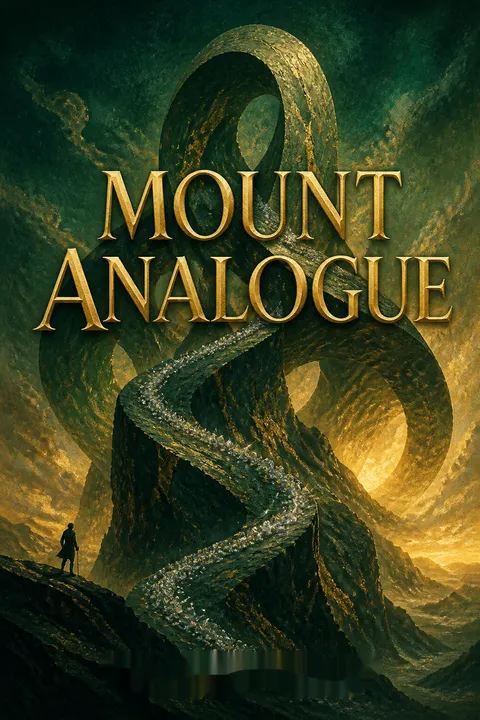


Plot Summary
The Letter at the Millpond
Theodore, a mountaineer and writer, has grown dissatisfied with his settled life when an unfamiliar letter arrives. Its author, Pierre Sogol, has read Theodore’s essay arguing that a real mountain must connect the human world to the divine, and wants to search for it.
Theodore finds Sogol teaching mountaineering in an attic workshop filled with scientific displays. Their conversation turns to childhood fear, death, and the need to wake from habitual living.
Sogol recounts leaving a monastery after realizing that clever inventions and religious rules could also become ways to avoid self-examination. He proposes that the mountain exists and can be found. When Theodore tells his wife, Renée, she immediately wants to join, making their private possibility a shared commitment.
The meeting turns an intellectual proposition into a test of character. Sogol’s workshop externalizes thought, exposing how easily a person mistakes accumulated knowledge for awareness. Renée’s quick commitment disrupts Theodore’s retreat into skepticism: the search begins not with certainty, but with the choice to act before certainty arrives.
Eight Set Sail
Sogol gathers climbers, scholars, and artists, then argues that an unseen island could be concealed by curved space. He believes the sun opens a brief passage at sunrise or sunset, and his calculations place the land in the South Pacific.
His persuasive staging makes the group feel already committed. Arthur Beaver offers his yacht, the Impossible, and the funds for an expedition. Four recruits withdraw before departure: poet Alphonse Camard is too ill to climb, journalist Emile Gorge has other work, actress Julie Bonasse stays with her protégés, and philosopher-tailor Benito Cicoria retreats into elaborate reasoning.
Sogol had expected defections and kept the precise location secret. On October 10, the remaining eight leave Europe, telling outsiders they will explore ordinary Pacific islands.
The departures distinguish longing from readiness without making the stay-behinds villains. Each quitter has a plausible attachment that outweighs the unknown. Sogol’s concealment protects the expedition, but his manipulation also reveals the tension between guiding others and respecting their freedom to choose.
The Impossible Waits
The eight take on shipboard work because the crew is small, learning to sail despite seasickness and friction among their different temperaments. Beaver manages health and provisions, while Sogol organizes the search.
He tests how few linked ideas people can hold in mind at once, arguing that this mental narrowness makes them confuse means with ends. Near the South Pacific, the group tries to enter at sunset, steering west and waiting for the predicted opening. Each failed attempt deepens doubt.
To fill the evenings, Beaver tells a mountain legend: twin brothers, Mo and Ho, must overcome fear and combine their strengths to find a truth-testing flower. The story echoes their own divided capacities. They also wonder what they could offer the mountain’s guides in exchange for knowledge.
The voyage makes spiritual aspiration physical: the crew must cooperate through discomfort, not merely agree with Sogol’s ideas. The twins’ legend gives the expedition a miniature model of integration, while the empty question of payment exposes a deeper poverty. The travelers have supplies, but do not yet know what they can genuinely give.
Through the Curved Door
At last, as the sun disappears, a sudden force draws the yacht into a vast, calm bay surrounded by unfamiliar land. The travelers are towed ashore and questioned by a guide. Asked who they are and why they have come, they find their names and occupations inadequate answers. The guide explains that they have reached a coastal settlement of newcomers, Port-des-Singes, and must continue inland to the mountain’s base.
Their photographs develop blank, and even the bay’s horizon appears to shift with the sun. Nearby, vessels from many centuries lie abandoned in the harbor. The uncanny arrival feels less like a discovery than an appointment: the visitors have crossed a threshold, but have not yet proved they understand what brought them there.
The crossing confirms Sogol’s theory while weakening the travelers’ confidence in their usual ways of knowing. The guide’s question makes identity more than a matter of biography, and the failed photographs deny them the comfort of treating the new country as an object they can simply record.
Peradams at Port
The guide advances the newcomers metal tokens for local expenses, but explains that the mountain’s true standard is the peradam, a nearly invisible crystal found higher on the slopes. Settlers can repay their debts through ordinary work, while guides recognize the rarer stones as the only fully valued currency.
The group studies the colony’s customs, languages, strange plants and animals, and stories about the land. Their plans multiply until a guide’s pointed reminder exposes how research is delaying the ascent. Then days of rain force them to reconsider their equipment.
They discard failed instruments, oxygen devices, and Beaver’s portable gardens, choosing local clothing and simpler provisions. As Sogol gives up his self-image as leader, he finds a tiny peradam in the sand. The party makes pouches for the climb.
The peradam turns value into a question of perception: what matters cannot be seized by habit or convenience. The travelers’ research initially disguises avoidance as diligence. Their decision to shed equipment, followed by Sogol’s unexpected discovery, links practical simplification with a less possessive way of seeing.
The Trail Above
The party begins the climb with porters and donkeys, passing forests, streams, strange wildlife, and high pastures. At the first camp, the shelters and food seem to have been left ready by an earlier caravan.
A distant plume of smoke signals that other climbers are ahead, and the group understands that their route joins a chain of seekers they may never meet. Their head porter, Bernard, points out a cross marking his brother’s grave and explains why hunting is forbidden above the camp.
He recounts killing an old rock rat and being held responsible for damage linked to the local balance of wasps, plants, and unstable slopes. His account breaks off as he describes the ecological consequences. The unfinished manuscript stops before the party reaches the higher base or resumes its climb.
The camp turns progress into a responsibility shared across time: earlier travelers leave provisions and signals for those who follow. Bernard’s incomplete story warns that seemingly minor acts can disturb systems a person barely understands. The abrupt ending leaves the expedition’s central test unresolved rather than inventing a summit or a resolution.
Analysis
Mount Analogue treats spiritual progress as both a literal expedition and a discipline of attention. Its wonder is not separated from practical life: the travelers must sail, share labor, manage provisions, read local customs, and revise their equipment. Sogol’s curved-space theory gives the invisible a material mechanism, yet arrival does not grant mastery. The guide’s question about identity unsettles the travelers more than the crossing itself, and the peradam economy makes value depend on what ordinary perception overlooks. The novel also distrusts easy self-congratulation. Research can become delay, technical equipment can become dependence, and even a minor act of hunting may carry consequences beyond its maker’s knowledge. The smoke from the next caravan suggests that seekers are linked by work left for others, not by shared certainty. The manuscript ends during Bernard’s account, before the climbers reach the mountain’s higher stages. Véra Daumal’s afterword describes René Daumal’s plans for further chapters, including the quitters’ misguided expedition and the duty to prepare a camp for those following. Those intended events remain plans, not part of the completed narrative. The open ending therefore preserves the book’s central demand: the journey has begun, but the reader must decide what seeking requires.
Review Summary
Mount Analogue is praised as a metaphysical adventure novel blending mountaineering, philosophy, and spirituality. Readers appreciate Daumal's unique style, combining surrealism, pataphysics, and esoteric concepts. Many lament its unfinished state due to the author's untimely death, but find the incomplete nature fitting for the book's themes. The novel's exploration of spiritual ascension through mountain climbing resonates with readers, who often compare it to other philosophical works. Some find it challenging or obscure, while others consider it a masterpiece of allegorical fiction.

Characters
Theodore
Restless seeker and witnessThe first-person narrator is a mountaineer and writer whose essay gives Sogol a reason to seek him out. He is drawn to the mountain but wary of being credulous. His careful observations preserve the expedition’s practical details, while his questions reveal how little he can claim to understand.
Pierre Sogol
Teacher of impossible routesAn inventive mountaineering teacher, Sogol links scientific speculation to a demand for inner attention. His varied experience and irreverent wit make him persuasive, but he knows that cleverness can become another form of sleep. He leads the expedition while questioning the identity he has built around leadership.
Renée
The narrator’s committed companionTheodore’s wife, Renée takes the expedition seriously before he is ready to. On the journey she contributes to the group’s practical work and plans to study the local religious life.
Arthur Beaver
Doctor and yacht ownerA physician, sailor, and high-altitude climber, Beaver supplies the yacht and plans the expedition’s food and equipment. His medical vigilance and dry humor help keep the group functioning.
Judith Pancake
Painter of mountain spacesAn American painter who climbs to understand unfamiliar mountain perspectives, Judith contributes an artist’s eye and later sketches what cameras cannot capture.
Ivan Lapse
Linguist and careful observerA gifted Russian-Finnish linguist, Ivan is interested in how language shapes thought. He studies speech and social customs in Port-des-Singes.
Hans and Karl
Climbing brothers and thinkersThe Austrian brothers bring athletic skill and contrasting intellectual interests. Hans studies mathematical physics; Karl is drawn to Eastern metaphysics. Their arguments enliven the expedition’s attempts to explain what they encounter.
Bernard
Porter marked by the mountainThe expedition’s head porter knows the mountain’s customs and the consequences of ignoring them. His personal account connects the caravan’s route with the careful laws governing life above the coast.
Alphonse Camard
Poet held back by illnessA celebrated poet whose health prevents a long climb, Alphonse sends mountaineering songs to accompany the expedition from afar.
Emile Gorge
Journalist drawn to descentA sociable journalist and skilled rope descender, Emile has other assignments and offers to help circulate the travelers’ reports.
Julie Bonasse
Actress and spiritual mentorA Belgian actress who guides a circle of young protégés, Julie weighs the expedition against her sense of responsibility to them.
Benito Cicoria
Philosopher and bold climberA Hegelian tailor with an uncompromising climbing style, Benito approaches decisions through elaborate philosophical argument.
Mo and Ho
Twins in the mountain legendThe twin climbers in Beaver’s tale embody divided abilities and the fear that obstructs discernment.
Father Kissé
Keeper of inherited knowledgeA priest-magician in the travelers’ legend, Kissé sets his sons a test through which they may earn his knowledge.
Plot Devices
Mount Analogue
Visible gate to the unseenThe physically real mountain joins ordinary human life to a higher order. Its inaccessible summit and reachable base make the spiritual quest a geographical journey, while leaving the summit beyond the events preserved in the unfinished novel.
Curved-space shell
Hides land from ordinary perceptionSogol’s theory explains why ships and observers cannot detect the island. He predicts that the sun briefly opens a passage at the horizon, making the group’s calculations and patient sunset searches necessary to reach it.
Peradam
Currency of earned perceptionThe nearly invisible crystal is the mountain’s recognized standard of value. Coastal tokens can pay for basic goods, but finding a peradam requires attention and effort, tying economic exchange to the expedition’s search for understanding.
The Hollow-men legend
A parable of integrated courageBeaver’s tale follows Mo and Ho as they face fear in pursuit of a flower that warns against falsehood. Its twin protagonists echo the travelers’ need to unite different capacities rather than rely on intellect or daring alone.
Download PDF
Download EPUB
.epub digital book format is ideal for reading ebooks on phones, tablets, and e-readers.








