

Key Takeaways
Stop treating disability as a spiritual emergency requiring a cure.
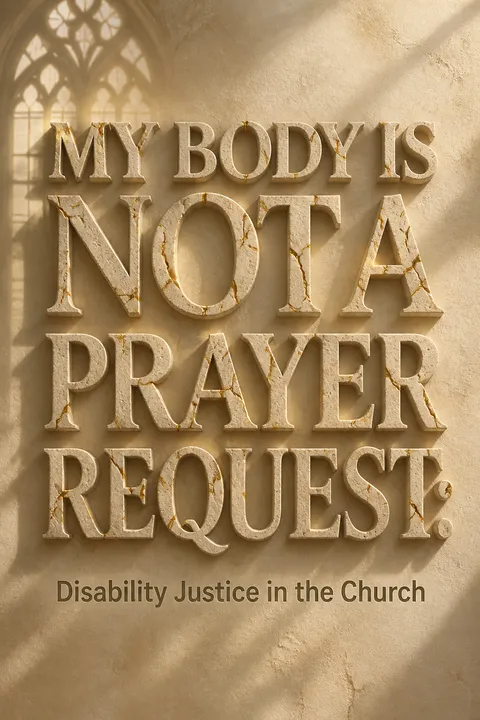
A body is not a crisis. Kenny recounts a stranger at church interpreting her cane as a reason to pray for her to be physically healed. When Kenny declines, the stranger insists that her disability means she is resisting God. The encounter turns prayer into a demand that a disabled person become more acceptable to others. Kenny argues that a disabled body can already be holy, loved, and a source of insight. This does not mean rejecting medical care or pretending pain is easy. It means refusing the assumption that cure is the price of dignity, faith, or a meaningful life.
Respect before intervention. A useful test for any offer of help is whether the disabled person asked for it. Prayer, advice, and treatment can be meaningful when freely chosen, but imposed remedies can treat someone’s body as public property. The first task is to listen, not to fix.
What's striking is how an apparently generous gesture can still deny someone agency. The distinction resembles informed consent in medicine: good intentions do not make an intervention ethical when the person affected has not agreed to it. The religious setting intensifies the problem because refusal can be recast as spiritual failure. A more respectful practice leaves room for prayer while asking what kind of support the person actually wants. That approach does not diminish faith. It treats disabled people as moral agents rather than occasions for someone else's demonstration of belief.
Measure healing by restored relationships, not bodily conformity.
The story continues after the cure. In John 9, Jesus rejects the disciples' assumption that a man's blindness resulted from sin. The man receives sight, but his neighbors interrogate and expel him. Kenny stresses that the chapter devotes far more attention to this social rejection than to the physical change. A bodily cure has not made the community welcoming.
Wholeness includes belonging. Kenny distinguishes curing, a physical change, from healing, a broader process of restoring social, spiritual, and relational life. She connects this to the Greek word sozo, used in Scripture for saving or making whole. The distinction shifts the question from whether a body has been normalized to whether a person can participate, worship, and flourish. A congregation can pursue healing by changing exclusionary habits even when no medical cure is possible or wanted.
This reading makes a valuable connection between health and social participation. Public health research likewise treats social conditions, including isolation and access to care, as consequential for well-being, not as decorative extras to biological treatment. The distinction should not become a reason to dismiss medicine: symptom relief and social inclusion can both matter, and individuals may value them differently. Its strongest use is as a corrective to cure-centered thinking. A community should not declare a problem solved merely because a body changes while the person remains stigmatized or shut out.
Locate ableism in the rules and spaces that ration belonging.
A system, not just a slur. Ableism is a system that ranks bodies and minds according to ideas about normality, intelligence, productivity, and independence. Kenny learned this as a student: teachers denied basic accommodations, including extra time to reach class and make-up tests after medical procedures. Even earning one of the school's highest grades did not change their conduct. Her effort could not repair a system that treated access as a favor.
Churches are not exempt. The book describes religious organizations lobbying against disability protections in the Americans with Disabilities Act, which does not generally require churches to comply. Individual prejudice matters, but the deeper pattern appears in budgets, buildings, policies, and beliefs about whose presence is worth the cost. Naming ableism as structural makes change more concrete: examine who can enter, participate, learn, and lead, then change the conditions that block them.
The structural lens helps explain why kind individuals can reproduce exclusion without intending harm. Organizational routines often appear neutral because they were designed around the people already served. That insight parallels work in institutional sociology, where unequal outcomes can persist without a single openly hostile decision-maker. Yet structural explanations should not erase individual accountability. A policy is maintained through choices, budgets, and priorities. Asking who benefits from a supposedly neutral arrangement, and who must spend extra effort to navigate it, turns a broad moral claim into an audit that an institution can act on.
Trust access needs without making people prove disability twice.
Disability is not always visible. At a motor vehicle office, an employee questioned Kenny's right to disabled license plates despite her medical documents, then challenged her ability to remove them. At Disneyland, strangers also questioned her use of step-free routes because she was not always in a wheelchair. Her account reflects a common misunderstanding: disability can be invisible, fluctuating, or compatible with walking. The book notes that 60 percent of wheelchair users are ambulatory.
Access is a right, not a prize. Kenny also describes landlords using stacks of paperwork to delay an accessible parking space. These hurdles make disabled people repeatedly defend their credibility before receiving basic accommodations. A stranger who offered to change her license plates showed more practical care than the official who questioned her. Institutions should make access workable without demanding that every person disclose private medical details or perform disability in a prescribed way.
Repeatedly demanding proof creates a hidden cost: time, stress, disclosure, and the risk that a person will give up rather than continue arguing. This is a form of administrative burden, a concept used to describe how complex procedures can make public benefits difficult to obtain even when someone qualifies. Fraud prevention can be legitimate, but suspicion applied casually often burdens eligible people more than it catches misuse. A proportionate process asks only for information genuinely needed, protects privacy, and avoids turning front-line staff into judges of whether a stranger looks disabled enough.
Share the extra costs that inaccessible society imposes.
Interdependence is ordinary. Disability justice rejects a hierarchy in which some bodies count more than others. It recognizes that needs and abilities change, and that people flourish through mutual support. Kenny describes the extra cost of living with disability as the crip tax: a yearly burden estimated in the book at $10,000 to $30,000 for disabled adults in the United States. The figure includes costs society often treats as private problems, such as mobility equipment and care.
Make care practical. Kenny's church community shared driving duties during years of frequent medical appointments, preventing her family from carrying every trip alone. The book urges communities to ask disabled people what would help, then offer specific support, such as transportation, meals, or help with expenses. This is not pity or a rescue project. It is an acknowledgment that access costs are produced collectively and can be shared collectively.
The idea makes interdependence visible in financial terms. Disability-related costs are not simply the result of individual bodies; inaccessible systems can force people to buy workarounds that others receive as ordinary public infrastructure. Mutual aid can meet immediate needs, while policy changes remain necessary to address the source of the burden. Those approaches should not be confused: a caring congregation cannot substitute for accessible transportation or fair benefits. The most durable community support combines direct help with pressure to change the systems that keep making the same people pay extra.
Read Jacob's limp as covenant, without prescribing suffering to others.
A limp becomes part of the story. In Genesis, Jacob wrestles through the night with a mysterious stranger, injures his hip, receives a new name, and leaves limping. Kenny reads the new name and changed body as signs of transformation and covenant, not punishment or proof that Jacob is defective. The encounter precedes a changed relationship with his brother Esau: Jacob becomes more generous and less driven by schemes and acquisition.
A blessing is not a mandate. This interpretation challenges the habit of treating disability in Scripture as a problem that must disappear before a story can end well. It also does not mean every disabled person must call pain a gift, or that disability should be romantically imposed as a spiritual lesson. The point is that a disabled body can belong within a sacred story without first being cured, explained, or made useful to others.
The reading expands the range of biblical images available to communities that often associate bodily difference only with fallenness or tragedy. Its strength is interpretive possibility, not a universal explanation for why disability occurs. That limit matters: assigning divine purpose to another person's impairment can become another form of control, especially when it pressures someone to express gratitude for suffering. The more careful lesson is that disability does not disqualify a person from blessing, agency, or transformation. A story can honor bodily difference without turning every disabled life into a theological symbol.
Replace disability stereotypes with disabled people's full, self-authored stories.
Two narrow roles dominate. Kenny describes familiar portrayals of disabled characters as either bitter villains or cheerful overcomers. Both make disability serve a nondisabled audience: one embodies fear, the other provides inspiration. She calls the objectifying use of disabled people as motivational material inspiration porn. Such stories leave little room for ordinary complexity, anger, humor, ambition, or changing needs.
Small insults accumulate. Words such as “lame” or “blind” are often used to mean bad or foolish. Kenny compares everyday slights and dismissals to mosquito bites: each may seem minor to an observer, but repeated exposure leaves a cumulative injury. When someone points out harm, defending intent can eclipse the impact. Listening, apologizing, and choosing different language are more useful than arguing that a familiar phrase is harmless.
Representation shapes what audiences expect to recognize as real. When public stories repeatedly show disability as villainy or inspirational triumph, people may distrust experiences that do not match either script. First-person accounts can widen that range, though no single disabled person speaks for everyone. The same caution applies to language: changing a word cannot by itself dismantle discriminatory practices, but language helps establish which bodies are treated as normal, tragic, or laughable. A sound response pairs respectful expression with material change, while treating correction as an opportunity to learn rather than a verdict on someone's entire character.
Design church spaces around disabled leadership from the start.
Access belongs in the blueprint. Kenny recounts churches that offered a ramp only at a side entrance, or built inviting rooms that could be reached only by stairs. The message was inclusion in name, exclusion in practice. She calls for crip space: a physical and communal environment shaped with disabled people's needs and leadership at its center, rather than added as an afterthought. This includes entrances, bathrooms, seating, communication, worship, and opportunities to lead.
Design can benefit everyone. DeafSpace, created around visual communication and sightlines, offers one example of an environment designed with a community's needs in mind. The book also points to everyday technologies developed to address disabled people's access needs, including text messaging and touch screens. Churches should ask disabled members what works, build access into budgets and plans, and keep revising as needs change.
This approach aligns with universal design: planning for a wider range of bodies and ways of communicating from the outset, rather than retrofitting each exception. The benefit is practical, but the deeper shift is political. Disabled people move from being users consulted after decisions to participants who shape the institution. A checklist can identify obvious barriers, yet it cannot replace that redistribution of authority. Nor should the promise of broad benefits be the only justification for access. Disabled people deserve usable spaces even when no nondisabled visitor gains anything from the design.
Imagine God and resurrection without celebrating disabled people's erasure.
Bodies matter in theology. Kenny challenges worship lyrics and sermons that celebrate a future with no disabled people, as though disability itself were the defect that resurrection must remove. She points to biblical visions of God's throne with wheels and to the resurrected Jesus retaining the marks of crucifixion. These images support her theological exploration of a disabled God, developed in conversation with disability theologian Nancy Eiesland.
Do not claim certainty. Kenny does not insist that disabled people will or will not be disabled in new creation. Instead, she argues that speculation about the afterlife should not become a license to erase people now. A community can hope for an end to pain without treating disabled identity as shameful. The relevant question is not which bodies are acceptable in heaven, but why worship would celebrate the disappearance of neighbors who already belong.
The argument exposes how beliefs about the afterlife can shape present-day treatment. If a community imagines restoration as conformity, current disabled lives can seem like temporary mistakes; if restoration includes bodily diversity, that changes what can be honored now. The imagery of a disabled God is best approached as theological interpretation rather than a literal claim about divine anatomy. Its value lies in disrupting the assumption that power and holiness require normative embodiment. Hope for less suffering can coexist with respect for people who do not want their disability erased.
Let fluctuating bodies set the pace, not clocks or quotas.
Energy is not constant. The spoon theory, created by Christine Miserandino to explain life with lupus, uses spoons as a metaphor for limited energy. Each task spends some of that daily supply, which may differ from one day to the next. Kenny describes being unable to attend a party, then needing several days in bed after a severe crash. A brief message that she was merely tired failed to convey the scale of what had happened.
Time can be nonlinear. Crip time describes how disability can disrupt predictable schedules and expected life stages. A body may improve, worsen, or change without following a calendar's promises. Kenny connects this reality with Sabbath: rest is not a reward for finishing every task, but a refusal to measure human worth by output. The lesson is not that rest cures disability; it is that schedules and communities should make room for variable capacity.
The idea speaks beyond disability to a culture that treats availability as proof of commitment. In workplaces and congregations, fixed schedules can quietly exclude people whose energy, pain, or care needs vary. Flexibility can improve participation without requiring anyone to disclose a diagnosis. Still, personal rest practices cannot solve every access problem: some people lack control over shifts, income, or caregiving demands. Sabbath becomes most meaningful when it is both a personal practice and a communal commitment to stop treating exhaustion as a badge of virtue.
Set the banquet first, then solve access together.
The invitation is concrete. In Luke 14, Jesus tells a host to invite poor and disabled people to a feast. Kenny reads the scene not as a vague metaphor, but as a picture of who belongs in God's community. Making that invitation real requires practical access, not merely warm words. The guests are welcomed as they are; they are not first cured, tested, or asked to prove they deserve a seat.
Belonging requires shared power. Kenny connects the feast with the biblical story of Mephibosheth, a disabled man whom King David welcomes permanently at his table and restores to a place in the community. These stories challenge churches to become hosts rather than gatekeepers: invite disabled people to participate and lead, budget for accommodations, and listen when barriers are named. Inclusion is not complete when someone can enter the room but remains outside its decisions and relationships.
The banquet image turns inclusion from a matter of attitude into a test of institutional practice: who receives the invitation, who can reach the table, and who helps decide what is served. It also resists scarcity thinking, which treats access as a cost competing with the community's real priorities. A useful extension is to measure belonging through participation and authority, not attendance alone. The metaphor should not obscure material differences among disabilities, so practical planning must remain specific. A shared table is an ethical commitment, not a substitute for ramps, interpreters, or adequate support.
Analysis
Kenny's central intervention is theological and institutional at once. She challenges the assumption that disability is a defect whose removal proves divine favor, then asks what that assumption builds: unsolicited prayer, inaccessible rooms, suspicion of accommodation requests, and worship that imagines a better world without disabled people. Her personal narrative makes those effects legible in ordinary settings, from a school accommodation meeting to a church service and a licensing office. The recurring contrast between cure and healing is especially useful because it preserves the value of medical treatment while refusing to confuse bodily change with restored belonging.
The argument's strongest move is to treat disabled people as interpreters of theology and designers of community, not merely recipients of care. Biblical figures such as Jacob, the man born blind, and Mephibosheth become occasions to question inherited readings and imagine another account of holiness, power, and restoration. This reorientation also connects disability justice to broader critiques of productivity and independence. Bodies vary, needs change, and human flourishing has always depended on relations and shared infrastructure, even when dominant culture disguises that dependence.
The book's confidence in disability as a source of blessing is most persuasive when it names possibility rather than assigning purpose. Disability can yield insight, community, or a meaningful identity, but no person should be required to call pain sacred or to treat impairment as a gift. Kenny's insistence on disabled people's own accounts helps guard against that pressure. Her claims are grounded in a Christian reading of Scripture, so readers outside that tradition may not share every theological conclusion. The ethical challenge remains accessible across belief systems: a community's values are tested by whether people can participate without surrendering dignity, privacy, or authority over their own bodies. The practical measure is not how warmly a church speaks about disability, but whether disabled people can enter, belong, lead, and shape its common life.
Review Summary
Glossary
Ableism
System ranking bodies and mindsA system that assigns different value to people according to socially constructed ideas about normality, intelligence, productivity, and independence. It can appear in deliberate discrimination, but also in ordinary language, policies, buildings, and practices designed around nondisabled people. Kenny treats it as a social structure that can be recognized and changed, not simply a personal attitude.
Disability justice
Collective flourishing across bodiesAn approach that rejects ranking bodies by worth and recognizes that needs and strengths vary. It emphasizes mutual support, access, and shared participation, with communities moving at a pace that does not leave the most marginalized behind. In Kenny's Christian framing, disability justice follows from the belief that every person bears God's image and that flourishing is relational.
Crip tax
Extra costs imposed by disabilityThe additional expenses disabled people face because of disability and an inaccessible society. Costs can include medical care, mobility devices, and assistive technology. Kenny cites an estimate of $10,000 to $30,000 in extra annual costs for disabled adults in the United States. The term makes visible how burdens treated as private expenses can arise from shared social arrangements.
Crip space
Space shaped by disabled peopleA physical and communal environment designed with disabled people's needs and participation at its center. It goes beyond minimum access features to cultivate belonging, leadership, and flexible ways of gathering. Kenny argues that such spaces should be created with disabled people from the beginning, rather than treating access as a later addition or an act of charity.
Inspiration porn
Disability used to inspire othersA term for presenting disabled people as inspirational objects for nondisabled audiences, often for ordinary activities, rather than as full people with their own stories and goals. The portrayal can appear positive while still objectifying disabled people and centering the audience's feelings. Kenny connects it to cultural stories that demand cheerful overcoming instead of allowing complexity.
Spoon theory
Metaphor for limited daily energyA metaphor developed by Christine Miserandino to explain how chronic illness can limit energy. Each spoon represents capacity that an activity uses, and a person's available supply can vary from day to day. The metaphor helps communicate why routine tasks may carry different costs for someone with fluctuating symptoms, even when those costs are not visible.
Crip time
Time shaped by disabled bodiesA way of describing how disability can disrupt linear schedules, predictable capacity, and expected life stages. Energy and symptoms may fluctuate, making plans uncertain and progress uneven. Rather than requiring disabled people to match a fixed clock, the idea asks communities and institutions to adapt time and expectations to the realities of different body-minds.
Charity model of disability
Access treated as benevolenceA view that casts disabled people as dependent recipients of kindness rather than people entitled to access and equal participation. It can turn accommodations into favors that require gratitude and can be withdrawn. Kenny contrasts this model with a rights-based and relational approach in which inclusion is part of respecting neighbors, not an act of personal generosity.
Sozo
To save or make wholeA Greek word Kenny discusses in relation to biblical healing. It can be translated as saving or making whole, and is used in Scripture in ways associated with salvation. Kenny draws on this vocabulary to distinguish a narrow focus on physical cure from a broader understanding of healing that includes social, spiritual, and relational restoration.
Download PDF
Download EPUB
.epub digital book format is ideal for reading ebooks on phones, tablets, and e-readers.








