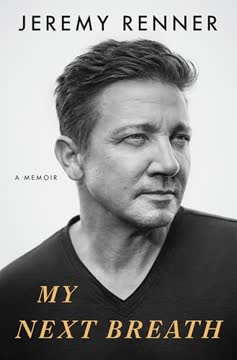
Key Takeaways
1. Action is Everything, Especially in Crisis
I believe that the most important thing in life is to take action.
Commit to action. Jeremy Renner's core philosophy emphasizes decisive action over mere thought or emotion. He asserts that feelings alone cannot build bridges, feed the hungry, or save a life; only concrete steps lead to change and improvement. This belief system was deeply ingrained long before his accident.
Split-second decision. On New Year's Day 2023, a 14,000-pound snowcat slid uncontrollably towards his nephew, Alex, who was trapped. Without a moment's hesitation, Renner attempted a perilous leap to the machine's cab to hit the emergency stop button. This instinctive act, driven by love and his "action-first" ethos, was a direct manifestation of his lifelong commitment.
No choice but to act. He felt he had "one shot" to save Alex, prioritizing his nephew's life above his own safety. This pivotal, instinctual decision, though it led to his catastrophic injuries, defined the incident and underscored his belief in the power of a deed done, setting the stage for his arduous journey of survival.
2. Love for Family Fuels Unimaginable Strength
I live for that gang up at the house. They are my whole life, my heart.
Ultimate motivation. Renner's profound love for his extended family, especially his daughter Ava and nephew Alex, served as the primary engine for his actions and his will to survive. This deep connection transformed into an "immovable force" that compelled him to act without hesitation when Alex was in danger.
Sacrifice for loved ones. His attempt to save Alex from the snowcat embodied an "innate sense of 'rather me than him, rather me than anyone.'" Even after being crushed, the vivid images of his family, particularly Ava, fueled his desperate fight to breathe and return from the brink of death, refusing to leave them behind.
Collective healing. Recognizing the immense trauma his accident inflicted on his loved ones, Renner felt a deep responsibility to heal them through his own recovery. His fight for life and subsequent achievements became a shared journey, transforming their fear into hope and strengthening their bonds.
3. Conscious Breathing: A Lifesaving Skill
I need to head out on a quest to find the most fundamental thing to life: my next breath.
Early lessons. As a teenager, Renner unexpectedly attended Lamaze classes with his pregnant mother, learning explicit breathing techniques to control pain. This seemingly unusual childhood experience instilled in him a profound understanding of conscious respiration, which would later become a critical survival tool.
Survival on ice. After being crushed by the snowcat, with a collapsed lung and multiple broken ribs, natural breathing was impossible. He consciously willed each breath into existence, using guttural groans to confirm exhalation. This agonizing, manual breathing for 45 minutes was his immediate, desperate act of self-preservation.
Mind-body connection. His lifelong practice of conscious breathing as an anti-stressor and a way to connect with his body proved invaluable. Amid excruciating pain and disorientation, he leveraged "body awareness" to focus on respiration, preventing panic and cementing his relationship with his body as a tool for survival.
4. Facing Fears Prepares You for the Ultimate Test
When I found myself getting afraid of something, I decided to simply go right at it, right into it, until it was no longer scary.
Decade of defiance. From his early twenties, Renner embarked on a decade-long process of systematically confronting his fears. He would meticulously write down each fear and actively work to overcome it, transforming anxiety into actionable steps and building profound inner fortitude.
Practical application. His fear-facing regimen included:
- Singing karaoke five to six days a week to conquer stage fright.
- Earning a master diver's license and swimming with sharks to overcome thalassophobia.
- Riding a mechanical bull for prize money, conquering physical apprehension.
Inner fortitude. This continuous practice ingrained a pattern of resilience within him. By the time of the snowcat incident, facing adversity had become reflexive, allowing him to confront the "ultimate fear" of death with a deep-seated ability to push through terror and fight for survival.
5. Death is Not to Be Feared, But a Beautiful Connection
I knew then, as I know now to this day and will always know: Death is not something to be afraid of.
Electric serenity. When Renner's heart rate plummeted to 18 beats per minute on the ice, he experienced a profound sense of death. He described it as an "exhilarating peace," a state of "electric serenity" where he was connected to everything and everyone, beyond time and space.
A new perspective. This near-death experience revealed death as a "magnificent" and "exhilarating" return to a pure, eternal energy. It confirmed his belief that love is the only lasting currency, outliving temporary emotions like hatred and fear, which eventually "burn out."
Live now. Returning from this state, he brought back "cheat codes" for life: a renewed sense of purpose and the imperative to "Live your life now." Death, for him, became a confirmation of life's continuity and the eternal nature of love, removing all fear of its inevitability.
6. Perspective Transforms Trauma into Triumph
My honest perception of the incident was, and is, and will always be, that it was a glory moment. I didn’t fucking die.
Choosing joy. Despite catastrophic injuries, Renner consciously chose to view the incident as a "glory moment" and a "victory of love and perseverance." This radical shift in perspective allowed him to frame his survival as a triumph, rather than a tragedy, for himself and his loved ones.
No more "bad days." He adopted the mantra, "I have the blessings of knowing what a bad day really is, and I’ll never get to have another one ever again." This mindset eliminated trivial worries, focusing his energy solely on gratitude and the relentless pursuit of recovery.
Fueling recovery. This positive outlook wasn't naive optimism but a deliberate strategy to harness his "superpower" of finding joy amidst suffering. By reframing his experience, he transformed potential despair into a powerful motivation for healing and inspiring those around him.
7. Recovery is a Collective Journey, Driven by Accountability
I had invited the people I loved into a hellscape of my own making. And the only way I could save each of those people from that hell was to survive in the first instance, and then power through recovery, dragging them with me as I did so.
Shared trauma. Renner recognized that his accident profoundly impacted his family and friends, causing them immense emotional pain and trauma. He felt a deep sense of responsibility for the "hellscape" he had inadvertently created for them.
Healing together. His recovery became a collective effort, driven by his desire to "change the narrative, rewrite the script, reshoot the ending" for everyone involved. Every milestone he achieved was a step towards healing their hearts and minds, transforming their fear into hope.
Love as a bond. The incident deepened his family's bonds, turning the snowcat into a "bat signal for that love." His commitment to getting better was fueled by accountability to his loved ones, ensuring that his survival served as a testament to their shared resilience and enduring affection.
8. The "Worst Patient Ever" Mentality Accelerates Healing
I was a pain in the ass. But I was also a fighter.
Impatience for healing. Renner's intense desire to escape the hospital and accelerate his recovery earned him the title "Worst Patient Ever." He viewed hospitals as places for fixing, not healing, and his impatience stemmed from a deep-seated need to regain control and return to normalcy.
Stubborn determination. Despite being hooked to multiple machines and needing blood transfusions, he made multiple comical escape attempts. This "lifesaving stubbornness" was not bullying, but rather a fierce self-motivation to push his body and mind forward, rejecting complacency.
Humor as a gauge. Even amidst his "tyrannical" demands and rants, he used humor to gauge his lucidity and provide relief to his caregivers. His relentless drive, though challenging for others, was an essential part of his unique, self-directed path to healing.
9. Redefining Pain: Mind Over Body
Pain is my bitch; I own it. It doesn’t own me or dictate my spirit.
The Agreement. Renner developed a unique "Agreement" with his body to manage excruciating pain. He treated his injured leg as a separate, "freeloading roommate," engaging in verbal arguments to reprogram his brain's interpretation of pain signals.
Reprogramming nerves. By consciously reframing pain as "discomfort" or "stiffness," and visualizing it as an "iPhone notification" to be swiped away, he created new neuro pathways. This process, which he believed took 28 days to solidify, allowed him to reduce the intensity of his suffering.
Pain as language. He understood that physical pain is an "earthly experience" and a "language" that can be reinterpreted. This mental mastery over his body's signals enabled him to push through agony, demonstrating that perspective and intention can profoundly alter one's experience of suffering.
10. Eliminating White Noise Reveals True Purpose
What had disappeared was the white noise in my life. In this new reality, I could so clearly see what I needed without extraneous and pinching distractions.
Clarity from catastrophe. The snowcat incident stripped away all non-essential elements of Renner's life, leaving him with profound clarity. The "white noise" of trivial concerns, career anxieties, and social media distractions vanished, revealing his true priorities.
Purposeful living. This newfound clarity led to a simpler, more intentional existence. He now focuses solely on his physical health and family, recognizing that these are the foundations for his emotional and spiritual well-being. He no longer thinks, "What should I do next as an actor?"
Superpower of focus. He views his injuries not as ailments but as a "superpower" that allows him to ask, "What do I want to focus on? What do I no longer want to run from?" This distilled perspective enables him to live a life filled with love, honor, humility, and gratitude, free from superficial demands.
11. Milestones Over Tombstones: The Power of Incremental Progress
Milestones over tombstones became an inner mantra in my recovery.
Incremental goals. Renner's recovery strategy involved setting and celebrating small, achievable milestones daily. From sitting up to opening his mouth, each tiny improvement was deemed as important as running a 4.5-second 40-meter dash, fostering a continuous sense of progress.
No hierarchy of healing. He rejected the idea of a hierarchy in recovery, treating every step, no matter how simple, as a vital contribution to his overall healing. This approach prevented self-serving ego from hindering his progress, as he recovered for others as much as for himself.
Relentless pursuit. His determination to be "better than before" was unwavering. This mindset, combined with his belief in love and perseverance, propelled him to defy medical predictions, eventually running again and returning to work, proving that consistent, purposeful effort leads to extraordinary outcomes.
Last updated: