

Key Takeaways
Build touch, balance, and awareness through play before adding complexity
The street was his first coach. Growing up in Amsterdam, Cruyff played wherever he could. A kerb became a wall for a quick pass; uneven concrete forced him to adjust his balance and control on the fly. He later argued that young players need varied, playful practice, not just drills on perfect pitches. His childhood at Ajax added a different education: he helped care for the grounds, and learned that the playing surface, equipment, and changing room were part of the game, too.
Standards start small. Cruyff carried those lessons into coaching. He wanted players to clean their boots and respect the pitch, because looking after tools builds awareness of the environment and responsibility to teammates. The point is not nostalgia for hardship. It is that skill grows through repeated contact with real problems.
What's striking is how closely this account resembles ecological approaches to learning: skill develops through interaction with a changing environment, not by rehearsing movements in isolation. A bouncing ball, a tight space, or an awkward surface asks the player to perceive and adapt. That helps explain why street play could build improvisation. But rough conditions are not automatically better; injury risk and unequal access matter. The useful lesson is to preserve variety and decision-making in practice, while making play safe and welcoming.
Treat mistakes as feedback, not verdicts, and keep moving
Errors became instruction. Cruyff describes his development as a steady process of trying, failing, noticing what went wrong, and moving on. His youth coach Jany van der Veen taught technique through games that made room for creativity. Rinus Michels brought discipline and tactical discussion, often taking the young Cruyff aside to work through how the team should respond when a plan broke down. The lessons were absorbed over years, not delivered as a single system.
Look beyond football. Playing baseball as a catcher taught Cruyff to scan the field and decide where the next throw should go before receiving the ball. He later applied the same anticipation to passing in football. He did not need to remember every match in detail; he valued understanding the process and carrying a lesson into the next one. Repetition made quick judgment possible, while reflection kept it improving.
This is a practical account of expertise as stored experience. In fields from surgery to chess, skilled performers often recognize patterns quickly because they have encountered many variations, not because they consciously calculate every option. Cruyff's baseball example makes that transfer visible: scanning and acting ahead of the ball mattered in both sports. Still, moving on should not mean skipping review. Good learning needs a clear signal about what failed, followed by another attempt. Otherwise, repetition can simply harden the same mistake.
Organize space so the ball, not endless running, does the work
Total Football is coordinated movement. Cruyff uses the term for a system in which players exchange positions while preserving the team's shape, so defenders can attack and forwards can defend. The controlling problem is distance: teammates need to stay close enough to support one another, while possession should stretch the opponent and losing the ball should compress the team's space. He describes organizing play through connected lines, with a goalkeeper who helps build attacks and a striker who begins the pressing.
Movement creates options. The player on the ball is not the only decision-maker. Teammates' runs create passing lanes, overloads, and space for the next action. Cruyff's example is a forward pressing a defender toward his weaker foot as a midfielder closes from the other side and a fullback fills the space behind. In moments, the team can create a numerical advantage without simply running farther.
The idea is a form of systems thinking: local actions, such as a forward pressing or a fullback stepping up, reshape the choices available to everyone nearby. The team's intelligence is distributed across its positioning rather than concentrated in one star's decisions. This also clarifies why spacing can matter more than raw effort. Yet a compact, high-pressure style demands technical ability, shared understanding, and careful risk management. It is not a plug-and-play formation; its apparent simplicity depends on extensive preparation.
Play to delight, but do not let success dull your concentration
The 1974 team made its case through play. Cruyff saw the Netherlands' 2-0 win over Brazil as a defining performance. The team attacked with speed, shifted positions, and used technique to control space. Its football attracted worldwide attention, even though the Dutch had not won the tournament before. For Cruyff, entertaining the public was part of the job, not decoration added after the result.
The final exposed a different weakness. The Netherlands scored early against West Germany after a long passing move, but lost 2-1. Cruyff believed the team had become too relaxed after beating Brazil and failed to match Germany's focus. He also points to missed chances and small defensive errors. The defeat did not erase what the Dutch had shown, but it did show that attractive play and confidence cannot substitute for attention in the decisive moments.
The distinction between playing well and winning is central here. In performance research, outcomes can obscure the quality of the process: a good decision may fail, and a poor one may succeed through luck. Cruyff's account rightly resists treating a trophy as the only measure of a team's contribution. At the same time, the final is a useful warning against romanticizing style. Spectacle earns admiration, but elite competition punishes lapses. A strong culture must value both the quality of play and the discipline to sustain it under pressure.
Put family safety ahead of public expectations, even when silence invites blame
A private danger changed a public decision. In 1977, an armed man entered the Cruyffs' Barcelona home and tied Johan up while his family was there. Afterward, police guarded the family around the clock for months. Cruyff decided not to play in the 1978 World Cup in Argentina. He did not tell the full story publicly at the time, and Dutch fans and commentators speculated about his reasons, sometimes blaming his wife Danny.
He chose what he could protect. Cruyff later acknowledged that missing the tournament left him wondering whether he had lost a chance to become world champion. But leaving his family behind while they felt threatened was not a real option for him. The episode shows how a choice can look like a career sacrifice from the outside and still be the only responsible choice from within a family's circumstances.
This decision illustrates a basic principle of judgment under uncertainty: the visible reward, a World Cup, does not capture the full cost of a choice. Safety, responsibility, and the well-being of dependents belong in the calculation even when outsiders cannot see them. The years of silence also show the social cost of privacy for public figures, since an information vacuum invites speculation. That does not make disclosure obligatory. It does suggest why audiences should be cautious about treating a famous person's unexplained decision as evidence of selfishness.
Put football decisions in informed hands, and keep the board out of the changing room
Cruyff built teams around complementary expertise. As Ajax's technical director, he used specialist coaches for areas such as fitness, goalkeeping, and scouting, while focusing himself on technique and tactics. At Barcelona, he insisted that the coach lead football matters and that directors not intrude into the changing room. His teams were designed around fit and cooperation, not simply a list of the eleven most celebrated players. Barcelona won its first European Cup under his leadership in 1992 and the league four times in succession from 1991 to 1994.
Governance could undo good work. Cruyff's accounts of Ajax and Barcelona repeatedly turn on conflict between sporting staff and executives. He believed that leaders without football knowledge should rely on those who had it. His later proposal for Ajax's technical heart, a group of former players and coaches guiding football decisions, reflected the same principle: give specialists responsibility, then hold them accountable for results.
This is a strong case for matching decision rights to expertise. Organizational design works better when the people who understand a problem can act on it, rather than translating every choice through a distant hierarchy. Cruyff's use of specialists also anticipates modern interdisciplinary teams. There is a necessary counterweight, however: expertise does not eliminate conflicts of interest or guarantee sound judgment. A club still needs transparent goals, clear accountability, and oversight. Autonomy works best when it protects informed decisions without turning any one expert into an unquestionable authority.
When unfamiliar success turns to ruin, return to work you know
A football star learned he was no pig farmer. After retiring in 1978, Cruyff invested in a pig-breeding venture and land plots without checking the paperwork. His father-in-law Cor Coster discovered that there were no deeds to the land. Cruyff lost much of his property and later described the investment as a costly lesson in pretending to understand a business he knew nothing about.
Starting over meant returning to football. Cruyff moved to the United States and signed with the Los Angeles Aztecs, then the Washington Diplomats. He valued the experience of American sports organizations, including their use of specialists and the connection between school and sport. After a spell in the United States, he returned to play for Ajax and Feyenoord, winning league titles with both. The recovery was not a clever investment strategy. It began when he stopped improvising in an unfamiliar field and went back to the work he understood.
The pig-farm episode is more than a story about bad luck. It exposes the danger of confusing general confidence with transferable expertise. Research on decision-making calls attention to domain specificity: success in one complex field does not reliably predict skill in another. Cruyff's recovery also depended on Coster's financial guidance, which makes the lesson less solitary than the comeback narrative suggests. Returning to a strength mattered, but so did accepting help and building safeguards around a known blind spot.
Give children access to sport, and judge impact by participation, not polish
One successful kick changed how he saw coaching. In Washington, Cruyff led football sessions for children with disabilities and became frustrated when the children did not follow instructions as he expected. Organizers asked him to watch a video of a session and notice the children's expressions, and their parents' relief. The achievement was not a perfect pass. It was a child enjoying movement, gaining confidence, and joining other children in play.
That experience shaped the Cruyff Foundation. The foundation created accessible places to play, including Cruyff Courts, small neighborhood pitches. By 2016, the book reports 208 such courts worldwide. The project also developed Playground 14, which brought play spaces to schools. Cruyff's larger point was practical: children need places and chances to move, regardless of ability or background, and a small intervention can open a door to wider participation.
The story aligns with inclusive design: environments should be judged by who can use them, not only by how efficiently they serve the already skilled. It also shifts the measure of success from performance to belonging. A child joining a game can matter more than a technically polished session. That insight should not be mistaken for a claim that sport alone resolves disability or social exclusion. Access requires sustained support, appropriate adaptation, and listening to participants. The foundation's value begins with making participation possible, not promising a cure.
Train fundamentals individually, then make them work inside a team
The simple skills need deliberate work. Cruyff's Ajax youth training emphasized controlling, passing, dribbling, shooting, and heading. A clean one-touch pass may look effortless, but it rests on repeated practice. He was wary of training that prized running for its own sake. Players should learn to use position and the ball to reduce unnecessary movement, while improving the small technical details that decide whether a move succeeds.
Small-sided play connects skill to judgment. Cruyff favored six-a-side games because they create frequent touches, close pressure, and simple positional relationships. Players have to protect a teammate, track an opponent, and use the ball carefully, not merely repeat a movement without context. As a coach, he also wanted players to solve problems rather than receive every answer from the touchline. The objective was to build individual ability and make it useful within the group.
This combines deliberate practice with representative learning: players rehearse core skills, then use them in situations that resemble the decisions of a match. Small-sided games increase involvement and make errors visible quickly. The approach is more demanding than either pure drills or unstructured play alone. It also challenges the assumption that fitness is best measured by distance covered. Still, training should fit the players' age, health, and level. Cruyff's preference for a method is most useful as a design question: what practice makes the next game easier to read?
Treat talent as borrowed, and use it to improve life beyond the pitch
Achievement did not end with trophies. Cruyff often described his footballing ability as a gift, while emphasizing the work and relationships that developed it. His wife Danny helped anchor family life through moves, public scrutiny, and career upheaval. In 1991, after a double heart bypass, Cruyff stopped smoking. He used a public-service film about his smoking to make the health risk legible to others, rather than returning to football as though his body had no limits.
He carried sport into institutions. The Cruyff Foundation built places for children to play, and the Cruyff Institute offered education in sports management. Both grew from his belief that practical knowledge should be shared and that athletes should not have to choose between sport and education. His Fourteen Rules for courts and schools translated team values into everyday conduct, from responsibility to creativity.
The movement from personal excellence to public infrastructure is a compelling model of legacy: knowledge becomes durable when it is embedded in places, programs, and other people's capabilities. The heart surgery adds a sharp reminder that expertise does not exempt anyone from physical limits. Yet the language of talent as a gift can understate the social conditions that make excellence possible, including mentors, family support, and institutions. Cruyff's own story supplies that correction. Individual ability matters, but it is cultivated by a network and gains wider value when returned to one.
Analysis
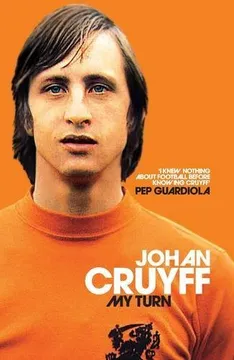
My Turn is not simply a record of trophies. It is Cruyff's attempt to explain football as a way of seeing: notice the available space, anticipate what others can do, and arrange people so that the whole becomes more capable than its parts. His life supplies the argument. Street football becomes perception and balance; baseball becomes anticipation; Ajax becomes a learning community; Barcelona becomes a designed system. The same logic shapes his coaching and his institutional proposals. Put expertise where it can act, make individual strengths serve collective play, and keep asking how the work can improve.
The memoir's most revealing tension is between collaboration and personal authority. Cruyff argues for specialists, shared responsibility, and club identity, yet his own uncompromising standards repeatedly bring him into conflict with boards and colleagues. That tension is not merely a flaw to be edited out. It shows how a powerful vision can protect a craft from short-term political interference, while also making compromise difficult. His autobiography is necessarily one person's account of disputes, so its descriptions of motives and blame should be read as interpretation, not neutral institutional history.
The book is strongest when its abstractions arrive attached to concrete scenes: a child learning to play, a goalkeeper used as an attacker, a family choosing safety over a tournament, a coach recognizing that the point of an adapted session is joy rather than precision. These episodes make football's technical ideas legible beyond sport. They also temper the myth of the lone genius. Cruyff's own account depends on mentors, teammates, family, and specialists. His lasting contribution is therefore not only a style of play, but a method of attention: study the situation, find the small adjustment that changes it, and build conditions in which other people can do their best work.
Review Summary
Reviews for My Turn are mixed, averaging 3.62/5. Many readers admire Cruyff's candidness and insights into football philosophy, tactics, and his contributions to Ajax and Barcelona. However, common criticisms include excessive self-serving narratives, repetitive complaints about management disputes, and a lack of depth regarding his playing career's greatest moments. Some found the book poorly edited and overly focused on score-settling. Others appreciated the personal glimpse into Cruyff's life, philosophy, and lasting influence on the game.
Glossary
Total Football
Fluid, coordinated team playCruyff's term for a style in which players can exchange positions while the team maintains its shape and attacking purpose. It depends on technical skill, disciplined movement, close support, and awareness of space. The goalkeeper participates in building attacks, while forwards help defend by pressing. It is a collective system, not simply a formation or a license for players to roam.
five lines
A linked team structureCruyff's way of organizing players into connected bands across the pitch, from the defensive line through midfield and attack. The lines must remain close enough to support one another, while positioning changes according to possession. The structure helps create passing options, pressure opponents, and reduce the space available after losing the ball.
technical heart
Shared football leadership groupA football decision-making structure proposed for Ajax, built around the head coach and former players with relevant expertise. Rather than concentrating technical policy in one technical director, the group would guide football matters across the club. Cruyff presented it as a way to connect the first team, youth development, and scouting through people who understood the game.
Cruyff Courts
Accessible neighborhood playing fieldsSmall football pitches developed through the Cruyff Foundation to give children places to play in their neighborhoods. The courts are intended to encourage participation, activity, and shared use, including by children who may not belong to a traditional sports club. Cruyff saw them as practical infrastructure: make a place to play available, and more children can take part.
The Fourteen Rules of Johan Cruyff
Sport's everyday valuesA set of fourteen principles displayed at Cruyff Courts and school sports grounds. The rules connect sport with conduct outside it, covering ideas such as teamwork, responsibility, respect, inclusion, initiative, coaching, technique, learning, and creativity. Cruyff intended them as simple prompts for how people treat one another and contribute to a shared activity.
Download PDF
Download EPUB
.epub digital book format is ideal for reading ebooks on phones, tablets, and e-readers.








