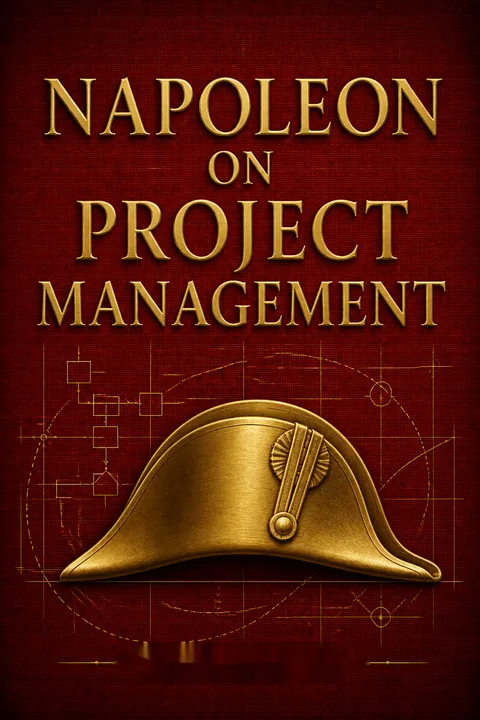


Key Takeaways
Run projects like campaigns: align purpose, people, and execution before momentum.
A campaign needs a cause. Jerry Manas uses Napoleon’s rise and defeats to argue that project management is not just scheduling tasks. It is leadership through a changing effort: understand the need, prepare the team, coordinate resources, and adjust as conditions shift. Napoleon led military campaigns and large rebuilding programs, from financial reforms to roads and civil law, while France was still reeling from revolution and war.
Success came from a system. The book groups Napoleon’s practices into six connected principles covering preparation, pace, adaptability, clarity, character, and morale. The point is not to copy a nineteenth-century emperor. It is to treat an initiative as a coordinated campaign, where plans, people, and purpose must reinforce one another.
The campaign metaphor makes project leadership vivid because it emphasizes dependencies, uncertainty, and collective effort rather than paperwork. It also reminds readers that a deliverable is not the same as a successful outcome: Napoleon’s reforms mattered because they changed how France functioned. The analogy has limits, though. Business projects rarely involve life-or-death stakes, and employees are not troops to be commanded. The most useful transfer is disciplined coordination, not military hierarchy or unquestioned obedience.
Solve the real problem before selling a polished destination.
Start with the need. The book separates a compelling vision into three parts: a problem that matters, a strategy for addressing it, and a clear picture of the intended future. Napoleon faced a country exhausted by revolution and instability. His early program emphasized order, economic recovery, and equal treatment under law, rather than beginning with an abstract promise of glory.
Make the aim testable. He tracked the finances of France’s communes and set staged goals: get them out of debt within five years, then make them prosperous within ten. For project leaders, tools such as the Five Why’s can help uncover the root cause behind a request. Objectives should be specific, measurable, aligned with the broader purpose, realistic, and tied to a timeframe. A vision should also account for stakeholders’ needs, not just the sponsor’s preferred solution.
This is a strong antidote to solution-first thinking. A team can execute a request flawlessly and still fail if the request addresses the wrong problem. The distinction between a mission and a vision is useful, too: purpose explains why work exists, while the future state shows what success looks like. The challenge is that stakeholders may disagree about the problem itself. In that case, measurement and open debate are more reliable than simply polishing a persuasive story.
Keep the plan alive: research, track, and refine as reality changes.
Plan in layers. Before campaigns, Napoleon studied terrain, previous battles, troop positions, and potential risks. For a project, the equivalent is learning the technical and organizational landscape, consulting people who have done similar work, and identifying likely trouble before it arrives. The book advises moving forward with enough information to make a reasoned decision, rather than waiting for certainty that may never come.
Refine near the work. Rolling wave scheduling means planning the whole effort at a high level, then adding detail as each phase approaches. The book suggests phases of roughly ninety days as a useful planning horizon. Interim deliverables make progress visible. Earned Value Management compares the value of completed work with the time and money spent, exposing a project that appears on budget only because little has actually been finished. Revisit risks and plans throughout, not just at kickoff.
This approach combines foresight with humility. A plan is a model of the work, not the work itself, so its accuracy should improve as evidence accumulates. Shorter planning horizons also make assumptions easier to test before they become expensive. Metrics need care, however. Teams can optimize for reported completion rather than useful outcomes, especially when estimates are treated as promises. A useful review asks not only whether the numbers are green, but whether the delivered result is solving the original problem.
Concentrate scarce talent on the work that can unlock everything else.
Focus creates speed. In the Ulm campaign, Napoleon shifted roughly 200,000 troops from the Channel coast toward Austria, while assigning about 50,000 to a secondary effort in Italy. The main force moved rapidly, used reconnaissance, and surrounded an Austrian army before Russian support arrived. The lesson is not to give every objective equal resources. Put enough capacity behind the work that determines success, and keep secondary demands from consuming the critical team.
Protect constrained people. The book connects this strategy to Economy of Force and Critical Chain Project Management. In project settings, identify scarce roles, schedule around their availability, and avoid making them juggle too many active tasks. Extra people do not always accelerate work: they can add coordination costs, training time, and interruptions. Use remaining capacity deliberately, rather than launching more projects simply because someone appears available.
The insight is especially useful in organizations where every initiative is called urgent. Treating all work as equally important guarantees competition for the same specialists. A focus on bottlenecks can improve flow, but it should not become an excuse to neglect supporting work. A neglected secondary task may turn into the next constraint or create a risk that blocks the main objective. Good prioritization therefore includes regular checks that the chosen focus still reflects the actual system.
Give teams freedom inside a shared mission, not a maze of approvals.
Delegate with context. Napoleon’s army combined central planning with decision-making by its separate corps. Commanders received the campaign’s purpose and broad guidance, then adapted locally and reported changes. In project work, a project concept should explain the situation, intended outcome, approach, priorities, and how to communicate important changes. A work package assigns a defined deliverable to an owner, who plans its detailed execution and flags changes that affect the larger project.
Keep the force coherent. Delegation works only when people have the ability and information to act. The book emphasizes shared methods, common terminology, frequent updates, and one accountable leader for related work. At Ulm, Marshal Murat ignored instructions and allowed some Austrian troops to escape. The episode illustrates the risk of delegating to someone without the right judgment, as well as the cost of instructions that are not followed.
This is a practical balance between autonomy and coordination. Detailed approval chains slow local decisions, while unchecked autonomy can fragment an effort. Clear intent gives people a basis for choosing well when circumstances change. But delegation is not simply handing off responsibility and disappearing. It requires suitable skills, access to information, and a safe route for escalating uncertainty. A shared method should create interoperability, not force every team into identical procedures when their work differs.
Make objectives, messages, and operating rules simple enough to survive pressure.
Clarity reduces friction. Napoleon favored straightforward objectives and brief orders, while keeping detailed coordination behind the scenes. At Ulm, the central aim was to reach and surround the Austrian force before the Russians could reinforce it. A project leader can use the same discipline: state the outcome plainly, explain what matters most, and avoid burying the request beneath unrelated detail.
Simple does not mean vague. The book warns that a short instruction can still be misunderstood if it omits essential context. It also argues for lean processes: enough structure to coordinate work, but not so much bureaucracy that the process becomes the work. Napoleon used consistent reporting systems across government functions, making information easier to compare. For teams, common templates and concise procedures can help, provided they leave room for sound judgment.
Simplicity is a form of cognitive support. Under pressure, people have less capacity to interpret tangled goals, conflicting messages, and elaborate procedures. Clear priorities reduce the number of decisions that must be reinvented in the moment. Yet simplifying can also hide important complexity, especially in safety-critical or highly regulated work. The goal is not fewer words at any cost. It is to make the essential distinctions visible, while retaining the detail needed to prevent costly misunderstanding.
Treat integrity and composure as operational tools, not personal decoration.
Trust is part of execution. The book presents character through consistency between values, words, and actions; steadiness under pressure; and ownership of decisions. Napoleon’s treatment of conquered communities sometimes reflected his stated commitment to equality, and he reprimanded soldiers who abused local people. The wider lesson is that leaders cannot credibly demand respect while tolerating behavior that contradicts their stated standards.
Stay calm without pretending nothing hurts. Napoleon tried to keep a composed public presence, which the book links to team confidence and clearer judgment. When news is bad, assess the facts before reacting; when it is good, avoid declaring victory before the work is complete. Responsibility also means speaking thoughtfully, considering the audience, and raising serious concerns when a plan appears likely to fail.
Character is not separate from performance. People are more willing to surface problems when they expect fair treatment, and a leader’s reaction can either preserve or destroy that channel. Composure is valuable because it slows contagious panic, but emotional suppression is not the same as resilience. Leaders can acknowledge uncertainty or strain without offloading fear onto the team. The practical test is whether honesty, respect, and accountability remain visible when deadlines and status are under pressure.
Build morale with stability, meaningful work, public credit, and tangible rewards.
Morale needs conditions. The book calls this motivational force a combination of order, purpose, recognition, and rewards. Napoleon prepared and organized his troops, made the mission understandable, and publicly described what they had achieved. After Austerlitz, he rewarded soldiers, supported families of those killed, and highlighted acts of courage. Recognition gave effort a public meaning; material support showed that praise was not the only return.
Make contribution visible. In a project, teams need clear expectations, preparation, and a reason their work matters. Celebrate concrete accomplishments, credit contributors, and make rewards proportionate to the effort. Include people outside the immediate team when their work helped deliver the result. The book’s argument is that recognition can build confidence and encourage others to contribute, while meaningful rewards signal that collaboration is valued.
The mix of purpose, recognition, and tangible support is stronger than relying on inspirational speeches alone. It joins symbolic value with material reciprocity, which makes appreciation credible. The important nuance is fairness: rewards can damage morale if they appear arbitrary or favor visible roles over essential behind-the-scenes work. Recognition should describe real contributions, not inflate results to manufacture confidence. Teams also need reasonable workloads and adequate resources; praise cannot compensate for chronic exhaustion or poor working conditions.
Win real allies by listening to the people who bear the cost of change.
Compliance is not commitment. Napoleon often succeeded by studying local needs and making agreements. In Italy, he paired military victories with reforms and negotiated moderate settlements. In Egypt, he learned about local customs before asking his soldiers to respect them. His later intervention in Spain followed a different pattern: he trusted reports from elites, underestimated popular resistance, and installed a new ruler. The resulting rebellion consumed resources and damaged his position across Europe.
Map interests before acting. Project leaders should ask who is affected, what each group needs, and who has influence over adoption. If resistance persists, building support elsewhere may create momentum, but it does not erase the need to understand legitimate objections. When disputes exceed a leader’s authority, mediation or referral upward can be safer than becoming a partisan in someone else’s conflict.
The Spanish episode exposes a recurring weakness in top-down change: leaders often mistake access to powerful representatives for knowledge of the people affected. Stakeholder consultation is not a popularity contest, and not every request can be granted. Its value is diagnostic. It reveals tradeoffs, hidden costs, and practical barriers before they harden into resistance. Listening also needs to be consequential. If feedback cannot change a decision, leaders should explain why, rather than stage participation that only creates the appearance of consent.
Set stop rules, protect capacity, and know when ambition has become damage.
A winning record can still end badly. Napoleon’s 1812 invasion of Russia began with a force of hundreds of thousands. Despite reaching Moscow, his army was devastated by disease, heat, hunger, scorched-earth tactics, and an early winter. He had planned to stop at Smolensk, but continued after repeated chances to halt or revise the campaign. Only a small fraction of the original force returned. At Waterloo, exhaustion, poor appointments, delays, and miscommunication compounded the final defeat.
Define limits before commitment. For major projects, test “what if” scenarios, prepare for large or distributed teams, and establish decision points where sponsors can continue, change, pause, or end the effort. Watch for overwork and declining morale, not just missed milestones. Leaders also need a sustainable pace: burnout can weaken judgment, relationships, and execution long before it becomes visible in a status report.
Stop rules counter the sunk-cost trap: past spending can feel like a reason to continue, even when the expected value has collapsed. Pre-agreed review points make it easier to distinguish persistence from escalation. Planning cannot predict every shock, as Napoleon’s campaign demonstrates, so resilience matters as much as forecasting. That means preserving options, maintaining reserves, and treating human capacity as finite. A project that reaches its target by exhausting its people may be a delivery success and an organizational failure.
Analysis
The book’s most useful move is to recast project management as a human coordination problem rather than a technical scheduling exercise. Napoleon’s campaigns provide memorable tests of that idea. Ulm illustrates how intelligence, speed, and concentrated effort can exploit an opponent’s slow response. Austerlitz shows how preparation and morale can make a smaller force appear more capable. Spain and Russia reveal the opposite: strategic brilliance cannot rescue a leader who misreads public sentiment, overextends resources, or mistakes persistence for sound judgment.
The six-part leadership model works best as a set of interacting questions, not a universal recipe. Is the team seeing enough of the situation? Is the goal clear? Can people adapt? Are the right resources focused? Does the leader deserve trust? Do contributors believe their work matters? This systems view is more valuable than treating any single trait, such as speed or discipline, as a guarantee of success.
The historical analogy also needs restraint. Military command relies on authority and coercion in ways that ethical workplace leadership should not. The book’s project-management vocabulary is applied retrospectively to Napoleon, so the stories illustrate concepts more convincingly than they prove that modern methods descend from his practice. The reader should borrow the questions, not assume that every claim about historical priority or business effectiveness is established evidence.
The most durable lesson is the book’s double vision: build conditions for execution, then watch for the leadership failures those same conditions can enable. Confidence can become self-righteousness, focus can become obsession, and delegation can become neglect. Effective project leadership therefore needs both a forward plan and a mechanism for correction. Success is not simply reaching the objective. It is reaching a worthwhile objective without losing the people, judgment, or legitimacy needed to sustain the result.
Review Summary
Napoleon on Project Management receives mixed reviews, averaging 3.64/5 stars. Readers appreciate the unique blend of history and management principles, finding it informative and enjoyable. Some praise its insights on leadership and pragmatic approach, while others note it's more history-focused than business-oriented. The book's strengths include its interesting take on Napoleon's life, easily digestible business context, and valuable project management principles. However, some reviewers mention repetition and a thin treatment of historical content. Overall, it's recommended for those interested in both Napoleonic history and management concepts.
People Also Read



Glossary
Six Winning Principles
Integrated leadership guideManas’s framework for translating Napoleon’s successes into project leadership. It groups the book’s lessons into six connected areas: preparation and awareness, timely action, adaptability, clarity, trustworthy conduct, and team motivation. The principles are intended as a compass for judgment, not rigid rules to follow regardless of circumstances.
Four Critical Warning Signs
Risks that derail leadersA framework for recognizing leadership conditions that can undermine project success: power that isolates or breeds impatience, overzealousness that leads to obsession or impulsive choices, too few effective leaders, and an unbalanced lifestyle that produces burnout. Each warning sign points to problems that can weaken judgment, morale, and execution.
coup d’oeil
Rapid situational judgmentA French term used in the book for quickly grasping a situation and judging what action fits. Manas connects it to broad visibility, careful observation, experience, and frequent communication. It may look like sudden intuition, but the book presents it as judgment built from accumulated knowledge and practice.
Economy of Force
Focus resources on prioritiesA strategy of concentrating the largest effective share of available resources on the primary objective while assigning only the necessary minimum to secondary aims. It does not mean leaving resources idle. Remaining capacity should be used strategically, while secondary work must not become so under-resourced that it obstructs the main effort.
rolling wave scheduling
Refine plans near executionA planning method that maps an entire project at a high level but details only the nearer phase. As work advances and more information becomes available, the next phase is planned in greater detail. The method recognizes that distant estimates are less reliable and keeps the schedule responsive to changing conditions.
Earned Value Management
Compare work value with costA project-control method that compares the planned value of work completed with actual spending and the value expected by that point. It can reveal a project that appears on budget or schedule only because spending and time have not yet produced enough deliverables. The book links it to phased, measurable outputs.
Critical Chain Project Management
Schedule around constrained resourcesA project scheduling approach associated in the book with Eliyahu Goldratt’s Theory of Constraints. It focuses attention on the sequence of work and scarce resources that most constrain completion, limits disruptive multitasking, and uses protective buffers to absorb uncertainty. Its purpose is to improve project flow and delivery reliability.
work package
Owned deliverable with broad guidanceA defined piece of project work assigned to an individual or team owner. The project manager specifies the deliverable and relevant objectives or guidelines, while the owner develops the detailed plan for completing it. The owner reports issues that could affect major project commitments, allowing local flexibility without losing overall coordination.
FAQ
1. What is Napoleon on Project Management by Jerry Manas about?
- Historical-Project Management Parallel: The book draws direct parallels between Napoleon Bonaparte’s military leadership and modern project management, using historical campaigns to illustrate timeless management lessons.
- Comprehensive Leadership Guide: It explores Napoleon’s rise, strategies, and eventual downfall to extract practical insights for planning, execution, and leadership.
- Six Winning Principles: Central to the book are Napoleon’s Six Winning Principles—Exactitude, Speed, Flexibility, Simplicity, Character, and Moral Force—each mapped to project management concepts.
- Dual Perspective: The book analyzes both Napoleon’s triumphs and failures, offering a balanced view of sustaining success and avoiding common leadership pitfalls.
2. Why should I read Napoleon on Project Management by Jerry Manas?
- Unique Historical Perspective: The book offers a fresh, engaging approach by blending military history with project management theory, making abstract concepts tangible and memorable.
- Actionable Leadership Advice: Each chapter ends with “Marching Orders,” summarizing key actions for immediate application, bridging theory and practice.
- Holistic Success Framework: It emphasizes not just technical skills but also character, motivation, and the human side of leadership, making it valuable for anyone leading teams or managing change.
- Lessons from Success and Failure: By analyzing both Napoleon’s victories and mistakes, readers gain insights into sustaining success and avoiding leadership pitfalls.
3. What are the key takeaways from Napoleon on Project Management by Jerry Manas?
- Six Timeless Principles: The book distills Napoleon’s approach into six core principles—Exactitude, Speed, Flexibility, Simplicity, Character, and Moral Force—that are directly applicable to modern project management.
- Stakeholder and Team Management: It provides practical advice on engaging stakeholders, building alliances, and motivating teams for project success.
- Balanced Leadership: The importance of balancing planning with action, and technical skills with integrity and morale, is emphasized throughout.
- Learning from History: The book demonstrates how historical examples can inform and improve contemporary leadership and project execution.
4. What are the Six Winning Principles in Napoleon on Project Management by Jerry Manas?
- Exactitude: Emphasizes thorough awareness, research, and continuous planning to minimize surprises and make informed decisions.
- Speed: Focuses on reducing resistance, increasing urgency, and concentrating resources to maintain momentum and capitalize on opportunities.
- Flexibility: Advocates for adaptable, empowered, and unified teams that can respond swiftly to changing circumstances.
- Simplicity: Encourages clear objectives, concise communication, and streamlined processes to reduce confusion and risk.
- Character: Highlights integrity, calmness, and responsibility as foundational leadership traits that inspire trust.
- Moral Force: Stresses the importance of motivation, purpose, recognition, and rewards to drive teams beyond their perceived limits.
5. How does Jerry Manas define and apply the principle of Exactitude in project management?
- Situational Awareness: Exactitude starts with visibility into projects, people, and external factors, using observation and analysis to develop a “coup d’oeil” or intuitive grasp of situations.
- Thorough Research: It involves studying the business landscape, reviewing past projects, and identifying risks to improve planning accuracy and avoid surprises.
- Continuous Planning: The book recommends rolling wave scheduling and ongoing risk management to keep plans aligned with reality and adapt to new information.
- Informed Decision-Making: Exactitude ensures decisions are based on data and experience, not guesswork, leading to better project outcomes.
6. What does Napoleon on Project Management by Jerry Manas say about the importance of Speed in projects?
- Critical for Momentum: Speed is essential to capitalize on opportunities, maintain focus, and prevent stakeholder disengagement, mirroring Napoleon’s rapid military maneuvers.
- Balance with Planning: The book warns that speed must be balanced with careful planning—haste without preparation leads to failure.
- Reducing Resistance: Speed is achieved by managing stakeholders, removing barriers, and focusing resources on critical tasks.
- Modern Methodologies: References to Critical Chain Project Management illustrate how to maintain speed through strategic resource allocation and buffer management.
7. How does Napoleon on Project Management by Jerry Manas recommend reducing resistance and increasing urgency in projects?
- Early Stakeholder Engagement: Involve stakeholders in goal setting and requirements definition to create shared vision and buy-in.
- Barrier Removal: Eliminate process inefficiencies, provide necessary tools and training, and resolve political conflicts to reduce resistance.
- Change Champions: Appoint change champions for major cultural shifts to influence and manage resistance systematically.
- Urgency Through Clarity: Clearly communicate the “why” behind tasks, manage deadlines wisely, and provide frequent progress updates to maintain momentum.
8. How does Jerry Manas describe the principle of Focus (Economy of Force) in Napoleon on Project Management?
- Concentrate Resources: Focus maximum effective resources on the primary objective, allocating minimal resources to secondary tasks to avoid diluting impact.
- Avoid Multitasking: Schedule projects around key resource availability and avoid simultaneous major goals to maintain momentum and prevent resource scattering.
- Strategic Resource Use: Use excess resources to supplement noncritical work or reserve for future needs, ensuring critical tasks get uninterrupted attention.
- Program Management: Group related projects into programs to maintain focus and strategic alignment.
9. What does Napoleon on Project Management by Jerry Manas say about building flexible and unified teams?
- Shared Resource Pools: Teams should have access to shared resources that can be mobilized across projects as needed, increasing responsiveness.
- Empowerment and Decentralization: Convey the overall project concept and use broad directives, allowing team leaders to plan details and make independent decisions.
- Unity of Command: Establish common methodologies, terminology, and leadership structures to ensure cohesion and avoid chaos.
- Adaptability: Flexibility enables teams to adjust plans quickly without losing alignment with overall objectives.
10. How does Jerry Manas define Simplicity in project management in Napoleon on Project Management?
- Clear Objectives: Focus on straightforward, high-level goals to reduce risk and confusion, often by consulting experienced individuals for the simplest effective solution.
- Concise Communication: Deliver one clear message at a time, avoiding vagueness and information overload to ensure understanding.
- Streamlined Processes: Keep plans high-level and delegate detailed tasks, balancing order and agility to avoid excessive bureaucracy.
- Empowering Simplicity: Simple administrative systems, like Napoleon’s civil code, empower judgment and adaptability rather than rigid rule-following.
11. What character traits and leadership qualities does Jerry Manas highlight from Napoleon in Napoleon on Project Management?
- Integrity: Consistently aligning values, words, and actions to foster trust and credibility, and upholding principles of equality and respect.
- Calmness: Maintaining composure in both adversity and success, inspiring confidence and enabling wise decision-making.
- Responsibility: Taking full ownership of actions and outcomes, advocating for ethical decisions, and practicing empathy in communication.
- Continuous Improvement: Leaders are encouraged to commit to self-improvement and to lead by example in all circumstances.
12. What is Moral Force according to Napoleon on Project Management by Jerry Manas, and how can leaders build it?
- Definition of Moral Force: Moral force is the spirit and motivation that drive teams to overcome obstacles and achieve beyond expectations, rooted in self-confidence, mission commitment, and trust.
- Order and Stability: Leaders build moral force by providing discipline, clear rules, and a sense of security through preparation and example.
- Purpose and Recognition: Instilling a sense of purpose, publicly acknowledging achievements, and offering tangible rewards inspire pride and ambition.
- Team Cohesion: Moral force is reinforced by creating a shared identity and celebrating contributions from all team members, fostering collaboration and loyalty.
Download PDF
Download EPUB
.epub digital book format is ideal for reading ebooks on phones, tablets, and e-readers.








