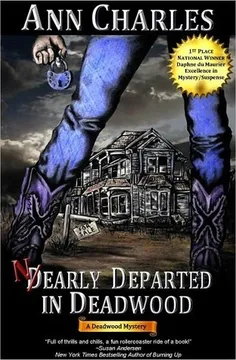


Plot Summary
Harvey's Shotgun Listing
Violet Parker has left a draining car-dealership job, moved her twins into Aunt Zoe’s Deadwood home, and started as a realtor with one last chance to prove herself. Her probation ends in three weeks, and she has yet to sell a house. Her first prospect, Willis Harvey, greets her with a shotgun because he mistakes her for someone pursuing his gambling debt.
Once Violet persuades him she is there to list his ranch, Harvey admits he wants to escape its lonely winters, broken fences, and strange noises near the barn. He agrees to work with her, but his weekly-dinner condition makes the deal as awkward as it is necessary. Violet leaves with a listing and little room for failure.
Violet’s professional risk is inseparable from her family life: losing the job would mean moving the twins again and returning to dependence on her parents. Harvey’s shotgun turns the realtor’s routine sales call into a blunt test of whether she can stay composed while frightened. Yet her willingness to bargain with him also shows the resourcefulness beneath her comic self-deprecation. Harvey is not merely a difficult client; his loneliness mirrors the isolation Violet fears for herself. The first contract therefore begins two linked pursuits: Violet needs economic stability, while the people she serves are looking for a place where they can belong.
Missing Posters, New Neighbors
At Calamity Jane Realty, coworker Ray Underhill tears down a fresh missing-child poster because he thinks it will scare away buyers. Violet keeps it: this is the second poster she has seen, and both girls are close to her blonde, nine-year-old daughter, Addy.
A potential seller, jewelry designer Wolfgang Hessler, arrives to list his late mother’s house, but Violet has to leave when her son, Layne, summons her home. On the way out, she trips over a box belonging to the new neighbor, Dane Nyce, whom everyone calls Doc.
He notices the missing girl’s picture with unsettling intensity. At home, Violet discovers Layne’s emergency is a horse skull dug from Aunt Zoe’s yard, its bullet hole thrilling the boy and deepening Violet’s sense that Deadwood hides more than old history.
The chapter makes the town’s commercial image collide with its children’s safety. Ray treats the poster as a threat to real-estate sales; Violet sees the face of a child whose resemblance to Addy makes the danger immediate. The contrast establishes her priorities before she has any evidence or authority. Wolfgang and Doc arrive through separate kinds of business, one offering a listing, the other appearing at the scene of Violet’s fall, yet both are marked by absence: Wolfgang’s family house is empty, and Doc seems to know more about the missing child than he explains. Layne’s skull brings the buried past physically into the family’s backyard.
Clowns Behind the Curtains
Wolfgang’s mother’s Victorian is neglected, packed with clown decorations, and marked by rumors about the family’s troubled past. Wolfgang explains that his sister, Wilda, died young and that his mother never recovered from the loss.
Violet signs the listing anyway, hoping a successful sale will persuade her boss to keep her. She recruits her childhood friend Natalie Beals, a capable contractor, to tackle repairs. Meanwhile, Doc becomes her first serious buyer, but his house tours are bizarre: he sniffs rooms and flees a house scented with gardenias.
The Hessler property brings another obstacle when Violet learns that historic-preservation approval could delay exterior work for months. With her deadline approaching, she must prepare a house she cannot yet repair and find a buyer willing to see past its decay.
The house concentrates the novel’s concerns with inheritance and concealment. Its clown-filled rooms preserve the mother’s taste, while its neglected exterior records the family’s retreat from ordinary life. Violet sees a commission where Wolfgang sees a burden, and her willingness to invest labor in the place reflects her own precarious effort to build a future from damaged circumstances. The preservation rules sharpen the irony: Deadwood protects its historic surfaces even as Violet’s own job is under immediate threat. Doc’s reactions suggest that the property’s past is not merely decorative or financial, though Violet initially interprets his behavior as another complication in her real-estate work.
The Wymonds' Trash Bag
Addy befriends Kelly Wymonds, whose best friend Emma disappeared the previous summer. Violet visits Kelly’s home and finds her father, Jeff, drunk, hostile, and unnervingly familiar with Addy’s appearance. Later, at a gas station, Violet sees Jeff secretly discard a bag of little-girl clothes. She retrieves it and finds a jacket marked with Emma’s initials.
Harvey then sneaks a look inside the Wymonds’ bedroom and reports a collage of the missing girls, with Addy’s picture among them. Anonymous bouquets and poems begin arriving at Violet’s office, adding a watcher to her growing list of worries. She cannot prove Jeff is involved, but the clothes, photographs, and his behavior make it difficult to trust him with either girl.
Violet’s suspicion grows through objects that have outlived their original context: a discarded jacket, a wall of photographs, and flowers whose sender remains unknown. Each clue invites a coherent but incomplete story, and Violet’s maternal fear makes the darkest interpretation feel persuasive. The Wymonds household also complicates a simple division between safe adults and dangerous strangers. Jeff is frightening, but Kelly is a grieving child whose friendship with Addy matters. Violet’s investigative instinct is therefore ethically fraught: acting on weak evidence might expose Kelly to further harm, while doing nothing could leave Addy vulnerable.
Every Girl Swam There
Violet studies the Rec Center’s old team photographs and recognizes Emma, Jade Newel, and Tina Tucker, the three missing local girls, among the swimmers. Jeff coached their team, turning coincidence into a pattern. Doc adds that Sherry Dobbler, a girl who escaped a recent abduction in nearby Spearfish, also spent time at the Rec Center.
Still, the police have already questioned Jeff, and Harvey warns Violet that suspicion is not proof. At lunch, Jeff tells her his marriage is breaking apart, his wife has left, and Kelly is struggling with grief. He asks Violet to sell his house so he can move closer to family. His troubles make him more human, but they do not erase the possibility that he knows something about the girls.
The team photograph gives Violet a concrete pattern, but not a verdict. That distinction matters: the image connects the girls through a shared institution, while Jeff’s role as coach creates opportunity rather than proof. The novel places amateur detection beside official procedure and asks Violet to tolerate uncertainty instead of turning fear into certainty. Jeff’s family crisis further unsettles her suspicions. His pain is real, and his daughter’s distress is visible, yet empathy cannot guarantee innocence. Violet’s attention to the children keeps the investigation grounded in individual lives rather than reducing them to a single ominous pattern.
The Empty Bike
After Addy fails to come home, Violet and Harvey search Deadwood’s library, cemetery, shops, and recreation center. At the Wymonds’ place, they find Kelly’s bicycle abandoned with a flat tire, but no girls. Doc joins the search, and after hours of fear, Jeff calls to say he has Addy. Violet races to the hospital, where Addy and Kelly are alive, shaken, and injured.
The girls had followed Addy’s chicken, Elvis, into an old mine opening; Addy fell into a shallow shaft and broke her arm. Jeff had pulled them out. His rescue undercuts Violet’s strongest suspicion, though it does not settle every question about the missing girls. Addy’s cast is a painful reminder that her impulsive rescues can put her in real danger.
The disappearance turns Violet’s abstract fear into bodily panic. Her search moves through familiar public places, each one transformed by the possibility that Addy has vanished there. The hospital reverses the apparent kidnapping plot: the girls are found through Jeff, not rescued from him, and their danger comes from an abandoned mine rather than a calculated abduction. That reversal forces Violet to revise her judgment without pretending her earlier fears were irrational. Addy’s broken arm also crystallizes the tension in Violet’s parenting. Protecting her daughter cannot mean controlling every choice, yet the cost of giving her freedom can be frighteningly literal.
Daisies and a Double
The anonymous flowers and poems lead Violet to a dinner arranged under Addy’s name. Her admirer is Benjamin Underhill, Ray’s nephew and the realtor waiting to take her job. Ben says he noticed Violet through Addy’s sidewalk sales and admits he once followed her home.
His attentions are unsettling, but he is not the kidnapper she feared. Ray’s own behavior remains suspicious: Violet sees missing-girl posters in his vehicle and watches him move a heavy crate from a funeral parlor.
Meanwhile, Doc visits the Hessler house with Violet and collapses at its threshold. He later insists that a dead presence inside the house showed him how it died. Violet cannot accept the explanation, but Doc’s warning makes the property feel dangerous in a new way.
This turning point separates two forms of surveillance. Ben’s courtship is intrusive but personal, while the missing posters and crate make Ray’s professional conduct look potentially sinister. The reader, like Violet, must resist treating every unsettling man as the same kind of threat. Doc’s collapse shifts the mystery from social evidence toward the supernatural, but Violet’s skepticism remains a useful counterweight. She wants explanations she can verify, not merely intuitions, even as the Hessler house repeatedly overwhelms Doc’s body. The scene also exposes Violet’s vulnerability to attention: she welcomes romance, yet the poems make desire feel indistinguishable from being watched.
A Tea Party for Three
Wolfgang stages a candlelit dinner at his mother’s house, where Violet drinks wine and wakes bound beside the preserved bodies of Emma, Jade, and Tina. He reveals that he used jewelry to lure the girls, then killed and mummified them, hoping their shared swimming background would quiet the presence of his dead sister.
Wilda had poisoned their father as a child; Wolfgang later pushed her down the stairs when she threatened another girl. He believes her spirit now demands that he kill the woman he loves. Because Violet’s curls resemble Wilda’s, he has chosen her as the final offering. His gentleness toward Addy and his charm toward Violet have concealed a delusion joined to deliberate murder.
Wolfgang’s crime makes the novel’s recurring acts of preservation grotesque: the clowns, family house, and mummified girls all attempt to keep the past from changing. His account of Wilda mixes childhood guilt with a supernatural explanation, but neither grief nor delusion absolves the harm he chooses to inflict. The tea-party arrangement turns his childhood history into a ritual that casts living girls as objects in his private family drama. Violet’s resemblance to Wilda is not a meaningful bond; Wolfgang makes it one because he needs a victim who can stand in for the person he cannot release.
The House Catches Fire
Wolfgang leaves Violet tied while he prepares to burn the house and its victims. She works one hand free, but a fallen candle ignites the fuel he has spread through the room. As fire races toward the stairs, Violet locks herself in another bedroom, breaks a window with a lamp, and fights Wolfgang when he finds her with a crowbar. She knocks him unconscious, but flames block the escape route.
Doc arrives, smashes through the front door, and carries Violet through the burning house on his back beneath a wet blanket. Outside, she watches the building collapse while rescuers arrive. Wolfgang’s charred remains are later identified, and Violet survives with burns, rope injuries, and the knowledge that the missing girls were murdered.
Violet’s escape depends on practical improvisation, not a sudden transformation into an invulnerable hero. She tests doors, uses the room’s furniture, and turns a lamp into a weapon because each failed route forces another decision. The fire collapses the domestic setting into an immediate physical threat, while Doc’s rescue fulfills the care he has shown without making Violet passive: she has already fought Wolfgang and created the opening he needs. The cost remains visible in her injuries and in the destruction of the house. Survival does not restore the town’s innocence, but it prevents Wolfgang from choosing the final shape of Violet’s story.
After the Ashes
After police recover evidence of the girls’ bodies and the salt Wolfgang used to preserve them, Doc tells Violet that he senses the dead through smell. He says Wilda showed him how she died and explains that Wild Bill Hickok’s ghost first persuaded him to stay in Deadwood. Violet still doubts the supernatural account, but she trusts Doc enough to keep his secret.
Their attraction, long restrained by his rule against sleeping with clients, finally becomes physical. Doc then makes an offer on a well-kept house Violet showed him, giving her a genuine chance to secure a sale before her probation ends. Their new intimacy cannot erase her financial uncertainty, but it changes their connection from teasing and evasions into chosen trust.
Doc’s explanation asks Violet to accept testimony that cannot be measured by the standards she uses in real estate or police work. Her decision to protect his confidence does not require her to share his beliefs; trust here means respecting his experience without surrendering her own judgment. Their intimacy follows that disclosure, making honesty rather than supernatural certainty the emotional turning point. The offer on the house links private desire back to Violet’s material stakes. She does not escape economic precarity through romance alone; Doc’s possible purchase gives her work a concrete opportunity, while the sale still depends on another person’s decision.
A Foot in the Tree
The murder case closes, but the hills around Deadwood keep producing evidence of something unexplained. Harvey’s trap catches a human ear and part of a scalp, strangely without blood. Police search the mine behind his ranch and find human-looking teeth and bones, along with signs that something has made a nest and disturbed an old cemetery.
Harvey dismisses the danger as a local oddity, while Doc says a long-dead presence remains nearby. Then Layne calls Violet from Aunt Zoe’s yard: he has found a human foot hanging in a tree, missing two toes. Violet has only just survived Wolfgang’s house, and now her son’s discovery opens a new mystery without identifying what is moving through the hills.
The ending refuses the emotional comfort of a perfectly sealed case. Wolfgang’s murders are accounted for, but the ear, the mine, and the foot point toward a separate danger that neither Violet nor the police understand. The children’s curiosity, previously expressed through skulls, chickens, and homemade traps, now brings an adult crime scene into the family’s immediate space. Layne’s discovery also echoes Violet’s initial encounter with buried history, but the stakes have shifted from old bones to fresh human evidence. The novel closes on the limits of resolution: one explanation can be found without making the surrounding world safe or fully knowable.
Analysis
The novel binds its mystery to Violet’s daily labor. Selling houses is not a decorative occupation beside the plot: every client, repair, commission rule, and office rivalry carries consequences for whether she can support her children. That material pressure makes Violet’s investigations feel risky in a specifically personal way. She does not pursue danger from professional ambition alone; she does so because the missing girls resemble Addy and because ordinary adult institutions have not made the town feel safe.
Deadwood’s past is likewise more than atmosphere. Historic homes, mining tunnels, cemeteries, and local legends give the town physical layers through which people conceal, preserve, or misread what happened before. Wolfgang’s house embodies preservation in its most disturbing form: the family cannot release its dead, and the murderer turns that refusal into a ritual that kills living children. Doc offers a supernatural account of the same landscape, but Violet’s skepticism prevents the novel from treating belief as a substitute for investigation.
The book also examines how care can become control. Violet tries to protect Addy by limiting her independence, while Addy’s impulse to rescue animals repeatedly takes her into danger. Jeff’s concern for Kelly is mixed with behavior that gives Violet genuine reason to worry, so suspicion cannot be resolved by appearances alone. The eventual revelation of Wolfgang’s crimes confirms the danger of trusting charm, but it does not make every uneasy impression accurate. Violet has to revise her conclusions as new facts emerge.
Humor supplies a working defense rather than an escape from consequence. Violet jokes through job insecurity, awkward desire, and fear, but her body still registers panic, exhaustion, and injury. By the close, the central murders are exposed and Doc and Violet move toward intimacy, yet the unexplained remains in the hills deny a tidy sense of safety. Deadwood remains a place where history can surface without warning, and Violet’s new life requires both attachment and vigilance.
Review Summary
Nearly Departed in Deadwood is a humorous mystery set in South Dakota, featuring Violet Parker, a single mother and struggling realtor. The book receives mixed reviews, with many praising its quirky characters, witty dialogue, and intriguing plot involving missing children. Some readers found Violet's character annoying and the plot unrealistic. The mystery and romantic elements garnered both praise and criticism. Overall, readers appreciated the book's unique blend of comedy, suspense, and small-town charm, though some felt it fell short in character development and believability.
Characters
Violet Parker
Deadline-driven single motherViolet is a newly licensed realtor and single mother raising nine-year-old twins, Addy and Layne. After leaving a job where she was mistreated, she moves the children from the prairie to Deadwood and takes a position that may not last unless she makes a sale. She is funny, impulsive, and candid about her insecurities, but her humor often helps her keep moving when fear or financial pressure threatens to overwhelm her. Protectiveness drives her investigation into the missing girls, though she has to distinguish instinct from evidence. Violet wants affection, independence, and a stable home for her children, and she often discovers that pursuing one goal complicates the others.
Doc Nyce
Secretive house-hunting clientDane Nyce, known as Doc, is a financial planner who comes to Deadwood looking for a house and becomes Violet’s most unusual client. He is physically self-possessed, observant, and difficult to read; his habit of studying rooms and his sudden reactions to certain places make Violet wonder what he is hiding. He has a dry sense of humor and is protective without always explaining why, which both reassures and frustrates her. Doc resists mixing work with romance, even as his attention to Violet becomes increasingly personal. His secrecy reflects a wish to control what others know about him, but his loyalty makes that control difficult to maintain.
Wolfgang Hessler
Charming jewelry heirWolfgang is a successful jewelry designer who returns to Deadwood to sell his late mother’s deteriorating Victorian home. Polished, generous, and handsome, he can make Violet feel seen while also keeping parts of his history out of view. He has inherited a family business and a house crowded with the tastes of the past, and he presents himself as someone capable of moving between old Deadwood and a modern life elsewhere. His attention to Violet and warmth toward her children give him an immediate place in her hopes, though his reserve leaves her unsure how much she truly knows.
Willis Harvey
Shotgun-toting rancherWillis Harvey is an isolated rancher who greets Violet with a shotgun and soon becomes her client, confidant, and self-appointed bodyguard. His crude jokes and appetite for gossip make him seem careless, but he is perceptive about people and more compassionate than his bluster suggests. Years alone on his ranch have sharpened his suspicion of strangers and intensified his need for company. His weekly-dinner condition on Violet’s listing is both a comic intrusion and an honest admission of loneliness. Harvey often helps Violet by taking action before she has decided whether she wants help, and his loyalty is expressed through practical, sometimes alarming, intervention.
Addy Parker
Animal-loving matchmakerAdelynn, called Addy, is Violet’s nine-year-old daughter and Layne’s twin. She loves animals, wants to become a veterinarian, and repeatedly tries to arrange a romantic life for her mother, including placing a singles advertisement. Addy is generous and brave, but her confidence can outrun her understanding of danger. She befriends Kelly, rescues a chicken, and treats practical warnings as obstacles to negotiate rather than rules to obey. Her resemblance to one of the missing girls makes Violet’s fears more personal, while her stubborn affection keeps the household lively even when mother and daughter are at odds.
Layne Parker
Young backyard archaeologistLayne is Addy’s twin brother, a curious boy who favors a fedora, a bow tie, and hands-on projects involving bones, glue, and improvised traps. He wants to be useful to Violet and worries that a new man might displace his place in the family. His scientific curiosity is genuine, though his projects regularly test Aunt Zoe’s yard and Violet’s patience. Layne notices details adults overlook and takes his role as a protector seriously. Beneath his stoic claims that the family needs no man, he is still a child seeking reassurance that his mother’s love and the household’s shape will not change without his consent.
Natalie Beals
Builder and lifelong friendNatalie is Violet’s childhood friend, a skilled contractor, and the practical ally who agrees to help repair Wolfgang’s house. Outspoken and flirtatious, she often pushes Violet toward dating and resists giving up on romance herself, even after repeated disappointments. Her loyalty is expressed through labor and favors, not simply encouragement. Natalie can read Violet’s moods, but her own appetite for excitement sometimes makes her underestimate the complications around other people.
Aunt Zoe
Generous glass artistAunt Zoe is Violet’s artistic aunt, a glass artist who opens her home to Violet and the twins after their move to Deadwood. She gives practical support without treating Violet as a burden, and she protects the children while continuing to run her gallery. Her steady, nonjudgmental presence provides the family with a secure base as Violet struggles with work, money, and danger.
Mona Hollister
Flame-haired office mentorMona is Violet’s coworker, mentor, and friend at Calamity Jane Realty. She is polished, warm, and experienced enough to recognize Ray’s behavior without letting it define the office. Mona supports Violet with advice, introductions, and practical help, while still pursuing her own hopes for lasting love. Her encouragement helps Violet keep working when her confidence falters.
Ray Underhill
Hostile senior realtorRay is Calamity Jane Realty’s high-performing salesman and Violet’s openly antagonistic coworker. He uses condescension, sexual pressure, and office politics to undermine her, partly because his nephew is waiting for a position he believes should have been reserved for him. Ray knows the town’s people and routines, making his influence useful as well as threatening. His focus on sales often makes him dismissive of community concerns.
Jane
Pragmatic brokerage ownerJane owns Calamity Jane Realty and hired Violet despite Ray’s preference for his nephew. She is professional, organized, and attentive to measurable results, especially pending sales. Jane offers Violet a fair chance but cannot ignore the firm’s business needs. Her lists and deadlines give the workplace its structure and keep Violet aware of what she stands to lose.
Jeff Wymonds
Kelly's embattled fatherJeff is Kelly’s father, a former football player and swim coach whose rough manner and drinking make Violet wary of him. He is dealing with a collapsing marriage and concern for his daughter, who is grieving her missing friend. Jeff can be abrasive and socially clumsy, but he is also capable of taking responsibility when the children are in danger. His difficult circumstances make him hard to judge from appearances alone.
Kelly Wymonds
Grieving new friendKelly is a quiet girl who becomes close to Addy after losing her best friend, Emma. She carries her grief privately and is drawn to Addy partly because the two girls share an easy affection for animals and play. Kelly’s family life is unstable, and her silences leave Violet uncertain about what she needs. Her friendship with Addy gives both girls a companion, though it also brings Violet into the Wymonds’ troubled household.
Benjamin Underhill
Ray's ambitious nephewBenjamin is Ray’s nephew, a well-qualified realtor whose arrival threatens Violet’s chance to keep her position. He is polished and confident, and his relationship to Ray gives him an advantage in the office before he has even joined it. His ambitions sharpen the pressure on Violet to make a sale and prove she belongs.
Detective Cooper
Harvey's police nephewDetective Cooper is a Deadwood police investigator and Harvey’s nephew. He follows official leads in the missing-girl cases and later questions Violet about the evidence she encountered. His professional caution contrasts with Violet’s urgent, personal involvement, though his family connection to Harvey brings him into her circle.
Wilda Hessler
Wolfgang's absent sisterWilda was Wolfgang’s younger sister, whose early death shaped the atmosphere of the Hessler household. She appears in family photographs and in stories that other people tell about the Hesslers, an absence that continues to influence Wolfgang’s account of his past.
Emma Cranson
Kelly's missing best friendEmma was Kelly’s close friend, a blonde girl who disappeared after leaving her bicycle outside a store. Her disappearance leaves Kelly grieving and gives Violet an urgent reason to pay attention to the missing-child posters.
Jade Newel
Missing library regularJade is a young girl who disappears after leaving the Deadwood library. Described as a quiet, capable student who enjoyed swimming, she becomes one of the names Violet studies while searching for a pattern.
Tina Tucker
Missing local childTina disappears while walking home from her grandparents’ house. Her family’s distress makes the danger in Deadwood increasingly difficult for Violet to treat as distant news.
Sherry Dobbler
Escaped kidnapping victimSherry is a girl from nearby Spearfish who survives an attempted abduction. Her escape shows that the danger is not confined to the earlier Deadwood disappearances.
Plot Devices
Violet's probation deadline
Economic pressureViolet must sell a house before her probation ends or lose her new realtor job. The deadline gives each listing practical urgency and makes her pursue difficult clients, accept Harvey’s awkward terms, and invest in Wolfgang’s neglected home. It also connects the romance and mystery plots to her central concern: keeping a stable life for her twins.
Historic-preservation rules
Renovation bottleneckDeadwood’s historic commission requires approval before major exterior repairs to Wolfgang’s Victorian. The process can take months, making the property difficult to prepare for sale within Violet’s deadline. This obstacle forces her to consider alternative buyers, work on the interior, and confront how the town’s attachment to its past can obstruct the practical needs of its present residents.
The missing swimmers
Pattern detectionPosters, newspaper articles, and the Rec Center’s team photographs allow Violet to connect Emma, Jade, and Tina through their swimming team and coach. The pattern directs her attention toward Jeff without proving his guilt. Sherry’s escape complicates the apparent connection and keeps the investigation from collapsing into a simple theory. The device drives Violet’s amateur inquiry and places her protectiveness of Addy in direct contact with incomplete evidence.
Anonymous flower poems
Romantic misdirectionBouquets of daisies arrive with short, unsigned poems that comment on Violet’s clothing and movements. Because the sender watches her, the attention feels both flattering and threatening. Violet suspects Jeff and worries that the admirer knows Addy’s name; the eventual identification makes the messages a misleading clue in the kidnapping investigation while also exposing how easily courtship can become surveillance.
Doc's sensitivity to the dead
Supernatural evidenceDoc experiences the past through a sensory response to places associated with the dead. His reactions to the Hessler house and other locations give Violet information that ordinary investigation has not supplied, but his explanations remain difficult for her to verify. This ability connects Deadwood’s history to the present mystery and complicates the boundary between evidence, intuition, and belief.
Download PDF
Download EPUB
.epub digital book format is ideal for reading ebooks on phones, tablets, and e-readers.








