

Key Takeaways
Replace the pathology paradigm with a framework that treats neurological variation as human diversity.
Two competing starting points. Walker calls the assumption that one kind of mind is correct or healthy the pathology paradigm. Its opposite, the neurodiversity paradigm, treats variation among minds as a natural part of humanity and asks how social power shapes people’s lives. The difference is not just vocabulary: each framework decides what counts as a problem and what questions deserve attention.
A change in the lens. Walker traces these ideas to autistic communities that began connecting online in the 1990s and challenging professional accounts that cast autism as a defect. Like a shift in astronomy, a paradigm change can make familiar observations mean something new. Instead of asking how to make autistic people conform, the new frame asks how institutions and relationships can stop marginalizing them.
The book’s strongest move is to show that assumptions shape research and practice before anyone announces a conclusion. A framework that begins with a deficit tends to fund interventions aimed at correcting individuals; one that begins with diversity makes barriers and power visible. This is a useful corrective to the idea that professional language is automatically neutral. The contrast can sound absolute, however. People may reject stigma while still needing medical help for pain, distress, or health conditions. A productive shift changes the default question without ruling out individual care.
Name the norm, and distinguish neurodiversity from neurodivergence.
Use the terms precisely. Neurodiversity means the variation among human minds. Neurodivergent describes an individual whose way of thinking differs significantly from prevailing cultural expectations. Neurodiverse describes a group whose members have different neurocognitive styles, not a person or a synonym for neurodivergent. Neurotypical describes someone whose functioning fits the local dominant expectations; it does not mean that person has a standard type of brain.
Make the default visible. Walker argues that calling one group “normal” turns a majority into an ideal and makes others seem defective. He favors identity-first language such as “autistic person,” rather than phrasing that can imply autism is separable from the person. But adopting preferred terminology alone does not prove a genuine change in attitudes or practice.
Careful distinctions prevent a social movement’s central terms from blurring into feel-good labels. The distinction between a diverse group and a neurodivergent individual is especially useful because it exposes tokenism: adding one marginalized person is not the same as changing who sets the rules. Language also affects who is treated as the unmarked default. Still, no single phrasing will suit every individual or community. Precision works best alongside attention to how people describe themselves and what institutions actually do.
Measure disability by barriers and access, not by diagnosis alone.
Separate impairment from disablement. In the social model of disability, an impairment is an individual difference or limitation; disability arises when a setting fails to accommodate the person’s access needs. A wheelchair user is more disabled in a building with stairs and no lift than in one designed for access. The same principle applies to neurodivergence: eye-contact rules can turn an autistic communication style into a barrier at school or work.
Context changes the result. Walker uses dyslexia to show how social demands matter. Difficulty reading becomes especially disabling in a society that depends on written text, and less so when teaching offers effective alternatives. The model does not deny individual needs. It shifts attention toward the interaction between a person and an environment that can either enable participation or obstruct it.
This framework makes access a design question rather than a test of whether someone deserves help. It also helps explain why the same person may function well in one setting and struggle in another. The model’s strength is its attention to changeable barriers, including attitudes that are harder to measure than stairs or signage. Its limit appears when an impairment causes pain or difficulty even in a supportive environment. Social and medical accounts can coexist, provided treatment does not become a demand to imitate the majority.
Treat social trauma without trying to erase autistic identity.
Communication runs both ways. The Double Empathy Problem, named by autistic scholar Damian Milton, describes how people with different ways of experiencing the world can struggle to understand one another. Walker argues that these failures are often blamed solely on autistic people because neurotypical people hold greater social power. Repeated rejection can teach autistic people to anticipate humiliation, turning social interaction into a source of anxiety.
Address the actual distress. Walker recounts advising a research team studying MDMA-assisted psychotherapy with autistic adults who wanted help with social anxiety. The pilot study reported lasting reductions in anxiety; its aim was not to treat autism, but to address distress understood as connected to social trauma. That distinction matters: support should respond to the person’s chosen goal, not assume that autistic identity itself is the illness.
The Double Empathy Problem reframes communication as a shared task and gives clinicians a reason to examine their own assumptions. The trauma account also connects present distress to repeated social experiences rather than treating it as an inevitable feature of autism. That is a valuable clinical possibility, not a universal explanation: anxiety can have multiple causes, and not every autistic person experiences it in the same way. The pilot study offers a promising example of consent-centered research, but a pilot result is not proof that the approach works broadly.
Protect stimming as embodied expression, not a symptom to suppress.
Movement can serve a purpose. Stimming is sensory-seeking action, often repetitive, that can support regulation and help a person organize experience. Rocking, tapping, repeating sounds, or watching a moving pattern may each serve different needs. Walker argues that stimming can also be exploration, expression, and a route into concentration or other states, not merely a coping mechanism for an alleged defect.
Look beyond appearances. The book describes Walker’s aikido practice as a sophisticated form of embodied expression. More broadly, people pace while thinking or move with music, yet similar actions may be judged pathological when an autistic person does them outside accepted norms. Walker’s account invites a practical question: does the behavior harm someone, or does it mainly make observers uncomfortable?
Seeing movement as meaningful can prevent adults from removing a person’s self-regulation without offering anything in return. It also broadens access: a classroom that permits harmless movement may demand less energy spent on suppressing it. The comparison with everyday pacing and dancing makes the double standard easy to see. At the same time, not every repetitive action is safe or comfortable for the person doing it. Respect means asking what the action does for that individual, then addressing real risks without treating conformity as the goal.
Give autistic people authority over the systems that teach and serve them.
Expertise includes lived experience. Walker argues that professionals should learn from autistic educators, researchers, and writers, rather than relying only on non-autistic authorities. His proposed course on autism puts autistic perspectives at its center: at least 80 percent of assigned readings should be by autistic authors, and the instructor should model accommodation instead of merely discussing it.
Change the power relationship. In therapy, education, and research, the professional usually controls the setting while the autistic person is treated as a client, student, or subject. Walker urges professionals to question that imbalance, seek autistic supervision, and make access needs negotiable. His examples include adjusting a classroom’s layout so typing does not disrupt one student’s concentration or another’s note-taking.
This is a case for epistemic justice: people affected by a system should help define its problems, standards, and remedies. It also improves practical knowledge, since insider experience can reveal needs that an outside observer misses. The course design turns an abstract commitment into visible choices about authorship and access. A requirement that one instructor or reading ratio fit every context may be difficult to implement, but the larger test is valuable: do autistic people have real influence, or are they present only as examples?
Support autistic flourishing on autistic terms, not by rewarding imitation.
Ask what thriving means to the person. Walker tells parents that autistic children can have lives filled with connection, joy, and creative fulfillment, but those lives may not resemble familiar models of success. Autistic adults can offer parents insider knowledge about sensory experience, communication, and needs that may be difficult for non-autistic caregivers to infer.
Make participation voluntary and real. Walker’s own aikido training began in a traditional dojo, where he pursued mastery alongside non-autistic students. He argues that activities can support autistic people best when they offer genuine participation and shared purpose, rather than a segregated program built around lowered expectations or training someone to appear less autistic. His related principle of cognitive liberty opposes non-consensual efforts to alter a person’s mind or embodied expression.
The emphasis on a person’s own goals guards against a familiar mistake: measuring well-being by how comfortably someone fits into existing institutions. The dojo story makes an important distinction between inclusion and participation with equal expectations. Yet one successful path cannot prescribe the right setting for every child. Some people benefit from specialized support, and some need substantial assistance to participate. The useful standard is not whether a program is separate or mainstream, but whether it respects agency, provides needed support, and serves the person rather than a conformity agenda.
Neuroqueer the scripts that police how minds and bodies should behave.
Treat neuroqueering as a practice. Walker uses neuroqueer to describe actions that disrupt neuronormativity, the culturally enforced performance of what a “normal” mind and body are supposed to look like. The term also connects these expectations to gender and sexuality norms. Neuroqueering can mean expressing a natural movement style, exploring a different way of using the body, creating art, or changing a social space so nonconformity is welcome.
Make room for change. Walker traces the idea to his efforts to reclaim autistic movement and loosen gender expectations in his own life. He argues that identity labels can help, but neuroqueer is first a verb: a set of possible practices, not a fixed category reserved for one kind of person. The aim is greater freedom to experiment and live beyond inherited scripts.
Neuroqueering connects disability and queer theory through a shared focus on how repeated performances make social norms feel natural. Its practical insight is that small bodily freedoms can challenge assumptions embedded in schools, workplaces, and relationships. The framework is intentionally open-ended, which invites experimentation rather than a new checklist of acceptable identities. But the language of choice needs care: many people cannot safely refuse masking or normative performance. Individual experimentation matters most when paired with changes that reduce the penalties for nonconformity.
Move from tolerating different minds to building society with them.
Aim beyond inclusion. Neurocosmopolitanism is Walker’s vision of approaching differences among minds with the openness and respect associated with engaging across cultures. It goes beyond accepting or accommodating neurodivergent people: people with different bodyminds should help shape shared institutions and practices. A neurodiverse workplace or classroom does not realize this vision if participation depends on acting neurotypical.
Let difference contribute without demanding proof. Walker imagines schools and organizations designed collaboratively by people with varied communication, sensory, and cognitive styles. He sees those differences as possible sources of learning and creative exchange, not as problems to manage. The practical starting point is local: invite people to explain what enables their participation, negotiate conflicting needs, and share authority over the setting.
This vision shifts inclusion from admission into someone else’s system toward shared authorship of the system itself. It also avoids treating accommodation as a favor granted by a dominant group. The idea that cognitive difference can enrich collective work is compelling, but inclusion should not depend on proving that marginalized people are especially creative or useful. Their dignity is not conditional on productivity. The strongest version of neurocosmopolitanism therefore values participation in its own right while remaining open to the unexpected benefits of genuine collaboration.
Analysis
Neuroqueer Heresies is less a linear argument than a collection of essays that steadily revises the reader’s starting assumptions. Its central claim is that the language used to describe autistic people is inseparable from the institutions and practices built around them. Calling a person disordered, deficient, or less functional does not merely label a trait; it can direct attention away from inaccessible environments, unequal authority, and coercive efforts to produce conformity.
The book’s most useful distinctions are also its most durable: neurodiversity is variation across humanity, neurodivergence describes an individual difference, and disability depends partly on the relationship between a person and their surroundings. These distinctions prevent a common false choice between claiming that autism is inherently a deficit and pretending that autistic people never need support. The book is clearest when it insists on both acceptance and accommodation.
Walker’s strongest evidence is experiential and institutional. The stories of autistic community, sensory life, aikido, and professional training illustrate what abstract definitions leave out: whose behavior is treated as self-expression, whose as pathology, and who gets to decide. The discussion of social trauma and mutual misunderstanding extends that argument into clinical practice. Its forceful rhetoric can sometimes blur distinctions among professionals, treatments, and individual preferences. A reader should retain the book’s demand for autistic authority without assuming every medical account is oppressive or every support need is socially produced.
The culminating ideas, neuroqueering and neurocosmopolitanism, turn critique into possibility. They ask not only how to stop enforcing narrow norms, but how people might experiment with embodiment and build shared settings differently. The book’s enduring challenge is institutional: terminology is an opening, not evidence of transformation. The deeper measure is whether autistic people can participate, express themselves, and shape the conditions of their lives without first proving they can pass.
Review Summary
Neuroqueer Heresies receives mostly positive reviews, with readers praising its paradigm-shifting ideas on neurodiversity and autism. Many appreciate Walker's insights on disability, identity-first language, and critiques of ABA therapy. Some readers find the writing style condescending or repetitive, while others value the accessible explanations of complex concepts. The book challenges readers to reconsider societal norms and embrace neurodiversity. Despite occasional criticism of the author's tone, most reviewers recommend it as an important contribution to disability studies and neurodiversity discourse.
Glossary
Pathology paradigm
Deficit-centered view of mindsA framework that assumes there is one correct or healthy way for minds to function and treats significant divergence from that standard as something wrong with the individual. Walker argues that this framework shapes language, research, and practice, often directing effort toward making neurodivergent people conform rather than changing exclusionary environments.
Neurodiversity paradigm
Diversity-centered view of mindsA perspective that understands variation among human minds as natural and valuable, rejects the idea of one universally correct mind, and recognizes that social power affects how different neurocognitive styles are treated. It provides a foundation for approaches focused on respect, access, and inclusion rather than eliminating neurodivergence.
Neurodivergence
Significant cognitive variationA broad term for significant divergence from dominant cultural expectations of neurocognitive functioning. Walker uses it for innate differences, such as autism and dyslexia, as well as differences acquired through experience. Neurodivergence is not inherently positive, negative, or disabling, and it is not a synonym for autism.
Neuronormativity
Culturally enforced mental normsThe socially constructed expectations for how a supposedly normal person should think, communicate, develop, and behave. These expectations are taught and reinforced through everyday interactions and institutions. Walker describes neurotypicality as alignment with this local normative performance, rather than possession of a single standard type of brain.
Neurominority
Marginalized neurocognitive groupA group whose members share a similar, largely innate neurodivergence that is closely connected to their identity and way of relating to the world, and that is met with prejudice or exclusion. Autistic and dyslexic people are examples. The term distinguishes marginalized groups from the broader category of all neurodivergent people.
Double Empathy Problem
Mutual cross-neurotype misunderstandingA concept named by autistic scholar Damian Milton for the difficulty people may have understanding others whose experiences and communication styles differ from their own. In autism discourse, Walker emphasizes that misunderstanding between autistic and non-autistic people is reciprocal, even though social power often causes the problem to be attributed only to autistic people.
Stimming
Sensory-seeking embodied actionAn action that provides sensory stimulation and may support regulation, perception, cognition, or expression. Examples include rocking, tapping, repeating sounds, or engaging with visual movement. Walker challenges accounts that treat stimming as purposeless pathology, describing it instead as potentially useful, exploratory, and meaningful embodied activity.
Cognitive liberty
Sovereignty over mental processesAn ethical principle invoked by Walker that protects a person’s right not to have their brain or cognitive processes altered without consent, and their right to choose voluntary changes. Because movement and embodiment are connected to cognition, the principle also supports freedom to express neurodivergence through the body.
Neuroqueering
Practice of disrupting mental normsA range of practices that challenge or loosen neuronormative and heteronormative expectations. Neuroqueering can involve reclaiming nonconforming movement, experimenting with embodiment, creating cultural work, or changing environments to support different ways of being. Walker treats the term chiefly as a verb and practice, while allowing it to function as an identity label.
Neurocosmopolitanism
Active engagement across mind differencesAn approach to neurodiversity that goes beyond tolerance or basic inclusion. It calls for actively engaging with differences among minds in a spirit of respect, humility, and openness to learning, while ensuring that neurodivergent people help shape shared environments. Walker presents it as a vision for both individual attitudes and society.
FAQ
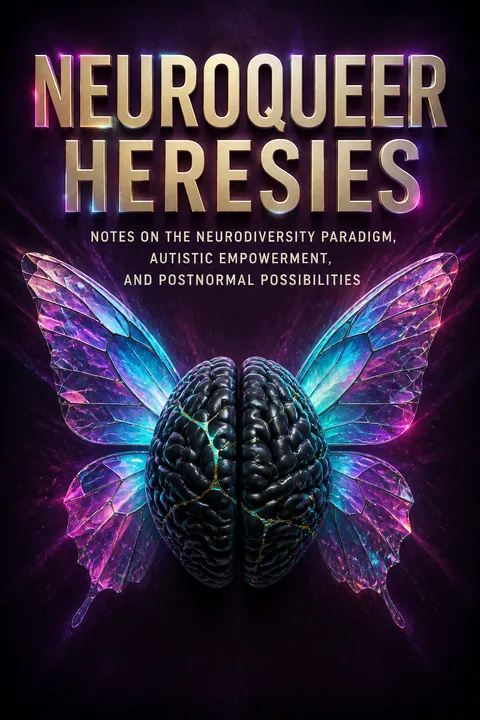
What’s "Neuroqueer Heresies" by Nick Walker about?
- Foundational work on neurodiversity: The book explores the neurodiversity paradigm, challenging the dominant pathology paradigm that frames autism and other neurodivergences as disorders.
- Intersection of neurodivergence and queerness: It introduces and develops the concept of neuroqueer and neuroqueering, examining how neurodiversity and queerness intersect and inform each other.
- Collection of essays and commentary: The book is a curated collection of essays, both previously published and new, with updated commentary reflecting the author’s evolving understanding.
- Guide for empowerment and possibility: It aims to empower autistic and neurodivergent people, offering new language, frameworks, and visions for a more inclusive and creative future.
Why should I read "Neuroqueer Heresies" by Nick Walker?
- Paradigm-shifting perspective: The book offers a radical shift from viewing neurodivergence as pathology to seeing it as natural human diversity, which can transform how you understand autism and related topics.
- Authoritative and accessible: Nick Walker is a foundational thinker in neurodiversity and neuroqueer theory, and her writing is clear, accessible, and deeply informed by both scholarship and lived experience.
- Practical and theoretical insights: The book provides both conceptual frameworks and practical advice for individuals, parents, educators, and professionals.
- Empowerment and liberation: It centers the voices and experiences of neurodivergent people, offering tools for self-acceptance, advocacy, and social change.
What are the key takeaways from "Neuroqueer Heresies" by Nick Walker?
- Neurodiversity is natural: Human minds are inherently diverse, and neurodiversity should be valued like other forms of diversity (e.g., ethnicity, gender).
- Pathology paradigm is harmful: Framing neurodivergence as a disorder perpetuates stigma, oppression, and ineffective or abusive interventions.
- Language matters: The words we use (e.g., "autistic person" vs. "person with autism") reflect and shape our attitudes and can either empower or marginalize.
- Neuroqueering as liberation: Actively subverting neuronormativity and heteronormativity—through embodiment, language, and practice—opens up new possibilities for selfhood and community.
What is the neurodiversity paradigm, as defined in "Neuroqueer Heresies"?
- Diversity among minds: Neurodiversity refers to the natural variation in neurocognitive functioning within the human species.
- Rejects "normal" as a standard: There is no single "right" or "normal" way for minds to function, just as there is no "normal" ethnicity or gender.
- Social dynamics of power: The paradigm recognizes that neurodiversity is subject to the same social dynamics—privilege, oppression, creative potential—as other forms of diversity.
- Foundation for activism: The neurodiversity paradigm underpins the Neurodiversity Movement, which seeks civil rights, equality, and inclusion for neurodivergent people.
How does "Neuroqueer Heresies" by Nick Walker define and critique the pathology paradigm?
- Pathology paradigm basics: It assumes there is one "normal" or "healthy" way for brains and minds to function, and deviations are seen as "something wrong."
- Institutionalized bigotry: The pathology paradigm is described as institutionalized prejudice masquerading as science, similar to historical pathologizing of homosexuality or race.
- Language and practice: Terms like "disorder," "high-functioning," and "person with autism" reinforce the pathology paradigm and perpetuate stigma.
- Need for paradigm shift: Walker argues that genuine empowerment and well-being for neurodivergent people require abandoning the pathology paradigm in favor of the neurodiversity paradigm.
What are the most important terms and definitions in "Neuroqueer Heresies" by Nick Walker?
- Neurodiversity: The biological fact of diversity among human minds; not a movement or perspective.
- Neurodiversity paradigm: The perspective that neurodiversity is natural and valuable, and that "normal" is a cultural fiction.
- Neurodivergent: An individual whose neurocognitive functioning diverges from dominant societal norms (e.g., autistic, dyslexic).
- Neurotypical: Someone whose neurocognitive functioning falls within dominant societal standards of "normal."
- Neurominority: A group sharing a similar, largely innate form of neurodivergence, often subject to discrimination.
- Neuroqueer: Both a verb and an adjective, referring to practices and identities that subvert neuronormativity and heteronormativity.
How does "Neuroqueer Heresies" by Nick Walker explain the relationship between neurodivergence and disability?
- Medical vs. social model: The book contrasts the medical model (disability as an individual defect) with the social model (disability as a result of societal barriers and lack of accommodation).
- Context-dependent disability: Disability is not inherent to neurodivergence; it arises when society fails to accommodate different needs.
- Autism and disablement: Autistic people are often disabled by societal attitudes and structures, not by autism itself.
- Not all neurodivergent people are disabled: Some forms of neurodivergence do not result in disablement, especially when needs are accommodated or the divergence is not stigmatized.
What is neuroqueer theory and the practice of neuroqueering, according to "Neuroqueer Heresies"?
- Queering neuronormativity: Neuroqueering means subverting, disrupting, and liberating oneself from both neuronormative and heteronormative expectations.
- Practice over identity: Neuroqueer is first a verb—something you do—rather than a fixed identity; anyone can engage in neuroqueering practices.
- Embodiment and self-expression: Neuroqueering includes reclaiming non-normative ways of moving, communicating, and being, especially those suppressed by social pressure.
- Expanding possibility: Neuroqueer theory rejects essentialist, fixed categories and instead points to a "horizon of possibility" for self-creation and collective liberation.
How does "Neuroqueer Heresies" by Nick Walker address language, especially person-first language and labels like "high-functioning"?
- Person-first language critique: The book argues that "person with autism" is rooted in autistiphobia and is disrespectful, as it implies autism is separable from the person and inherently negative.
- Identity-first language: "Autistic person" is preferred, aligning with how other minority identities are named (e.g., "Black person," "gay person").
- Functioning labels: Terms like "high-functioning" and "low-functioning" are critiqued as meaningless and harmful, as they reinforce neurotypical standards and hierarchies.
- Language shapes reality: The words we use reflect and reinforce paradigms; shifting language is a key part of shifting consciousness and practice.
What practical advice does "Neuroqueer Heresies" by Nick Walker offer for parents, educators, and professionals?
- Listen to autistic voices: Prioritize the insights and experiences of autistic adults and neurodivergent people themselves.
- Reject harmful therapies: Be wary of "treatments" aimed at making autistic people appear neurotypical, such as ABA, which are often traumatic and ineffective.
- Focus on accommodation and empowerment: Support neurodivergent people by accommodating their needs and fostering environments where they can thrive as themselves.
- Model and invite neurodivergent expression: In educational and therapeutic settings, create spaces where neurodivergent embodiment and communication are welcomed and modeled.
What are the best quotes from "Neuroqueer Heresies" by Nick Walker and what do they mean?
- “The master’s tools will never dismantle the master’s house.”: Quoting Audre Lorde, Walker uses this to argue that using the language and frameworks of the pathology paradigm cannot lead to true liberation for neurodivergent people.
- “I don’t believe in normal people.”: This challenges the very concept of "normal," emphasizing that all human diversity is natural and valuable.
- “You’re neuroqueer if you neuroqueer.”: Identity is rooted in practice and self-creation, not in fixed categories or external validation.
- “Disability is what happens when those needs aren’t sufficiently accommodated.”: Disability is not an inherent trait but a result of societal failure to include and support diverse needs.
How does "Neuroqueer Heresies" by Nick Walker envision a neurocosmopolitan future?
- Beyond mere acceptance: A neurocosmopolitan society not only accepts neurodiversity but actively engages with and values it as a source of creative potential.
- No privileged default: No one neurocognitive style is privileged as "normal" or superior; all are seen as equally valid.
- Mutual accommodation: Education, organizations, and communities are shaped collaboratively by diverse minds, with mutual learning and adaptation as the norm.
- Infinite creative possibility: Embracing neurodiversity and neuroqueering opens up new horizons for individual and collective growth, innovation, and well-being.
Download PDF
Download EPUB
.epub digital book format is ideal for reading ebooks on phones, tablets, and e-readers.








