

Key Takeaways
Build a team that leads itself, not a leader who carries everyone
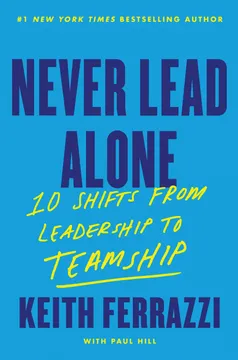
Share the load. Keith Ferrazzi’s central idea, teamship, is a way of working in which teammates share leadership and responsibility instead of relying on a single person to direct, motivate, and correct everyone. Co-elevation, the reciprocal commitment to achieve the mission while helping colleagues succeed, is its behavioral core.
Stars need a system. Venture capitalist Sergey Young had hired talented people, yet most decisions still flowed through him. After his team changed how it worked together, he reported reclaiming about a third of his time while pursuing ambitious growth and starting a separate longevity fund. The book contrasts this with Ferrazzi’s experience at Deloitte, where teams rallied around a common mission, and Starwood, where talented individuals did not become a cohesive team.
What's striking is the shift from leadership as an individual trait to leadership as a property of relationships. This resembles distributed cognition: groups can notice, interpret, and act on more information than any one person, but only when people share knowledge rather than guard it. The model also has a useful boundary. Shared responsibility does not erase formal authority or make every decision collective. Teams still need clear decision rights, especially when time is short or accountability is uneven.
Move disagreement into the room before it becomes expensive
Make dissent useful. The book reports that 72 percent of team members avoid conflict. Private complaints and post-meeting lobbying keep relevant information away from the people who can test an idea together. At Comcast, Bill Connors’s weekly Outlier Meetings focus on troubled business measures and unresolved problems, not routine progress reports. At iHeartMedia, Bob Pittman explicitly welcomes dissent when it brings evidence, a risk, or a possible solution.
Give candor a structure. The Power of Three moves discussion into small groups, where the book reports candor is 85 percent higher than in a full-room conversation. Stress Testing asks a project owner to share progress, obstacles, and next steps, then invites colleagues to identify risks, suggest improvements, and offer help. The owner responds to feedback with a clear yes, no, or maybe.
Candor works best when it is a procedure, not a personality test. Small groups and specific prompts lower the social cost of speaking, while a response to feedback shows that dissent has consequences. This connects to psychological safety, the shared belief that interpersonal risks can be taken without humiliation. Safety, however, is not the same as comfort or unfiltered criticism. Seniority, retaliation risks, and unequal speaking time can still silence people unless leaders actively manage those conditions.
Schedule trust-building instead of hoping colleagues bond by accident
Make relationships deliberate. Professional trust, personal trust, and structural trust are distinct. Colleagues may respect each other’s expertise and still have little personal connection, while their roles may create real conflicts of interest. The book argues that personal understanding helps people work through those differences rather than assuming bad intent.
Turn names into people. PhoenixDX, a growing Australian technology company, found its teams working in silos despite strong relationships between its founders. Practices such as brief personal check-ins and deeper storytelling helped employees learn about one another beyond job titles. Over six months, the team’s relationship score rose from 2.4 to 4.7 out of 5. The company reported annual staff turnover of 4 percent, compared with an industry range of 20 to 25 percent.
The practical insight is that trust is not merely a warm feeling. It can make disagreement less likely to be read as hostility and help colleagues share information across functional boundaries. This is consistent with research on social capital, the value created by reliable relationships. Still, scheduled vulnerability needs consent and good judgment. A personal story can invite empathy, but no employee should have to disclose private pain to prove commitment or earn belonging.
Treat team energy as shared infrastructure, not private weakness
Notice strain early. Team resilience means colleagues share responsibility for recognizing when someone is struggling and helping sustain the group’s capacity to work. The book describes a pharmaceutical sales team reduced from more than 100 people to little more than a dozen, with much larger territories and a shift to remote work. Instead of treating stress as an individual failing, teammates developed forums to solve practical problems and cover for one another. The group exceeded its former 5 percent growth target, reaching 10 percent.
Check in routinely. An Energy Check-in asks each person to rate their current energy from 0 to 5 and briefly explain the rating. A monthly Resilience Spot Check considers one factor, such as whether people feel their work matters or whether they are keeping up with new ideas.
This approach treats well-being as a signal the team can respond to, rather than an invisible private matter. It also fits the broader idea of collective efficacy: people are more capable of handling difficulty when they believe help is available and coordinated. But peer care cannot substitute for adequate staffing, fair workloads, or organizational support. A check-in that reveals exhaustion but leaves the causes untouched risks turning empathy into another unpaid task for already strained colleagues.
Replace meeting-first habits with broad, asynchronous collaboration
Choose the right channel. The Collaboration Stack is the book’s model for four ways to work together: asynchronous, remote in real time, hybrid, and in person. Asynchronous collaboration lets people contribute at different times through shared documents and other tools. It can give quieter colleagues time to form their views and let a wider group examine an issue before a meeting is called.
Meet for what meetings do best. WordPress cofounder Matt Mullenweg showed Ferrazzi a lasting digital record of proposals and decisions at Automattic, a distributed company with 1,900 employees in more than 90 countries. The book also cites research suggesting at least one in three meetings is unnecessary. It recommends using in-person time for relationship-building, difficult discussions, and decisions that benefit from live exchange, while considering AI a potential collaborator in analysis and idea testing.
The strongest claim is not that meetings are obsolete, but that they are only one tool in a larger process. Written collaboration can widen participation and preserve the reasoning behind decisions, while live conversation can resolve ambiguity and build connection. This is a useful antidote to equating visibility with productivity. Yet asynchronous work also creates risks: people may face notification overload, unclear response expectations, or unequal access to digital tools. Teams need explicit norms about timing and ownership.
Run work in short customer-led cycles, then revise from evidence
Replace grand plans with learning cycles. The book argues that agile can guide whole teams, not only software groups. Work begins with a clear outcome for a customer, then proceeds in short sprints, often lasting two weeks to a month. At regular reviews, the team examines what it delivered, what blocked progress, and what should change next. The aim is iteration toward value, not a polished plan that becomes outdated before execution.
IBM tested this beyond IT. CEO Arvind Krishna used multidisciplinary teams and biweekly check-ins to redesign IBM’s sales approach across the company. Leaders first agreed on the problem, then tracked progress and obstacles in manageable stages. IBM reported revenue growth in software, consulting, and infrastructure during 2022. The book also recommends assigning clear roles for driving a decision, approving it, contributing, and staying informed.
Agile is valuable here as a learning architecture: short cycles bring assumptions into contact with customer response and make it easier to change course. It also gives leaders a reason to set outcomes while stepping back from micromanaging every action. The caution is that rituals can survive after learning disappears. Stand-ups, sprint reviews, and role labels add little if the team cannot change priorities, access decision-makers, or acknowledge evidence that contradicts its plan.
Make recognition a peer habit, not a boss’s rare reward
Praise the work in motion. Recognition can help people see how their effort contributes to customers and the wider organization. When Carol Clements joined JetBlue’s technology group, employees felt their work was overlooked. She asked new hires what motivates them and how they prefer to be recognized, then encouraged colleagues and leaders across the company to make that contribution visible.
Build a steady cadence. The book describes several options, including ending meetings with a brief gratitude round, sharing notable weekly accomplishments, and holding a monthly peer appreciation exercise. At JetBlue, voluntary departures from the technology team fell by 40 percent compared with 2021, and regrettable losses fell by 65 percent. The approach also tailors recognition: some people appreciate public attention, while others prefer their teams to receive the spotlight.
Recognition is more than a pleasant extra when it connects specific behavior to shared purpose. It tells a team what to repeat and helps less visible work become legible. Research on motivation distinguishes meaningful acknowledgment from generic praise, which can feel manipulative or empty. The book’s emphasis on personal preference matters for that reason. Recognition should not become compulsory enthusiasm, nor should it obscure poor conditions or replace candid discussion of work that needs improvement.
Use difference as business intelligence, not a compliance checkbox
Invite perspectives into the work. The book treats inclusion as the practical ability to hear and use differences in experience, identity, and expertise. At Frito-Lay, employees in a Hispanic employee group helped identify demand for a chip flavor suited to Latin American tastes. The resulting jalapeno flavor became a billion-dollar brand, illustrating how people close to a customer can notice opportunities others miss.
Make difference discussable. Practices in the book invite teammates to share moments when they felt like outsiders, reflect on advantages and obstacles in their careers, and widen candidate slates when a hiring pool lacks diversity. The author notes that diagnostic evidence for this shift was not yet statistically significant. Representation matters, but the team must also create ways for people to speak, disagree, and influence decisions.
The business case is strongest when diversity is treated as access to information, not as a guarantee of better decisions. A broader range of perspectives can reveal overlooked users, assumptions, and risks, but inclusion determines whether those perspectives actually affect the work. Structured turn-taking and transparent decisions can help. Personal disclosure exercises deserve care, though: employees should not be pressed to represent a demographic group or explain experiences they would rather keep private.
Make coaching a daily peer responsibility, including for senior leaders
Feedback should travel sideways. The book argues that coworkers often see one another’s work more closely than a manager does. Peer coaching can address ideas, delivery, skills, and work style, rather than limiting feedback to formal reviews. At e.l.f. Beauty, CFO Mandy Fields helped CMO Kory Marchisotto strengthen her financial fluency, while Marchisotto coached Fields to explain her reasoning more clearly to investors.
Make development concrete. The Open 360 exercise asks teammates to name one strength they value and one change that could help a colleague. In the 5/5/5 Learning Roadmap, a colleague spends five minutes sharing a development goal, five answering questions, and five receiving advice. The book links this culture to e.l.f.’s ability to bring products from concept to online launch in as little as 13 weeks, against industry cycles of two to three years.
Peer coaching can make learning timely and grounded in actual work, while challenging the assumption that seniority means development is finished. The most useful feedback is specific, behavior-focused, and connected to an agreed goal. The format also matters: public feedback can build shared learning, but it can embarrass or silence people when trust is weak. The book’s sequencing is sensible. Relationship quality and clear norms should precede exercises that ask colleagues to critique one another openly.
Keep every networked team aligned on one North Star and trade-offs
Alignment is ongoing work. A North Star is the shared mission that helps a team choose priorities and make trade-offs when demands compete. The book argues that teams should be organized around goals, drawing in the people needed to achieve them rather than relying only on the formal organization chart. Its Alignment Collaborative Problem-Solving practice gathers perspectives on the mission, major obstacles, and choices through shared documents before using a meeting to resolve open questions.
Make commitments visible. At Procter & Gamble, Sundar Raman’s team pursued an unusually ambitious goal of 40 consecutive quarters of growth. Members shared quarterly commitments and reviewed results openly, making both accountability and learning visible. At Salesforce, sales leaders collaborated on allocating quotas against a shared target rather than negotiating only for their own units. These examples show alignment as shared ownership, not merely agreement with a slogan.
A shared mission is useful only when it guides concrete choices. The important test is whether teams can explain what they are prioritizing, what they are not doing, and why. This connects to shared mental models in team research: coordinated groups need overlapping understandings of goals and responsibilities, not identical opinions. Alignment can also become conformity if disagreement is unwelcome. Regularly revisiting trade-offs keeps the North Star informative without pretending that every unit has the same needs.
Analysis
Never Lead Alone turns a leadership argument into a practical operating model. Its central claim is that organizations underuse the intelligence between people: they promote the leader as the engine of performance while leaving teammates to operate in silos, avoid difficult conversations, and wait for permission. Teamship redirects that responsibility toward peers, supported by collaboration practices and technology. The ten shifts are therefore best understood as one connected system, not a menu of isolated morale initiatives. Trust makes candor safer, candor improves decisions, iterative work tests those decisions, and visible commitments help teams stay aligned.
The book’s strength is its insistence that behavior change needs scaffolding. Diagnostics, team agreements, recurring reviews, small-group discussion, and short work cycles make abstract virtues observable. The case studies also broaden the argument beyond a single industry, from manufacturing and media to software, airlines, and consumer products. The examples make the proposed practices concrete enough for a team to try without waiting for an enterprise-wide culture campaign.
Its evidence needs careful interpretation. Many figures and success stories come from the author’s own coaching work or company reports. They illustrate plausible mechanisms and impressive outcomes, but they do not by themselves establish that a practice caused a result or will work equally well elsewhere. Team maturity, leadership behavior, resources, and selection effects may all matter. The book is most persuasive as an applied playbook, less as a controlled test of universal effects.
The deeper contribution is a change in where responsibility is located. A team is not simply a set of roles coordinated by a manager. It is a working network that can share knowledge, care, challenge, and adaptation. That promise depends on safeguards: clear authority, consent around personal disclosure, protection from retaliation, and organizational willingness to fix structural problems. Without them, candor can become aggression, resilience can become pressure to endure, and alignment can become silence. With them, teamship offers a disciplined way to turn interdependence from an organizational fact into a performance advantage.
Review Summary
Reviews for Never Lead Alone are mixed, averaging 3.52 out of 5. Readers appreciate its practical framework for transitioning from traditional leadership to collaborative "teamship," including ten actionable shifts, diagnostic tools, and real-world examples. The book resonates most with corporate audiences, with non-corporate readers finding it less applicable. Some praise its accessibility and implementable strategies, while critics note repetitiveness, excessive corporate jargon, and heavy DEI content. Several reviewers suggest alternatives like Radical Candor or simply listening to the author's podcast interviews instead.
Glossary
Teamship
Shared team leadershipA model of work in which teammates share responsibility for performance instead of depending mainly on a designated leader. It combines reciprocal behaviors, such as feedback and accountability, with collaborative processes and tools that help people contribute across roles and organizational boundaries.
Co-elevation
Mutual commitment to succeedA team agreement to pursue a shared mission while helping colleagues improve and succeed. It calls for direct communication, mutual accountability, and support rather than passive coexistence or competition between teammates. The term describes the behavioral foundation of teamship.
Social contract
Agreed team behaviorsThe explicit or implicit expectations governing how a team works together: what people say, avoid, share, and hold one another accountable for. In the book, teams can renegotiate this contract and support it with specific practices, rather than leaving working norms vague or assumed.
Red Flag Rule
A concise team commitmentA short, memorable statement describing how teammates agree to behave in a particular area of team performance. Each rule gives the group a practical standard to return to when checking whether its everyday actions match its stated commitments.
Red Flag Replay
Review of team commitmentsA recurring team discussion, recommended about monthly during initial change, that checks whether members followed their Red Flag Rules and used agreed practices. Teammates identify lapses, take responsibility without expecting perfection, and consider what would help sustain the new behavior.
Stress Testing
Peer review of workA structured review in which a colleague presents progress, difficulties, and intended next steps, then invites peers to identify risks, propose improvements, and offer support. The presenter remains accountable for the work and considers the feedback rather than automatically accepting every suggestion.
Collaboration Stack
Four collaboration modesA model that treats collaboration as a combination of asynchronous work, remote real-time interaction, hybrid meetings, and in-person work. Each mode serves different purposes. Teams choose and combine them deliberately rather than treating a live meeting as the default form of collaboration.
Meeting Shift
Move collaboration before meetingsA change in which teams move preparatory cycles of discussion, feedback, and idea development into shared digital documents or other asynchronous tools. A later meeting can then focus on unresolved issues and decisions, with participants having already considered one another’s perspectives.
Relationship Action Plan (RAP)
Map critical working relationshipsA shared plan identifying the people whose expertise, input, or support matters to a particular goal. It tracks the strength of each relationship, the person’s importance to the work, and steps for building collaboration. The plan can include colleagues, customers, suppliers, and other stakeholders.
Team of seekers
Peers pursuing developmentA team in which members recognize their own growth needs and actively work to improve. Rather than treating development as a manager’s occasional task, teammates share responsibility for learning, coaching, and helping one another strengthen relevant skills and work habits.
Open 360
Peer feedback roundA team exercise in which each participant receives specific appreciation and constructive suggestions from colleagues. Feedback is delivered openly in a structured round-robin, with recipients listening before responding. The practice depends on sufficient trust and a shared understanding that peer feedback is information, not an order.
Foresight Five Minutes
Brief team risk scanA recurring team practice in which members each monitor a different source of potential risk or opportunity, such as customers, technology, or competition. The team briefly shares signals that may deserve deeper assessment, helping it notice changes before they become urgent problems.
About the Author
Other books by Keith Ferrazzi


Download PDF
Download EPUB
.epub digital book format is ideal for reading ebooks on phones, tablets, and e-readers.








