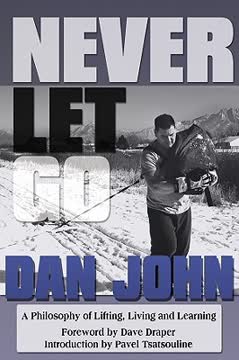
Key Takeaways
1. Free Will: The Ultimate Training Secret
The secret to success is free will.
Finite resource. Dan John argues that free will, or self-discipline, is a finite resource, much like a can of shaving gel that runs out without warning. Every decision, from resisting cookies to getting out of bed, depletes this mental energy. This explains why prisoners, with fewer daily choices, often achieve impressive physiques—they have more free will left for training.
Strategic conservation. To succeed in fitness goals, one must strategically conserve free will. This involves reducing the number of daily decisions related to diet and training. Examples include:
- Meal prepping for the week to eliminate food choices.
- Hiring a personal trainer to outsource decision-making during workouts.
- Creating a structured environment that minimizes temptations.
Whittle down. John advises "whittling down" unnecessary life complexities that drain free will. Cutting back on excessive commitments, mindless entertainment, or unproductive habits frees up mental energy for crucial fitness pursuits. By simplifying life, more self-discipline remains for the gym and healthy eating.
2. Embrace the Rule of Five for Realistic Progress
In a group of five workouts, I tend to have one great workout, the kind of workout that makes me think in just a few weeks I could be an Olympic champion, plus maybe Mr. Olympia.
Non-linear progress. Training progress is rarely linear; expecting every workout to be a personal best leads to frustration and burnout. The "Rule of Five" suggests that out of five workouts, one will be exceptional, one will be awful, and three will be "punch-the-clock" sessions. This realistic perspective helps manage expectations.
Accepting variability. Understanding this natural fluctuation allows athletes to embrace lousy days as part of the process, rather than seeing them as failures. It prevents overtraining by not chasing an impossible "perfect" every session. This mindset fosters long-term adherence and mental resilience.
Strategic planning. Instead of constantly pushing for peak performance, plan for periods of high intensity followed by lighter, easier weeks. This cyclical approach, often seen in classic training plans, prevents physical and emotional exhaustion. Redefine "easy" days as opportunities to try new lifts or focus on technique.
3. Dieting: An All-Out War, Not a Lifestyle
Fat loss is an all-out war. Give it twenty-eight days — only twenty-eight days. Attack it with all you have.
Intense, short-term focus. Dan John advocates for treating fat loss as an intense, short-term battle rather than a perpetual lifestyle diet. Programs like the Velocity Diet, which involve strict adherence to protein shakes and minimal whole foods for 28 days, demonstrate rapid, undeniable results. This "scorched-earth" philosophy demands total focus.
Beyond moderation. While moderation is often preached, John argues it's for "sissies" when it comes to initial fat loss. Lukewarm efforts yield lukewarm results. A concentrated, aggressive approach creates a significant physiological and psychological "jumpstart" that can then transition into sustainable habits.
Discipline transfer. Successfully completing a demanding fat-loss protocol like the Velocity Diet builds immense self-discipline. This newfound mental fortitude can then be applied to other life goals, proving that if one can conquer food cravings and alcohol for a month, other challenges become more manageable.
4. Uncover "The Rest of the Story" in Training
Computers helped a little, but essentially turning women into men helped even more.
Beyond the surface. Many training fads and breakthroughs have a "rest of the story" – hidden truths or external factors that are often overlooked. John uses the example of the East German swim team, whose success was attributed to computer programs, but later revealed to be heavily influenced by anabolic steroids.
Questioning assumptions. It's crucial to question the simplistic narratives surrounding training methods. For instance:
- Functional Isometric Contractions (FIC) were dismissed, but rack work and dead-stop lifts are highly effective for sticking points.
- Abdominal training was thought to build six-packs, but its primary role is supporting overall training and internal organs.
- High-Intensity Interval Training (HIIT) is effective, but only if truly high-intensity, not just light jogging.
Seek the source. Always strive to understand the true mechanisms behind perceived success. This means looking beyond marketing hype, celebrity endorsements, and superficial explanations to find the fundamental principles that genuinely drive results.
5. Simplicity and Consistency: The Gable Method
If it’s important, do it every day. If it isn’t, don’t do it at all.
Core principle. Inspired by wrestling coach Dan Gable, this philosophy emphasizes daily practice of essential movements. Instead of complex, varied routines, focus on what truly matters for your goals and integrate it into your daily regimen, even if it's just for a few sets.
Warm-up as workout. John suggests transforming the warm-up into a comprehensive training session. By performing all nine fundamental movements (pushes, pulls, squats, deadlifts, etc.) lightly during the warm-up, athletes ensure daily exposure to crucial skills without overtraining. This builds a robust foundation.
Daily repetition. For weak points or new skills, consistent, daily repetition is key. John's personal experience with front squats, doing two easy sets of five every day, eliminated his sticking point in the clean. This consistent "banging away" allows the body to adapt and master movements over time.
6. Systemic Learning: Test, Adapt, Don't Overkill
If you have a tree and add ten ingredients to your soil, nine of them good for the tree and the tenth poison, how will you figure out which one is which?
One change at a time. When integrating new training ideas, supplements, or diets, introduce them one at a time. Adding multiple new elements simultaneously makes it impossible to discern what is working and what might be detrimental. This systematic approach allows for clear cause-and-effect observation.
Baseline routine. Establish a reliable, moderate training routine that keeps you in shape and feeling good. This baseline serves as a control against which new experiments can be measured. If a new addition causes pain or hinders progress after a few weeks, it can be easily identified and removed.
Avoid overkill. The "if a little is good, more is better" mentality often leads to injury and burnout. John warns against excessive volume or intensity, especially when adopting new methods. Subtle variations and planned deloads are more effective than constantly pushing to the extreme.
7. Leverage "Geezer Wisdom" for Lasting Fitness
In eight years, you could be as accomplished (and as good as) a collegiate athlete.
Advantages of age. Being over 35 brings unique advantages for fitness:
- Experience: A lifetime of diverse physical activities provides a deep well of movement patterns and body awareness.
- Time: Reduced peer pressure and clearer life priorities allow for dedicated focus on personal goals.
- Money: Financial stability enables investment in quality equipment, supplements, and coaching.
- Focus: Life decisions narrow interests, allowing for intense concentration on chosen fitness pursuits.
Long-term vision. Older athletes can leverage their perspective to set long-term goals, understanding that consistent effort over years can lead to collegiate-level accomplishments. The journey itself becomes a reward, rather than just the immediate outcome.
Rekindle the fire. Use these advantages to reignite passion for training. Instead of lamenting lost youth, embrace the wisdom and resources gained with age to pursue new challenges or excel in existing ones. This mindset transforms aging into an opportunity for continued physical growth.
8. The AIT Formula: Accumulation, Intensification, Transformation
This formula I came across is simple and natural. It works in three parts: 1. Accumulation 2. Intensification 3. Transformation
Holistic training cycle. The AIT formula provides a structured yet flexible framework for long-term athletic development, acknowledging life's unpredictable nature. It moves beyond rigid periodization to integrate new skills, focused effort, and strategic maintenance.
Accumulation (Explore & Learn): This phase involves actively seeking and learning new sports, lifts, or movements. The goal is to broaden one's physical capital, challenge existing notions of strength, and expand the "boredom index." It's about adding variation and new challenges.
Intensification (Focus & Prioritize): Here, the focus narrows to what is truly important for one's goals. Inspired by Dan Gable, it means doing what you need to do, even if it's hard. This phase demands high effort on core movements, often identified by asking, "What would I do if I only had 15 minutes to train?"
Transformation (Apply & Maintain): This final phase involves backing off from peak intensity to allow success to happen, applying accumulated skills towards specific goals, and maintaining fitness. It often includes a return to basic, repeatable programs with an emphasis on fun and preventing injury.
9. Master the Big Five Fundamental Movements
What are the Big Five most people recommend? You won’t like the list: - Squat - Deadlift - Good Morning - Bentover Row - Plank
Foundational strength. These five movements are considered the bedrock of total body strength and physical development. They are often neglected by average gym-goers but are crucial for building a robust, functional physique. Mastering them provides a strong base for any athletic or aesthetic goal.
Correct execution is paramount. John emphasizes that "squats don't hurt your knees; what you are doing hurts your knees." Proper technique, often learned through drills like goblet squats or potato-sack squats, is more important than heavy weight, especially for beginners. The body must learn the movement pattern correctly.
Beyond the obvious. Each movement offers unique benefits:
- Squat: Total mass and body strength.
- Deadlift: Absolute strength, exposes grip and core weaknesses.
- Good Morning: Hamstring development, not just lower back.
- Bentover Row: Rhomboid development, shoulder health, thickness.
- Plank: Core stability, reveals imbalances and nutritional deficiencies.
These lifts are hard and require dedication, but their impact on overall fitness is profound.
10. Prioritize Recovery: The Unsung Hero of Progress
You must balance the cost-to-benefit ratio, also known as getting the biggest bang for the buck.
Beyond training. As one ages, recovery becomes as critical as training itself. John, reflecting on his post-50 experience, highlights that teenagers recover effortlessly, but adults must actively manage recovery to sustain progress and prevent injury.
Cost-benefit analysis. Evaluate recovery methods based on their effectiveness and cost. Expensive options like regular massages or hot tubs can be beneficial but may not be sustainable. Cheaper alternatives like Bikram Yoga (for structured stretching and dialogue), foam rolling, or simple stretching routines can offer significant returns.
Active recovery & rest. True rest days mean resting, not engaging in other strenuous activities that deplete the body. John also advocates for active recovery methods like Z-Health exercises or Pavel Tsatsouline's "Relax into Stretch" techniques, which can quickly improve flexibility and address minor issues.
11. Goal-Setting: From "Should" to "Must"
Rarely do people improve because of the pleasure of the goal; rather it’s pain that sets them toward a goal.
The motivation spectrum. Goals exist on a spectrum: "Should," "Could," and "Must." Most people languish in the "should" phase (e.g., "I should lose weight"), which is worthless. "Could" implies knowledge but lacks impetus. True success stems from transforming goals into "musts."
Pain as a motivator. John argues that pain is a far more potent motivator than pleasure. The "Alpo Diet" analogy—promising to eat dog food if a weight loss goal isn't met—illustrates how the fear of public humiliation can drive intense commitment. This external pressure creates a "must" scenario.
Aligning behavior and rewards. Critically assess if your current behaviors align with your goals and the perceived rewards for achieving them. If the pleasure of failure (e.g., comfort, indulgence) outweighs the pain of not achieving a goal, change is unlikely. Conversely, making the pain of not achieving a goal unbearable, or the pain of achieving it manageable, is key.
12. The Journey to Excellence: Disdain Medium
Danny, you just hate medium, don’t you?
Rejecting mediocrity. Dan John expresses a strong "disdain for medium" in training and life. While moderation and "punch-the-clock" workouts have their place for maintenance, true excellence demands periods of intense, focused effort, followed by strategic rest, rather than constant mediocrity.
Highs and lows. Charlie Francis's insight—"Their highs are too low and their lows are too high"—highlights a common training flaw. Many fail to push hard enough during intense phases and fail to truly rest during recovery, leading to stagnation. Excellence requires pushing the "highs" to their limits and making the "lows" genuinely restorative.
Simplicity in excellence. The path to excellence often involves eliminating excess and striving for simplicity. This means focusing on a few core movements, executed with precision and intensity, rather than a myriad of exercises. Like a skilled athlete, true excellence appears effortless, born from years of focused, hard work.
Last updated:
Review Summary
Similar Books