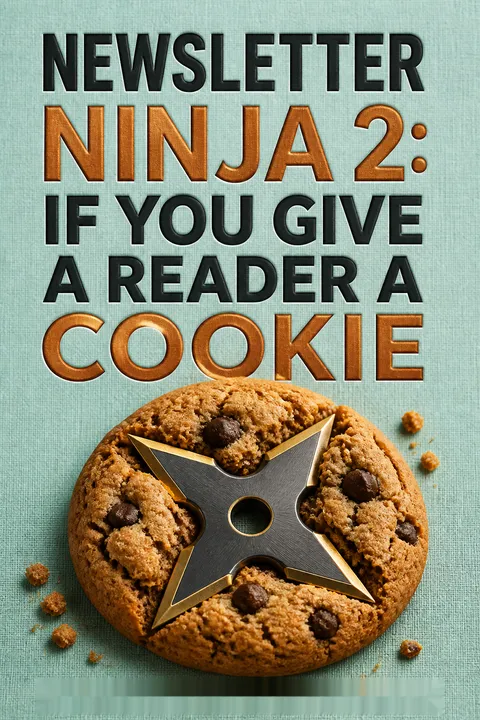


Key Takeaways
Build a cookie for your ideal reader, not the largest possible crowd.
A focused invitation. A reader magnet, which the author also calls a cookie, is bonus content offered in exchange for an email address. It works like a loss leader: the free item draws a potential customer toward the rest of an author’s books. The point is not to attract the most signups, but to attract people likely to enjoy the catalog. A broadly appealing prize, such as a gift card, may collect addresses from people with no interest in the author’s fiction. A story set in the same world, or a promotion limited to a close subgenre, makes a more relevant offer.
Fit beats volume. The closer the magnet, the books, and the reader’s tastes align, the better the chance that a signup becomes an engaged reader. Tight genre bundles can help authors reach readers who already subscribe to newsletters and click their links. Broadening into adjacent niches can work, but requires more careful follow-up.
This is a product-market-fit problem in miniature. A magnet is not merely a bribe; it is a sample that helps both sides determine whether a relationship makes sense. Narrow targeting can improve that match, while excessive narrowness can limit discovery, so adjacent genres are best treated as deliberate experiments rather than mistakes. The useful metric is not the number of addresses collected, but the proportion of subscribers who read, respond, and continue to the books. That reframes list growth from a vanity contest into a question of audience quality.
Set the goal and strategy before copying another author's list-building tactic.
Three levels of choice. A goal is the result an author wants, a strategy is the broad route toward it, and a tactic is a specific action. The book’s example: a romance author selling through Kindle Select may aim to reach Kindle Unlimited readers, while a successful wide-publishing author may use a permanently free first book to attract readers across retailers. Copying the second author’s free-book tactic could undermine the first author’s plan.
Tactics can change. A city planner trying to reduce crashes might educate drivers, deter speeding, or redesign an intersection. Each strategy allows different tactics, from warning signs to speed bumps to a traffic circle. Author tactics also change as platforms and tools change. The stable discipline is to ask whether a new tactic serves the chosen strategy and goal.
The distinction resembles the difference between an organization’s theory of change and its operating procedures: actions make sense only when tied to a desired outcome. It also protects authors from survivorship bias, the tendency to imitate a visible success without seeing the conditions that produced it. Strategy should not become dogma, however. A tactic that fails repeatedly may reveal a flawed strategy, so periodic review matters. The practical balance is commitment to a direction, paired with evidence-based adjustment rather than reflexive trend-chasing.
Judge subscribers by engagement, not whether a free offer recruited them.
Two signup routes. The book calls people who join without an incentive organic subscribers, and those who receive an incentive non-organic subscribers. Labrecque argues that neither label reliably predicts quality: either group may become a devoted reader, drift away, or disengage immediately. In her experience across genres and list sizes, subscribers who remain four to six months after joining behave similarly, regardless of how they arrived.
Onboard everyone. A welcome sequence is a series of initial emails that introduces the author and helps identify subscribers who want to stay. Some readers who like a book do not want another newsletter in an already crowded inbox; a bonus can persuade them to try it. Others may accept the bonus and leave. That is part of the exchange, not a broken promise: the signup guarantees the offered content, not a future superfan.
This argument replaces a moralized label with observable behavior. In customer analytics, the source of a lead can matter, but it is not a substitute for tracking what that person does after joining. The author’s reported pattern is useful, though the book does not specify sample sizes or experimental controls, so it should be treated as experience-based evidence rather than a universal law. Authors can compare signup sources, welcome-email engagement, unsubscribes, and book purchases over time. Such comparisons test whether a magnet or promotion is attracting the right audience without assuming that free-seeking itself predicts low value.
Use one complete, genre-faithful story to convert strangers and delight fans.
One magnet, two audiences. A magnet aimed only at existing readers can be an epilogue, deleted scene, or alternate point of view. Those readers already know the author can tell a satisfying story. A magnet for potential readers has a higher bar: it should make sense without prior knowledge, have a full beginning, middle, and end, and resemble the author’s books in genre, tone, pacing, and themes.
The convertible cookie. This is the author’s term for a magnet that can appeal both to current fans and to people who have never read the author. It can save time when an author has only one magnet to write. A complete story gives new readers a fair sample of the author’s storytelling, while familiar characters, settings, or genre pleasures make the offer attractive to established fans.
The convertible-cookie idea solves a genuine design tension: existing fans want recognition and more of what they love, while newcomers need an accessible starting point. In sampling theory, a sample is informative only when it resembles the product being evaluated. A magnet that is technically well written but unlike the catalog can create misleading expectations. The constraint is that one story may not be equally compelling to both groups. Its success depends on choosing a premise with an independent narrative arc and a clear connection to the author’s larger work.
Make the magnet's next-book connection feel like the obvious next click.
A loose thread, not a cliffhanger. In Genevra Black’s urban fantasy example, a heroine unknowingly brings her dead hamster back as a zombie. The novel skips the characters’ trip to an emergency veterinary clinic, since the episode does not advance the main plot. A short bonus story fills in that comic side adventure. Readers who finished the book naturally want to know what happened; newcomers can follow the story through Don, a vet technician who knows nothing about the supernatural world.
Build the bridge. The bonus ends by pointing toward the series, where readers can learn more about the necromancer and her zombie companion. A useful call to action directs readers to a specific next step, such as the first book. A magnet can also introduce a memorable supporting character or raise a small question answered in the catalog. The goal is curiosity that leads into the books, not a frustrating unfinished story.
The hamster episode demonstrates how narrative design can do marketing work without feeling like an advertisement. The missing scene creates a curiosity gap, while the outsider point of view gives newcomers a guide into unfamiliar rules. This resembles a well-designed product demo: it offers a satisfying experience and makes the next feature legible. The method depends on restraint. If every bonus exists only to funnel readers onward, it can feel engineered; the story must first reward attention on its own, then make the next step appealing.
Choose bonus content that fits your genre, catalog, and spoiler boundaries.
Match the form to the appetite. Romance readers often enjoy epilogues and extended looks at a couple’s future; speculative fiction may benefit from a prequel that explains how a world or villain came to be. Other options include point-of-view flips, side stories, character dossiers, maps, recipes, case files, or in-world documents. These need not be full novels. The author’s own magnets range from 5,000 to 12,000 words, and shorter pieces can be easier for readers to finish.
Protect the reading experience. Place a magnet where readers have the context they need, and avoid revealing important plot turns too soon. Do not hide essential series developments in bonus content, since some readers will never find it and others will resent having to search for it. A romance couple’s eventual happy ending is expected in the genre; a specific surprise, such as a proposal scene, may still reveal too much.
The variety here points to a useful principle of transmedia design: a fictional world can support artifacts, side narratives, and character perspectives, not just another conventional book. Genre expectations help determine which format feels like a genuine treat rather than an assignment. At the same time, spoiler tolerance differs by reader and by genre. The conservative choice is usually to keep essential plot information in the main work and make bonus material enriching rather than required. This preserves the magnet’s value without turning access to the story into a scavenger hunt.
Protect your series momentum; don't give Book Two as a signup bonus.
A free download can mislead. The book warns against making Book One permanently free and offering Book Two as the mailing-list reward. Many readers may download the first book but never reach or buy the second. The author argues that this weak sell-through can signal poor series performance to Amazon’s recommendation systems, making later books less likely to receive visibility. The danger is especially relevant to authors selling through Amazon, where the book says most ebook sales occur.
Offer a separate story. A complete short story or novella can attract readers without replacing the next paid installment. The author also recommends making the magnet exclusive, reporting that signups fall when the same content is available elsewhere. A full-length novel is not required, and the book cautions that free books are already abundant. A short, distinctive bonus can be more efficient to produce and more closely tied to the series.
This is a reminder that acquisition tactics can affect downstream measurement: a large number of first-book downloads is not the same as healthy series read-through. The platform-algorithm explanation is plausible within the book’s account, but platform recommendation systems are opaque and can change, so the warning is best read as a strategic risk rather than a guaranteed outcome. More broadly, the magnet should create a separate path into the catalog, not cannibalize the sequence readers are meant to follow. Authors can track whether different offers produce paid continuation, not just initial downloads.
Polish a magnet's cover, copy, and prose to match your catalog.
A sample is a promise. Potential readers use the magnet to infer what the author’s books will be like. Its cover should look credible and, when it belongs to a series, share recognizable design cues. The description needs a hook and enough character and setting to make the download appealing. The writing should receive the same care as the author’s published work. If professional design or editing is unaffordable, the book recommends learning basic design skills, proofreading carefully, and trading services with another author rather than releasing something careless.
Remove delivery friction. Services such as BookFunnel help readers get stories onto their devices, a process that used to involve confusing manual file transfers. The author favors BookFunnel while acknowledging alternatives. New magnets should also be sent to current subscribers, sometimes more than once, since an email can be missed. A polished story only works as a marketing tool if readers can find it, trust it, and open it easily.
A magnet functions as both creative work and interface. Its cover and description set expectations before reading, while delivery determines whether readers can act on their interest. This is a human-factors problem: every extra step creates another opportunity for abandonment, especially for readers who are less comfortable with technology. Consistency with a series can make the connection legible, but visual branding need not mean expensive custom production. The central test is whether the presentation signals care and gives readers a low-friction route to the story.
Analysis
The book’s central contribution is a shift in what a mailing-list incentive is supposed to optimize. It is not the biggest possible pile of email addresses; it is a well-matched first encounter between an author’s work and a reader’s taste. That reframing connects the book’s practical advice: align the offer with the catalog, treat signup source as weaker evidence than subsequent engagement, and make the next reading step easy to see.
Its most useful model is the relationship between goal, strategy, and tactic. This prevents authors from confusing another writer’s visible method with a universal recipe. The distinction is especially valuable in a publishing environment where distribution choices, retailer algorithms, and delivery tools can change. The book is at its strongest when it uses concrete examples to show how one tactic can fit one business model and damage another.
The convertible cookie is the most memorable creative application. A standalone story can serve as both a reward for fans and a sample for newcomers, provided its plot is complete and its connection to the catalog is clear. The hamster-at-the-vet side story shows that a magnet need not be a miniature novel or an isolated free book. It can expand a fictional world while giving the reader a reason to continue.
Some claims deserve cautious interpretation. The author’s experience suggests organic and incentivized subscribers perform similarly after onboarding, but the text gives no sample sizes or controlled comparisons. Likewise, Amazon’s recommendation systems are not transparent. These are useful working hypotheses, not guarantees. Authors can strengthen the advice by tracking subscriber behavior by source, magnet, genre, and time, then judging success by paid read-through and sustained engagement rather than signup totals alone. The result is a pragmatic system: make a specific promise, deliver it well, and measure whether the right readers want more.
Review Summary
Newsletter Ninja 2 receives high praise for its concise and actionable advice on creating reader magnets for authors. Readers appreciate Tammi Labrecque's humorous writing style and clear explanations. The book is seen as a valuable resource for both new and experienced authors looking to improve their email marketing strategies. While some reviewers found the content familiar, most agree it offers useful insights and ideas for developing effective reader magnets. A few critics felt the book could have provided more new information, but overall, it's highly recommended for authors seeking to enhance their newsletter game.
Glossary
Reader magnet
Free content for signupsA piece of content an author offers in exchange for a reader’s email address. It can be a complete short story, a series-related scene, or supplemental material such as a map. Its purpose is to attract readers who may enjoy the author’s books, rather than simply to maximize the number of signups.
Cookie
A reader magnetThe author’s informal name for a reader magnet, using the image of a treat offered to a reader. A cookie may be a story or another kind of bonus content. Its usefulness depends on whether it appeals to the intended readers and connects appropriately to the author’s catalog.
Convertible cookie
A magnet for two audiencesA reader magnet designed to work for existing readers and people who have never read the author. It should stand alone, tell a complete and satisfying story, and resemble the author’s books in genre and tone. A clear connection to the catalog can encourage newcomers to continue reading.
Organic subscribers
Subscribers without an incentiveReaders who join an author’s mailing list without being offered a bonus in exchange. The book challenges the assumption that these subscribers are automatically more valuable than incentivized subscribers. Their eventual engagement depends on their interests and behavior, not just the route by which they joined.
Non-organic subscribers
Subscribers offered an incentiveReaders who join an author’s mailing list after being offered something, such as a reader magnet. The term describes how they signed up, not whether they will become engaged readers. The book argues that incentives can attract strong subscribers as well as people who later disengage.
Alignment
Fit between offer and audienceThe degree to which a reader magnet matches the author’s catalog and the tastes of the people it attracts. A closely aligned offer, such as a cowboy romance promoted to cowboy romance readers, is more likely to lead to interest in the author’s other books. Broader targeting can work, but may require more careful onboarding.
Newsletter Ninja Series
About the Author
Other books by Tammi Labrecque
Download PDF
Download EPUB
.epub digital book format is ideal for reading ebooks on phones, tablets, and e-readers.








