

Plot Summary
Truth in the Interrogation Room
At Dungeness Federal Prison, Nate Saldana waits through another interrogation, feeding his crowd-binding power with the attention of agents and observers. Agent Phan replaces the usual interrogators and brings Verity, a teenage FBI operative whose presence forces Nate to answer honestly.
Phan describes a carefully controlled blackout in nearby Eureka, and Nate realizes that Chizara, his friend with power over electronics, must be responsible. When the lights flicker, Nate admits that the Zeroes are probably coming to free him.
He also learns that the FBI suspects Kelsie of helping cause a police officer's death, while Phan hints that a larger crisis is gathering in New Orleans. The questions have revealed the rescue plan, but they have also placed a truth-powered agent between Nate and his friends.
Nate's power depends on an audience, so prison attacks not only his freedom but the basis of his identity. Verity's ability reverses his customary advantage: instead of shaping what a crowd believes, he is compelled to expose what he knows. His admission that the Zeroes are nearby is both a tactical failure and a sign of how urgently he needs connection after weeks of isolation. The agents' mistaken theories about his abilities protect some secrets, but their partial understanding is enough to turn his friends' rescue into a trap.
Dungeness Opens From Inside
Chizara, Flicker, Kelsie, and Ethan enter the prison by disrupting its electronic systems, while Ethan's borrowed guard persona and Kelsie's mood-shaping power keep staff from raising an effective alarm.
They reach Nate's interrogation room, but Phan has prepared insulated restraints that Chizara cannot unlock. With reinforcements already on the way, Nate provokes Chizara by pressing on her guilt over a past loss of control. The lights fail and prison alarms erupt, making the danger of a riot credible enough for Phan to order a guard to bring the key.
Once freed, the five reach the exposed perimeter and face police marksmen. Nate turns his crowd power inward, making the officers overlook them, while Chizara disables a pursuing bus and opens their escape route.
The rescue succeeds through coordinated abilities, but Nate's method is morally costly. He weaponizes Chizara's shame, knowing that her fear of harming people can make the threat convincing. The others escape because they combine restraint, deception, and technical force, not because any one power can solve the crisis. Nate's new ability to become unnoticed offers a different kind of escape from the command he usually seeks. Yet the choice leaves trust damaged before the group has even reached safety.
The Sixth Zero Vanishes
In the getaway van, Nate asks why Thibault, the quiet member of their group, never came to the prison. None of the others can remember him clearly until the escape exposes the absence.
At a remote cabin, Nate explains that Thibault's power makes people forget him, and the group slowly recovers fragments of their old friendship with the missing boy. Flicker remembers that Thibault had erased family photographs before leaving Cambria, while Ethan recalls a hotel room and long gaming sessions.
Nate admits privately to Chizara that Thibault, not Nate, fired the shots that killed Swarm, the predator who had threatened the Zeroes. He proposes finding Thibault, partly to repair the group and partly because the others need a mission before they turn against one another.
Forgetting functions here as a social injury rather than a simple memory trick. Thibault's power protects him from being noticed, but it also prevents others from sustaining a relationship with him. The Zeroes' realization that they once loved and depended on someone they cannot remember makes their own bonds feel less reliable. Nate's disclosure to Chizara introduces a second fracture: he has let the others mistake him for a killer. His instinct is to manage people toward a goal, even when honesty might be the first step toward healing.
Vegas Turns Against Them
The Zeroes travel to Las Vegas to recover Nate's notes on Thibault, hidden in Flicker's attic and brought by her twin sister Lily. Lily arrives with the folder, but she has also made a deal with the FBI, hoping to bring Flicker home.
When the agents surround the diner, Chizara blacks out the casino and Kelsie absorbs the crowd's fear. The terror threatens to turn Kelsie into the murderous Swarm she once served, until Chizara floods the casino with winning signals and transforms panic into a greedy scramble for prizes.
Nate uses the casino's speakers to keep the crowd moving without violence. Flicker escapes with the folder, but Lily's betrayal leaves her shaken, and Kelsie's near-loss of control confirms how easily a crowd can become a weapon.
The scene makes emotional contagion both a practical ability and a danger to the person who carries it. Kelsie does not merely observe panic; she becomes its conduit, risking a return to the identity imposed on her by Swarm. Chizara's intervention shows that another emotional current can interrupt violence, though her solution redirects greed rather than dissolving it. Lily's choice wounds Flicker precisely because it is motivated by love and fear, not simple malice. The group learns that loyalty can be sincere and still place them in danger.
Two Helicopters Overhead
The FBI pursues the fleeing Zeroes across the desert with helicopters and armed agents. Chizara refuses to bring the aircraft down in a way that might kill their crews, while Kelsie fears what imprisonment would do to her power. Nate steers the group off the highway and tells them to appear ready to surrender.
Chizara jams the agents' pistol firing mechanisms and sabotages the grounded helicopters' engines, while Kelsie keeps the officers panicked and Nate hides the group from their attention. They reach the sedan and escape through dust and smoke, though a shot shatters the rear window. The group has survived another federal pursuit, but the chase leaves them exhausted and makes clear that they cannot keep evading capture forever.
Nate's plan depends on looking powerless long enough to control the terms of the encounter. That reversal marks a change in his leadership: he no longer treats forceful command as the only form of strength. Chizara's refusal to crash the helicopters recklessly is equally important. She understands that technical mastery does not absolve her of responsibility for the people affected by it. Their escape is a fragile cooperation between restraint and calculated risk, shaped by the knowledge that each person's power could become lethal.
The Redwoods Remember Thibault
Following clues in Nate's recovered notes, the Zeroes find Thibault alone in a winter forest, where he has been moving unseen and neglecting his body. Flicker calls him back from the edge of disappearing, and the group warms him, treats his injured feet, and gives him the notes that record their past together. At the campfire, Thibault learns that his friends believe Nate killed Swarm.
Nate finally tells the whole group that Thibault fired the shots to protect them. The revelation brings back the memory Thibault tried to escape, and it deepens his guilt rather than easing it. Flicker asks him to stay, and he agrees to wear a small tracker so they can find him if his power makes him vanish again.
Thibault's return is physical before it is psychological: food, warmth, and attention reconnect him to a body he had treated as expendable. The notes offer evidence that he existed, but they cannot decide for him whether he deserves to belong. Flicker's plea counters the shame that made him withdraw, while the tracker carries an uneasy double meaning. It is a promise of care and an intrusion on his autonomy. Their reunion therefore restores connection without pretending that trust or self-acceptance is already complete.
Mardi Gras Draws Them South
Nate argues that the Zeroes should go to New Orleans, where Verity warned that someone called Piper was preparing something large. The group votes after Flicker refuses to let Nate decide alone, and Ethan's unexpected support tips the result toward the city because he hopes to see Sonia, a friend from Cambria.
On the long drive, the fugitives evade detection at a gas station, where a local newspaper displays their wanted photographs. Ethan keeps messaging Sonia on a burner phone, even as Chizara insists that contact could expose them.
They reach New Orleans and take over a vacant house, but the crowd-filled city quickly strains Chizara's senses and Kelsie's self-control. Nate sees the move as a chance to understand the rising number of powered people, while the others fear it will draw every danger toward them.
The vote establishes a fragile alternative to Nate's command: shared decisions can restrain him, but they do not remove his influence. Ethan's reason for voting yes is personal, not strategic, a reminder that his longing for ordinary friendship persists beneath the fugitive life. New Orleans promises exactly what the Zeroes need and fear: a large crowd that can strengthen their powers and overwhelm their judgment. The journey is therefore not simply toward a new mystery. It is a choice to enter the conditions that make their abilities most difficult to govern.
Pins Mark the Dead
Thibault slips into the FBI's New Orleans office and photographs Agent Phan's map of crowd-related incidents across the United States. Its colored markers distinguish ordinary power incidents from dead or injured Zeroes and law-enforcement officers.
Cambria's few marks are dwarfed by the clusters around New Orleans, where the map records a rising toll. Thibault also learns that Phan is arranging an operation for the following morning, so he hides the tracker Chizara made inside Phan's badge wallet before escaping.
Elsewhere, Ethan meets Sonia in a park, where Verity corners them and uses nearby children as a crowd to force answers. Ethan's voice unsettles her by exposing her private fears, and she lets him go. The team now knows both that danger is concentrated locally and that the FBI is moving against someone.
The map converts the Zeroes' scattered adventures into a national pattern of consequences. Its marks puncture the comforting idea that the Cambria group is exceptional or uniquely dangerous; other powers are producing casualties far beyond their hometown. Thibault's decision to preserve intelligence rather than withdraw into anonymity signals a tentative commitment to the shared world. Ethan's confrontation with Verity reveals a different danger: the voice's access to knowledge can protect him, but its invasiveness resembles the surveillance state he fears. Both scenes place information itself among the story's contested powers.
Piper's Cemetery Ambush
The Zeroes follow Phan's team to a cemetery, where agents plan to seize a young man named Beau. Beau's power draws attention until he seems impossibly beautiful, distracting the officers as Piper's hidden group emerges from a shielded crypt.
Ren, the Zero known as Glitch, disrupts the agents' perception, and Piper's allies knock them unconscious. Piper takes Verity, her former friend and a truth-powered FBI operative, rather than letting Phan's team capture Beau.
Nate meets Piper face to face and feels the force of her crowd-commanding power, which is stronger and more assured than his own. Thibault secretly moves his tracker from Phan's badge to Verity's clothing before the Zeroes retreat. Piper invites Nate's crew to find her again, leaving them a way to follow and a reason to worry.
The cemetery reverses the expected balance of power. The FBI arrives with planning and numbers, yet Piper's group has shaped the space itself, hiding a crowd beyond the Zeroes' senses. Beau's beauty is not merely personal attraction; it organizes attention and makes collective focus a force that can be redirected. Nate's fascination with Piper exposes his vulnerability to a leader who performs the authority he has always wanted. Meanwhile, Thibault's quiet transfer of the tracker keeps the group from losing its only route to Verity.
The Makers' Hidden Float
Chizara and Kelsie find a derelict warehouse whose electronics are hidden behind a Faraday cage. Chizara solves a complex lock designed for someone with her abilities, and inside they discover a workshop occupied by about twenty young Crashes who call themselves Makers.
Their leader, Essence, shows them a towering, bead-covered machine built onto a parade float. The Makers refuse to explain the device, but Chizara recognizes its satellite dish and intricate circuitry as more than ordinary technology.
When she returns to the warehouse later, the machine has been moved, leaving its packaging behind. She deduces that it was designed to transmit powers across a crowd, not merely receive signals. With Mardi Gras approaching, that discovery suggests Piper's project could affect thousands or millions of people at once.
The Makers offer Chizara a glimpse of belonging: other people who perceive technology as an intimate landscape rather than background noise. Their workshop also complicates the usual divide between power and machinery. The device they build is not an extension of one person's ability but an attempt to scale it across a crowd. Chizara's excitement is therefore inseparable from alarm. Her technical curiosity draws her toward the machine even as she understands that engineering can magnify intention without making that intention wise.
Zoe's Second Family
Kelsie tracks her estranged mother, Zoe Moseley, to a Clarity Circle gathering. There she sees Zoe with a new partner and two young sons, and realizes that her mother has built a life without her. The gathering's leader, Oliver, carries a power that makes people recognize truths about themselves.
Kelsie's first encounter with him leaves her briefly forgiving Zoe, but that clarity fades when she returns alone to ask for help. Zoe refuses to expose Oliver, fearing the fugitives will bring danger to his community.
Later, Kelsie returns with Flicker and persuades Zoe that New Orleans faces a real threat. Zoe agrees to take them to Oliver. In a dawn meeting, Oliver tests Kelsie's willingness to face her own capacity for Swarm's violence, then agrees to help confront Piper.
Kelsie's family search does not deliver the repair she imagined. Seeing Zoe's new children makes abandonment concrete, but Oliver's power briefly offers a way to hold pain without being ruled by it. The later relapse matters: insight does not instantly erase a history, and forgiveness cannot be treated as a switch. Kelsie's decision to return is therefore an act of agency, not proof that she has stopped hurting. Oliver's test also refuses a reassuring division between good people and monsters. Kelsie must acknowledge the hunger in herself before she can choose what to do with it.
Their Powers Turn Inside Out
As the Zeroes search for Verity, Flicker meets Beau and learns that his power reverses her own: he draws every gaze toward himself, while she can enter other people's vision. She also learns her blindness is not a side effect of her ability.
In another part of the city, Thibault finds Rien, a girl with a similar anonymity power, who warns that Piper is planning a transformation she now regrets helping create. Rien disappears into the crowd before she can explain everything.
Ethan and Sonia search for another Scam among New Orleans fortune-tellers; the final reader offers an unsettling warning but proves to have no such power. Afterward, Sonia kisses Ethan. These encounters give the Zeroes new ways to understand their abilities, but each discovery arrives with uncertainty, loss, or the risk of trusting the wrong person.
The mirrored powers turn self-knowledge into a relational problem. Flicker has defined herself through observation, while Beau demonstrates that attention can be gathered rather than entered; neither direction is morally neutral. Rien's warning gives anonymity a second face, showing that withdrawal can become a refuge and a trap. Ethan's search for another Scam expresses his fear that no one can understand the voice from inside him. Sonia's kiss offers connection without solving that fear, keeping intimacy distinct from a tidy answer.
The Power Station Bites Back
The Zeroes locate Piper's headquarters in an abandoned power station, surrounded by stockpiles of food, medicine, weapons, and survival gear. Nate finally accepts that Piper is preparing for disaster rather than merely attracting followers.
Chizara tries to breach a protected window, but a hidden device floods her with overwhelming power and leaves her incapacitated. Nate stays behind with her while Flicker, Kelsie, Ethan, and Thibault escape in a truck. Essence takes control of the vehicle, forcing them to crash; Ethan suffers a head injury.
The fugitives reach their safe house, but Piper's people capture Ethan there. Thibault separately enters the power station, fights a guard, and frees Verity, only to face the scale of Piper's defenses. The group is divided, injured, and no longer able to approach the final confrontation as a unit.
The power station transforms the Zeroes' fear of losing control into an engineered threat. Chizara is trapped by a device built from the very systems she normally manipulates, a reversal that exposes her limits and her appetite for power at once. Nate's choice to stay with her is a more protective form of leadership than his earlier coercion of her at Dungeness. The disastrous escape also shows how quickly a plan can splinter when the group treats technical advantage as certainty. Their separation leaves each member vulnerable to forces they cannot see.
Clarity Chooses a Side
While Nate and Chizara remain in Piper's hands and Ethan is missing, Kelsie and Flicker return to Zoe's community to find Oliver. He hesitates because he fears Kelsie's capacity to control a crowd, but Kelsie agrees to face that fear under the influence of his power.
Oliver makes her experience the truth that Swarm's hunger is part of her, not a foreign force she can simply erase. Kelsie remembers the violence she participated in and feels its pull, then chooses to hold on to her relationships rather than surrender to it.
Oliver recognizes that his own power can be misused and agrees to accompany them. Meanwhile, Chizara discovers that the light's electrical wire can carry her ability through the shielding around her cell, revealing a narrow path back into the world.
Oliver's power does not absolve Kelsie; it removes the comfort of pretending that danger belongs only to someone else. Her resistance becomes meaningful precisely because the desire to dominate remains present. The choice is ongoing rather than a permanent cure, which makes her relationship with Chizara and the rest of the group essential without making them responsible for her morality. Chizara's discovery offers a practical counterpart to this insight: a barrier may be formidable, but examining its overlooked connections can still reveal a way through.
Piper's New World Bargain
Piper brings Nate to the completed float, Nexus, and explains the plan: use a mass audience to broadcast Verity's truth power, Troy's ability to undermine money's value, and Essence's ability to crash technological systems.
Piper believes these powers will break the institutions that harmed New Orleans and put Zeroes in control of what follows. Her warehouses of supplies and weapons show that she expects the old order to collapse. Trapped in a shielded cell, Nate is offered a choice between helping Piper and returning to isolation.
Verity's power forces him to admit that he does not know whether he is on Piper's side. His fear of prison and attraction to her certainty finally tip him toward cooperation. Chizara, Thibault, and the others must find a way out before the parade gives Piper the crowd she needs.
Piper's program begins with recognizable injuries: debt, political neglect, and a city abandoned after disaster. Its flaw lies in treating collapse as justice, as if removing systems automatically removes the inequalities those systems contain. Nate is especially vulnerable because prison has made belonging feel more urgent than scrutiny. His answer under Verity's power is not a calculated lie but a genuine uncertainty he resolves under pressure. The scene distinguishes persuasion from consent only imperfectly: Piper offers a future, but Nate's confinement narrows the choices through which he can accept it.
The Parade Changes Everything
On Fat Tuesday, Sonia gathers WeirdCon attendees to block Piper's float, while Flicker, Chizara, Kelsie, Oliver, and Thibault converge on the parade. Beau's amplified beauty pulls the enormous crowd into one gaze, overwhelming Flicker until Rien urges her to reverse her own power.
Flicker rises as a rival focus, giving Thibault time to reach the float. Oliver makes Nate see that Piper's plan will kill millions, and Nate turns against her. Chizara then crashes Piper's heart and brain, killing her, while Thibault pulls Ren and another Zero into his anonymity.
The crowd's Swarm consumes Beau. As Kelsie struggles to resist that same hunger, Ethan falls against Nexus's controls. The machine releases Verity, Oliver, and Kelsie's powers worldwide instead of Piper's intended combination.
The climax is not a clean victory over a single antagonist. Every power amplifies a different collective impulse: beauty gathers desire, clarity exposes consequence, and Swarm threatens to convert emotion into possession. Chizara stops Piper by crossing the ethical line she has feared throughout the story, while Thibault uses his power to remove people from immediate harm and risks losing himself again. Ethan's accidental contact with the controls makes the outcome depend on contingency as well as intention. Nexus becomes a machine whose effects exceed its maker's design.
A World Wakes Different
The crowd falls asleep as Nexus sends truth, clarity, and Kelsie's shared emotional power around the globe. Ethan wakes with an expanded knowledge of the transformation and cannot speak; Sonia guides him to food and helps him communicate by writing.
The broadcast forces a prolonged period of honesty and gives people sudden insight into their relationships and communities. Piper and Beau are dead, while Nate survives and will direct his charisma toward prison reform, working with Phan. Flicker is positioned to use her sight-casting in public service, Chizara toward medicine, and Thibault toward people who live unseen.
Kelsie's capacity to connect remains powerful and potentially dangerous. Ethan can describe everyone else's possible future, but his own remains beyond his new knowledge, leaving the ending hopeful without making it certain.
The resolution refuses a simple restoration of the old world. Nexus produces collective consequences that no individual can fully control, yet its accidental outcome shifts attention from domination toward recognition and shared feeling. The characters' projected futures translate their established traits into forms of public responsibility, though Ethan's inability to speak complicates his role as witness. His missing self-knowledge is an important limit on the fantasy of omniscience: knowing everything about others does not guarantee access to one's own future. Change opens possibilities, not guarantees.
Analysis
Nexus treats superpowers as forms of social relation made visible. Each ability depends on a connection among people, whether attention, shared feeling, recognition, or the technologies through which attention now travels. The Curve makes that premise practical: isolation weakens the Zeroes, while crowds magnify both their gifts and their capacity for harm. Their powers are not private possessions. They are interventions in other people's minds, moods, and choices.
That structure gives the book's ethical conflicts unusual precision. Nate can call manipulation leadership; Piper can call systemic collapse justice; Kelsie can mistake emotional merger for care. The novel repeatedly asks whether a desired outcome excuses the means used to secure it. Chizara's fear of becoming a killer is not answered by a claim that she is good. She must confront what she can do, then choose amid pressure. Kelsie likewise cannot erase the part of herself drawn to Swarm's power. Selfhood is framed as repeated practice rather than moral purity.
The contrasting powers of truth and clarity sharpen the difference between disclosure and understanding. Verity can force facts into the open, but truth alone does not repair a relationship. Oliver's ability gives people a moment of recognition, yet Kelsie's return to old pain shows that insight must be renewed and lived. Thibault's anonymity makes the same point from the opposite direction: a person can be physically present and still disappear when no one maintains a relationship with them.
Piper's politics emerge from real grievances, especially the abandonment of New Orleans after disaster and the injuries created by debt and power. Her failure is not that she wants change, but that she imagines destroying shared systems without accounting for the vulnerable people who depend on them. Nexus turns this flaw into a global experiment. Its unintended broadcast does not simply restore order; it temporarily changes how people relate to truth, responsibility, and one another. The ending's hope rests less on perfect powers than on the possibility that stronger connections can make people harder to exclude and harder to deceive.
Review Summary
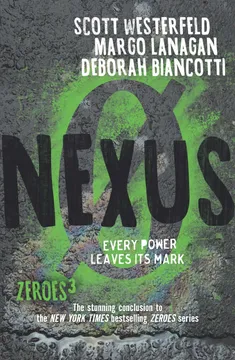
Nexus is the third book in the Zeroes series, earning an overall rating of 3.98/5. Readers praised its diverse cast, unique superpowers, and compelling characters, with many finishing it in a single sitting. The series was frequently compared to Sanderson's Reckoners and the TV show Heroes. Common criticisms included a rushed ending, too many unanswered questions, frequent perspective shifts, and an unsatisfying conclusion. Despite mixed feelings about the finale, most readers enjoyed the trilogy and recommended reading the books consecutively.
Characters
Nataniel Saldana
Crowd-shaping fugitiveKnown as Nate, he is the Zeroes' charismatic strategist, able to gather and direct a crowd's attention. He has long treated influence as a natural form of leadership, often confusing persuasion with permission. His imprisonment strips him of the audience that sustains his power and forces him to examine what he is without command. Nate cares about keeping the Zeroes together, but his instinct to protect them can make him manipulative and morally reckless. His relationships with Flicker, Chizara, and the others expose the difference between being followed and being trusted. He is drawn to leaders who promise a place for people like him, especially when he feels excluded or powerless.
Riley Phillips
The team's far-seeing leaderKnown by her codename Flicker, Riley is a blind teenager who can see through other people's eyes and move her awareness between them. She often supplies the practical judgment and steady attention that keep the Zeroes functioning when Nate is absent or overconfident. Her blindness is part of her identity, not a consequence of her power, and she has learned to navigate a world designed around sight by listening closely to people and spaces. Riley is fiercely attached to her twin Lily and to Thibault, though those bonds leave her vulnerable to abandonment and divided loyalties. She is cautious about attention, especially when the group is wanted, but increasingly trusts her own authority.
Chizara Okeke
A maker who can crashChizara, usually called Zara, can sense and disrupt electronic systems, and she is learning to repair them as well as break them. The constant electronic noise of cities causes her pain, making quiet and technical problems feel like relief. Her early training in a repair shop taught her patience and the habit of checking her work, qualities that temper the intoxicating rush of her power. Zara fears that her abilities could harm people, especially after past failures made her see herself as dangerous. Her love for Kelsie and longing for her family ground her when the power to control machines begins to resemble the power to control bodies.
Kelsie Laszlo
A crowd's emotional compassKelsie can absorb and spread the emotions of a crowd, helping people feel connected or turning their shared mood into a dangerous force. Music gives her a language for organizing feeling without flattening individual differences. She is warm, forgiving, and hungry for company, traits shaped partly by a difficult childhood and the loss of her father. Kelsie's history with Swarm makes her fear that her compassion is only a thin cover for a desire to possess and direct others. Her relationship with Chizara gives her an anchor, but Kelsie must learn to distinguish care from control and to accept that her capacity for harm does not define every choice.
Ethan Cooper
The boy with the voiceEthan's power speaks through him with unnerving confidence, producing lies, insights, and information he does not always understand. He uses it to bluff, bargain, and escape trouble, while privately resenting that friends often treat him as a tool rather than a person. Ethan's humor protects him from fear, and his craving for ordinary companionship emerges in his growing attachment to Sonia. He is less certain of his value than his power's boldness suggests. Because the voice sometimes says things Ethan would never choose to say, he struggles with responsibility and authorship: whether a useful outcome makes a harmful intervention acceptable.
Thibault Durant
The boy people forgetThibault's power makes attention slide away from him, allowing him to pass through crowds unnoticed. He has built a quiet, almost spiritual discipline around that ability, but solitude has also taught him to expect abandonment. He is thoughtful and observant, often noticing the emotional or physical details others miss. His relationship with Flicker challenges his belief that remaining unattached is safer for everyone. Thibault's sense of himself is fragile because other people can forget him, and guilt can deepen that disappearance. He wants to act responsibly, yet fears that action may make him dangerous or unworthy of connection.
Piper
New Orleans' commanding ZeroPiper is a powerful crowd leader whose confidence can turn a gathering into a devoted following. She has deep roots in New Orleans and sees the city's history of disaster and neglect as evidence that ordinary institutions cannot be trusted to repair what they break. Her political imagination is sweeping: she wants people with powers to shape a new social order rather than remain feared or exploited. Piper's charisma makes her vision compelling, especially to Nate, who recognizes both her skill and the promise of belonging. She is decisive, strategic, and accustomed to treating disagreement as an obstacle to be overcome.
Verity
The truth-forcing agentVerity is a teenage FBI operative whose power compels people to tell the truth when a crowd's attention supports her. She approaches Zeroes as both a person with abilities and a potential danger, a tension that complicates her government role. Her history with Piper makes her loyalties more personal than her badge suggests. Verity is guarded because she knows what people reveal under pressure, including painful truths about herself. Her skill is valuable to agents seeking control, but she worries that the institution recruiting her may never fully trust her.
Agent Phan
The FBI's Zeroes expertPhan is an FBI agent trying to understand and contain the growing number of powered teenagers. Unlike colleagues who dismiss Zero abilities as hysteria, he studies their specific mechanisms and prepares for them. He is methodical, pragmatic, and willing to negotiate when force would make matters worse. His connection to Verity reflects both professional trust and concern for her safety. Phan's work places him between a government that wants control and young people who fear being imprisoned or used.
Sonia Sonic
Ethan's curious confidanteSonia is a Cambria friend and energetic weird-hunter blogger who wants to understand the growing phenomenon of Zeroes. Her curiosity is paired with a talent for asking questions and organizing people, though her eagerness to share information can expose others to risk. She gives Ethan a connection to ordinary life beyond the fugitives' constant planning. Sonia is not easily intimidated by his power, and her interest in him is grounded in both his mystery and his awkwardness. She believes that documenting strange events can make her part of something larger.
Zoe Moseley
Kelsie's estranged motherZoe is Kelsie's mother, a former musician who now belongs to the Clarity Circle. Her separation from Kelsie is tangled with addiction, guilt, and decisions made during a painful family rupture. Zoe has built a new household and tries to protect its fragile stability, including the privacy of Oliver and the community he serves. She is not simply indifferent to Kelsie's return; she is cautious, ashamed, and unsure how to repair old harm without creating new danger.
Oliver
The giver of clarityOliver can make people recognize truths about themselves and their relationships. He uses this ability in the Clarity Circle, where people seek understanding rather than instant cures. Oliver is wary of wielding insight as a weapon, since recognition can overwhelm as readily as it can help. His long friendship with Piper gives him reason to hope she can change, but he also knows that clarity cannot force anyone to choose well. He is cautious around Kelsie because he recognizes how dangerous crowd powers can become.
Lily Phillips
Flicker's protective twinLily is Riley's twin sister, an observant young woman who remains in Cambria while the Zeroes flee. She loves Riley and worries about the family left behind, but she does not share her sister's trust in the fugitive group's choices. Her attempt to secure Riley's return grows from fear and divided obligations rather than simple hostility. Lily's close knowledge of Riley gives her access to memories and information the others cannot recover on their own.
Essence
The Makers' chief builderEssence leads a collective of young Crashes known as the Makers. She is technically skilled, confident, and protective of the people and projects under her command. Her group's work combines electronic ingenuity with a disciplined suspicion of ordinary surveillance. Essence regards Chizara as a rare peer, but she does not assume that shared abilities create shared loyalties. She can turn machines into instruments of pursuit as effectively as Chizara can disrupt them.
Ren, also called Glitch
The mind-disrupting survivorRen can scramble perception and thought, making people lose their bearings and struggle to recognize the world around them. She has a history with Nate and the Cambria Zeroes, and grief shapes how she judges their actions. Ren's power makes her formidable in a crowd, but its effects also expose the danger of turning confusion into a weapon. She is loyal to Piper's group and wary of people who have harmed those she loves.
Beau
The attention-drawing beautyBeau's power intensifies his beauty in the eyes of a crowd, pulling attention toward him until people struggle to look away. He is an old friend of Verity and becomes part of Piper's plans because he can focus a mass audience. Beneath the glamour, he is a young man learning what his ability does and how other people respond to it. His presence makes the boundary between admiration and compulsion difficult to see.
Troy
The maker of false valueTroy can make objects seem valuable to a crowd, turning ordinary things into convincing treasures. He is confident in his talent and takes pride in demonstrations that persuade people to believe what they want to believe. Piper includes him in a larger plan because money itself depends on shared belief. His ability raises questions about whether value belongs to an object or to the people who agree to recognize it.
Quinton Wallace
The predatory SwarmKnown as Swarm, Quinton could gather people into a violent collective and direct their shared aggression. His attack on the Zeroes left Kelsie with a lasting fear of her own power and forced the group to confront the lethal edge of crowd influence.
Craig
The group's steady allyCraig was an older ally who helped the Zeroes operate the Petri Dish and offered practical support beyond their own powers. His loyalty made him part of their found family and sharpened the cost of the violence surrounding them.
Edie
Zoe's former bandmateEdie performs with Easy Vice and knew Zoe before she left music. She gives Kelsie a glimpse of her mother's past, including the grief and self-blame that shaped Zoe's choices.
Plot Devices
The Curve
Crowds amplify every powerThe Zeroes' abilities strengthen when attention gathers around them. A handful of people may provide enough focus for a small effect, while a packed casino or Mardi Gras parade can transform a power into something overwhelming. This shared mechanism makes crowds both resource and hazard: Nate needs an audience to influence people, Kelsie can absorb a group's mood, and Flicker can move through its many points of view. The Curve explains why isolation weakens the Zeroes and why dense public spaces make their plans unpredictable. It also turns crowd management into a moral responsibility, since an emotional shift can affect everyone present.
Inside-Out Powers
Every ability has another faceThe novel gradually reveals that powers can have inversions or complementary forms. Nate's crowd command has an anonymous counterpart; Flicker's ability to see through others has a reverse that gathers attention; Beau's glamour and Rien's disappearance likewise reshape how a crowd notices someone. Other characters discover that emotional influence can soothe or inflame, while technological disruption can expose the channels through which powers travel. These reversals are not simple opposites or moral upgrades. They force each character to imagine what their existing ability conceals and what new responsibilities might follow.
Anonymity
Attention slips awayThibault's power makes human attention glide past him, allowing him to move through crowds without being registered. The same effect can spread to someone he touches, but using it risks isolating both people from ordinary reality. Nate discovers a related version of the ability while imprisoned, when shame and guilt turn his command power inward. Anonymity offers escape from surveillance and social pressure, yet the novel treats it as dangerous because being unseen can erode a person's memory, identity, and ties to other people.
Nexus
A transmitter scales powersNexus is a satellite-dish transmitter built into a Mardi Gras float by Piper's Makers. It gathers power from a massive crowd and broadcasts selected abilities far beyond the people who possess them. Piper intends to use it to project truth, undermine money's value, and crash technological systems, making it a technological amplifier for a political revolution. The machine's design depends on the same human connections that sustain Zero abilities, but its effects exceed any one person's control. Its final activation produces a different combination of consequences than Piper intended.
Power Shielding
Mesh blocks the CurveMetal mesh and Faraday-like enclosures block electronic signals and, in more advanced forms, interfere with the Zeroes' crowd-based abilities. The FBI and the Makers use shielding to conceal rooms, people, and equipment from powers that normally reach through attention or technology. Such barriers can imprison a Zero by removing the social contact their ability needs. Chizara's eventual insight that a powered light wire crosses the shield illustrates the device's limit: a barrier can stop broad influence while leaving a narrow physical connection open.
About the Author
Other books by Scott Westerfeld


Download PDF
Download EPUB
.epub digital book format is ideal for reading ebooks on phones, tablets, and e-readers.








