


Key Takeaways
Listen before a warning becomes impossible to act on.
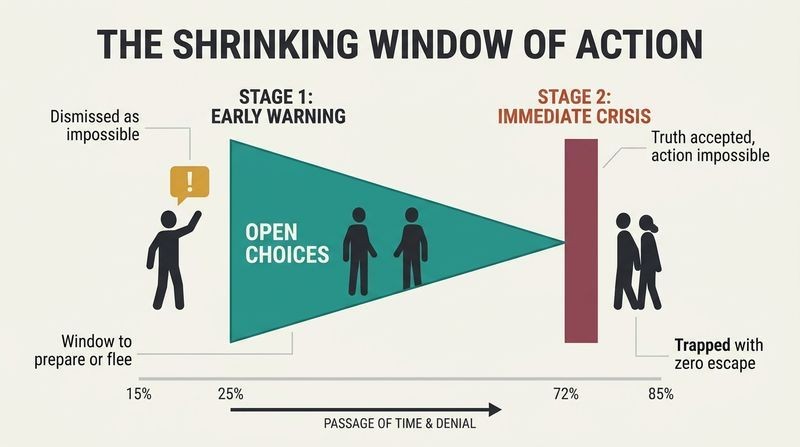
A witness returns. In Sighet, the young Eliezer studies Jewish mysticism with Moishe the Beadle, a poor, gentle man. After Moishe is deported with other foreign Jews, he escapes a mass killing and returns to describe what he saw. He begs the community to prepare. People dismiss him as mad, and Eliezer hears him without grasping the warning’s urgency. Months pass before German forces arrive and deport the town’s Jewish population.
Denial feels ordinary. Moishe’s story shows how a warning can be rejected not because it lacks evidence, but because accepting it would shatter the life people still hope to preserve. The community’s disbelief is understandable in its uncertainty, but it leaves people unprepared when the danger becomes immediate.
What's striking is that Moishe offers more than a prediction: he is a survivor reporting witnessed events, yet his neighbors treat his testimony as an emotional disturbance. That pattern matters wherever disturbing evidence threatens a community's sense of normality. Social psychology describes how people often interpret alarming information in ways that protect shared expectations, especially when acting on it carries immediate costs. Still, the memoir does not make hindsight a license to blame those who stayed. The future was not obvious to them, and their choices were constrained. Its sharper lesson is to distinguish uncertainty from evidence-free dismissal, and to keep investigating warnings that are painful to hear.
A polite occupier can still be enforcing a murderous system.

Courtesy can mislead. When German soldiers first enter Sighet, some behave politely in the homes where they are billeted. One even brings chocolates to a neighbor. Their manners encourage residents to think the worst may not happen, despite reports of violence and the escalating persecution of Jews elsewhere.
Restrictions become a trap. Authorities first seize property, impose curfews and require Jews to wear identifying stars. They then confine people to ghettos, where residents mistake familiar routines and Jewish-run services for a measure of safety. Soon the ghettos are emptied and families are deported. The sequence shows how each restriction can seem survivable on its own, while the cumulative effect is to remove freedom, resources, and time to escape.
This contrast separates personal demeanor from institutional function. A courteous soldier may be easier to trust than an openly cruel one, but civility does not reveal what a government is organizing or what its policies make possible. The residents read visible politeness as evidence about the whole system, a familiar reasoning error: judging a large structure by a few face-to-face encounters. The account also makes clear that the danger does not arrive as one unmistakable signal. Coercion advances through successive limits, each of which can be normalized. Attention to patterns and outcomes is therefore more reliable than judging a policy by the manners of the people administering it.
In the camps, a name and family role become assigned numbers.

Separation happens fast. At Birkenau, guards divide men from women. Eliezer sees his mother and young sister Tzipora move away, without knowing it is their final separation. On the train, a distraught passenger named Mrs. Schächter repeatedly cries out about flames. The others silence her because they see nothing. When the train reaches Birkenau, flames rise from the camp’s crematoria.
A number replaces a name. The SS sort arrivals through a selection, a rapid inspection that assigns some prisoners to labor and others to immediate death. Eliezer survives by giving a false age and claiming to be a farmer. Prisoners are shaved, stripped, and tattooed. He receives the number A-7713. The procedures make people easier to classify and control, while family ties and individual histories are treated as irrelevant.
The chapter's sequence links two forms of erasure: the enforced break between family members and the conversion of a person into a category. The selection is especially chilling because it combines arbitrary power with the appearance of routine assessment. Bureaucratic systems can make consequential violence seem like ordinary sorting, allowing decision-makers to distance themselves from individual lives. Mrs. Schächter's ignored cries add a painful complication: a truthful warning can be dismissed when its messenger is distressed and the evidence is not yet visible. The scene does not suggest that every alarm is accurate. It asks how people decide whom to silence when the cost of being wrong is borne by others.
Judge choices made under starvation with caution, not easy moral certainty.
Hunger narrows life. In the camps, bread and soup become the main measures of the day. Prisoners learn to guard small portions because the next meal is uncertain. During a later transport, German bystanders throw bread into a cattle car and watch starving prisoners fight over it. An elderly man hides a crust, only to be attacked by his own son, who takes it; both die in the struggle.
Survival carries shame. Eliezer also finds himself resenting his father when a camp overseer beats him, and he later recognizes how frighteningly far hunger and fear have changed him. In Buchenwald, he gives his ill father food, but not always freely or without resentment. The memoir records these reactions without turning them into simple proof of either goodness or selfishness.
The bread episode forces attention onto the conditions that shape behavior, rather than inviting a comfortable verdict about character. Extreme deprivation compresses time and attention around immediate survival. That does not make every action harmless, but it changes what moral judgment can responsibly claim about a person with few choices and a body near collapse. The narrator's own shame is important: he does not present himself as untouched by the camp's pressures. A careful reader can hold two ideas together, that the violence remains horrifying and that the prisoners' responses cannot be measured by the standards of ordinary life.
Let faith become protest when inherited answers cannot explain atrocity.
Belief changes shape. Before the war, Eliezer is a deeply observant boy who studies the Kabbalah, a Jewish tradition of mystical interpretation. In the camps, he watches children and adults die, and his faith in divine justice breaks down. During the Jewish New Year service, he cannot join in praising God as though the suffering around him were compatible with a just order. On Yom Kippur, he eats rather than fast, treating the act as refusal.
Ritual remains complicated. Other prisoners continue to pray, debate the meaning of suffering, or lose the faith that once sustained them. Eliezer's response is not simple indifference: he becomes an accuser, still addressing the God whose silence he cannot accept. The book presents belief as a struggle shaped by what the prisoner witnesses.
The account gives religious doubt an unusual form: not an abstract argument about whether God exists, but a moral protest arising from the sight of specific suffering. That makes the question of divine justice concrete without pretending it can be resolved. Religious traditions often preserve lament alongside praise, giving grief a language that does not require premature consolation. Eliezer cannot use that language in the same way as some fellow prisoners. His response should not be treated as the only honest one, nor theirs as denial. The memoir's force lies in showing how faith, protest, and ritual can diverge under conditions that test their meaning.
A loved one can be both your reason to endure and your burden.
A bond keeps him moving. During the winter evacuation from Buna, Eliezer's injured foot makes every step painful. He keeps running partly because his father is beside him and depends on him. In the crush of prisoners, he fears losing his father more than he fears the road itself. Their attachment gives each a reason to continue through a march designed to exhaust them.
Care has limits. After they reach Buchenwald, his father's health collapses. Eliezer searches for him, shares food, and tries to protect him, yet he also has moments when he wishes he could be free of the responsibility. His father dies after days of illness and mistreatment. Eliezer is left with guilt over not answering his final calls, and even a feeling of relief that horrifies him.
The father-son relationship resists the comforting idea that love makes people consistently generous. Under threat, attachment can organize effort and provide purpose, but it can also intensify exhaustion and conflict with self-preservation. The narrator's mixed feelings are not a verdict on the quality of his love; they are evidence of what prolonged coercion does to the range of choices a person can bear. This distinction matters when reading survivor testimony. Compassion does not require idealizing the survivor, and moral complexity does not diminish the brutality of the circumstances that produce it.
Use small acts of recognition to resist systems that erase personhood.
Care survives in fragments. After a camp overseer beats Eliezer, a French forced laborer quietly gives him bread and speaks to him with tenderness. A block leader named Alphonse tries to get extra soup for young and weak prisoners. These gestures do not end the violence, but they acknowledge that the person receiving them is more than a number or a body to exploit.
Art still reaches someone. During a transport, Juliek, a young violinist Eliezer knew at Buna, plays a piece by Beethoven in a barrack crowded with dying men. By morning, Juliek is dead and his violin is broken. The performance cannot rescue either the musician or his audience. It remains an act of expression offered to others when ordinary life, privacy, and safety have disappeared.
These moments are powerful precisely because they are not presented as victories over the camp. They restore neither safety nor justice. Instead, they briefly interrupt the logic that treats people as interchangeable and disposable. Research on social connection often emphasizes recognition as a basic human need, but here recognition is not a program or guarantee of resilience. It is a fragile, local act whose value does not depend on changing the outcome. Juliek's music also complicates the idea that art must provide comfort. Sometimes its role is simply to make a human presence perceptible amid conditions designed to erase it.
Liberation frees the body before it can restore the self.
Freedom begins with hunger. At Buchenwald, prisoners organize resistance as the Germans prepare to empty the camp. American forces arrive, ending the immediate captivity. The survivors' first concern is food, not revenge or celebration. Eliezer soon becomes gravely ill and spends two weeks in a hospital.
The past remains visible. Once he can stand, he looks in a mirror for the first time since leaving the ghetto. The face looking back seems to him like that of a corpse. The memoir ends there, refusing a neat return to the boy who once studied and prayed in Sighet. Liberation changes his physical circumstances, but the years of deprivation, loss, and witnessing remain part of his life.
The ending resists a common narrative shortcut: treating liberation as the point at which suffering becomes past tense. The first impulse toward food is not a failure of gratitude. It reflects how completely deprivation has reorganized the survivors' immediate needs. The mirror then makes survival visible without making it equivalent to recovery. In contemporary discussions of trauma, the distinction between ending a threat and integrating its effects is crucial, though this memoir does not offer a clinical account. Its final image instead insists that testimony has a purpose: the survivor's altered face cannot be mistaken for an uncomplicated happy ending.
Analysis
Night is both a testimony about the Holocaust and a memoir of a young person's transformation under persecution. Its structure carries the reader from Eliezer's religious questions in Sighet through deportation, camp life, the death of his father, and liberation. The movement is not simply from belief to disbelief or from childhood to adulthood. It is a record of how each stage changes what a question, a family bond, a meal, or a prayer can mean.
The memoir's moral force comes partly from refusing to make its narrator a flawless witness. Eliezer describes moments of fear, resentment, self-protection, and relief alongside acts of care and endurance. This honesty complicates the familiar survivor narrative in which suffering produces a clear moral hero. The camp's violence is not softened by that complexity. Rather, the account shows why judging people under engineered starvation and terror by ordinary standards can be misleading.
Its scenes also reveal a progression from public denial to administrative violence. Moishe's report is dismissed; polite soldiers encourage false reassurance; restrictions and ghettos make confinement appear manageable; selections turn lives into decisions made in seconds. The narrative links catastrophe not only to direct brutality, but to the routines and assumptions that make brutality easier to ignore.
Yet a memoir is not a complete history of a camp, nor does one person's experience represent every prisoner's. Its authority is narrower and more valuable: it preserves what one witness saw, felt, and could not forget. The closing image in the mirror makes survival visible without claiming that it repairs the damage. The book's lasting demand is therefore not easy optimism, but attention: to testimony, to the machinery behind apparently ordinary actions, and to the human cost that abstractions conceal.
Review Summary
Night is a powerful, harrowing memoir of Elie Wiesel's experiences in Nazi concentration camps. Readers find it deeply moving, important, and difficult to read due to its brutal depiction of the Holocaust. Many consider it essential reading to ensure such atrocities are never forgotten. The sparse, honest writing style effectively conveys the horror and trauma Wiesel endured. Some readers note it lacks the detail of other Holocaust accounts, but most agree it's a profoundly impactful work that should be widely read.
People Also Read










Glossary
Kabbalah
Jewish mystical traditionA Jewish tradition of mystical interpretation and spiritual study. As a boy, Eliezer seeks a teacher to guide him in its teachings, especially the Zohar. His early interest establishes a life shaped by religious questions, making the later crisis of faith part of the memoir's central personal arc.
Shekhinah
Divine presence in exileA term in Jewish mystical thought for the divine presence. In the memoir's opening, Moishe connects the Shekhinah's exile with human suffering and the hope of redemption. The idea gives spiritual significance to the relationship between God's presence and the suffering of people.
Kapo
Prisoner overseerA prisoner assigned authority over other prisoners, often to supervise work or enforce camp rules. In the memoir, Kapos can wield violence and exploit their position, though the role itself describes a place within the camp hierarchy rather than one uniform personality or behavior.
selection
Sorting for labor or deathA camp procedure in which SS personnel inspect prisoners and decide who is considered fit for work and who will be killed. The judgment can depend on physical appearance and happen rapidly. In Night, selection makes survival contingent on arbitrary assessments that prisoners try to influence by appearing healthy.
Muselman
Term for near-starved prisonersA camp term used in the memoir for prisoners who have become profoundly emaciated and weak. Such prisoners are treated as unlikely to survive and may be targeted during selection. The term reflects the camp's brutal categorization of people according to their perceived capacity for labor.
Sonder-Kommando
Forced crematoria work detailA prisoner unit forced to work in connection with the crematoria, including handling the bodies of people murdered there. In the memoir, Eliezer learns that prisoners selected for their strength may be assigned to this work. The term names a coerced role within the machinery of mass killing.
Kaddish
Jewish prayer of sanctificationA Jewish prayer traditionally associated with mourning and the remembrance of the dead. In the memoir, prisoners recite it for relatives and, at times, for themselves. Its presence in the camps underscores the persistence of religious ritual even when familiar beliefs about justice and divine protection have been shattered.
Appelplatz
Camp assembly groundThe open area where prisoners assemble for roll call and other camp procedures. In Night, executions and announcements also take place there. Its use as a site of routine counting and public violence shows how ordinary administration and terror occupy the same physical space.
FAQ
What's Night by Elie Wiesel about?
- Holocaust Memoir: Night is a memoir by Elie Wiesel detailing his experiences as a Jewish teenager during the Holocaust, including his deportation to Auschwitz and Buchenwald.
- Loss of Faith: The narrative explores Wiesel's profound loss of faith in God amidst the atrocities he witnesses, reflecting on the transformation of his understanding of humanity and divinity.
- Survival and Witnessing: Wiesel emphasizes the importance of bearing witness to the Holocaust, serving as a testament to the resilience of the human spirit amidst overwhelming despair.
Why should I read Night by Elie Wiesel?
- Historical Significance: Night provides a personal account of the Holocaust, making historical events more relatable and impactful, and serves as a crucial reminder of the consequences of hatred and indifference.
- Moral Reflection: The book challenges readers to reflect on moral and ethical questions regarding humanity, faith, and survival, prompting consideration of personal responses to injustice and suffering.
- Literary Impact: Wiesel's powerful and evocative writing uses stark imagery and emotional depth, influencing countless readers and establishing the book as a staple in Holocaust literature.
What are the key takeaways of Night by Elie Wiesel?
- The Power of Silence: Wiesel illustrates how silence can be both a response to trauma and a form of complicity, emphasizing the lasting impact of such silence.
- Humanity's Capacity for Evil: The memoir highlights the depths of human cruelty, serving as a warning against apathy and moral disengagement.
- The Struggle for Identity: Wiesel's journey reflects the struggle to maintain one's identity and humanity in the face of dehumanization, emphasizing the loss of self during the Holocaust.
What are the best quotes from Night by Elie Wiesel and what do they mean?
- “Never shall I forget that night…”: This opening line encapsulates the trauma and horror of Wiesel's experiences, setting the tone for the memoir and emphasizing the lasting impact of those memories.
- “Where is God now?”: This question reflects Wiesel's profound crisis of faith as he witnesses the suffering of innocents, underscoring the struggle between belief and the reality of evil in the world.
- “From the depths of the mirror, a corpse gazed back at me.”: This haunting image reflects Wiesel's loss of identity and humanity, symbolizing the psychological scars left by trauma.
How does Night by Elie Wiesel address the theme of faith?
- Crisis of Belief: Wiesel's faith is shattered by the atrocities he witnesses, leading him to question God's justice and presence.
- Struggle with God: Throughout the memoir, Wiesel grapples with his relationship with God, expressing anger and confusion, portraying God as both absent and present.
- Redemptive Faith: Despite his loss of faith, Wiesel emphasizes the importance of remembering and bearing witness, serving as a call to maintain hope and humanity in the face of despair.
What literary techniques does Elie Wiesel use in Night?
- Sparse Language: Wiesel employs a concise and straightforward writing style to convey the gravity of his experiences, enhancing the emotional weight of the narrative.
- Imagery and Symbolism: The use of vivid imagery, such as fire and night, symbolizes destruction and loss, illustrating Wiesel's profound transformation.
- First-Person Perspective: The memoir is written in the first person, creating an intimate connection between Wiesel and the reader, deepening the impact of his story.
How does Night by Elie Wiesel depict the relationship between father and son?
- Mutual Dependence: Wiesel portrays the bond between him and his father as a source of strength amidst the horrors of the camps, relying on each other for emotional support.
- Strain Under Duress: The relationship is tested by the extreme conditions of the concentration camps, leading to moments of guilt and conflict.
- Ultimate Loss: The death of Wiesel's father marks a profound turning point, symbolizing the loss of familial bonds and the devastating impact of the Holocaust.
What role does memory play in Night by Elie Wiesel?
- Preserving the Past: Wiesel emphasizes the importance of remembering the Holocaust to honor the victims and ensure that such atrocities are not forgotten.
- Trauma and Healing: Memory serves as both a source of pain and a means of healing for Wiesel, helping him confront his trauma and make sense of his past.
- Collective Memory: Wiesel's narrative contributes to the collective memory of the Holocaust, shaping how future generations understand and remember this dark chapter in history.
How does Night by Elie Wiesel challenge the reader's understanding of humanity?
- Moral Ambiguity: Wiesel's experiences force readers to confront the complexities of human nature, including the capacity for both good and evil.
- Empathy and Responsibility: The memoir calls on readers to empathize with the suffering of others and take responsibility for preventing future injustices.
- Reflection on Identity: Wiesel's struggle to maintain his identity amidst dehumanization challenges readers to consider their own values and beliefs.
What is the significance of the title Night by Elie Wiesel?
- Symbol of Darkness: The title represents the pervasive darkness of the Holocaust, signifying the loss of faith, hope, and humanity experienced by Wiesel and other victims.
- Contrast to Light: Night contrasts with the idea of light, which often symbolizes knowledge, truth, and life, illustrating how the Holocaust plunged individuals into despair.
- Enduring Legacy: The title serves as a reminder of the ongoing impact of the Holocaust on collective memory and identity, challenging readers to confront the darkness within humanity.
How does Elie Wiesel's background influence Night?
- Jewish Heritage: Wiesel's upbringing in a Hasidic community informs his understanding of faith, tradition, and the Jewish experience, shaping the themes in the memoir.
- Survivor's Perspective: As a Holocaust survivor, Wiesel's firsthand experiences lend authenticity and urgency to his narrative, conveying the emotional impact of the Holocaust.
- Literary Influences: Wiesel's education and exposure to Jewish texts and philosophy influence his writing style and thematic choices, enriching the depth of his reflections.
How does Night by Elie Wiesel compare to other Holocaust literature?
- Unique Perspective: Night is a deeply personal account focusing on Wiesel's individual experiences, setting it apart from more historical or collective accounts.
- Literary Style: Wiesel's stark and unadorned writing style reflects the gravity of his subject matter, contrasting with other Holocaust literature that may use more elaborate prose.
- Thematic Depth: While many Holocaust texts explore themes of survival, Night delves into the complexities of faith, identity, and the human capacity for evil, adding philosophical inquiry.
The Night Trilogy Series

Download PDF
Download EPUB
.epub digital book format is ideal for reading ebooks on phones, tablets, and e-readers.








