


Key Takeaways
Stop selling and start solving, because people hate being sold
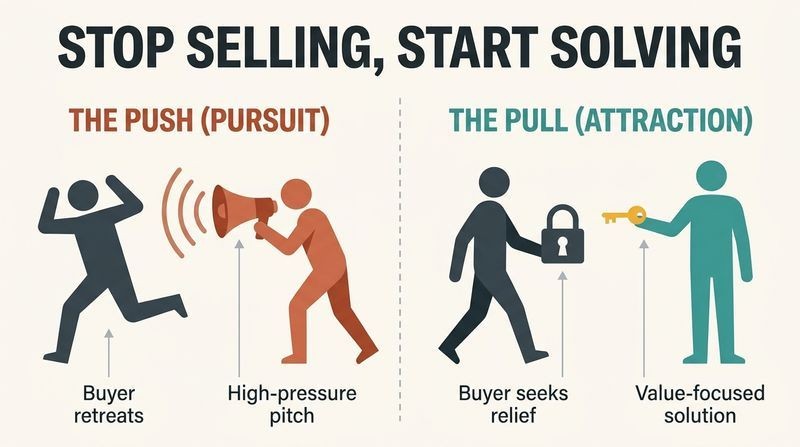
The core reframe of Ninja Selling. Larry Kendall, cofounder of Colorado's most productive real estate firm, argues that the pushy, high-pressure salesperson is obsolete. His origin story: at a 1970s Denver sales rally he watched trainers brag about pulling out a toothbrush and refusing to leave until the customer signed. He left nauseated. The Internet finished off that model. Buyers now often know more than the agent.
The alternative is to attract rather than pursue. People move toward value, defined as anything that solves a problem (relieves pain) or makes them feel good (brings pleasure). Instead of pitching features, Ninjas ask questions, discover pain and pleasure, then offer a solution if they have one. The word sell descends from an old English term meaning to give.
The thesis aligns with Daniel Pink's To Sell Is Human and Neil Rackham's SPIN Selling research, which found consultative questioning outperforms feature-dumping in complex sales. What's striking is Kendall's insistence that this works for introverts. Traditional sales lore assumes the DISC power personality, roughly 15-20% of people. By systematizing solving rather than charisma, he democratizes the craft. The limitation: solving-not-selling can become a slogan that masks avoidance of asking for the business. Genuine service still requires a moment of proposing. Kendall handles this through soft closing questions, but the danger of endless rapport without commitment is real.
Choose the player channel; nobody wants to work with a victim

Your vibe precedes your value. Kendall opens with Maria Vitale, a single mom living in her mother's basement with two toddlers, broke after a divorce. She was surrounded by potential clients but closed nothing. Once she shifted from a victim mind-set to a player mind-set, contracts appeared. She closed nine transactions in one December (the national average is six per year) and bought her own home.
Kendall frames humans as broadcasters of energy. Your thoughts and feelings emit a frequency others read as your vibe. Sports psychologist James Loehr's four emotional-energy quadrants show peak performers operate in high positive: cool, confident, attentive. Players occasionally dip negative but bounce back quickly, showing response-ability. Victims get stuck. Rituals (music, gratitude, exercise) pull you back to the performance zone.
The energy-frequency language is metaphorical rather than literal physics, and skeptics will bristle at talk of measurable vibes. Yet the underlying mechanism is well documented: emotional contagion research by Elaine Hatfield shows humans unconsciously mimic and catch each other's affective states within milliseconds. Loehr's work with elite athletes is legitimate performance psychology. What's valuable here is the reframe of emotion as a controllable input rather than a weather system that happens to you. The player-versus-victim binary risks toxic positivity when applied to genuine hardship, but as a working posture before a client meeting, it is practical and testable.
What you focus on expands, so program your brain's search engine

Your RAS is an onboard Google. At the base of the brain sits the Reticular Activating System, a filter that admits into awareness whatever you deem important. Decide to buy a certain car and suddenly you see it everywhere. It runs two pathways: things you want and love, or things you fear and avoid. The golfer who repeats stay out of that sand trap programs the ball straight into it.
Kendall applied this to his own debt. Focusing on getting out of debt made debt expand. Refocusing on being free and clear worked within five years. In sales, this means writing positive, measurable goals in first person, present tense, because the nonconscious cannot process future tense as real. Improper: I want to list more houses. Proper: I am grateful I list twenty-five houses a year.
The RAS is real neuroanatomy, though Kendall stretches it into something closer to law-of-attraction folk psychology. Attentional science supports the core claim: selective attention and the Baader-Meinhof phenomenon (frequency illusion) show priming genuinely alters perception. Mother Teresa's line about attending a peace rally rather than an antiwar rally captures the reframe elegantly. The present-tense affirmation advice echoes visualization protocols used by Olympians. Caution: focus expands opportunity recognition, not reality itself. Believing you weigh your goal weight does not melt fat; it nudges behavior that does. Kendall's weight-loss anecdote actually proves the behavioral mechanism, not magical thinking.
Ask the FORD questions, then listen for the change that moves people
Four doors into anyone's life. FORD stands for Family, Occupation, Recreation, and Dreams, the four topics people love discussing. Kendall coached his partner Mike Malvey, who felt guilty at his kids' soccer games, to leave his chair in the car and work the sidelines asking parents these questions rather than the dreaded Do you know anyone buying or selling?
The power is not chitchat; it is listening for change. A promotion, divorce, new baby, longer commute, or empty nest reshapes real estate needs. Kendall's friend Russ got promoted but had to commute an hour each way. Kendall did the math (roughly 480 hours a year in the car), knew Russ was in pain, and simply monitored until Russ was ready. Customers should talk about 75% of the time.
FORD is a clever mnemonic that operationalizes what psychologists call active-empathic listening. Research on rapport by sociologist Nick Morgan and on the mere talking effect shows people rate conversations more positively when they speak more, and Harvard neuroscience (Tamir and Mitchell) found self-disclosure activates the brain's reward circuitry like food or money. So asking FORD questions literally makes people feel good, which is Kendall's definition of value. The listen-for-change discipline is the genuinely sophisticated part: it converts social pleasantry into a predictive signal. The ethical tightrope is surveillance versus service. Kendall's answer is that intent (help, not harvest) is felt by the other person.
Flow is oxygen; clients pick whoever touched them in the last 72 hours
Doing a great job does not earn the next job. Kendall cites National Association of Realtors data: 84% of sellers say they will definitely or probably reuse their agent, yet only 25% actually do. For buyers, 88% intend to return but just 12% do. Why? Buying a home is rare, memory fades, and the average person knows twelve Realtors.
The deciding factor is flow, defined as frequency of interaction. Though the whole process takes 9 to 21 months, people choose an agent in about 72 hours, picking whoever they were most recently in flow with. Kendall recommends three auto-flow touches per month (mail and email) plus fifty live interviews per week. Crucially, every touch must create value; junk mail destroys flow.
This is the book's most counterintuitive and best-evidenced claim. The intention-behavior gap is a robust finding in psychology (Sheeran's meta-analyses show stated intentions predict behavior far less than people assume). Kendall's numbers dramatize it viscerally. The mechanism echoes the marketing concept of top-of-mind awareness and the mere-exposure effect (Zajonc): repeated benign contact breeds preference and recall. His Hobbs/Herder study, where a fictitious agent became the most-recalled Realtor after eight weekly mailings, is a striking natural experiment. The vulnerability: in an era of inbox saturation, the value bar for flow keeps rising, and what counted as valuable contact in 1995 is now noise.
You are swimming in abundance: 100 households you know equal 15 deals yearly
The math that kills scarcity thinking. Roughly 11 to 14% of US households move each year. Factoring owners versus renters, the national transaction rate lands near 15%. That means for every 100 owner households who know you, there are about fifteen transactions annually, and one owner can generate several (sell, buy, plus an investment property).
Kendall bet a slumping agent that her 200-person database had done thirty-plus deals the prior year. A title search revealed forty-three, almost none with her, because she had cut her flow when the market scared her. Most agents average six deals a year while surrounded by thirty. Working the Ninja System, agents earn roughly $1,000 in commission per name in their database. Two hundred names, worked properly, means $200,000.
Reframing a scarcity market as an abundance problem is cognitively powerful and grounded in real IRS address-change data. This connects to Carol Dweck's abundance versus scarcity framing and to behavioral economics on loss aversion: frightened agents cut marketing precisely when consistency matters most, a procyclical error. The $1,000-per-name heuristic is elegant but market-dependent (average sale price and commission structure vary wildly by region). The deeper insight is that the constraint is rarely demand; it is the agent's failure to stay visible. This mirrors sales-pipeline research showing most revenue loss happens through neglect of existing relationships, not lack of prospects.
Do the Ninja Nine daily; production takes care of itself
Focus on causes, not results. Kendall reverse-engineered top producers into nine repeatable habits. Five daily: express gratitude, show up without opening email first (email puts you on someone else's agenda), write two personal handwritten notes, review your hot list, review your warm list. Four weekly: make customer service calls, book two live real estate reviews, complete fifty live interviews, and update your database.
The hot list is people ready to transact within ninety days. The warm list is people who do not yet know they will move but whose life changes (a sixteen-item checklist) signal it. When rookie-of-the-year Tami Spaulding froze in a slump chasing income goals, Kendall replaced them with daily activity goals: so many notes, so many interviews. She doubled her income. Her goals had her; he flipped it.
This is textbook systems-over-goals thinking, the same principle James Clear popularized: you fall to the level of your systems. The activity-goal reframe is supported by self-determination theory, which finds that process goals sustain motivation better than outcome goals because they are within personal control and provide daily wins. The handwritten-note prescription is quietly radical in a digital age; scarcity makes analog mail more differentiating, an application of signaling theory (a note costs effort, so it signals genuine care). One critique: fifty live interviews weekly is demanding, and the book's own star cases often override the system through sheer volume of contact, suggesting the real driver is total meaningful touches, however achieved.
Match the personality: Power, Party, Peace, or Perfection
The Platinum Rule beats the Golden Rule. Treat others not as you want to be treated, but as they want to be treated. Kendall adapts the DISC model into four types, borrowed from Chris Helder:
1. Power (15-20%): future-focused, fast deciders, want the executive summary
2. Party (25-30%): present-focused, fun-seeking, impulsive, love color and testimonials
3. Peace (35-40%): status-quo lovers, slow deciders, need trust and process
4. Perfection (15-20%): data-driven, past-focused, will recalculate your charts
Power and Party are risk-takers (toward strategy); Peace and Perfection are risk-avoiders (from strategy). So the closing question shifts: for risk-takers, Shall we see if you can buy this? For risk-avoiders, Shall we make sure you don't lose this? The hardest gaps are diagonal opposites: a fast Power person with a cautious Peace person.
Personality typing sells well and aids empathy, but the science is shaky. DISC and its derivatives lack the validity of the Big Five (OCEAN), and meta-analyses find weak evidence that matching sales style to buyer type boosts outcomes. The four-P labels risk stereotyping and cold reading. That said, the practical kernel is sound: cognitive and communication-style flexibility improves persuasion, a finding supported by research on behavioral mimicry and adaptive selling (Weitz). The toward/from distinction maps neatly onto regulatory focus theory (Higgins), where promotion-focused and prevention-focused people respond to gain-framed versus loss-framed messages respectively. Frame the tool as a flexibility prompt, not a taxonomy of souls.
Ask questions in sequence: rapport, foundation, diagnosis, then solution
Order matters as much as content. Kendall stumbled onto what Thomas Freese's Secrets of Question-Based Selling proves: questions must climb a ladder. Start with rapport (the FORD questions and a three-step greeting). Then foundational questions that access prior learning, easy questions the customer already knows the answers to, which build trust and confidence. Only then diagnostic questions that create clarity across six areas: who, what, when, where, why, and how. Finally, solution questions, at which point clients often close themselves.
With a skeptical retail CEO deciding whether to open a store, Kendall skipped the maps and stats his team expected and instead asked the executive to tell the story of his company. Confusion in any of the six areas makes customers think about it. One agent showed a couple forty homes fruitlessly; the real issue was the boyfriend unsure his girlfriend was the one. Confusion about who.
The sequencing insight is genuinely sophisticated and underappreciated in sales training. It mirrors motivational interviewing in clinical psychology, where premature advice triggers resistance and eliciting the client's own reasons produces change talk. Starting with prior-learning questions exploits the psychological safety of competence: answering easy questions builds momentum, an application of the consistency principle (Cialdini) and the foot-in-the-door effect. The six-areas clarity model resembles journalistic completeness checks. The forty-houses anecdote is a superb illustration that unmet decisions cannot be solved with more inventory, a lesson that generalizes far beyond real estate into any advisory role where the presenting problem masks the real one.
Let clients close themselves with pretend states and permission
People commit when they are clear and confident, not pressured. Two Ninja techniques bypass fear. First, the pretend state: If you could wave a magic wand and have this go perfectly, what would that look like? Because the answers do not count, people open up. Kendall's wife declared she loved their house of 23 years; a few magic-wand questions later she was ready to jump up from brunch to tour lakefront homes. They bought one.
Second, giving permission. Kendall tells buyers no one ever finds the perfect home; even people who build custom homes nitpick them. So when you find an 85% home you can picture living in, seriously consider it. Buyers then adopt the language, rating houses 85 or 90. The scratch-pad solution chunks the scary buy decision into five small ones (price, terms, dates, inclusions, contingencies), and buyers proceed about half the time.
These techniques are elegant applications of cognitive reframing and choice architecture. The pretend state lowers the stakes of self-disclosure, echoing improv theater and design-thinking's how might we framing, which research shows unlocks divergent thinking by removing the fear of wrong answers. The 85% permission move preempts the perfectionism that drives decision paralysis, related to Herbert Simon's satisficing versus maximizing: maximizers are measurably less happy with decisions. Chunking a large commitment into small sequential yeses is textbook commitment-and-consistency psychology. The ethical line is thin; the same tools that help a paralyzed buyer act could nudge a reluctant one. Kendall's guardrail, control the process but let the customer own the decision, is the crucial distinction between facilitation and manipulation.
Price homes on the bridge and where the market is heading
Two pricing tricks most agents miss. Buyers search in price blocks online. A home priced at $299,900 vanishes from the $300,000-to-$350,000 search. Price it on the bridge at exactly $300,000 and it appears in both searches; a national study found bridge-priced homes get 28% more showings. Kendall's rule: do not price houses the way stores price sweaters. When inventory is short, look under the bridge for hidden listings other agents mispriced.
Dynamic pricing means pricing where the puck is going, quoting Gretzky. Agent Joanne DeLeon took an expired listing that sat six months at $289,900 during the slow season. Recognizing spring as the neighborhood's hot season and seeing it would be the only home available, she raised the price to $300,000. It drew three offers and closed at $306,000, then appraised there using a market-timing package.
These are the book's most concrete, falsifiable tactics, and they translate beyond real estate into any pricing or search-visibility problem. The bridge concept is really about how discretization of search filters creates threshold effects, the same reason products cluster at $9.99 and job listings at round salary numbers. Raising the price of a stale listing violates naive intuition but reflects sound supply-and-demand reading: scarcity plus seasonality. The counterintuitive move exposes how anchoring and market psychology trump mechanical comparable-sales math. The appraisal risk is real, and DeLeon's solution (documenting seasonality and competing offers for the appraiser) shows that unconventional pricing demands evidence, not just nerve. A rare instance of a sales book offering genuinely testable operational edges.
Analysis
Ninja Selling occupies an unusual niche: a real estate sales manual that doubles as a personal-development treatise. Larry Kendall, an admitted introvert left with slurred speech and a paralyzed leg from childhood encephalitis, built America's most productive brokerage and then reverse-engineered why it worked. The result braids four strands: performance psychology (energy quadrants, the RAS, affirmations), consultative-sales science (FORD questions, question sequencing, the four-step consultation), relationship-marketing systems (flow, the Ninja Nine, databases), and operational tactics (bridge pricing, scattergrams, the ten- and sixteen-step processes).
The book's intellectual spine is a rejection of what Kendall calls Depression-Era Selling, the manipulate-and-close paradigm, in favor of attraction through value. This lands squarely in the same tradition as Pink's To Sell Is Human, Rackham's SPIN Selling, and Burg's The Go-Giver (whose author wrote the foreword). What distinguishes it is the fusion of soft interior work with hard operational discipline. Most sales books pick one; Kendall insists mind-set overrides skill set and action, then still hands you a fifty-interviews-per-week checklist. The strongest, most defensible claim is the intention-behavior gap in client retention: 84% intend to reuse an agent, 25% do. That single statistic reframes the entire business from transaction-hunting to relationship-farming, and it is buttressed by robust psychology (Sheeran, Zajonc's mere exposure).
The weakest links are the pseudo-scientific flourishes: vibrational frequencies, the nonconscious that cannot take a joke, and DISC-derived personality typing, which lacks the validity of the Big Five. These are best read as useful metaphors and empathy scaffolds rather than literal mechanisms. What elevates the book is its coherence. Gratitude feeds vibe, vibe attracts, attraction requires value, value requires questions, questions require flow, flow requires systems, systems require abundance thinking. Each principle reinforces the next. For any advisory profession where trust and repeat business matter, the transferable lesson is stark: consistency of caring contact, not talent or pressure, compounds into results.
Review Summary
Ninja Selling receives mostly positive reviews, with readers praising its practical advice for real estate agents and other sales professionals. Many appreciate the focus on building relationships, providing value, and maintaining a positive mindset. Some readers found the book transformative for their careers and personal growth. However, a few criticisms mention sexist undertones and an overemphasis on positive thinking. Overall, reviewers recommend the book for its actionable content and holistic approach to sales.
People Also Read









FAQ
What's Ninja Selling about?
- Sales Philosophy Focus: Ninja Selling by Larry Kendall is a sales system that emphasizes creating value for customers and building relationships over traditional high-pressure sales tactics.
- Core Principles: The book is structured around four main principles: Personal Mastery, Stop Selling! Start Solving!, Ninja Business Strategy, and Connect and Communicate.
- Mindset and Energy: It highlights the importance of mindset and emotional energy, encouraging salespeople to project positivity to attract clients.
Why should I read Ninja Selling?
- Transformative Approach: Offers a fresh perspective on sales, focusing on serving clients rather than just selling to them.
- Proven Results: Many readers, including real estate professionals, have reported increased income and client satisfaction after applying its techniques.
- Cross-Industry Application: While designed for real estate, its principles are applicable to various fields, benefiting anyone in sales or client-facing roles.
What are the key takeaways of Ninja Selling?
- Value Creation: Emphasizes solving problems and creating value, as people prefer buying over being sold to.
- Mindset Matters: Personal mastery and controlling emotional energy are crucial for successful sales interactions.
- Flow and Relationships: Consistent communication is essential for building and maintaining client relationships.
What is the Ninja Selling System?
- Structured Approach: A documented process providing predictable results, focusing on teachable skills applicable to any personality or market condition.
- Four Principles: Built around Personal Mastery, Stop Selling! Start Solving!, Ninja Business Strategy, and Connect and Communicate.
- Daily and Weekly Habits: Includes the "Ninja Nine," a set of habits to maintain focus and productivity, such as gratitude practices and customer service calls.
How does Ninja Selling define value?
- Value Creation: Defined by solving problems or making clients feel good, prioritizing client needs over sales tactics.
- Law of Value: States that true worth is determined by how much more you give in value than you receive in payment.
- Understanding Client Needs: Involves asking the right questions and listening actively to tailor services to client needs.
What is the FORD method in Ninja Selling?
- Core Areas of Life: Stands for Family, Occupation, Recreation, and Dreams, key aspects for building rapport.
- Asking Questions: Engages clients in meaningful conversations, revealing motivations and needs.
- Listening for Change: Encourages active listening for life changes that may indicate a need for services.
What is the significance of flow in Ninja Selling?
- Flow as Relationship Builder: Refers to the frequency of interactions with clients, keeping you top-of-mind.
- Auto-Flow and Live Flow: Differentiates between automated communications and personal interactions, both essential for relationship building.
- Impact on Business: A strong flow system can lead to increased referrals and repeat business.
What is the Ninja Consultation process?
- Four Steps: Consists of Connection, Information, Solution, and Proposal, designed to build rapport and guide decision-making.
- Client-Centric Approach: Focuses on understanding client needs rather than pushing a sales agenda.
- Soft Closing Techniques: Uses questions that help clients feel comfortable making decisions without pressure.
How does the Funnel Process work in Ninja Selling?
- Elimination Method: Helps buyers avoid fear of missing out by filtering properties that don't meet criteria.
- Visual Representation: Provides a visual process to reassure clients they aren't missing options.
- Engagement: Encourages active participation, making buyers feel in control while being guided effectively.
What are the Ten-Step Buyer Process and its significance?
- Structured Approach: Guides buyers from initial contact to closing, ensuring all critical aspects are covered.
- Clarity and Confidence: Helps buyers become clear and confident in their decisions, reducing anxiety.
- Key Steps: Includes Buyer Interview, Dream Home Exercise, and Scale of 1 to 10 to identify needs and readiness.
How does Ninja Selling address different personality types?
- Understanding Personalities: Categorizes clients into Power, Party, Peace, and Perfection, each with distinct styles.
- Platinum Rule: Advocates treating others the way they want to be treated, adapting to client personalities.
- Effective Communication: Enhances communication by recognizing and adjusting to different personality types.
What is the Ninja Prayer and its significance?
- Daily Affirmation: Encourages gratitude, clarity, and a positive mindset, reinforcing Ninja Selling principles.
- Mindset Foundation: Reminds practitioners to focus on purpose, embrace challenges, and maintain a nonanxious presence.
- Cultural Element: Embodies the culture of Ninja Selling, promoting service, positivity, and personal growth.
Download PDF
Download EPUB
.epub digital book format is ideal for reading ebooks on phones, tablets, and e-readers.








