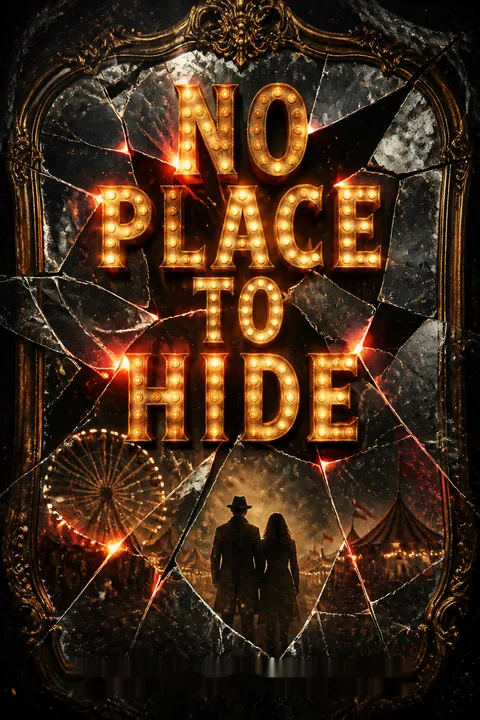


Plot Summary
Two Strangers at Shifty's
Jackson,1 a former inmate with few job options, works for a traveling carnival and chooses its decrepit Shifty's Fun House for Halloween. Blair Fields2 visits with her best friend,3 Mallory,3 still raw from ending a long relationship with Travis.4
Mallory3 distrusts the greasy midway, but Blair2 enjoys the rides and food she was discouraged from experiencing in her polished upbringing. Travis4 corners Blair2 beside Jackson's1 attraction, grips her shoulders, and treats their breakup as temporary. Jackson,1 working the ticket entrance, notices her discomfort and intervenes.
Travis4 leaves in anger; Jackson1 slips away before Blair2 can thank him. She follows him behind the fun house, where his guarded manner makes her curious rather than reassured. Mallory3 returns, objects to Blair's2 interest, then storms off when Blair2 refuses to leave.
The carnival gives both protagonists a temporary escape from the identities they have been performing. Blair has recently rejected the predictable relationship that helped define her, while Jackson's criminal record has pushed him into work at the edge of respectable society. Their first connection is not a conventional rescue: Jackson notices an immediate imbalance and interrupts, but Blair chooses to follow him after the danger has passed. That distinction matters. Her curiosity begins as an act of agency, even as it draws her toward a person whose history and guardedness make him difficult to read.
The Clown's Open Mouth
With Mallory3 gone, Blair2 studies the young worker who looks out of place among the midway crew. Jackson1 admits that a criminal record narrowed his employment choices, then dismisses her thanks and urges her to leave before the grounds empty.
Instead, she hands him two tickets and enters Shifty's alone. The attraction's darkness, broken mirrors, spinning tunnel, and lunging clown frighten her more without company, but the ride makes the carnival feel newly charged.
When Blair2 emerges, Jackson1 refuses to escort her because he must guard the entrance. He warns that the closing grounds attract dangerous people. She knows his warning is sensible, yet the tension between them has become more compelling than the safe plans Mallory3 wanted her to follow.
Blair's passage through the fun house turns fear from something imposed on her into something she elects to approach. The attraction's cheap effects are frightening partly because she is alone, but she exits rather than being rescued, then stays to pursue the feeling. Jackson's warning is genuine, yet his bluntness also sharpens the contrast between his world and Blair's protected routine. She is not simply mistaking danger for romance. She recognizes that he is warning her away and still chooses to remain, testing whether her curiosity can survive contact with the reality he represents.
One Night, One Rule
Blair2 explains that she has spent years being the dependable student, cheerleader, and girlfriend, and that the sameness helped drive her breakup with Travis.4 She wants one night outside the careful role she has always played. Jackson1 gives her a choice: leave for the gate or wait inside the fun house until he finishes work. Blair2 goes inside.
When Jackson1 returns, he checks that she understands he may push her beyond familiar limits and that she must tell him if she needs him to stop. She stays, and their first encounter begins as a negotiated power game in the dark. Jackson1 lets Blair2 experience pleasure on her own before taking control, then proposes hide-and-seek across the carnival, with being caught carrying a punishment.
Blair's confession makes her desire intelligible without reducing it to impulsiveness. She is trying to find out whether her identity can contain more than dutiful achievement and a familiar boyfriend. Jackson answers by turning her wish for change into an explicit performance, but he also names a limit: she must communicate if the experience becomes too much. Their arrangement remains emotionally unstable, since his control and her curiosity are not the same thing as trust. The game begins where those forces overlap, offering Blair a way to experiment while placing Jackson in charge of the terms.
The Hayloft Hunt
Blair2 runs into the busy carnival while Jackson1 counts down, then uses the petting zoo's stable as cover. She pays a little girl to misdirect him toward a hay pile, but Jackson1 discovers fresh marks on a ladder and climbs to the loft. He catches Blair2 there after she falls and tries to kick free.
Their game continues in the hayloft, where Jackson1 turns the catch into another round of dominance before sending her back into the grounds with her clothes. Blair2 scrambles into a kiddie ride to dress, then thinks through the carnival's layout instead of simply running at random. With Jackson1 familiar with every attraction, she needs an unexpected hiding place. She climbs the Ferris wheel and squeezes into a raised basket.
The first chase gives Blair a concrete way to resist the imbalance between them. Jackson knows the grounds, but she improvises, recruits a child, and briefly sends him in the wrong direction. Her escape is not a victory, yet it changes her from a passive object of pursuit into a player who studies the rules and the terrain. The stable also makes the carnival's ordinary family attractions part of the private game, emphasizing how completely the setting has become their temporary world. By climbing the Ferris wheel, Blair chooses a riskier hiding place because familiar paths have stopped serving her.
Caught Above the Carnival
Jackson1 spots Blair2 in the Ferris wheel basket and starts the ride rather than climbing after her. As it turns, he insults her until she cries, then draws her into an intimate reward for surviving the pursuit.
The shift from taunting to tenderness leaves Blair2 demanding to understand the man behind the game. They trade accounts of the worst losses in their lives. Blair2 describes the death of her twin sister, who was waiting for a heart transplant; Jackson1 reveals that a fight with his best friend ended in the friend's death and a manslaughter sentence.
Blair's2 fear of Jackson1 becomes more specific, while his confession exposes the guilt beneath his hard exterior. Before starting another chase, they establish bumper cars as a safe word that ends the game.
The Ferris wheel shifts their relationship from spectacle toward disclosure. Jackson's insults are part of the role he has constructed, but Blair's questions interrupt that performance and demand a history rather than another provocation. Their losses are not interchangeable: Blair's grief is rooted in helpless waiting, while Jackson's is bound to an act of violence he cannot undo. Naming these histories makes the attraction between them more consequential and more dangerous. The safe word gives their game a concrete boundary, yet the story's tension remains in whether either character can distinguish an exciting loss of control from a real need to stop.
The Clown's Cage
Jackson1 uses Blair's2 abandoned phone as bait inside the fun house, ringing it from concealment until she follows the sound into a small cage. When he locks the door, Blair's2 claustrophobia triggers panic. Jackson1 recognizes her distress and uses the scene's physical play to redirect her attention and steady her breathing, then continues their negotiated game.
The cage becomes another test of how far Blair2 wants to go and how carefully Jackson1 can read her reactions. After their encounter, he releases her but orders her to crawl through the attraction rather than stand. Blair2 obeys, moving along the splintered floor with Jackson1 close behind. She reaches a dead end and searches for a place to hide before he catches up.
The cage gives the fantasy a literal boundary and exposes a vulnerability that Blair cannot simply reinterpret as excitement. Jackson's use of her phone is a deliberate trick, but his response to her panic shows him monitoring her body as well as controlling it. That dual role complicates the power exchange: he is both the source of the threat and the person expected to notice when the threat becomes real. Blair's choice to continue preserves the game, though the scene makes clear that consent requires more than initial enthusiasm. Her crawl afterward leaves her physically vulnerable while keeping her active inside the rules she accepted.
Curtains and Broken Glass
Blair2 hides behind a curtain in the fun house, but Jackson1 finds her by recognizing the smallest change in a place he knows by heart. He drags her into the room of cracked mirrors and orders her to expose herself rather than cover up.
During their continued roleplay, Jackson1 presses her against the mirror wall, and the glass breaks, cutting Blair's2 cheek. She finds a loose shard and places its edge against Jackson's1 throat as he continues to move against her.
A thin line of blood appears, and Jackson1 urges her onward rather than retreating. Blair2 reaches climax, then sees her own cuts and his blood in the fractured reflection. The sight frightens her, not because she acted, but because she recognizes how far she crossed her own imagined boundary.
The mirror room makes self-recognition the scene's real danger. Blair's reflection appears in fragments, while the shard gives her a form of power that reverses the usual direction of the chase. Jackson's willingness to let her hold a weapon to his throat suggests that he wants more than obedience; he wants her to meet him inside the darkness he claims as his own. Yet pleasure does not erase Blair's alarm. The blood makes the roleplay physically visible, and she has to confront the possibility that her desire is changing her sense of who she can be.
Dawn Ends Their Game
After the mirror scene, Blair2 apologizes for cutting Jackson,1 while he dismisses his own wound and points out the scar forming on her cheek. Their argument turns to whether she has been honest with herself about enjoying the game.
Blair2 storms away; Jackson1 catches her, and she fights back by striking and kicking him. The clash breaks into laughter, and Jackson1 carries her to his trailer. They spend the last hours of the night together there, but dawn brings the game to its agreed end.
Jackson1 gives Blair2 a sweatshirt and offers no promise of a conventional relationship. She leaves, and he cannot bring himself to ask her to stay. Their separation preserves the terms he set while leaving both of them unsettled by what the night has made possible.
The shift from argument to laughter gives Blair a moment of resistance that is neither erotic submission nor simple escape. She can hurt Jackson, surprise him, and share humor with him, which briefly makes their dynamic less one-sided. Dawn then restores the boundary they had set: the game ends, and Jackson retreats into the rule that one night is all he can offer. His hesitation suggests that the rule protects him from attachment as much as it limits Blair. The sweatshirt becomes a material trace of intimacy that neither character knows how to translate into a promise.
A Scar Comes Home
Blair2 drives home through sunrise, replaying the night and struggling to fit her choices into the version of herself she knew before the carnival. In her apartment, Jackson's1 sweatshirt and the cut on her cheek make the experience difficult to dismiss; she sees a stranger in the bathroom mirror, then recognizes herself beneath the dirt and blood.
When Mallory3 later notices the wound, Blair2 refuses to explain what happened. She tells her friend3 that Jackson1 did not cause it, although the broken mirror was part of the encounter, and leaves before Mallory3 can press further.
Blair2 cannot yet describe what she wanted or what it changed. She does know that Jackson1 has taken up space in her thoughts, and that part of her believes she left something of herself with him.
The return to ordinary surroundings does not restore Blair's old sense of self. The clean apartment and familiar friendship with Mallory instead sharpen the contrast with the carnival, while the scar gives her private experience a public mark she cannot fully conceal. Her evasion protects Jackson, but it also protects Blair from having to narrate an encounter she has not integrated. Mallory represents a form of care grounded in accountability rather than erotic intensity. Blair's inability to tell her the truth suggests that the night has become both a source of self-discovery and a secret that keeps her isolated.
Epilogue
A month later, Blair2 drives four hours to find Jackson1 at another stop on the carnival circuit. She finds Shifty's closed and waits until Jackson1 comes out, then tells him that one night has not been enough for her. Jackson1 admits that he thought her departure meant she was afraid of what they had done, and warns that he cannot offer the tenderness or certainty of an ordinary romance.
Blair2 still chooses to see him again. Jackson1 kisses her and proposes another night, leaving the future open rather than promising a transformed life. Blair2 accepts the uncertainty, and the game begins again on terms neither of them can pretend are only temporary.
The epilogue refuses the tidy cure of a declaration or a conventional courtship. Blair's drive turns longing into action: she no longer waits for Jackson to decide whether their night mattered. Jackson, for his part, explains his withdrawal as fear of being asked to become someone he is not, yet he does not reject her. Their agreement remains provisional, which suits a story in which both characters use rules to manage vulnerability. The repeated game is not simply a return to the carnival's original power arrangement. Blair now chooses the encounter with knowledge of its costs, while Jackson has to face the fact that she can leave and still come back by choice.
Analysis
The carnival is more than a backdrop for a dark romance. Its temporary structures, cheap scares, and closing hours create a world where Blair2 can step outside the respectable identity she has practiced without immediately having to explain herself to everyone who knows her. Jackson1 belongs to that marginal world for less voluntary reasons. His criminal record has made the carnival one of the few places willing to employ him, and his cruelty functions as both erotic performance and armor against the shame attached to his past. Their game translates desire into movement, rules, and physical pursuit. Blair's2 escapes matter because they prevent her from becoming only the object of Jackson's1 attention. She misdirects him, chooses where to hide, names a safe word, and ultimately puts a shard of glass to his throat. Those actions do not erase the imbalance between them, but they give her a way to discover agency inside an experience built around surrender. The story's central psychological tension is that pleasure and fear can coexist without becoming identical. Blair's2 alarm after the mirror scene shows that wanting an intense experience does not mean she already understands what it will mean to her.
The characters' histories deepen that tension. Blair2 carries grief shaped by helplessness, while Jackson1 carries guilt for violence he cannot undo. Their confessions create intimacy, but not instant trust; knowing one another's pain does not magically resolve the defenses built around it. Dawn restores the ordinary boundary of one night, yet Blair2 cannot return unchanged to the script she had been following. The scar and sweatshirt make that unresolved change tangible. Her return a month later is a choice to pursue what she wants, not evidence that Jackson1 has become a conventional partner. The ending leaves both characters negotiating the distance between a thrilling role and a relationship that may ask them to be honest outside it.
Review Summary
No Place to Hide is a 99-page dark romance novella set in a Halloween carnival featuring Jackson and Blair's intense encounter involving hide-and-seek and primal play. Reviews are polarized: fans praise the spicy content, well-written scenes, and atmospheric setting, rating it 4-5 stars. Critics found it boring, emotionally flat, and excessively degrading, with Jackson coming across as verbally abusive rather than attractively dark. Common complaints include lack of character depth, poor kink negotiation, and pacing issues despite the short length. The ending hints at a potential sequel.
People Also Read








Characters
Jackson
Disgraced carnival workerJackson works at a traveling carnival because his criminal record has narrowed his options. He is physically imposing, impatient with authority, and quick to meet disrespect with aggression, but he also notices when Blair2 is uncomfortable and intervenes. His attraction to her is inseparable from his preference for control, a preference that lets him shape desire into rules rather than risk speaking plainly about attachment. Beneath his cruel teasing is a man burdened by a past he cannot reverse and wary of being judged by it. Jackson's challenge is not merely to let someone close, but to do so without hiding behind the persona of the monster he believes others already see.
Blair
Sheltered risk-takerBlair is a college student raised in a polished, carefully managed world. She has long played the role of the good student and dependable girlfriend, but the end of her high-school relationship leaves her questioning whether safety has become another kind of confinement. Curious, socially perceptive, and more stubborn than she first appears, Blair is drawn to experiences that let her test her own limits. Her interest in Jackson1 is not simply a wish to be rescued or dominated. She wants to discover what she wants when the familiar expectations fall away. Her central tension is between the identity she has learned to perform and the parts of herself she has not yet allowed into view.
Mallory
Protective best friendMallory is Blair's2 outspoken best friend, skeptical of the carnival and especially wary when Blair2 stays behind with Jackson1. Her blunt humor and practical concerns offer a counterweight to Blair's2 attraction to risk. Mallory cares enough to challenge Blair2 rather than simply indulge her, but she cannot make Blair2 explain an experience she is not ready to share. She represents the familiar social world Blair2 is trying to move beyond, while also offering the possibility of care that does not depend on secrecy or performance.
Travis
Possessive former boyfriendTravis is Blair's2 recent ex and her longtime high-school boyfriend. He treats their breakup as temporary and tries to reclaim her attention in public, ignoring the clear distance she wants. His behavior helps explain why Blair2 experiences their old relationship as confining, though he remains a peripheral presence after the carnival's opening night.
Hank
Jackson's hard-drinking coworkerHank is an older carnival worker who smokes, drinks, and tries to draw Jackson1 into poker games. His rough familiarity gives Jackson1 one of the few casual connections available at the carnival, even when Jackson1 pretends not to want company.
Sylvester
Hard-edged carnival bossSylvester manages the carnival crew and tracks the attractions' nightly ticket totals. His authority matters to Jackson1 because losing this job would leave him with few alternatives, even though Sylvester appears mostly as a practical obstacle in the workday.
Plot Devices
Shifty's Fun House
Carnival fear-play stageShifty's is a dilapidated haunted attraction built around darkness, a clown-shaped entrance, broken mirrors, a spinning tunnel, and mechanical jump scares. It gives Jackson1 a workplace that doubles as a maze he knows intimately, making his familiarity with its passages a source of power during the game. For Blair2, the fun house is first an unsettling ride she enters alone, then the setting where she begins to test her appetite for fear. Its costumes, props, and hidden corners allow the carnival's public entertainment to become a private performance, while the cracked mirrors later turn that performance back toward the characters themselves.
Hide-and-seek rules
Turns darkness into pursuitJackson1 transforms hide-and-seek into the structure of Blair's2 night at the carnival. He knows the midway's attractions and shortcuts, while Blair2 has to improvise, study the layout, and find unexpected hiding places. Each round changes the balance: her bribed helper briefly misdirects him, the Ferris wheel challenges his expectations, and the fun house lets him exploit his knowledge of its rooms. The chase supplies the story's momentum and gives their power dynamic a concrete shape. Being found becomes an agreed part of their fear-play, though the escalating danger makes the safe word essential to distinguishing performance from a genuine request to stop.
Bumper cars
Agreed emergency brakeBlair2 chooses bumper cars as the safe word during her conversation with Jackson1 on the Ferris wheel. The phrase gives their increasingly intense game a clear signal that overrides the ordinary rules of the chase and requires everything to stop. Its introduction matters because Jackson's1 roleplay deliberately treats fear, commands, and resistance as part of the fantasy. The safe word marks a boundary beyond those performances, giving Blair2 a way to retain agency while agreeing to surrender control for a time. The story's tension comes partly from the fact that she does not use it, even when the physical and emotional stakes rise.
The scar and sweatshirt
Tokens of unfinished nightThe cut on Blair's2 cheek and Jackson's1 sweatshirt carry the carnival encounter into her ordinary life after dawn. The scar is a visible mark she cannot easily conceal from Mallory3, while the sweatshirt keeps Jackson1 physically present through its scent and texture. Neither object explains what happened, so both become prompts for memory rather than proof of a settled relationship. When Blair2 returns to the carnival a month later, these reminders have helped turn private longing into a decision to seek Jackson1 again. The objects connect the night to the epilogue without resolving the couple's uncertainty or making their next encounter inevitable.
Download PDF
Download EPUB
.epub digital book format is ideal for reading ebooks on phones, tablets, and e-readers.








