Key Takeaways
1. The "Not Today" Mindset: Time is a Precious, Finite Gift
We’d give all our tomorrows for one more yesterday with Ari, but we know we can’t.
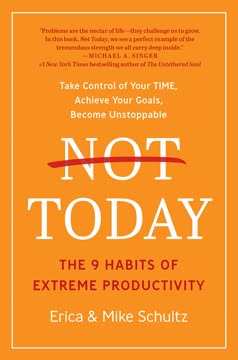
Life's profound lesson. The authors, Erica and Mike Schultz, learned the true value of time through their son Ari's battle with a severe congenital heart defect. His five-and-a-half years were a constant reminder that life is precious and fleeting, forcing them to confront how they spent every moment. This intense personal journey became the crucible for developing their "Extreme Productivity" system, born not from a desire for more output, but from a desperate need to find meaning and joy amidst unimaginable challenges.
Beyond traditional productivity. Most productivity advice focuses on working harder or smarter to "get more done." However, the authors discovered that true productivity is about working wholeheartedly—focusing on activities that fulfill your purpose and bring deep satisfaction. It's about making deliberate choices, setting boundaries, and understanding that maximizing output without meaning leads to emptiness.
A new perspective. Ari's life taught them that time isn't just a resource to be managed; it's a gift to be cherished. This realization led them to redefine productivity, shifting the focus from mere efficiency to a holistic approach that integrates purpose, well-being, and happiness. Their system helps individuals not just achieve more, but live richer, more fulfilled lives, starting "not today" but right now.
2. Manufacture Motivation: Recruit Your Drive by Defining Your "Why"
Those who have a ‘why’ to live can bear with almost any ‘how’.
Purpose fuels action. Motivation isn't an innate trait; it's a skill that can be learned and strengthened. The first step to manufacturing motivation is to define your "New Reality"—your desired future state and the profound "why" behind it. This personal meaning transforms tasks from chores into purposeful actions, giving you psychological ownership and a powerful drive.
Goals clarify direction. The Extremely Productive (The XP) are three times more likely to have written goals, which serve as a clear roadmap. This involves a three-part framework:
- Big Picture Goal: Your ultimate destination.
- Three-Year Goals: Significant strides towards the big picture.
- Annual Goals: What must be accomplished this year.
Breaking down these goals into manageable chunks provides clarity and direction, preventing aimless drifting.
Weekly planning and tracking. To sustain motivation, translate your goals into weekly action plans. The XP are almost three times more likely to plan weekly actions and 3.4 times more likely to track their progress weekly. This consistent planning and self-accountability, often shared with a partner, creates a powerful feedback loop, reinforcing commitment and making the journey itself more fulfilling.
3. Ignite Proactivity: Spark Action by Lowering Activation Energy
A journey of a thousand miles begins with a single step.
Overcoming procrastination. Our brains are "cognitive misers," preferring the path of least resistance. This often leads to procrastination, especially with difficult but high-impact tasks. Igniting proactivity means understanding and lowering the "activation energy"—the minimum effort required to start a task—making it easier to take that crucial first step.
Catalysts for action. The XP consistently use specific catalysts to overcome inertia:
- Calendar Investment TIME: Block off specific time slots for your Greatest Impact Activities (GIAs) in your calendar. This pre-commitment makes you 91% more likely to start.
- Positive Self-Talk: Challenge negative inner narratives. Instead of "I can't," use third-person affirmations like "Jean, you can do this!" This builds mental toughness and a success mindset.
- "3...2...1...Go!": Use Rapid Activation Talk to bypass your emotional brain's resistance. Count down and immediately start the task, preempting excuses and short-term reward impulses.
The power of starting. Proactivity isn't about being naturally driven; it's about systematically organizing yourself to act. By implementing these catalysts, you transform the daunting task of getting started into a manageable, almost automatic process, freeing up mental energy and boosting overall happiness.
4. Reengineer Your Habits: Architect Your Behavior for Lasting Change
How we spend our days is, of course, how we spend our lives.
Habits shape destiny. Productive habits are the number-one factor distinguishing The XP from The Rest. Habits aren't entirely involuntary; they involve a "thought" component that can be influenced. The authors propose a 4-element habit loop: Trigger → Thought → Response → Reward, emphasizing that intervening at the "thought" stage is key to change.
Blueprint for change. To reengineer habits, you must:
- Identify the habit and its "why": Understand why you want to change it.
- Create a blueprint: Intervene at the trigger, thought, response, or reward stage.
- Drive automaticity: Consistent repetition makes new behaviors feel effortless over time. It takes an average of 66 days, not 21, for habits to become automatic.
Strategic interventions. Specific hacks help in habit reengineering:
- "When I, Then I" statements: Plan your response to triggers in advance (e.g., "When my phone buzzes, then I will turn off the alert"). This creates a "cognitive wedge" between trigger and old response.
- Change your environment: Design your physical space to make desired habits easier and distractions harder (e.g., close your door, use noise-canceling headphones, work in a different location).
- Sacred morning routine: A consistent routine sets a productive tone for the day. The 5-Step Extreme Productivity Morning Routine helps you start with your GIA, check your mindset, and make better decisions.
5. Control Your TIME: Master Your Schedule with a Four-Level Framework
When you change the way you look at things, the things you look at change.
Redefining time management. Traditional time management often feels like trying to cram more into an already full schedule. The authors' "TIME" framework offers a transformative mindset, categorizing all activities into four levels: Treasured, Investment, Mandatory, and Empty. This framework helps you consciously choose how you spend your minutes, hours, and days.
The TIME framework:
- T (Treasured time): Cherished activities that fill you up (e.g., quality time with loved ones, hobbies, meaningful work).
- I (Investment time): High-priority activities yielding outsized returns towards your goals (e.g., strategic planning, skill development).
- M (Mandatory time): Tasks you feel you must do, but might not be necessary or done by you (e.g., commuting, administrative tasks).
- E (Empty time): Wasted time, nothing gained (e.g., aimless scrolling, excessive TV).
Dynamic and personal. How you define activities within TIME is deeply personal and dynamic. What's "Treasured" for one person might be "Empty" for another, and it can change based on your current needs. The goal is to be mindful and regularly question why you're spending your time a certain way.
6. Obsess Over TIME: Prioritize Treasured & Investment, Minimize Mandatory & Empty
If you were aware of how precious today is, you could hardly live through it.
Strategic time allocation. The XP and XP TIME Champions spend significantly more time on high-return Investment activities (46% and 77% more, respectively) and less on Mandatory and Empty time. This isn't accidental; it's a deliberate obsession with how time is spent, driven by a clear understanding of their "why."
Optimizing each TIME level:
- Take T (Treasured): Maximize this time, as it's the number-one key driver of happiness. Don't defer joy; integrate it into your daily life.
- Increase I (Investment): Devote more time to activities that directly advance your goals. This is the third key driver of Extreme Productivity.
- Minimize M (Mandatory): Convert these tasks into Investment or Treasured time (e.g., listening to a podcast during commute), delegate them, or question if they need to be done at all. This can significantly boost happiness.
- Eliminate E (Empty): Ruthlessly cut out time-wasting activities that don't bring joy or value.
Track to transform. To truly obsess over time, you must first know where it goes. Meticulously tracking your time for a few days, noting both activity and TIME level, reveals your actual habits versus your perceived ones. This awareness is the first step to making conscious choices and reclaiming significant portions of your day.
7. Say No & Play Hard to Get: Shield Your Focus from Distractions
Daring to set boundaries is about having the courage to love ourselves, even when we risk disappointing others.
The courage of "no." In a world of constant demands, the inability to say "no" is a productivity killer. Saying "no" is about setting boundaries, aligning your actions with your goals, and protecting your precious time from others' agendas. The XP are significantly better at saying no, understanding that it's essential for focusing on what truly matters.
Playing hard to get. Distraction is rampant, with people checking smartphones dozens of times a day and taking 23 minutes to recover from interruptions. Playing hard to get is your shield against this barrage, allowing you to concentrate and find peace. The XP are nearly four times more likely to avoid distractions.
Tactics for protection:
- Keep a "to-don't" list: Actively list activities you will not do, either temporarily or permanently. This clarifies focus and prevents overcommitment.
- "If it's not gung ho, it's no": Apply this rule to priorities. If you're not enthusiastically committed to an activity's return, decline it.
- Practice saying no: Start with low-stake scenarios, use phrases like "No, I can't do that right now," and take a moment to breathe before responding.
- Be free from alerts: Turn off all non-essential notifications on phones and computers. Expect withdrawal, but embrace the freedom.
- Signal "do not disturb": Use visual cues (headphones, closed door, out-of-office messages) to communicate unavailability.
- Be someplace else: Physically remove yourself from distracting environments to a place conducive to deep work.
8. Execute in the Zone: Achieve Peak Concentration with TIME Sprints
When you can get in the zone at will, you become unstoppable.
The power of flow. The "zone," or flow state, is an optimal consciousness where you feel your best and perform your best—time feels suspended, focus is extreme, and tasks feel effortless. Getting into the zone is a key driver of extreme productivity, with The XP 2.6 times more likely to achieve it regularly.
TIME Sprinting methodology. The authors developed TIME Sprinting to intentionally enter and sustain the zone:
- Sprint: Work obsessively on one planned task for 20-90 minutes with a visual stopwatch counting up. This differs from timers that break concentration.
- Relay: Perform four sprints in a row, with short (up to 6-minute) breaks in between. After four sprints, take a longer (15+ minute) break to refuel.
- Block distraction: Keep a "distraction capture list" handy. When distracting thoughts arise, write them down and immediately return to your sprint. This quiets the "inner critic" and prevents task-switching.
Conditions for flow. Four factors facilitate entering the zone: task clarity, strong consequences, a zone-conducive environment, and complete focus. By following the 9 Habits, these conditions are naturally established, making flow accessible for any task requiring deep concentration.
9. Fuel Your Energy: Nurture Your Mind, Body, and Spirit for Sustained Drive
Energy—and the stamina to sustain it over long periods—is the fuel that drives productivity.
The energy triad. Sustainable energy is crucial for extreme productivity and happiness. The XP are 3.5 times more likely to sustain energy for long periods, achieved by nurturing the interconnected triad of mind, body, and spirit. Neglecting any leg of this stool leads to depletion and hinders productivity.
Mind:
- Concentrate early: Tackle GIAs in the morning when mental energy is highest.
- Minimize decisions: Reduce decision fatigue by automating choices (e.g., consistent morning routine, pre-planned meals).
- Positive self-talk & mindfulness: Combat negative thoughts and anxiety. Mindfulness, even for short periods, can physically change brain structure, increasing focus and reducing stress.
Body:
- Eat well: Fuel your body with nutritious food to avoid energy crashes.
- Sleep well: Prioritize 7-8 hours of quality sleep for physical and mental restoration.
- Take care of your body: Regular exercise (The XP are twice as likely to be active) boosts physical fitness and overall energy levels.
Spirit:
- Take Treasured TIME: Engage in activities that bring joy and fulfillment, replenishing your spiritual well.
- Find meaning: Connect your actions to a deeper purpose or "why."
- Connect with nature: Spend time outdoors to feel more alive and energized.
- Practice breathing/yoga: Techniques like diaphragmatic breathing and yoga reduce stress and enhance spiritual well-being.
10. Right the Ship: Embrace Imperfection and Make Quick Comebacks
You are braver than you believe, stronger than you seem, and smarter than you think.
The inevitability of derailment. Even with the best intentions and systems, everyone falls off track. The key to long-term extreme productivity isn't perfection, but the ability to recover quickly. The XP are 5.3 times more likely to right the ship when they veer off course, recognizing unproductive habits and stopping them swiftly.
Strategies for comebacks:
- Practice "free won't": Consciously veto impulsive, unproductive actions. Use "3...2...1...Stop!" to halt unwanted behaviors (e.g., excessive scrolling, task-switching). This asserts conscious control over subconscious impulses.
- Make micro change: Break daunting tasks into progressively smaller, easier steps. If a 20-minute sprint feels too much, commit to just 5 minutes. Small wins build momentum and make it easier to stick with new habits.
- Make a commitment contract: Formalize your commitment by putting something at stake (e.g., money, reputation) and involving an accountability partner. Studies show this can increase success rates by 200-300%, providing powerful incentives to stick to your goals.
Embrace the journey. The path to extreme productivity is not linear. Expect setbacks, but view them as opportunities to refine your approach. By consistently applying these comeback strategies, you build resilience, reinforce positive habits, and ensure that temporary lapses don't derail your long-term progress.
Last updated:
Similar Books