

Key Takeaways
See a layoff as a rupture in identity, not merely a lost paycheck
Work carries a life. In DW Gibson’s interviews, people define work as income, but also as pride, purpose, routine, dignity, and a place to go. Losing a job can therefore unsettle much more than a budget. Wendy Hamilton lost two nonprofit jobs within 18 months. After the second, she felt humiliated, struggled to eat and get out of bed, and worried that others would judge her for being unemployed again.
The dismissal is personal. People describe being escorted from offices, dismissed by email, or made to wait for a meeting while decisions happen elsewhere. Even the language of restructuring cannot make the experience feel impersonal to the person losing a livelihood. The book’s many voices show why the same event can be both a financial blow and a profound loss of belonging.
What's striking is how thoroughly employment can become a social identity, not simply an economic transaction. Losing a job can remove everyday recognition from colleagues and disrupt the routines that help people feel competent and connected. That makes emotional distress an understandable response, not evidence of personal weakness. At the same time, the stories suggest that identity built around one institution is vulnerable to decisions outside an individual's control. A broader sense of worth, grounded in relationships, skills, and contributions beyond a job title, cannot prevent layoffs, but can reduce the power they have to define a whole person.
Read unemployment numbers as an incomplete snapshot, not the whole crisis
The official count is narrow. The national unemployment rate rose from 4.6 percent in early 2007 to 9 percent by summer 2011, reached 10 percent in October 2009, and stayed above 9 percent for 28 straight months except for one month. Economist Elliot Parker explains that the official measure excludes people who stop looking for work and counts some people as employed after only a few hours of work. He says broader estimates could put unemployment closer to 17 percent, still excluding people working far below their skill level.
Precarity spreads outward. The book uses “precariat” for people living with insecure work and the vulnerability it creates. The instability also reaches spouses, children, coworkers, and local services. A percentage can track a trend, but it cannot capture all those connected losses.
A statistic is useful partly because it leaves things out. A narrow definition enables comparison over time, but can make underemployment, discouraged workers, and household strain disappear from view. That is a measurement problem with policy consequences: what is not counted is easier to treat as marginal. The interviews restore lived detail to aggregate figures. Still, a broader estimate should not be mistaken for a precise headcount unless its method is clear. The strongest use of the book's numbers is not to claim exact scale, but to show why the official rate cannot stand in for the full experience of economic insecurity.
Do not mistake long tenure for protection from corporate restructuring
Loyalty is not a guarantee. Randy Badman worked 36 years at DeWitt’s vise-grip plant, where generations of his family had worked. The factory supported more than jobs: it helped fund local services and gave the town a shared rhythm. After the company was sold, the plant closed in 2008. Randy was dismissed years earlier, then lost a second job, and had to re-enter the labor market without ever having built a resume.
The rules changed. Gibson traces a shift from stronger employer-worker attachment toward layoffs as routine management. He points to the economic downturn of the 1970s and President Reagan’s 1981 decision to fire striking air-traffic controllers as milestones in normalizing a harsher employment climate. Across the interviews, long service and strong performance do not reliably protect workers when companies restructure, outsource, or cut costs.
The DeWitt story makes corporate restructuring visible as a break in a social contract, whether or not that contract was formally written. A worker may reasonably invest in a workplace and community, while the company retains the option to move or close operations. This mismatch helps explain why a dismissal can feel like betrayal even when no individual manager intended harm. The history here is suggestive rather than a complete account of labor policy: economic forces, industry changes, and local decisions also matter. The practical lesson remains clear. Security built only on an employer's promise is fragile, so workers and communities need protections beyond individual loyalty.
Stop treating a layoff as evidence that you failed
Performance is not control. Wendy Hamilton had a master’s degree, relevant experience, and advanced through four interview rounds before being rejected for a position because the employer wanted someone more experienced. She still concluded, at times, that the rejection meant she had done something wrong. Yet her earlier museum job had disappeared as donors withdrew pledges during the recession, not because she lacked ability.
The stories resist self-blame. Managers in these accounts sometimes explain that positions are eliminated for budget reasons, while workers who have done good work are dismissed alongside others. A strong resume or careful effort can matter, but it cannot create vacancies when institutions are cutting staff. The book does not deny that people can learn from setbacks. It distinguishes that useful reflection from assuming that every rejection is a verdict on character or competence.
Self-blame can feel like a form of control: if a rejection was caused by a personal flaw, then perhaps changing that flaw will fix the problem. But this explanation can be false when jobs vanish for reasons unrelated to an applicant's performance. Separating controllable choices from external conditions is a useful discipline in psychology and in practical decision-making. The reverse danger is also real: treating every outcome as uncontrollable can block learning. The more accurate question is narrower than “What is wrong with me?” It asks which parts of the outcome were within reach, and which belonged to budgets, timing, or a shrinking labor market.
In a buyer’s market, even seniority can become a hiring penalty
Experience can be recast as a cost. Dominick Brocato, a longtime human-resources leader, sent roughly 380 to 390 applications and reported about 40 interviews over 17 months. Despite strong reviews and years of experience, he was told that some employers did not want applicants over 50, people unemployed for six months, or workers with more than 15 years at one company. These were the very traits he had once understood as evidence of reliability.
Downward moves bring new barriers. Teresa Baseler spent 31 years at one company, then took a customer-service job at half her former salary. She still found its rigid monitoring difficult to adjust to. Other interviewees described being labeled overqualified for lower-paid work. The book shows how the job search can punish both seniority and attempts to accept less, leaving many experienced workers squeezed between too expensive and not suitable.
This section exposes a labor-market paradox: experience can increase a worker's capacity while reducing perceived hireability if employers focus on salary, age, or assumptions about adaptability. The reported accounts do not establish how common each hiring bias is across all employers, but they show how candidates encounter and interpret it. That distinction matters. A hiring system may reproduce age discrimination through informal screening even when explicit rules prohibit it. For individuals, translating experience into current, concrete skills can help, but it cannot resolve discriminatory preferences or an oversupply of applicants. Those barriers require institutional scrutiny, not just better resumes.
Protect basic routines and health before joblessness compounds the damage
Unemployment changes daily life. Several interviewees describe disrupted sleep, anxiety, less movement, skipped meals, and reduced medical care. George Ploghoft weighed going without health insurance, while Barbara and Raul had no coverage for themselves or their children. The Reno food pantry where Scott Cooksley worked served just under 27,000 people in one month, up from 5,000 to 6,000 when he started. Many clients were not homeless. They had reached a point where food was the easiest expense to cut.
Structure can help. Some people kept a regular wake-up time, volunteered, or took on practical tasks to keep the day from dissolving. Others found that isolation and distress made even basic self-care difficult. The stories make a case for seeking food, health, and community assistance early, rather than waiting until a crisis becomes impossible to manage alone.
The material points to a feedback loop: lost income makes health care and adequate food harder to afford, while poorer health can make it more difficult to search for work or care for others. This is why routine is not a cosmetic productivity hack. It helps preserve physical capacity and a sense of agency during uncertainty. Still, personal structure cannot compensate for unaffordable insurance, scarce jobs, or inadequate benefits. Advising people to exercise or keep busy is helpful only when paired with accessible support. The pantry's rising demand is a reminder that what looks like an individual budgeting problem can be a community-level failure.
Use human relationships to cross a job market built to ignore resumes
The application process is often impersonal. Jessica Smith found a library job after her employer read her blog through the website in her email signature. She said the personal connection, not resume formatting, made the difference. Roni Chambers, who helped run a St. Louis employment network, described a “high-touch” search: building relationships through conversations, community groups, and volunteering, rather than relying only on online postings.
Connection is not a magic formula. The book also shows job seekers sending hundreds of applications, attending job fairs without clear openings, or struggling to reach employers through unanswered emails and calls. Relationships can make skills visible, but not everyone has equal access to useful contacts. A practical search can combine targeted applications with specific conversations and community participation, without mistaking silence or rejection for proof that the applicant has nothing to offer.
The contrast between automated screening and personal referral captures a broader tension in digital hiring. Technology can process large applicant pools efficiently, but it may filter out candidates whose strengths are difficult to reduce to keywords. Relationships provide context and trust, much as weak ties can expose people to opportunities beyond their closest circle. Yet networking advice can become unfair when it assumes everyone has the same time, social confidence, or professional contacts. The book's strongest point is not that personal connections guarantee work. It is that a search limited to anonymous forms can make a capable person almost invisible.
When an anchor employer closes, a town loses its social infrastructure
A factory can hold a community together. DeWitt had 572 residents, and the vise-grip plant employed generations of local families while supporting civic amenities. When the factory closed, the town lost its familiar industrial sounds, many jobs, and even its grocery store. In Nevada, the closure of the company town of Empire scattered residents and reduced enrollment at the nearby school. The school’s shrinking population meant that teachers, bus drivers, cafeteria workers, and janitors also lost jobs.
Public cuts have similar ripple effects. Camden firefighters described layoffs that left fewer crews to respond to emergencies. In each case, the initial savings or closure produced consequences beyond the people directly dismissed. Local employers, schools, public services, and social ties are interconnected. A community’s recovery therefore depends on more than helping each displaced worker find an individual replacement job.
These accounts make the multiplier effect tangible without reducing community life to a spreadsheet. A large employer can sustain suppliers, public revenues, schools, routines, and relationships; when it disappears, those supports weaken together. That perspective is useful for economic planning because it asks what an employer anchors, not just how many people appear on its payroll. It also complicates the idea that workers can simply relocate to where jobs remain. Moving may mean leaving family, community, or a way of life. The book’s cases are vivid local histories, not a universal prediction, but they show why closures deserve broader evaluation than a headcount of direct layoffs.
Adaptation restores agency, but it cannot make structural losses fair
People build new routes. After losing his construction-sales job, Paul Humphreys bought a crepe cart and started a small business with his wife’s support. Nancy Lee turned toward metalwork and teaching; Bridgette Lacy used her writing experience to create an unemployment column and explore entrepreneurship. These stories show how skills and interests can be rearranged when a former career disappears.
Not every ending is a comeback. Other interviewees remained unemployed, faced bankruptcy, lost housing, or relied on public benefits. Caregiving, disability, age, debt, and weak local job markets shaped what choices were available. The book values persistence, but its collective portrait does not suggest that optimism alone can restore lost work. Adaptation can give people a next step; a safety net and functioning institutions determine whether that step is survivable.
The stories of reinvention are most persuasive when read as evidence of human agency, not as proof that unemployment is secretly an opportunity. A new venture can restore purpose, but it can also transfer risk from an employer to a household already under strain. The people who succeed often have some combination of skills, support, health, or time, while others face constraints they cannot simply reframe. This is a valuable distinction in discussions of resilience: personal initiative deserves recognition, but it should not absolve institutions of responsibility. A fair response makes room for both self-directed change and material protection.
Analysis
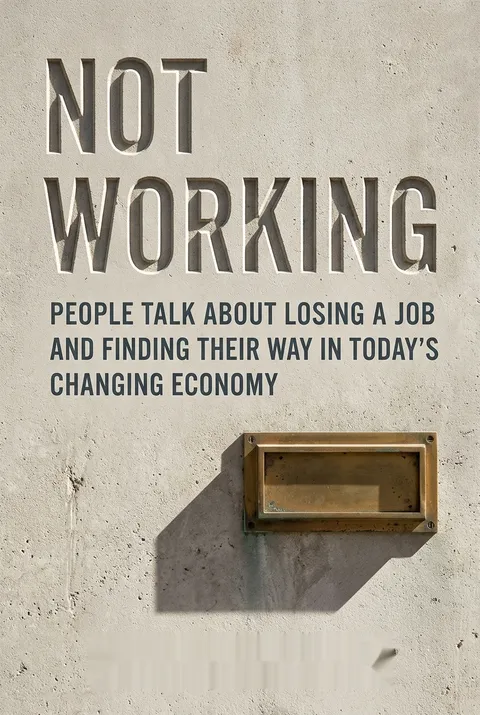
Not Working is an oral history of a labor-market shock told at human scale. Gibson travels across the United States and organizes interviews around youth, education, housing, community, corporations, public services, family, and changing occupations. That structure lets a reader see unemployment not as one event but as a chain: a position vanishes, then routines, health coverage, housing security, professional identity, and sometimes a whole town’s shared life come under pressure. Repeated experiences create the book’s central argument more forcefully than a single protagonist could.
Its most valuable method is to put unlike stories beside one another. A young nonprofit worker, a veteran factory employee, a teacher, a city firefighter, a caregiver, and a newspaper editor do not experience job loss identically. Their differences expose how age, disability, family responsibility, place, race, and access to savings shape the consequences. The recurring details, such as the ominous meeting invitation, the box of office belongings, or the application that receives no answer, make structural change legible without pretending every speaker represents every worker.
The book also resists a clean inspirational arc. Some people create businesses or find new work; others remain in crisis. This unevenness is ethically important. Resilience appears as a response to conditions, not a substitute for income, health care, public services, or job creation. The oral-history approach nevertheless has limits: its interviews are selected, its statistics and policy discussion reflect the 2007 to 2011 period, and the voices cannot establish how frequently any one experience occurs. Readers should treat the accounts as testimony and pattern recognition, not a representative survey or a current labor-market report.
The result is a civic argument as much as a portrait of personal hardship. A job is private income, but work is also a public relationship, linking people to colleagues, families, institutions, and place. When that link is severed at scale, individual job-search advice is inadequate. The book asks readers to notice not only who is unemployed, but what communities lose when stable work is treated as disposable.
Review Summary
Not Working receives mostly positive reviews, with readers appreciating its honest portrayal of unemployment across America. Many found the personal stories touching and relatable, highlighting themes of resilience and perseverance. Some critics noted redundancy in the narratives and wished for more analysis. The book is praised for its insights into the human impact of job loss and the changing nature of work. Despite occasional grammatical errors, readers found it engaging and eye-opening, recommending it to both employed and unemployed individuals.
Glossary
Precariat
People in insecure workA term used in the book for people exposed to unstable employment and the vulnerability that comes with it. Gibson connects the condition to a labor system that can benefit from workers’ insecurity and desperation. The word also points to effects beyond the workplace, including uncertainty in income, housing, health, and social life.
Lift and load
A transfer without visible changeA workplace transfer in which people keep the same desks, computers, managers, and duties but are formally moved from one employer to another. Steven Hay uses the term for a shift from a company that offered a pension and health care to a contractor that did not offer a pension. The setup looks unchanged while employment terms become less secure.
SILP
Semi-independent living programAn Indiana service program for adults with intellectual disabilities who could live with substantial independence but still needed some support. Kelly Graham-MacDonald helped clients manage daily life while using as little paid assistance as possible. The program was discontinued, ending a service that had helped clients retain independence and forcing workers and participants to adjust.
High-touch
Relationship-based job searchingRoni Chambers uses this phrase to describe a job search built around direct human contact, such as conversations, volunteering, and relationships formed in community settings. It contrasts with a process dominated by online postings and keyword searches. The idea is that a personal connection can make an applicant’s experience and character visible when a resume alone does not.
RIF
Reduction in forceAn abbreviation for reduction in force, a formal term used by employers for eliminating positions or laying off workers. In the book, the word appears in public-sector accounts, including a municipal workforce reduction. Its bureaucratic neutrality contrasts with the personal consequences described by workers who lose income, routine, and professional identity.
Download PDF
Download EPUB
.epub digital book format is ideal for reading ebooks on phones, tablets, and e-readers.








