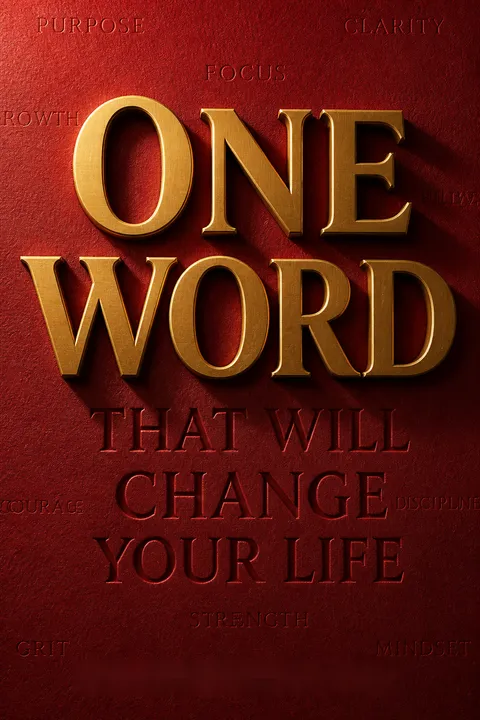


Key Takeaways
Choose one word to make the year’s growth focus hard to forget.
Less to remember. The book’s central practice is to select a single word as a theme for the year, then use it to guide choices across daily life. The authors contrast this with long lists of resolutions, which can be difficult to keep in view. Their argument is that one memorable idea can hold attention more reliably than a sprawling plan.
A word gains meaning. Dan first chose Intimacy to deepen his relationships with his wife, family, friends, and God. Jimmy’s word Life prompted him to examine his speech, food, thoughts, relationships, and work. The word is not a magic formula; it is a compact reminder to notice where change is needed and to return to that intention throughout the year.
A single word works like a retrieval cue: it gives the mind a simple prompt for recalling a larger intention. That economy is useful in busy lives, where elaborate plans can disappear from attention. The word also stays open enough to apply in unexpected situations, as Jimmy’s experience suggests. But simplicity has a limit. A theme can orient attention without specifying what to do, so it is most useful when translated into observable choices. The book’s strongest claim is not that a word changes circumstances by itself, but that a memorable focus can repeatedly bring a person back to their own priorities.
Trade a crowded resolution list for a question about who you are becoming.
The failure pattern. The authors report that 87 percent of adults make New Year’s resolutions and that half of those who make them abandon them by the end of January. They argue that resolutions often emphasize tasks and outcomes, such as accomplishing more, rather than the qualities a person wants to develop. Repeatedly setting plans that do not last can create frustration and guilt.
Aim beneath the checklist. The book’s alternative is to ask what kind of person the year calls for, then choose a word that reflects that direction. Its authors do not say that goals are inherently useless. Rather, they question an approach built only on effort and willpower, with little attention to the motives and values that make change matter.
The distinction between tasks and identity helps explain why a goal can feel hollow even when it is measurable. Values-based approaches to behavior change similarly ask people to connect actions with what they care about, not just with an external target. Still, the book’s resolution statistics are presented as motivation, not as a controlled test of its method. A word may improve focus, but it does not guarantee follow-through. The practical value lies in pairing a meaningful theme with concrete behaviors, especially when progress depends on circumstances beyond personal resolve.
Get quiet, then name the need, obstacle, and burden to release.
Make room first. Before choosing a word, the authors recommend stepping away from screens, noise, other people, and unfinished tasks. They acknowledge that silence can initially feel uncomfortable, partly because it exposes the mental clutter that busyness conceals. The goal is not to escape ordinary life permanently, but to create enough quiet to reflect honestly before committing to a theme.
Ask three questions. The preparation stage turns reflection into a practical inventory:
1. What do I need most right now?
2. What is getting in the way?
3. What do I need to let go of?
The answers help connect a possible word to past experience, present conditions, and desired change. The authors suggest taking several weeks or a single focused hour, depending on what works for the person.
This pause resembles reflective practices used in coaching and contemplative traditions: attention shifts from reacting to the next demand toward examining what deserves attention. The questions are especially useful because they include both external obstacles and internal burdens, such as resentment or self-defeating assumptions. Silence is not automatically clarifying, however; for some people, unstructured introspection can intensify worry. Writing answers down or discussing them with a trusted person can make reflection more grounded. The essential move is to create a deliberate interval between the pressures of the day and the choice of an annual focus.
Treat your word as discernment, not a clever slogan you manufacture.
A faith-centered search. The authors describe choosing a word as receiving guidance from God. After preparing through reflection, they recommend prayer, asking what God wants to develop in or through the person, and remaining open to an answer that may arise during reading, exercise, a conversation, or ordinary routines. Their own accounts include journaling with scripture and noticing a word during a painful ocean swim.
Stay open, stay honest. The book distinguishes a word that merely sounds appealing from one that feels personally fitting for the current season. Its process is explicitly rooted in Christian faith, though the act of listening for a meaningful direction can be adapted by readers who use different spiritual or reflective practices. The point is not to force a perfect answer, but to let reflection shape the choice.
The spiritual framing gives the practice a source of meaning beyond self-optimization. It can also soften the pressure to invent a complete life plan, allowing a person to approach change with humility and receptiveness. That framing will not fit every reader, and the book presents divine guidance as a conviction rather than as something independently verifiable. A secular version might treat the word as an emerging theme drawn from values, experience, and careful attention. Either way, discernment benefits from testing a candidate word against real needs rather than confusing intensity or coincidence with certainty.
Put the word where life happens, and invite trusted people to ask about it.
Make it visible. A chosen word can fade once work, family demands, and stress return. The authors advise placing reminders in ordinary settings: on a desk, in a car, on a phone screen, or in a journal. They also suggest revisiting the word regularly, such as through a weekly family conversation, so that it remains connected to actual choices rather than becoming decoration.
Borrow trusted attention. A Stretch Team is the authors’ term for close friends or family members who encourage a person, challenge them, and celebrate progress. Sharing the word with this group gives others permission to ask how it is being lived. The authors favor reminders and supportive accountability, not treating the word as a pass-or-fail assignment.
This advice turns an abstract intention into part of the environment. Visible prompts reduce the effort required to remember, while a trusted check-in adds social accountability and can reveal blind spots. The distinction between support and surveillance matters: accountability is more likely to help when people feel safe enough to admit difficulty. A word on a screen will not produce change if it never affects a decision, but a prompt paired with a brief recurring review can make the theme actionable. The Stretch Team idea is strongest when members offer curiosity and encouragement, rather than policing another person’s progress.
Use one word as a lens across six parts of life.
Broad reach, narrow focus. The authors say a yearly word can influence six dimensions: spiritual, physical, emotional, relational, mental, and financial life. The word remains singular, but its application is not limited to one goal. Jimmy’s Detox, for example, led him to examine negative patterns of thought, while Dan’s Healing became significant in his relationship with his father, even though his father did not recover from illness.
Expect surprises. A word may reveal needs that were not obvious when it was chosen. Jon’s Surrender took on new force after he injured his knee during an ocean swim and had to face his lack of control. These stories show how the same theme can shape very different responses depending on a person’s circumstances.
The six-part view counters the tendency to define a year’s success through a single metric, such as income or fitness. It encourages a more integrated picture of a life, where emotional and relational changes matter alongside visible achievements. It also makes the word flexible enough to remain relevant when circumstances shift. That breadth needs boundaries: a person can overextend one theme until every setback appears to demand the same response. Periodic reflection can help distinguish a genuine connection to the word from forcing a story onto events that may have other causes.
Measure the year by what it teaches, not whether you mastered the word.
Not a pass-or-fail test. The authors warn against turning the word into another item on a to-do list. Living a theme is a process with uneven progress, obstacles, and lessons. Jimmy expected Life to be easy, then discovered shortcomings in how he spoke, ate, thought, and treated relationships. The uncomfortable discoveries were part of the value, not evidence that the year had failed.
Let each year differ. The book recommends choosing a new word each year rather than repeating one simply because it was not fully mastered. The point is to recognize what the previous year revealed and approach the next season with fresh attention. A person might not feel finished with a theme, but the authors encourage treating the year as a chapter of learning, not a final exam.
This approach resists perfectionism, which can make a missed day or an imperfect result feel like proof of failure. It frames reflection as learning rather than scorekeeping, a useful stance when personal growth is nonlinear. At the same time, changing themes annually could encourage novelty over sustained work if a serious challenge needs longer attention. A new word need not mean abandoning old commitments. The more defensible interpretation is that the annual theme changes while important practices and relationships continue, informed by what the previous focus made visible.
Turn a private word into shared language without mistaking it for a strategy.
Make the focus collective. The authors describe families, schools, businesses, and sports teams choosing individual words and sometimes a shared theme. At the Fellowship of Christian Athletes, the leadership team used Together to emphasize unity. University of Georgia coach Mark Richt had players choose words, while Atlanta Falcons coach Mike Smith chose Finish as a team focus. Families painted words and displayed them at home as reminders.
Keep the practical work. The book does not argue that organizations should discard goals or measures. It says leaders can use a word to connect employees’ motivation and sense of purpose to those targets. A shared theme may strengthen conversation and belonging, but the team still needs clear responsibilities, plans, and ways to assess results.
Shared language can help a group coordinate attention and signal what behavior it wants to reward. A word such as Together may encourage cooperation, while Finish can make persistence salient. This is a cultural tool, not an operating plan: a team still needs resources, decision rights, and candid discussion of performance. The book’s examples are encouraging stories, not evidence that adopting a word caused a winning season or stronger financial results. Used well, the exercise opens a conversation about values and behavior; its impact depends on whether leaders embody the theme when tradeoffs become difficult.
Analysis
One Word That Will Change Your Life is a short, faith-centered self-help book organized around a personal ritual. Its premise is that a single yearly theme can outlast a conventional resolution list because it is memorable, emotionally meaningful, and applicable across situations. The book develops this premise through personal anecdotes, a three-part process of reflection, spiritual discernment, and daily application, then extends the practice to families and organizations. Its compactness is an advantage: the method is easy to understand and requires little infrastructure.
The most valuable insight is not that a word has inherent power, but that a clear cue can repeatedly redirect attention. A word such as Intimacy or Purpose gathers several intentions under one memorable label. The user can interpret it in new contexts, making it more adaptable than a narrow annual target. The recommendations to pause, examine obstacles, display reminders, and share the theme with trusted people help turn that cue into a practice rather than a slogan.
The book’s claims need to be read at the right scale. Its statistics about resolutions and its stories of personal or organizational change are not presented as rigorous tests comparing this method with other approaches. The authors’ certainty that the process works for everyone exceeds the evidence supplied in the text. A word can focus attention, but it cannot by itself resolve material constraints, mental health challenges, or conflicting priorities. The book is most persuasive when treated as a reflective framework, not a guarantee.
Its religious language is central to the authors’ account, especially the idea of receiving a word from God. That approach may be deeply meaningful for Christian readers, while others can use the same reflective structure without adopting its theology. Across both interpretations, the practice works best when a chosen word leads to specific behaviors and honest review. The book offers a memorable starting point for that work, not a substitute for planning, support, or sustained action.
Review Summary
One Word That Will Change Your Life receives mixed reviews. Many readers find the concept intriguing and powerful, praising its simplicity and potential for personal growth. Some appreciate the book's quick read and motivational aspects. However, critics argue it's unnecessarily long for the core idea, which could be summarized in a few pages. Some find it too preachy or religious. Despite divided opinions, many readers report successfully applying the "one word" concept to guide their year, finding renewed focus and purpose in various aspects of life.
People Also Read




Glossary
One Word
Yearly guiding themeA single word chosen as a focus for a year. The authors use it as a reminder and lens for decisions across different areas of life, rather than as a specific measurable goal. The word is meant to stay visible, prompt reflection, and shape how a person responds to everyday opportunities and difficulties.
One Word process
Three-stage reflection practiceThe book’s method for selecting and applying a yearly word. It begins by making quiet space and examining personal needs and obstacles, moves to finding a fitting word through prayer and attentive reflection, and continues by keeping the word visible and putting it into practice. The authors also encourage sharing it with trusted people.
Stretch Team
Trusted growth supportersThe name the authors give to a person’s close circle of friends or family who encourage growth. Members learn the chosen word, offer support, ask how it is being applied, and celebrate progress. The group is intended to challenge constructively and strengthen accountability, not to judge whether someone has perfectly achieved the theme.
Six dimensions
Six areas of lifeThe book’s categories for considering how a yearly word may influence a whole life: spiritual, physical, emotional, relational, mental, and financial. The framework emphasizes that one theme may have consequences beyond its apparent subject. For instance, a word focused on thought patterns may also affect relationships and a person’s response to challenges.
FAQ
What's "One Word That Will Change Your Life" about?
- Simple Concept: The book introduces a simple yet powerful concept of choosing one word to focus on for the entire year, which can lead to significant personal transformation.
- Three-Step Process: It outlines a three-step process to discover, live, and share your One Word, aiming to create clarity, power, and passion in your life.
- Life Change: The authors share personal stories and testimonials from others who have experienced life change by focusing on a single word.
- Broad Application: The concept is applicable to individuals, families, schools, businesses, and teams, making it a versatile tool for personal and collective growth.
Why should I read "One Word That Will Change Your Life"?
- Proven Method: The book offers a proven method that has helped thousands of people achieve life change by focusing on a single word.
- Overcome Resolutions: It provides an alternative to traditional New Year’s resolutions, which often fail, by offering a more sustainable and impactful approach.
- Focus and Clarity: By narrowing your focus to one word, you can achieve greater clarity and purpose in various aspects of your life.
- Inspiration and Motivation: The book is filled with inspiring stories and practical advice that can motivate you to embark on your own One Word journey.
What are the key takeaways of "One Word That Will Change Your Life"?
- Simplicity is Powerful: The book emphasizes that simplicity can lead to powerful life changes, as focusing on one word can have a broad impact.
- Heart Over Head: It stresses the importance of focusing on who you want to become rather than just what you want to achieve.
- Six Dimensions of Life: The One Word process impacts six dimensions of life: spiritual, physical, mental, relational, emotional, and financial.
- Community and Sharing: Sharing your One Word with others can enhance accountability and create a supportive community around you.
How does the One Word process work?
- Prepare Your Heart: The first step involves looking inward to prepare your heart by eliminating noise and distractions.
- Discover Your Word: The second step is about looking up and asking for guidance to find the word meant for you.
- Live Your Word: The final step involves looking out and applying your word to every area of your life, making it a daily focus.
- Action Plan: The book provides an action plan to help you implement and live your One Word throughout the year.
What are some examples of One Words people have chosen?
- Character Traits: Words like Love, Joy, Patience, and Kindness are common choices that focus on personal growth.
- Values and Disciplines: Words such as Discipline, Integrity, and Commitment emphasize developing specific habits or values.
- Spiritual Focus: Words like Prayer, Devotion, and Surrender highlight a desire for spiritual growth and connection.
- Unique Choices: Some people choose unique words that resonate personally, such as Inspire, Finish, or Overcomer.
What are the benefits of choosing a One Word for the year?
- Laserlike Focus: Choosing one word helps you maintain focus and clarity throughout the year, cutting through the noise of daily life.
- Personal Growth: It encourages you to grow in specific areas of your life, leading to transformation and self-improvement.
- Simplicity and Clarity: The simplicity of focusing on one word makes it easier to remember and apply than complex resolutions.
- Community Support: Sharing your word with others can create a supportive network that helps you stay accountable and motivated.
How can families and teams use the One Word process?
- Family Tradition: Families can choose a word together, creating a shared focus and strengthening relationships.
- Team Building: Teams can use the process to unify their efforts and improve chemistry, leading to better performance.
- Shared Goals: By choosing a collective word, families and teams can work towards common goals and support each other.
- Creative Expression: Activities like painting words on canvas or creating visual reminders can make the process engaging and memorable.
What are the best quotes from "One Word That Will Change Your Life" and what do they mean?
- "One Word creates laserlike focus that lasts." This quote emphasizes the power of simplicity in maintaining focus and achieving goals.
- "The most important part of life change is a change of the heart." It highlights the book's focus on internal transformation rather than external achievements.
- "Simplicity, done right, will always bring impact." This underscores the book's core message that simple actions can lead to significant change.
- "One Word is contagious." This suggests that the positive effects of choosing a One Word can spread to others, creating a ripple effect of change.
How does the One Word process differ from traditional goal setting?
- Focus on Being: Unlike traditional goals that focus on doing, the One Word process emphasizes who you want to become.
- Simplicity Over Complexity: It simplifies the process by focusing on one word rather than a list of goals, reducing overwhelm.
- Heart-Centered Approach: The process prioritizes internal change and personal growth over external achievements.
- Sustainable Impact: By focusing on one word, the process creates lasting change that extends beyond the typical lifespan of resolutions.
What challenges might someone face when choosing and living their One Word?
- Initial Resistance: Some may find it challenging to simplify their focus to just one word, especially if they are used to setting multiple goals.
- Staying Committed: Maintaining focus on the word throughout the year can be difficult amidst life's distractions and challenges.
- Unexpected Lessons: The word may lead to unexpected challenges and growth opportunities that require stepping out of comfort zones.
- Accountability: Without sharing the word with others, it may be easy to lose sight of it, so involving a community is crucial.
How can businesses benefit from implementing the One Word process?
- Employee Motivation: The process can motivate employees by aligning their personal growth with the company's goals.
- Improved Morale: Focusing on personal development can lead to increased job satisfaction and a positive work environment.
- Unified Vision: A collective One Word can unify teams and departments, enhancing collaboration and productivity.
- Customer Engagement: Sharing the One Word journey with customers can create a more authentic and engaging brand experience.
What is the legacy aspect of the One Word process?
- Long-Term Impact: The process encourages you to think about the long-term impact of your word on your life and those around you.
- Character Development: Your word shapes your character, which in turn influences your actions and relationships.
- Positive Influence: By living your word, you can positively influence others and contribute to a better world.
- Enduring Legacy: Each year's word contributes to your overall legacy, shaping the story that will be told about you in the future.
Download PDF
Download EPUB
.epub digital book format is ideal for reading ebooks on phones, tablets, and e-readers.








