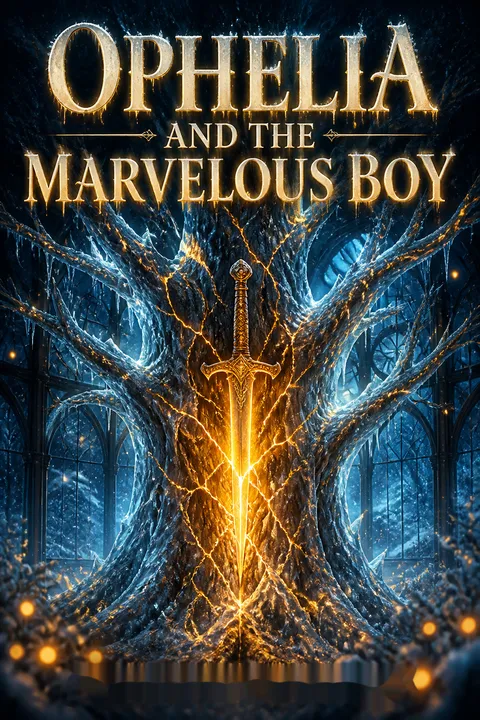


Plot Summary
Prologue
The Snow Queen persuades the young King to lock away the nameless boy who has been his friend, taking the boy’s sword and satchel and keeping the prison key close. The boy has already tried three times to escape, but the Queen’s growing winter closes around the kingdom: villages vanish under snow, lakes freeze, and people starve.
Alone, she tells her prisoner that his protection will eventually fail and promises to kill him then. The boy insists that someone will still find the sword and the person meant to wield it.
The opening gives the fantasy a political and emotional shape before Ophelia appears. The Queen does not seize power through open battle alone; she persuades the King to surrender the person who trusts him, then turns friendship into a locked room. Her courteous manner makes cruelty feel organized rather than impulsive. The boy’s insistence that help remains possible plants the story’s central tension: whether goodness can survive when people with authority choose comfort and fear over responsibility. His prison also makes the museum’s later displays of preserved creatures feel like part of the same world, not merely strange decoration.
Keyhole in Room 303
Eleven-year-old Ophelia Worthington-Whittard has come to a snowy foreign city with her father, Malcolm, a sword expert preparing a museum exhibition, and her older sister, Alice, who has withdrawn since their mother died. Wandering alone, Ophelia finds a small door hidden in a mural and peers through its golden keyhole.
A boy’s eye appears on the other side. He says he has no name and has been imprisoned by the Snow Queen, then asks Ophelia to help save the world. He gives her a sequence of museum locations to visit and explains that a clock will measure their remaining time. Ophelia, who trusts scientific explanations more than magic, leaves without agreeing to help.
Ophelia’s curiosity is not yet courage. It is a way to move through grief without naming it: she studies obscure rooms while her family avoids speaking about their mother. The boy’s request disrupts that controlled wandering by asking her to act on something she cannot classify. Her refusal is psychologically credible because disbelief protects her from responsibility as well as from fear. The meeting also establishes a useful contrast: Ophelia wants evidence before commitment, while the boy has spent years relying on incomplete instructions and trust. Their alliance will require each to borrow the other’s strength.
The Number Three
The next day, museum curator Miss Kaminski leads Ophelia and Alice past the enormous Wintertide Clock, explaining that it will chime on Christmas Eve. Ophelia notices the small window beneath its face: it shows three. Remembering the boy’s directions, she slips away to the seventh floor and finds a white drawer holding a golden key.
Her coat pocket has a hole, and the key falls through it. The clatter wakes something behind the locked doors. Talons scrape the marble as Ophelia retrieves the key and races back to the elevator. She hides her fear from Alice and Miss Kaminski, then returns to the boy. The key does not free him, but it begins a chain of dangerous errands.
The clock turns a vague prophecy into a deadline, while the leaking pocket makes Ophelia’s small practical weakness consequential. Her first act of help is neither elegant nor triumphant: she makes a mistake, hears the danger she has been warned about, and escapes by running. That physical fear matters because bravery in this story is not the absence of panic. The museum itself becomes an unreliable map, with its neglected corridors and contradictory signs forcing Ophelia to act without the certainty she normally seeks. The number three gives her anxiety a measure, but not a solution.
Kyra’s Last Crossing
The boy explains that the golden key opens a box on the sixth floor, where a second key waits. In a dark room among pillars and falling snow, Ophelia hears a crowd of dead girls asking her to share her life. Their voices grow rough when she tries to leave. Kyra, one of the girls, breaks from the group and guides Ophelia toward a bright doorway, even though the others fear the light.
Beyond it, four stone snow leopards awaken. Ophelia keeps Kyra strong by asking about her family and memories, then opens the box and takes the second key. The leopards attack as she escapes; one scratches her arm, while Kyra remains behind and fades from sight.
The ghosts are not simply threats. Their demand for Ophelia’s story grows from the same deprivation that shapes her own grief: they have lost the ordinary relationships that once made them distinct. Kyra’s decision to leave the group is therefore an act of self-definition, not rejection of the other girls. Ophelia helps her by listening closely, using questions as a form of care rather than interrogation. The scene also alters Ophelia’s standards of evidence. She cannot explain the leopards or Kyra, yet the wound on her arm makes the cost of refusing reality impossible to dismiss.
Mannequins With Moving Hands
Ophelia returns to the boy with the second key and tells him about Kyra and the snow leopards. He directs her to search the seventh floor again, this time for a room containing another key, and warns her about the Queen’s creatures. Before she can go, Ophelia tries to find the boy’s plain sword in the exhibition hall.
Her father is absorbed in his work, and she searches alone among covered displays. A Spanish conquistador mannequin grabs her arm. Miss Kaminski arrives, and the figure becomes motionless again before Ophelia can prove what happened. The curator dismisses her fear and steers her toward a display of dolls. Ophelia escapes and decides the boy’s warnings deserve belief.
The conquistador’s attack sharpens a conflict between perception and credibility. Ophelia experiences a real danger, but the curator’s calm explanation threatens to make the child herself seem unreliable. Her father’s absorption in work compounds the isolation: he is present in the museum but unavailable to what she sees. Ophelia’s choice to trust the boy is not a sudden conversion to magic in general. It is a narrower, harder judgment that her own experience has become more persuasive than the adult explanations offered to contain it. That distinction keeps her scientific habits alive while loosening their grip.
Sardines for the Monster
Ophelia takes superglue from her father and returns to the seventh floor. She seals the locks of the misery birds’ rooms, leaving one door open so she can enter room 707. A huge bird wakes and tears the pocket from her coat, spilling her inhaler, keys, map, and a tin of sardines.
Ophelia feeds the creature the fish while retrieving a third key from a box; once outside, she glues the room shut. In a corridor, the elderly keeper Mr. Pushkinova catches her and warns that she cannot help the boy. His threat frightens her into hiding, but anger replaces despair. She resolves to continue, then sneaks back to the prison at night with the key that will open it.
Ophelia survives by noticing what the monster wants rather than forcing a contest of strength. Sardines, an ordinary food she carries because of her habits, become more useful than any heroic weapon. The episode also makes resourcefulness distinct from invulnerability: she is terrified, her coat is ruined, and she needs her inhaler. Pushkinova’s warning briefly seems to confirm that the adults and keepers control the story. Instead, it provokes a shift from borrowed purpose to chosen responsibility. Ophelia no longer acts only because the boy requested help; she acts because she has judged the warning itself to be wrong.
The Boy’s Three Centuries
Ophelia unlocks the prison, and the boy steps out after centuries in the museum. As they search for his sword, he recounts how wizards chose him for his goodness, took his name to preserve a way home, and sent him across worlds. A wounded magical owl, Ibrom, bit off one finger and gave him a charm meant to last three days; it kept him ageless for three hundred and three years.
The boy befriended a young King, but the Queen persuaded that King to imprison him. The King secretly hid the sword rather than destroy it. When the Queen’s wolves pursue the pair through the museum, Ophelia and the boy escape down a rubbish chute and hide in the shifting sixth-floor rooms.
The boy’s history recasts his apparent passivity as the residue of repeated abandonment. The wizards chose a child for goodness, but gave him confused instructions and removed his name in the name of protection. The King loved him, yet let fear dictate the decisive choice. Each adult failure leaves the boy dependent on a promise that someone else will eventually arrive. Ophelia’s role is not to repair his past, which she cannot, but to respond differently in the present. Their shared search makes friendship practical: they exchange a coat, stories, and the willingness to keep moving.
The Queen’s Second Capture
After the wolves lose their trail, Ophelia leaves the boy in a carriage on the sixth floor so she can fetch her father. She hopes Malcolm will finally believe her and help search for the sword. Miss Kaminski intercepts her, squeezes her shoulders, and leaves Ophelia struggling to breathe.
At the workroom, Ophelia tells her father about the boy, the Queen, and the creatures, but he assumes she has a fever and carries her back to the hotel. While he is gone, the Queen searches the museum and finds the boy. The clock’s window has fallen from two to one. Ophelia wakes ill, knowing that her warnings have failed and that the boy is again beyond her reach.
The separation is caused partly by danger and partly by a familiar family pattern: Ophelia tries to reach her father, but his fear for her health becomes another reason not to hear her. His disbelief is not malice; it is the protective reflex of a grieving parent who cannot imagine the world Ophelia describes. Yet good intentions have consequences, and the Queen exploits the gap. The countdown now measures more than time. It measures how long Ophelia has to act without the adult support she wants. Her isolation becomes the condition under which she must develop her own judgment.
A White Gown’s Price
While Ophelia lies in bed, she dreams of her mother, who urges her to trust her heart rather than wait for proof. Alice is eager to return to the museum for her portrait, hair, and dress fitting. Ophelia offers to help her get there without their father knowing, and Alice agrees.
At the museum, Miss Kaminski unveils a brilliant sword for the exhibition, then gives Alice an extravagant white gown and promises her a place in the Christmas Eve ceremony. The curator asks whether Alice could forget her family in exchange for everything she wants. Alice accepts. Ophelia watches Miss Kaminski lead her away, recognizing that her sister’s longing to feel beautiful and admired has made her vulnerable.
Alice’s choice is shaped by grief as much as vanity. Since their mother’s death, she has been trying to inhabit a version of herself that attracts attention and promises a life untouched by loss. Miss Kaminski offers precisely that bargain, turning beauty into the imagined price of belonging. Ophelia, meanwhile, begins to separate care from control. She helps Alice pursue what she wants, even when she distrusts the curator, because she hopes her sister will not have to surrender everything else. The scene makes the sisters’ distance painful but legible: both are grieving, though they have chosen opposite defenses.
Alice in the Gallery
Ophelia slips back into the museum and searches the sixth floor for the boy, but the rooms have rearranged themselves and he is gone. In the Winter Garden, she finds a small Herald Tree and hears the wizards promise that the sword will find her. Returning inside, she discovers a new portrait among the paintings of lost girls: Alice’s face has joined theirs.
Ophelia understands that Miss Kaminski’s attention has led her sister into danger. She enters the curator’s office, searches its desk, and finds a hidden cache: the boy’s old satchel, his compass, his instructions, and a biscuit. A hidden door behind the bookshelf leads to a private room. Ophelia hears a machine running inside.
The Herald Tree answers Ophelia with reassurance but not directions. Its prophecy offers belonging to a tradition while leaving her responsible for the next concrete choice. The portrait of Alice then converts that uncertainty into urgency: a familiar face appears among girls whose lives have been erased from ordinary view. Ophelia’s response combines intuition and investigation. She follows a feeling, then searches drawers, books, and hidden mechanisms with the methodical care she trusts. The movement between these modes is her real development. She has not abandoned reason; she has learned that reason can serve a perception it did not produce.
The Machine Behind Beauty
Behind the bookshelf, Ophelia finds Alice inside a coffin-shaped machine that hums and drains something invisible from its occupant. She pulls the lever until the machine stops and the lid opens. Alice sits up, annoyed that Ophelia interrupted what Miss Kaminski presented as a beauty treatment.
Ophelia explains that the machine is meant to steal Alice’s soul and strengthen the Queen, but Alice refuses to believe her and rushes back toward the exhibition. Ophelia has saved her sister’s life without winning her trust. The satchel offers another lead: the boy’s written instructions and south-pointing compass. With the Wintertide Clock nearing its final chime, Ophelia must use what she has recovered before the Queen’s plan is complete.
The rescue exposes a painful limit of protection: Ophelia can interrupt physical harm, but she cannot make Alice accept the danger or undo the emotional need that drew her toward it. Alice’s denial protects the beautiful future she has been promised, even after the hidden machine contradicts that promise. Ophelia’s victory is therefore incomplete by design. She has recovered the boy’s tools and stopped one extraction, but the Queen’s larger system remains intact. The contrast between the public gown and concealed machine shows how coercion can arrive dressed as self-improvement, especially when someone already feels diminished.
South Points Home
Ophelia reads the wizard’s instructions, which emphasize kindness, patience, and refusing to give up. She follows the satchel’s compass south, expecting it to lead her to the sword, but it brings her to Malcolm instead. At last she tells him plainly that the family is sad and that pretending otherwise has not helped. Malcolm admits he misses Susan too and embraces his daughter.
In the storeroom, he produces a plain wooden-hilted sword he had found among discarded objects; a green eye appears in its blade when Ophelia takes it. She races toward the seventh floor, but the elevator stops at Pushkinova. Hearing the boy’s friendship in her plea, the keeper tells her he is buried in the Winter Garden.
The compass’s first destination is relational rather than magical. It leads Ophelia to the conversation her family has avoided, and that emotional truth makes the later discovery possible. Malcolm’s admission does not cure grief; it changes its status from private failure into something they can share. The sword’s appearance among discarded museum objects fits the book’s insistence that value is not always obvious to experts or institutions. Pushkinova’s change of heart also grows from attachment rather than argument. The boy’s years of kindness have left a claim on the keeper that fear could postpone but not erase.
One Other Revealed
Ophelia digs through a mound of snow in the courtyard and finds the frozen boy beneath it. He tells her that Ibrom whispered her name as the One Other, then places the sword in her hands and entrusts her with defending hope. The Snow Queen arrives with her own blade, the Great Sorrow.
Malcolm and Alice rush outside as the Wintertide Clock chimes six, releasing the museum’s frozen animals and misery birds. Malcolm fights the Queen long enough for Ophelia to face her. The magical sword drives Ophelia’s attack, and she strikes the Queen in the chest. The Queen collapses; the birds, wolves, and other creatures fall still, and the snow stops.
The revelation does not transform Ophelia into a different kind of person. The sword answers the qualities she has already practiced: attention, persistence, and care for beings others dismiss. The battle’s crowded setting makes her choice communal rather than private. Her father and sister arrive, the museum’s stored creatures awaken, and the audience witnesses the conflict that official spectacle had concealed. The Queen’s defeat is violent, but Ophelia’s immediate sorrow complicates any easy celebration. She recognizes a person in the fallen ruler, suggesting that resisting cruelty need not require pretending that cruelty has no human source.
A Farewell Without a Name
Ophelia finds the boy again as the snow clears. He is fading, but he says he can return to his own land now that the Queen has been defeated. Ophelia gives him the satchel and the last biscuit from Petal, still unable to guess his name. He leaves without a spoken goodbye, and Ophelia senses him returning toward the forest and river of his childhood.
Malcolm’s sword wound is treated at a hospital. Alice abandons the Queen’s borrowed clothes and returns to her familiar style, then takes Ophelia’s hand on the family’s flight home. For once, Ophelia looks at her watch without calculating how long her mother has been gone.
The ending resolves the quest without repairing every absence. The boy can go home, but Ophelia cannot keep him; friendship becomes something that must survive separation rather than prevent it. Her inability to learn his name is not a failure of effort but a reminder that intimacy does not confer ownership. Alice’s return to her own clothes marks a quieter recovery than a speech could provide, while Malcolm’s injury leaves the family with visible evidence of what they endured together. Ophelia’s stopped calculation signals a change in mourning: she still loves her mother, but grief no longer measures every passing hour.
Analysis
The novel makes grief the condition through which its fantasy becomes legible. Ophelia’s family has not stopped loving one another; they have stopped speaking about the person they lost. Malcolm retreats into sword catalogues, Alice into the promise of beauty and admiration, and Ophelia into classification. These strategies offer control, but each narrows the family’s ability to respond to what is happening. The museum’s magic presses directly against those defenses: it makes hidden things visible, but it also asks for judgment before proof is available.
Ophelia’s development is not a conversion from science to superstition. She remains observant and systematic, but learns that evidence is gathered through attention to people as well as objects. She survives the misery bird by noticing its hunger, helps Kyra by asking for the memories that sustain her, and finds the sword only after following a compass to an honest conversation with her father. Reason remains valuable, but it no longer claims exclusive authority over what counts as knowledge.
The book is also skeptical of benevolent power that refuses accountability. The wizards love the boy but give him inadequate preparation; the King loves him but submits to the Queen; Malcolm means to protect Ophelia but dismisses her account. In each case, affection without action leaves someone vulnerable. By contrast, Ophelia’s care is imperfect and concrete: she opens locks, shares food, listens, and returns when she is afraid. The climax makes her the chosen wielder not because she has become fearless or special in appearance, but because she has repeatedly treated overlooked lives as worth saving.
Finally, the ending refuses to present victory as the cure for loss. The snow lifts and the Queen falls, yet Ophelia must still let the boy go and continue loving a mother who is absent. What changes is not the fact of grief, but the family’s willingness to carry it together. Hope here is less a promise that nothing painful will happen than a practice of staying responsive after it does.
Review Summary
Ophelia and the Marvelous Boy is a beloved middle-grade fantasy retelling of "The Snow Queen." Readers praise its magical atmosphere, lyrical writing, and heartfelt exploration of grief and courage. The story follows Ophelia, a scientifically-minded girl who discovers a centuries-old boy trapped in a museum. Together, they embark on a quest to defeat the Snow Queen. While some found the pacing slow, most reviewers were enchanted by the richly-detailed setting, well-developed characters, and themes of friendship and self-discovery. The book is highly recommended for both children and adults.
People Also Read
Characters
Ophelia Worthington-Whittard
Curious grieving heroineEleven-year-old Ophelia is observant, cautious, and devoted to scientific explanations. She belongs to the Children’s Science Society, carries an inhaler, and often steadies herself by organizing facts or tugging her braids. Since her mother’s death, she has also been trying to live inside a family that will not discuss its sadness. Her curiosity draws her into the museum’s neglected corners, where she discovers how little her usual categories can explain. Ophelia’s courage is practical rather than fearless: she asks questions, notices what a creature wants, and keeps moving even when she is frightened. She wants to help without pretending she understands everything.
The Marvelous Boy
Ageless imprisoned guideA boy chosen by wizards for his goodness, he is sent on a dangerous mission with incomplete instructions and without his own name. He is kind, truthful, and often exasperatingly certain that Ophelia can help. His old-fashioned clothes and missing finger carry the physical history of a journey that began centuries before she met him. Years of captivity have not erased his hope, but they have taught him to depend on promises whose meaning he cannot verify. He relates to Ophelia through stories, patience, and small acts of care, including lending her his coat. His faith in her is both a comfort and a demanding responsibility.
Alice Worthington-Whittard
Grieving older sisterOphelia’s older sister has become withdrawn since their mother died. Alice is nearly sixteen, cares about fashion and beauty, and wants the attention that once came more naturally before grief altered her life. Her distance from Ophelia can feel cruel, but it grows from a teenager’s effort to manage loss without language for it. She is drawn to Miss Kaminski’s elegant world because it offers admiration, transformation, and escape from the family’s sadness. Alice and Ophelia love one another, yet their different defenses make it hard for either girl to recognize what the other needs.
Malcolm Whittard
Distracted sword expertMalcolm is a respected international sword expert and the father of Ophelia and Alice. His knowledge is precise, his work absorbs him, and grief has made him avoid direct conversations about Susan. He tries to care for his daughters by arranging a holiday and keeping them occupied, but his silence leaves them alone with feelings he also shares. Malcolm’s attention to objects is not coldness; it is a skillful world in which rules and evidence remain manageable. His challenge is to become present to the emotional life of his family as fully as he is present to the history of swords.
Susan Worthington
Storytelling motherSusan, Ophelia and Alice’s late mother, wrote horror stories and welcomed the strange possibilities her younger daughter tried to exclude. Her memories and appearances in Ophelia’s thoughts offer comfort, but they also press Ophelia to act rather than hide in certainty. Susan had prepared her family to face loss, though Ophelia resisted hearing those preparations while her mother was alive. Her affection is concrete: cleaning Ophelia’s glasses, fixing her hair, and making room for difficult conversations.
Miss Kaminski
Glamorous museum curatorThe museum’s beautiful, impeccably dressed curator knows how to command a room and direct people’s attention. She takes a particular interest in Alice, offering access to gowns, jewels, and the museum’s social spotlight. Ophelia feels uneasy around her despite the curator’s polished manners, sensing a chill that she cannot initially explain. Miss Kaminski’s influence rests on her ability to make people feel chosen and admired. Her presence tests whether Ophelia will trust her discomfort when adults and appearances suggest that everything is perfectly proper.
The Snow Queen
Ruler of endless winterThe Snow Queen is the powerful ruler at the center of the boy’s mission. Her winter advances across kingdoms, and her interest in goodness is more dangerous than simple conquest: she seeks to corrupt what she cannot easily destroy. She is patient, elegant, and skilled at using other people’s desires to serve her purposes. The stories told about her give Ophelia a reason to fear the unknown, but the Queen’s carefully managed public image makes it difficult to recognize danger by appearance alone.
Mr. Pushkinova
Keeper of the Queen’s keysAn elderly museum keeper, Mr. Pushkinova guards the boy’s cell and knows the routines of the Queen’s hidden floors. He brings the prisoner food and has spoken with him over many years, even while insisting that the arrangement cannot change. His sharp manner and threatening growl make him frightening to Ophelia. Beneath that severity lies a conflict between obeying the role that has kept him safe and responding to the boy as a person he has come to know.
Kyra Marinova
Defiant ghost girlKyra is one of the lost girls whose voices fill the dark forest-like room on the museum’s sixth floor. She remembers her family, her red hair, and the pleasure of running, and she tries to preserve a self distinct from the collective voices around her. Ophelia’s questions help Kyra recover the details that make her story her own. Kyra is frightened of the light but still longs to move beyond the place where the girls have been held together.
Ibrom
Wounded magical owlIbrom is one of the Queen’s great magical owls, creatures that gather the sorrows of the world. He is dangerous, immense, and capable of moving between worlds, yet his long exposure to suffering has made him reflective rather than simply cruel. In the boy’s account, Ibrom becomes an uneasy figure whose choices reveal that appearances do not reliably identify goodness. He carries a knowledge of both grief and possibility that the wizards’ instructions cannot neatly contain.
Petal
Wizard and biscuit makerPetal is a short, warm-hearted wizard who bakes biscuits and offers the boy comfort when the other wizards’ lessons leave him confused. Her practical kindness makes the wizard house feel less like an institution and more like a home. She gives the boy food for his journey, a small provision that later carries emotional weight.
The Great Wizard
Leader of the wizardsThe Great Wizard speaks for the group that chooses the boy and prepares him for his mission. He believes deeply in visions and long thought, but his guidance is often indirect and difficult for a child to use. He represents well-meaning authority whose confidence in a prophecy can exceed its practical care for the person asked to fulfill it.
The King
Boyhood royal friendThe King is a lonely child when the boy arrives in his kingdom. He wants the boy’s company and uses games, ceremony, and commands to keep him close. His affection is genuine, but his dependence makes him reluctant to take the boy’s warnings seriously. Through their friendship, the story distinguishes loving someone from acting bravely on their behalf.
The Boy’s Mother
Protective first homeThe boy’s mother understands that her son is ordinary in many ways and fears what the wizards’ mission will ask of him. She tries to give him a last day of freedom and sends him away with food, love, and the hope that he will return.
Plot Devices
The Wintertide Clock
Countdown to winter’s releaseThe enormous museum clock measures time until its rare Christmas Eve chime. A small window at its base shows a changing number that tells Ophelia how little time remains. The clock initially appears to be a celebrated exhibit, but its chime is tied to the release of the Queen’s forces and the awakening of the museum’s frozen creatures. It turns the story’s broad threat into a visible deadline, while the crowds gathering to admire it remain unaware of what they are waiting for.
The Taken Name
A mission without identityThe wizards remove the boy’s name and preserve it so he may have a way back through the meridian between worlds. The loss makes him more than a child who has forgotten a word: he cannot call up a piece of his own identity. His namelessness also complicates the prophecy, because he must carry out a mission without knowing who the One Other will be. The device links selfhood, memory, and homecoming, while leaving the boy dependent on other people to recognize his worth.
The Museum’s Hidden Floors
A maze of escalating trialsThe museum’s confusing signs, secret elevators, locked rooms, and unstable collections turn an ordinary public building into a landscape of tests. Its displays are not always inert: mannequins move, stone animals awaken, and the neglected upper floors conceal both creatures and machinery. Ophelia has to navigate the space with a flawed map, careful observation, and help from people she cannot always trust. The museum’s layered geography also binds the magical crisis to the family’s holiday and to Malcolm’s work preparing the sword exhibition.
The Herald Tree and Compass
Guidance through uncertaintyThe Herald Tree lets the wizards communicate across distance, but their messages are reassuring and cryptic rather than fully instructional. The boy’s compass is meant to point south and eventually leads Ophelia toward the sword. Together, they offer guidance without removing the need for judgment. The tree connects Ophelia to the boy’s past and the compass turns his abandoned belongings into a practical tool. Their limits matter: neither device solves the quest on its own, and the compass first leads Ophelia to the family conversation she has avoided.
The Two Swords
Goodness given a weaponThe boy’s plain sword was made to defeat the Snow Queen, while the Queen carries the Great Sorrow. The contrast between their appearances and powers helps keep the story from treating virtue as spectacle: the boy’s blade looks unimpressive, and its value is not obvious even to a professional sword expert. The sword responds to the person meant to wield it, making the final conflict depend on Ophelia’s choice as much as on the weapon itself. The Queen’s blade gives the threatened world a visible counterpart to its spreading winter.
Download PDF
Download EPUB
.epub digital book format is ideal for reading ebooks on phones, tablets, and e-readers.








