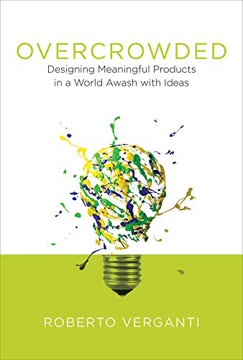
Key Takeaways
1. Innovation's New Frontier: From Solutions to Meaning
The winners are those who make existing problems old and redefine the scenario: those who make customers fall in love by offering not something better, but something more meaningful.
Two types of innovation. In a world "overcrowded with ideas," innovation is no longer just about finding better ways to solve established problems (innovation of solutions). It's increasingly about proposing a new "why"—a novel vision that redefines what problems are worth addressing, offering something more meaningful. This shift moves beyond merely improving how things are done to fundamentally changing why people need them.
Beyond "more of the same." Innovation of solutions focuses on a new how, delivering incremental or even radical improvements within an existing direction. Think of traditional thermostats constantly improving temperature control features. Innovation of meaning, however, introduces a new why, like Nest Labs' thermostat, which redefined its purpose from controlling temperature to providing effortless home comfort. This creates a new value proposition, making old problems obsolete.
Love over performance. When companies innovate meaning, they elevate their interaction with customers to a higher level: love. People don't fall in love with better performance alone; that's a transactional "date." True affection for a product, like for a person, stems from its meaning. The Nest thermostat, for instance, became a beloved "gift" because it offered an unexpected, more meaningful possibility that customers found irresistible.
2. People Seek New Meaning, Not Just Better Solutions
The search for meaning has never been as relevant as today, when people live in a world awash with ideas, bursting with options. A world where everything is possible and the big question in life is not “how?” but “why?”
The "why" over the "how." Society has shifted from a focus on finding solutions to predefined problems to a constant search for meaning in an increasingly complex and uncertain world. People are no longer just asking "how can I solve this?" but "is this meaningful to me?" This is evident in choices ranging from marriage and career paths to everyday purchases like cars or candles.
Paradox of choice. An overabundance of options, as highlighted by Barry Schwartz, can lead to paralysis and dissatisfaction. Businesses often mistakenly offer more variety, assuming people know what they want. However, people are often lost in choice, seeking clarity and purpose. This context makes the discovery of new meaning a delightful and valuable experience for individuals.
Continuous renegotiation. Meanings are no longer stable; they change rapidly and continuously. What was meaningful yesterday might be obsolete today. This "liquid modernity" means people are constantly renegotiating purpose, making the innovation of meaning crucial for building lasting connections. For example:
- Cars: From ownership to mobility-as-a-service (Uber, Zipcar).
- Clothes: From owning to experiencing (Rent the Runway).
- Photos: From capturing memories to communicating (Snapchat).
3. Competitive Advantage: Meaning is Scarce, Ideas are Abundant
Ideas are abundant. Meanings are rare. And value, in business, is in what’s rare.
The scarcity of meaning. While the demand for innovation is at its peak, the supply of new solutions is abundant thanks to widespread creative capabilities, open innovation, and crowdsourcing. However, the ability to produce visions—to see a meaningful direction amidst this abundance—remains scarce. This scarcity makes innovation of meaning a powerful source of competitive advantage.
Drivers for new meaning. Businesses thrive when they proactively identify and address shifts in meaning. Four key drivers signal the need for meaning innovation:
- Market Misalignment: When an industry's innovation trajectory is stuck in old meanings, failing to capture rapid changes in people's lives (e.g., car manufacturers vs. car-sharing services).
- Commoditization: When long-standing meanings lead to saturation and marginal differences among competitors, necessitating new "delighting dimensions" (e.g., Deloitte transforming risk from negative to positive).
- Technology Epiphanies: When new technologies offer the potential for novel meanings beyond mere substitutions (e.g., digital photography for communication, not just memory capture, leading to Kodak's downfall).
- Lost Organizational Focus: When an organization loses its sense of purpose, requiring a renewed reflection on its "why" to re-energize its people and market value.
Universal relevance. Innovation of meaning is not limited to specific industries or markets. Every product, service, and organization has a "why" for its existence, and every industry is overcrowded with solutions. Proactively driving this change, rather than passively observing, is essential for long-term relevance and value creation.
4. Innovation of Meaning is an Inside-Out Act of Love
People will never love a product you do not love. If you do not love it yourself they feel it … they smell it …
Interpretations cannot be outsourced. Unlike solutions, meanings are interpretations of what people will love, and these interpretations cannot be borrowed or outsourced. We all carry implicit hypotheses about what could be meaningful, shaped by our experiences and values. To genuinely innovate meaning, we must start from these internal convictions, making them explicit rather than pretending to have a "beginner's mind."
The gift maker's ethos. Designing meaningful products is akin to making a heartfelt gift. It's not about giving people exactly what they ask for, but proposing something we genuinely believe they would love and that would enhance their lives. This "love" from the creator is palpable in the details and the unexpected value, fostering a deeper connection than mere problem-solving.
Caring and responsibility. Innovating meaning is a moral act. When we redefine the "why" of things, we inherently judge what is "good" for people. This responsibility cannot be abdicated. Like a good parent, we propose a vision for a better world, driven by ideals such as joy, wisdom, and community. This inside-out approach ensures authenticity and a profound sense of purpose, both for the creators and the recipients.
5. Embrace Criticism: The Engine for Deeper Visions
Find more pleasure in intelligent dissent than in passive agreement, for, if you value intelligence as you should, the former implies a deeper agreement than the latter.
Beyond the myth of ideation. While traditional innovation often champions ideation and "deferring judgment," innovation of meaning requires the opposite: the art of criticism. In a world saturated with ideas, the challenge isn't generating more, but making sense of them. Criticism, far from being negative, is the process of going deeper, clashing different perspectives to forge richer, more robust interpretations.
Challenging internal assumptions. Criticism is vital for preventing us from getting stuck in our initial, often implicit, assumptions. By exposing our hypotheses to critical reflection, we uncover underlying frameworks built on past experiences, allowing us to "cure the ideas that we use to interpret life." This process helps unfreeze old schemes and creates space for new understanding.
Creating through judgment. New meanings don't emerge fully formed; they start as blurred intuitions. Criticism acts as the engine for their growth, transforming these inklings into powerful visions. It's a journey where envisioning and judging happen simultaneously, emphasizing differences to find underlying connections and a new, shared understanding. This "creative criticism" is a delicate art, best nurtured in environments of trust and shared purpose.
6. Envisioning: Cultivating Your Inner Hypothesis
What would I love people to love?
The starting point. The first phase of meaning innovation is individual and autonomous: each person asks, "What would I love people to love?" This question elicits deeply held, often unspoken, hypotheses about what could be meaningful to customers. It's a legitimate space to bring forth insights that have been silently brewing, rather than waiting for external prompts.
Stretching from solutions to meanings. To make abstract meanings tangible, individuals can start with an inkling of a solution, then stretch their thinking through an "experience of life" to uncover the underlying "meaning." This involves:
- Solution (how): A new product, service, or business model.
- Experience (what): The broader task or "job to be done" (e.g., a bed as part of a "fitness experience").
- Meaning (why): The deeper purpose or value (e.g., staying active even when confined to a bedroom).
This process helps clarify the "from" (existing meaning) and "to" (new meaning) of the proposed direction.
Autonomy and time for depth. This initial phase is best conducted individually, allowing each person to delve deeply into their own insights without compromise. It encourages diverse approaches and protects nascent, unorthodox ideas. Crucially, it requires time—not just working hours, but calendar time—to allow thoughts to rest, sediment, and be reconsidered with fresh, self-critical perspectives, fostering depth over mere quantity of ideas.
7. The Meaning Factory: Forging Visions Through Insiders' Clashes
Nothing could be more interesting than the talks we had with their perpetual clashes of opinion. Your mind was held in suspense all the time, you spurred the other on to sincere, disinterested inquiry and were spurred yourself, you laid in a stock of enthusiasm that kept you going for weeks on end until you could give final form to the idea you had in mind.
Sparring in pairs. After individual envisioning, the process moves to collaborative criticism, starting with pairs. Individuals with similar initial directions become "sparring partners," engaging in intense, critical discussions to deepen and strengthen their half-baked hypotheses. This "instrumental intimacy" allows for frank feedback, testing the potential and weaknesses of their ideas in a protected environment, making them robust enough for broader scrutiny.
Clashing and fusing in radical circles. Next, pairs assemble into a larger "radical circle" (15-20 participants) to clash and fuse significantly different directions. This is not about selecting the "best" idea, but about emphasizing differences to uncover new, unprecedented interpretations that lie beneath contrasting perspectives. The goal is to move beyond compromise, integrating insights to create a richer, more powerful vision.
Tools for creative tension. To transform critical tensions into creative energy, the radical circle employs specific practices:
- Focus on Delighters: Identify the few value parameters that will make the biggest difference for customers.
- Scenarios: Create 2x2 matrices by clashing two delighting directions, defining the "enemy" (bottom-left) and the "new meaning" (top-right).
- Converge on the Enemy: Start by defining what everyone dislikes about the existing meaning, building consensus on what to change.
- Use Metaphors: Employ metaphors (e.g., "A watch is a tie") to embody abstract meanings, make them tangible, explore imperfections, and facilitate innovation and communication.
8. Interpreters: Outsiders Who Sharpen Your Meaning
Interpreters are selective enhancers. They pay attention to something that we have suppressed (being focused on other things). They shift our attention in other directions.
Selective enhancement. After internal vision-forging, the process opens to external criticism from "interpreters"—experts from diverse fields who look at your customer's "experience of life" through a different lens. They act as "selective enhancers," highlighting aspects you've overlooked or suppressed due to your own focus. This helps you "see the signs, but also their meaning," offering new interpretations for things you might have already noticed.
Beyond ideas, to interpretations. Interpreters are not sought for new ideas, but for their ability to challenge and deepen your existing vision. They bring "good questions rather than good ideas," pushing your team to reframe assumptions and explore implications from novel angles. This engagement is most effective when your internal team has already developed a robust, albeit tentative, new meaning, providing a clear framework for comparison and critical dialogue.
Finding the right critics. Identifying effective interpreters requires careful selection, focusing on quality over quantity. Key criteria include:
- Domain: Experts from "outside the network" (e.g., a child psychologist for hospital imaging) who examine the same customer/life experience from a different industry.
- Category: A mix of direct players, academic professionals, and cultural interpreters (e.g., artists, writers) for diverse perspectives.
- Researcher & Critic: Individuals who have deeply investigated meanings in their field and possess a constructive, critical attitude, enjoying reflection and debate.
These carefully chosen outsiders provide invaluable, unbiased challenges that refine and strengthen your emerging vision.
9. Validate with People: From Robust Vision to Market Love
Do people really love our vision? How can we make it more meaningful?
The ultimate test. After internal criticism and external refinement with interpreters, the robust new vision is ready to be tested directly with the people it aims to serve: customers. This stage is about validating whether the proposed meaning resonates and how it can be made even more meaningful, leveraging existing tools and methods for user involvement.
Probing and iterating. Instead of just asking customers, a more active approach involves "probing" with tangible prototypes or "minimal viable products" (MVPs). These early versions allow customers to experience the new meaning firsthand and provide feedback. This iterative process helps refine the solution and validate the underlying meaning, ensuring it truly connects with people's lives.
Lean development with a clear frame. The inside-out, criticism-driven process perfectly complements lean product development methodologies like "Sprints." By starting with a robust, well-articulated vision, teams can conduct rapid experiments and interpret customer feedback more effectively. A clear frame provides direction for experimentation, making the development process faster and more purposeful, ultimately leading to products that people genuinely love.
Last updated:
Similar Books