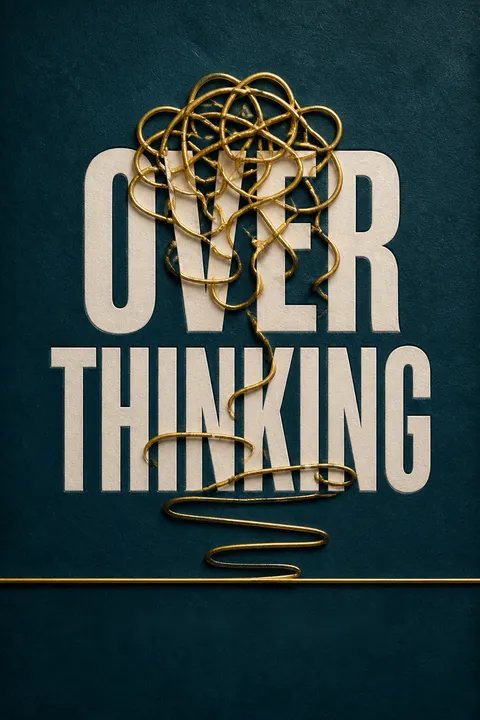


Key Takeaways
Treat overthinking as excess input, not proof that you are thinking carefully
Too much mental material. The book defines overthinking as taking in and processing more information than a task requires. Choosing a tie can become an exhausting comparison of every option; a relationship decision can become a tangle of imagined outcomes. The problem is not careful thought itself, but thought that stops helping and starts crowding out attention, confidence, and action.
Avoidance is not resolution. The book also describes compartmentalization: setting painful thoughts aside to function in another area of life. This can help someone get through a difficult moment, but permanently avoiding the underlying pain may keep it active. The aim is not to empty the mind, but to notice when thought has become a loop and respond to what is actually driving it.
A useful distinction is between reflection, which clarifies a choice or suggests a next step, and rumination, which repeats the same material without changing the decision. The book's definition makes the problem tangible: more analysis is not automatically better analysis. Still, the boundary is personal. A complex decision may genuinely need time, while a seemingly small concern can conceal a serious problem. The test is not whether a thought feels uncomfortable, but whether revisiting it produces new evidence, a useful question, or an action.
Stop measuring your life against polished timelines and social-media snapshots
Comparison feeds the loop. The book traces overthinking to social expectations about when people should finish school, find a career, advance at work, and build a certain kind of life. When reality diverges from that script, people may treat structural obstacles or ordinary uncertainty as evidence of personal failure. Comparing career progress, appearance, or relationships with other people's carefully selected images adds another round of self-doubt.
Relationships are not templates. A feed can show an idealized couple without showing their conflicts or compromises. The book argues that comparing a real relationship with a polished portrayal obscures what matters in that specific partnership. Instead of judging it by someone else's image of perfection, identify the actual concern and talk about it directly. Different relationships can work differently without being wrong.
The strongest point here is that comparison quietly changes the question. Instead of asking whether a life or relationship is working for the people in it, the mind asks whether it resembles a public standard. That shift can make ordinary variation feel like failure. Yet comparison is not always useless: observing others can reveal options or expose an unfair situation. The practical distinction is whether comparison expands a person's choices or turns someone else's curated outcome into a verdict on their own worth.
Reduce incoming information before demanding better decisions from yourself
Attention has limits. Information overload is the book's term for being flooded with more input than a person can use well. It can come from social feeds, news, email, phone alerts, or a job that demands constant task switching. The author cites a McKinsey Global Institute survey reporting that the average worker spends 25 percent of work time managing email. A coffee-shop worker's pride in juggling customers and tasks also gave way to fatigue and mistakes.
Lower the noise. The book recommends limiting phone use, doing one task at a time, taking short movement breaks, and choosing news sources carefully. A quieter setting can make it easier to separate essential information from distractions. The goal is not to withdraw from modern life, but to stop treating every incoming item as equally urgent.
This section connects mental clarity to information design: attention is shaped not just by discipline, but by what repeatedly demands a response. The email statistic illustrates how communication can consume time meant for the work it is supposed to support. The advice to reduce multitasking is especially practical when accuracy matters. Still, not every fast-paced job permits single-task focus, and some information is genuinely time-sensitive. The useful move is to distinguish necessary interruptions from habitual ones, then protect uninterrupted attention where the work allows it.
Put recurring thoughts on paper, then test or answer them
Make the loop visible. The book suggests writing down thoughts that feel negative, distracting, or unhelpful. Once a worry is visible, examine what it claims and how it affects you. For example, someone who fears a partner may be unfaithful can ask whether there is evidence for that belief and whether an honest conversation could address the insecurity. A work-related fear can be paired with a more balanced thought grounded in actual accomplishments.
Interrupt with purpose. The book calls this the interruption technique: notice a recurring thought, then deliberately redirect attention or respond with a more useful thought. Some concerns need a conversation or decision, not merely a positive counterthought. Others are stray distractions that can be let go. Repetition matters; the author presents this as a practiced habit, not an instant mental reset.
Writing thoughts down can create distance between a person and the story their mind is telling. That distance makes it easier to examine evidence, identify a need, and choose a response. The method is strongest when it separates solvable problems from hypothetical fears: one calls for action, the other may call for tolerating uncertainty. Positive counterthoughts can help, but forced reassurance may feel false or dismiss real warning signs. The better standard is a thought that is both fair and useful, rather than simply cheerful.
Clear one physical space to make change manageable and visible
Start smaller than the mess. The book links a cluttered home with the feeling of mental overload, while cautioning that cleaning alone cannot resolve stress, anxiety, or grief. Its practical approach is to choose one room, or even one small area, rather than treating the whole home as a single impossible project. Sort items into what to donate, discard, keep, or move elsewhere, and pause when the work becomes overwhelming.
Use minimalism as a prompt. Minimalism means reducing possessions toward a simpler way of living. The book does not insist that everyone should adopt an extreme version. Instead, it uses the idea to question whether purchases and possessions are supplying lasting fulfillment or adding demands. In shared homes, discuss changes with other residents rather than unilaterally removing their belongings.
The value of this advice is partly practical and partly symbolic. Completing one contained area offers visible evidence that an overwhelming task can be divided into workable pieces. Fewer objects may also mean fewer decisions about storing, maintaining, and replacing them. But a messy room is not a reliable diagnosis of a person's inner life, and a spotless home is no guarantee of calm. The book's more careful formulation is the useful one: change the environment when it helps, while addressing the emotional sources of disorder separately.
Replace empty scrolling with contact, movement, and personally chosen pleasure
Build a life beyond distraction. The book's habit advice starts with small, repeatable choices rather than a wholesale reinvention. Put the phone away during an errand or meal and make room for an in-person conversation. Reconnect with a friend, keep a journal of progress, add a little movement, or make time for a hobby that once brought joy. The author also recommends modest improvements to eating habits, gratitude, and rest, rather than demanding perfection in every area at once.
Protect limited energy. To-do lists can become another source of pressure if every task is treated as equally urgent. Sort tasks by priority, spread less urgent work across the week, ask for help, and decline commitments that do not deserve the time. A habit should support a fuller life, not become another standard for self-criticism.
These suggestions share a common design principle: make rewarding activities more deliberate than the default impulse to check a screen. Social connection, movement, and a chosen hobby give attention somewhere meaningful to go, rather than merely asking a person to suppress distraction. The book is also wise to warn against turning self-improvement into a second job. Its list is broad, so selecting one or two changes is more realistic than trying to become healthier, more organized, and more social all at once.
Set boundaries around people, habits, and work that keep reopening the loop
Name the influence. The book asks readers to revisit the sources of stress they identified and decide which remain active. A friend may repeatedly bring gossip, substance use, or other behavior that undermines a person's goals. When the relationship is otherwise supportive, a direct, non-accusatory conversation may be enough to set a boundary. If a close relationship involves ongoing abuse, the book advises seeking support and leaving immediately when there is physical danger.
Change the cues, too. Negative influences can be routines and environments as well as people. If passing a vending machine triggers a daily candy purchase, take another route or reduce exposure to the cue. The author also asks readers to examine whether a job is draining the energy needed for the rest of life. Major changes deserve thought, but social expectations alone are not a reason to stay.
This section treats boundaries as a way to change the conditions that keep a pattern alive, not as a test of toughness. That is a more useful frame than blaming someone for failing to resist every cue or social pressure. It also makes room for repair: a conversation can preserve a relationship while changing a specific behavior. The most important qualification is safety. Attempts at calm discussion are not appropriate when they increase danger, and professional or trusted support may be essential in abusive situations.
Practice presence without trying to police every thought
Return to what is here. The book defines mindfulness as sustained attention to present experience, including surroundings and feelings. A simple exercise is to sit outdoors, notice the breeze, sounds, and physical sensations, and gently return attention when the mind wanders. Its discussion of Zen meditation adds an important distinction: meditation need not force thoughts away. A thought can appear and pass without becoming the center of attention or pulling the mind into a replay of the past or a forecast of the future.
Make optimism practical. Positive thinking means meeting the day with openness instead of deciding in advance that it will be miserable. The book's Scrooge example shows how a fixed negative expectation can make someone miss what is happening around them. For a concrete goal, imagine the desired outcome, then write down the steps needed to pursue it.
The distinction between noticing a thought and obeying it is central here. Trying to eliminate every unwanted thought can make attention revolve around the very thing a person wants to avoid. A gentle return to sensation offers a less combative practice. The book's account of positive thinking is most persuasive when it leads to planning and readiness for opportunity, not when treated as a force that guarantees an outcome. Hope can support action, but it cannot substitute for realistic constraints or necessary help.
Treat sleep as part of clear thinking, not leftover time
Fatigue changes performance. The book argues that too little sleep can weaken alertness, decision-making, mood, and sustained work. It describes how people may normalize late nights for school or work, then notice the cost only when mistakes and sluggishness accumulate. Sleep also supports learning and memory: practicing a difficult piano passage, for example, may feel smoother after a night's rest.
Protect the transition. Track bedtimes and how rested you feel, then make gradual changes. The author suggests moving late-night eating earlier, keeping phone browsing and other wakeful activities out of bed, and reserving the hour before sleep for winding down rather than finishing stressful tasks. The book discusses the body's circadian rhythm, its roughly 24-hour pattern of sleep and wake signals, but individual schedules and needs can differ.
Sleep is not merely a reward for finishing the day's work. It is part of the conditions that make attention, memory, and judgment possible. The book's practical emphasis on routines is useful because the bedroom and the final hour of the day can either support rest or keep the mind engaged. Its clock-based account should be treated as a broad sketch rather than a universal timetable: bodies and schedules vary. The durable lesson is to observe personal patterns and protect enough regular time for recovery.
Analysis
The book's most useful organizing idea is that overthinking is not an isolated flaw of character. It is a pattern fed by excessive input, social comparison, unresolved emotional concerns, and habits that keep attention activated. Its proposed response is correspondingly ecological: change what enters the mind, how thoughts are handled, what the environment cues, and what routines sustain the body. That breadth gives readers multiple points of entry. Someone unable to change a job immediately can still limit phone exposure, write down recurring worries, or make a room easier to use.
The adaptation also reveals an important tension. The book sometimes treats diverse experiences, from ordinary indecision to anxiety after trauma, as versions of one problem that can be met with thought redirection and lifestyle adjustments. Those tools can support wellbeing, but they are not equivalent to treatment. Persistent anxiety, severe distress, trauma symptoms, or substance dependence may call for qualified professional care. Likewise, replacing a negative thought with a positive one can become avoidance if the original thought signals a real danger or an unmet need. The most robust version of the book's method is therefore not forced optimism, but accurate attention: notice the thought, check its evidence, identify whether it calls for action, and seek help when the problem exceeds self-guided tools.
Its practical strength lies in recommending small changes rather than an all-at-once makeover. Yet the long menu of habits could itself overwhelm a reader. The central method is better treated as a sequence of experiments: identify one source of overload, make one manageable adjustment, and observe whether attention or daily functioning improves. This approach keeps the book's humane message while making its advice testable. Clearer thinking is not a permanent state achieved by purging every difficult thought. It is the repeated ability to distinguish useful signals from mental noise, then respond proportionately.
Review Summary
"Overthinking" by Robert Leary receives mixed reviews, with an average rating of 3.07/5. Some readers find it helpful for identifying sources of overthinking and providing practical advice, while others criticize it for being too basic and lacking depth. Positive reviews praise its straightforward writing style and relatability, while negative reviews argue it offers nothing new. The book's brevity is seen as both a strength and weakness. Some readers appreciate its concise approach, while others feel it lacks substantial content and research-backed information.
People Also Read





Glossary
Overthinking
Excessive processing of informationThe book uses overthinking to mean taking in and processing more information than a task or problem requires. What may begin as careful consideration becomes counterproductive when thoughts multiply, distract from the present task, and feed worry or negative judgments. The term covers a pattern of unproductive mental repetition, not every instance of reflection or planning.
Information overload
More input than usefulInformation overload is the condition of facing so much incoming material that it becomes difficult to identify what matters and make sound decisions. In the book, sources include social media, news, email, workplace demands, and multitasking. The proposed response is to reduce unnecessary stimuli, focus on one task where possible, and take breaks.
Thought interruption technique
Redirecting a recurring thoughtThe book's thought interruption technique begins by identifying a recurring negative or distracting thought, then deliberately redirecting attention or answering it with a more useful, balanced thought. The reader is encouraged to write down patterns and examine their effects. Some thoughts require practical action or an honest conversation rather than simple replacement.
Mindfulness
Attention to present experienceMindfulness is the practice of attending to what is happening in the present, including surroundings, bodily sensations, actions, and feelings. The book presents it as a skill that can be practiced in ordinary settings, such as noticing sounds and sensations outdoors. The aim is to return attention when it wanders, not to demand flawless concentration.
Circadian rhythm
The body's daily timing cycleCircadian rhythm refers to the body's roughly 24-hour pattern of biological signals that help regulate sleep and waking. The book connects this rhythm with alertness, melatonin, eating, and bedtime, and argues that irregular routines can disrupt rest. It presents a general daily pattern, while acknowledging that people differ in their needs and schedules.
Compartmentalization
Keeping distressing thoughts separateCompartmentalization is described as placing different concerns or emotional experiences in separate mental categories so a person can focus on another activity. It may help someone function during an overwhelming period, including after trauma. The book cautions that using this strategy indefinitely can become avoidance, leaving painful concerns unaddressed.
About the Author

Download PDF
Download EPUB
.epub digital book format is ideal for reading ebooks on phones, tablets, and e-readers.








