

Plot Summary
A Job Before Floodwater
Catherine Lemay, a young archaeologist from New Jersey, discovers her vocation while helping excavate Roman ruins in bomb-damaged London. The work pulls her away from the piano career and marriage her family expects, and teaches her how quickly a developer’s plans can erase the past. After an archaeologist points her toward the Smithsonian’s River Basin Surveys, she secures a rare field assignment in Montana.
Dam builder Dub Harris is preparing to flood a vast canyon, including land the Crow regard as sacred, and Catherine must survey it before construction begins. Harris’s letter misspells her name and dismisses the Crow’s concerns, but Catherine travels west anyway, carrying a camera, field tools, and little sense of the country ahead.
Catherine’s move west is not simply a professional promotion. It is her first attempt to build a life from curiosity rather than inherited expectations. The damaged London streets have already taught her that excavation happens under pressure, with the shovel racing the bulldozer. Harris’s contemptuous letter sharpens the conflict: he hires an archaeologist to certify a decision he has effectively made. Catherine begins with confidence in her training, but the assignment will force her to ask whether recording a place is enough when the record cannot save it.
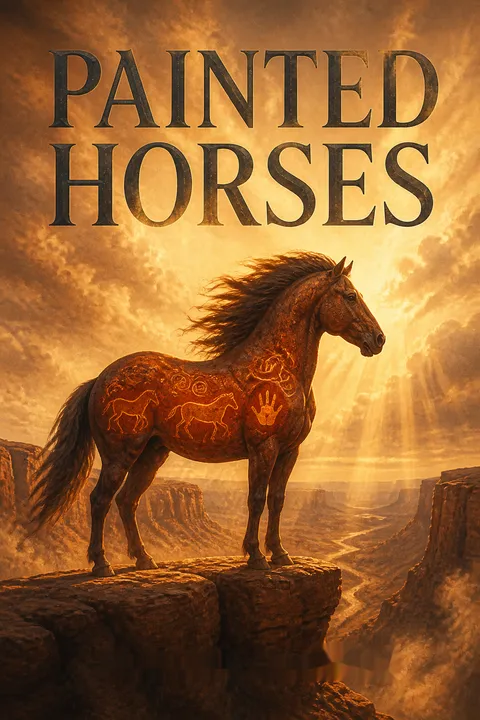
The Painted Palm
On the train west, Catherine glimpses John H, a blue-shirted painter whose horse bears fading stripes and handprints. In Miles City she recoils from the animal, then reaches the canyon in a surplus ambulance and discovers the landscape is far rougher than her preparation suggested. Along the road she sees another horseman, Jack Allen, beating a bloodied mustang inside a truck.
Once Catherine’s Dodge loses a tire, she struggles to change it and watches the vehicle roll away into a wash. John H finds her among carved aspens, changes the tire, and presses a yellow handprint onto the ambulance door. His calm help unsettles her more than the empty canyon, and the painted palm becomes a clue she cannot yet read.
The two horsemen introduce different forms of power over animals. Allen treats a wild horse as something to be subdued, while John H approaches Catherine and his horse with patience. Her reaction to both exposes the limits of her book learning: she can recognize a historical trace, but she cannot yet navigate the land or interpret its customs. The handprint matters because it is at once a literal mark and an unanswered question. Catherine has entered a place where evidence appears before she knows what questions to ask.
Miriam Joins the Survey
Jack Allen arrives the next morning as Harris’s hired guide and takes Catherine back toward the canyon on horseback. At a ranch in Agency, she finds Miriam, a sharp-eyed Crow teenager, helping her grandfather deliver a calf. Miriam knows the land and its people, but she also understands why opinions about the dam divide River Crow from Mountain Crow and younger residents from elders.
She agrees to guide Catherine, partly because she wants to examine her own future. On their first ride, Miriam leads Catherine toward a circling flock of cranes. Allen later finds hundreds of unshod hoofprints in the creek bed. The tracks turn the survey from a search across empty country into a hunt for a hidden horse herd.
Miriam is not a cultural key Catherine can simply turn in a lock. She is a young woman weighing jobs, family history, and personal choice, with reasons to see both sides of the dam dispute. Her willingness to help is therefore an act of agency, not a favor detached from consequence. Together, the women begin to change the scale of the work. Catherine brings archaeological methods; Miriam supplies local knowledge and a sense of what deserves attention. The hoofprints offer a first concrete result, but they also point toward a living history the survey cannot treat as an inert artifact.
Clues Beneath the Canyon
Max Caldwell, the Fort Ransom mechanic who has helped Catherine, takes her and Miriam to Inscription Cave near Billings. Its rock panel carries images from different eras, including comparatively recent horses and rifles alongside paintings Caldwell says are thousands of years old.
He remembers a Crow elder describing a vision quest in the canyon, near a black seam in the rock and a pointed formation. The elder also spoke of carved animals unlike those of his own time, including mammoth-like creatures.
Catherine doubts the story, but the cave and its damaged museum show that the region holds evidence older than the Crow presence. Caldwell gives her a possible lead, not proof, and Catherine must decide how to search a wilderness with few reliable maps.
Caldwell’s account shifts Catherine’s problem from finding familiar structures to recognizing meaningful places in a landscape that seems almost empty. The cave’s layers of images complicate any clean division between ancient and modern: different peoples have left marks in the same shelter. Caldwell offers local memory as a form of evidence, even though Catherine’s academic habits make her wary of anecdote. His story gives the survey a direction, but its uncertainty is productive. It asks whether scientific caution can coexist with listening before proof is secure.
The Boy Who Rode West
John H grows up among racehorses near Baltimore, Maryland, with an absent mother and a father whose fortunes have repeatedly failed. When the stable owners replace his father as trainer, his father stops working, drinks heavily, and confronts officials with an unloaded shotgun. Twelve-year-old John H escapes on a saddled horse, then leaves the animal with a dog breeder who understands that the boy is running from something more complicated than the law.
Placed with a minister’s family, he becomes attached to their daughter, Cora, who recognizes his loneliness and shares his fascination with horses. When her parents send her away, John H slips out at night and rides a freight train west, carrying her pillowcase and no real plan.
John H’s escape begins as an attempt to outrun shame and instability, but it also establishes his defining habit: he trusts movement more readily than institutions. Horses give him skill and belonging where family structures have failed him. Cora offers tenderness, yet even that refuge cannot survive the limits imposed by her household. His flight west is not a triumphant adventure so much as a child’s improvised answer to adult collapse. The pillowcase makes his departure intimate rather than purely rugged, preserving a fragile attachment inside a life organized around leaving.
Bakar's Long Apprenticeship
Hungry, injured, and nearly lost in Montana, John H is found by Jean Bakar Arietta, a Basque shepherd who feeds him and teaches him to survive on the range. At a ranch, John H proves his instinct with horses by taming a wary mare overnight, earning work and eventually buying a saddle.
He and Bakar spend years together among sheep and mustangs, while Bakar’s stories of Spain make the old shepherd’s abandoned homeland feel near. When grazing law ends their wandering livelihood, John H joins a horse-catching crew and saves his wages so they can travel back together.
News of the bombing of Guernica convinces Bakar that Spain is too dangerous. His health and mind deteriorate, and after Bakar dies, John H cremates him in the abandoned sheep wagon and removes swastikas from his bridle.
Bakar gives John H more than practical instruction. He models a form of kinship built through shared labor, food, and attention rather than blood or legal status. Their bond also teaches John H that caretaking can be a chosen obligation: he saves money for Bakar’s return to Spain, then stays when history makes that return impossible. The burning wagon is a private funeral and a rejection of symbols corrupted by violence. John H’s life remains mobile, but his loyalty to Bakar gives that mobility a moral center.
War on Horseback
Drafted in 1943, John H’s knowledge of horses places him in an improvised cavalry unit in Italy. He bonds with Yakima McKee, a farrier and inventive soldier, while the unit scouts through rain, mud, and German fire. After McKee disappears in combat, an officer orders the remaining horses slaughtered for refugees and sends the riders into infantry service.
John H refuses the order. He escapes with a gray dun and other horses, staying ahead of the front until he reaches liberated France. There he meets a family of Romani travelers who need horses to return to their home. John H trades his animals for a fine Austrian rifle, keeping one horse for his journey. His desertion will remain a danger whenever his identity is exposed.
John H’s choice is not a simple rejection of military authority. The order forces him to weigh human need against the lives he has taken responsibility for, and he chooses the animals he knows and can protect. That choice carries a real cost: he becomes a fugitive, and his war service remains a vulnerability. McKee’s absence deepens the choice, leaving John H with a sharper sense of what institutions discard when their priorities change. The horses are neither symbols alone nor possessions. They are dependents whose survival tests the limits of obedience.
The Cave Before Montana
In postwar Paris, John H studies painting and works around horses. He meets Elixabete Borel, a Basque activist who challenges his ideas about nature, politics, and the stories powerful people tell about progress. She takes him to a cave in France where prehistoric horses cover the walls.
The images overwhelm him and become the source of the horse paintings he carries in his memory. Their relationship deepens, but Elixabete dies during a difficult childbirth, along with their baby daughter, Jean Bakar.
John H leaves Paris and adopts the Borel name through forged papers, unable to remain among the places and people that remind him of his loss. He eventually returns to Montana, where he paints and lives apart from the world in a stone hideout in the canyon.
The prehistoric cave gives John H an artistic inheritance that is older than any nation or personal history. Elixabete helps him see the images not as decoration but as an argument about human dependence on animals and land. Their loss then makes the cave’s endurance painful: art survives across millennia, while intimate lives can end in a night. His later isolation is not merely a preference for wilderness. It is a way to avoid building a future that grief might again take from him.
The Bird Point
Catherine and Miriam spend days crossing the canyon without finding a major site. Miriam shares what she knows about Crow history, including the alliances and fears surrounding the Battle of the Rosebud and Custer’s defeat.
When the women find a finely worked bird point beside a spring, Catherine records its location before lifting it from the water. The modest find gives the survey its first firm archaeological result. Later, at a Crow celebration, Catherine watches the dancers and enters a smoky ceremonial lodge with Miriam.
Miriam’s great-grandmother, known as Crane Girl, presses a smooth stone into Catherine’s hand and again connects the blue-shirted horseman with a handprint. Catherine leaves the lodge carrying a clue she cannot interpret, but the canyon no longer seems empty.
The bird point matters because its scale is small enough to resist Catherine’s old preference for monuments. She must learn that a single tool, documented in its precise setting, can say more than an impressive object stripped of context. Miriam’s family history widens that lesson: memory is not a finished archive, and living people do not owe Catherine simple explanations. The lodge scene leaves Catherine with an object and a responsibility, not a tidy translation. Her research begins to depend on trust as much as observation.
A Soldier at the Dance
After the ceremony, Catherine meets John H again at a crowded Agency bar. He recognizes her, buys her water, and dances with her at the street celebration. Their exchange confirms that his life revolves around horses and traces of the past, though he gives her little about himself.
Jack Allen arrives with Dub Harris and recognizes John H from their years catching mustangs and serving in Italy. Allen tells Harris that John H deserted the Army after refusing an order, leaving Catherine to understand that the quiet painter is still at risk.
John H walks away before she can learn more. The encounter binds her archaeological search to a personal mystery, while Harris’s presence makes clear that the dam’s interests reach beyond the canyon survey.
The dance briefly lets Catherine and John H meet outside the roles that have framed them: investigator and guide, outsider and local. Its intimacy is provisional, built from shared attention rather than confidence. Allen’s account abruptly changes the stakes by turning John H’s guardedness into a matter of legal exposure. Catherine now has two kinds of evidence to protect, the canyon’s past and the man who has become part of her present. Her curiosity risks becoming a form of intrusion unless she learns what restraint requires.
Mammoths Under the Spire
On another expedition, Catherine and Miriam realize Allen keeps moving them across the canyon rather than searching systematically. They plan a longer camp survey, but his attention to wild horses still frustrates their work. When the horses’ calls echo from a steep rock passage, Catherine climbs ahead and finds a black mineral seam beneath a spire.
On the rock shelf, she sees faint carvings: mammoth-like animals etched into stone. She signals Miriam to stay quiet and distracts Allen by claiming her period, steering him away before he notices the figures. They leave knowing the discovery could halt Harris’s dam. That night, after returning to Fort Ransom, they learn Crane Girl has died while they were away.
The discovery answers Caldwell’s uncertain story, but it does not make the work feel like victory. Catherine must hide the evidence from the very guide assigned to help her, because Allen’s loyalty belongs elsewhere. Her improvised deception exposes how little formal authority she has, even when she is right. The news of Crane Girl’s death makes the timing harsher: the person who offered Catherine a fragment of cultural memory is gone just as her research reaches deep time. Discovery and loss arrive together, without canceling each other.
The Stone House
After Crane Girl’s death delays the women’s return, Catherine goes back to the gallery alone, hoping to document it before Allen or Harris can interfere. She loses her bearings, runs out of food, and spends a cold night using a sanitary napkin as tinder. In the morning, weak and disoriented, she follows the sound of cranes and a small stream through a narrow cleft in the rock.
Horse tracks lead her to a hidden stone house, where John H finds her exhausted and feeds her. His shelter contains canvases of horses and a record player, not the archaeological site she expected. Catherine has followed the land’s clues without a map, but survival now depends on the man whose secret life is tucked inside it.
Catherine’s solo journey strips away the comforts that had made her feel competent: equipment, company, and a clear route. Her ability to continue comes from practical improvisation, but also from admitting when she needs help. The stone house reverses the usual direction of her work. She has spent the summer trying to extract traces from the ground; now she enters a living space shaped by someone else’s history. The encounter asks whether her habit of finding things can become a relationship rather than another act of possession.
Painted Horses, Living Ones
Once Catherine recovers, John H leads her back to the rock art and shows her the narrow passage where he has painted horses on the walls. The old engravings are archaeological evidence; his vivid panels are his own work, born from the prehistoric cave in France. Catherine and John grow intimate, and he explains that a herd hidden in the canyon consists of Spanish Barb horses, a living remnant of the animals brought to the New World centuries earlier.
Allen has been searching for them. When a helicopter appears over the canyon, Catherine and John know Harris’s people are closing in. She asks John to get her camera and exposed film away from the site, while she climbs toward the gallery alone to keep it from being destroyed.
The distinction between ancient engraving and John’s paintings is essential: the canyon holds both archaeological evidence and an artist’s answer to it. Catherine’s work and John’s art meet without becoming the same thing. Their intimacy grows from shared attention to what might otherwise be lost, but the helicopter turns that closeness into a practical risk. The Spanish herd adds another kind of archive, one alive and vulnerable to capture. The story’s central question now concerns not just what survives, but who gets to decide what survival costs.
A Camera on the Rails
John rides hard toward Miles City with Catherine’s camera and film, pushing his mare until she collapses and dies outside the train depot. The station attendant helps him send the package east without taking his rifle or money. John then learns Catherine has disappeared. With Caldwell’s help, he returns to the canyon and finds Allen preparing to catch the Spanish herd.
John takes Allen’s gray horse and leads the mules toward the mustangs. When Allen aims at the herd, John fires into the rocks instead, scattering the horses before the roundup can close. He rides with the escaping animals, leaving Allen behind and choosing their freedom over the safety of his own position. The camera is away, but Catherine remains in Harris’s hands.
John’s ride makes care costly in concrete terms. The mare that has carried him through years of danger dies under the strain, and he cannot turn that loss into a clean victory. At the depot, the attendant’s help contrasts with the coercive power gathering around Catherine. John’s shot is deliberately aimed at stone, not a person, yet it changes the outcome by breaking Allen’s control of the herd. His actions reveal a consistent ethic: when institutions demand that living beings become expendable, he accepts personal danger rather than comply.
Harris's Price
Harris’s men keep Catherine in a hotel suite, then seize her after she smashes a typewriter through the window to attract help. In the company boardroom, Harris argues that electricity and modern services justify the dam, while his lawyer dismisses the Crow’s sacred claims as political leverage.
Harris produces a film canister and threatens to expose John H’s desertion. Catherine demands to know where Miriam is, but Harris uses her friend’s cooperation to show how thoroughly he has trapped them.
He says the gallery has already been destroyed. Catherine realizes that defiance cannot restore the images and may endanger John, so she gives David instructions about the package sent east and agrees to leave the company’s operation without exposing him.
Harris’s argument is persuasive precisely because it contains real material needs: light, medical care, work, and infrastructure. Its violence lies in treating those needs as permission to erase whatever resists his plan. Catherine cannot answer him with an abstract defense of the past; she must choose whom to protect under pressure. The canister turns documentation into a weapon that can endanger the person who helped secure it. Her decision is not a triumph over Harris. It is a costly refusal to let her own desire for proof become the reason John is destroyed.
The Work of Returning
Harris’s men take Catherine to Agency, where she finds Miriam working with her grandfather among the sheep. Miriam admits that, grieving Crane Girl and trusting Allen’s claim that Catherine needed her, she revealed where the women had been searching.
Their closeness survives the confession: Catherine understands Miriam’s grief and the pressures she faces, while Miriam learns that Harris had chosen Catherine because he expected a young woman to be easier to control. The company keeps Catherine under guard for two more days.
Caldwell brings her a shotgun and watches the guards, but she asks him not to summon a crowd. When Harris finally lets her call east, Catherine phones her mother, bruised and shaken but still determined to return to her work.
Miriam’s betrayal grows from grief, loneliness, and the desire to be seen, not from a settled wish to harm Catherine. That distinction allows the friendship to survive without pretending the breach was harmless. Catherine also recognizes that the same gender bias that opened the door to her assignment made her vulnerable to Harris’s control. She leaves the canyon without its artifacts, but not without knowledge of her own complicity and limits. Calling her mother is a small act with large emotional weight: Catherine lets herself seek care without surrendering the independence she fought to claim.
Epilogue
Before human history has a name, a painter enters the canyon by lamplight and begins a new horse figure on bare stone. Years later, Catherine returns to New Jersey bruised and silent, then rebuilds her archaeological life through a careful excavation in Israel.
She ends her engagement to David and refuses to explain the Montana summer to those who would reduce it to scandal. The dam is completed, and the gallery is gone. Then a battered envelope reaches her from Nevada. Inside is a painting of Catherine, dated July 1956, sent by John H. She studies the image, hears her father’s lawn mower outside, and writes back.
The epilogue places two acts of making beside each other: a prehistoric artist beginning a horse on stone and John H sending Catherine an image that survived the canyon’s destruction. Neither act restores what was lost, but both resist the idea that loss has the final word. Catherine’s return to archaeology is not a return to innocence. She carries violence, grief, and complicity into her later work, yet chooses not to let them harden into permanent retreat. The final letter creates a bridge without promising reunion or repair. Her answer matters because it accepts connection without pretending the past can be undone.
Analysis
Painted Horses makes preservation a conflict among forms of need rather than a contest between enlightened archaeologists and ignorant builders. Harris’s dam promises electricity, jobs, and services to a community that has reason to want them. The cost is a canyon whose significance cannot be measured only by its current economic use. Catherine begins with a familiar hierarchy of value: monuments and named civilizations matter, while the sparse remains of the American West appear to her almost negligible. Fieldwork with Miriam unsettles that hierarchy. A bird point, a family story, and a trace of an older culture each change what Catherine can see.
The novel also distinguishes recording from saving. Catherine’s film can carry evidence away, but the images cannot restore a destroyed site. Her earlier London experience has already shown her that documentation is often the compromise offered when preservation fails. In Montana, that compromise becomes personal because the evidence can expose John H, and because Catherine’s confidence in her own mission risks turning other people into instruments of her research. Her eventual choices do not defeat the forces of development. They do, however, make her responsible for how she uses knowledge and whom she protects.
John H’s life offers a parallel argument through care rather than scholarship. He repeatedly chooses horses, a shepherd, and vulnerable companions over orders that treat them as expendable. His actions are not free of cost or contradiction: the horse he loves dies under the strain of helping Catherine, and his protection of the herd demands another dangerous confrontation. The novel’s several generations of artists, archaeologists, shepherds, and horsemen all leave marks, but none can control what survives. A carved line may last thousands of years; a relationship, a language, or a herd may be lost within a lifetime. The book’s deepest measure of progress is therefore not how much power people can produce, but whether they can recognize what their power is about to erase.
Review Summary
Painted Horses by Malcolm Brooks received mixed reviews. Many praised the vivid descriptions of Montana landscapes and horse culture. The story follows Catherine Lemay, a young archaeologist, and John H, a mysterious horseman. Some readers found the characters compelling and the plot engaging, while others felt the narrative was disjointed and the ending rushed. Critics compared Brooks' writing to Cormac McCarthy's. The novel explores themes of progress vs. preservation, women's roles in the 1950s, and the changing American West. Overall, readers appreciated the ambitious scope but had varying opinions on its execution.
People Also Read
Characters
Catherine Lemay
Archaeologist at a crossroadsCatherine is a twenty-three-year-old archaeologist trained in classical history, raised in a comfortable New Jersey household that expects her to become a pianist, wife, and hostess. London’s postwar excavations awaken her appetite for fieldwork, but her assignment in Montana exposes how little she knows about Indigenous history or life in the West. She is intelligent, ambitious, and hungry for approval, yet increasingly willing to risk looking foolish in order to learn. Her instinct is to preserve evidence, though the canyon forces her to confront the gap between recording something and protecting it. Catherine’s curiosity is both her strength and a source of danger when she forgets that other people’s histories are not hers to claim.
John H
Painter and horsemanJohn H is a gifted horseman and painter whose life has been shaped by abandonment, migration, war, and loss. He understands horses through patience and close observation, skills that contrast with his distrust of institutions and his habit of keeping emotional distance. His art draws on both the animals he has handled and the prehistoric images that transformed his sense of time. John H rarely explains himself directly; he lets practical choices reveal what matters to him. His loyalty tends to attach to people and animals he can protect, even when that loyalty places him at odds with authority. The canyon gives him solitude, but not complete escape from the history he carries.
Miriam
Crow guide and skepticMiriam is a bright, self-educated Crow teenager who knows the ranch, animals, and family histories surrounding the canyon. Wry and observant, she uses humor to keep others from assuming she is a symbol of tradition rather than a young woman with ordinary tastes and anxieties. She can see why the dam might bring jobs and services while understanding why elders resist the loss of a place tied to memory and ceremony. Miriam’s intelligence is practical as well as historical: she reads tracks, terrain, and social situations. Her friendship with Catherine grows through work, but their different backgrounds ensure that trust must be negotiated rather than presumed.
Jack Allen
Mustanger with wartime scarsJack Allen is Harris’s horse wrangler, a former rodeo rider and wartime horseman whose skill is matched by a blunt, provocative manner. He knows the canyon better than Catherine does and understands how to handle difficult animals, but he does not share her archaeological priorities. His interest in wild horses makes him both useful and unpredictable as a guide. Allen treats hardship as ordinary and tests people by watching how they respond when plans fail. His own ideas about progress, loyalty, and the value of feral animals are complicated by years of work that has depended on catching and controlling them.
Dub Harris
Dam builder and power brokerDub Harris is the force behind the hydroelectric project, a wealthy developer who sees the canyon as a resource to be transformed for public benefit. He can speak convincingly about electricity, health, and economic opportunity, and he regards those gains as more substantial than claims rooted in spiritual or historical attachment. Harris is not simply indifferent to the past; he collects Indigenous artifacts and presents himself as a patron of education. His blind spot is the belief that possession and display amount to respect. He expects Catherine’s survey to support a conclusion already chosen, revealing how easily expertise can be recruited to legitimize power.
Jean Bakar Arietta
Basque shepherd and mentorJean Bakar Arietta is a Basque shepherd who has spent decades in Montana after leaving his homeland for work. He knows sheep, weather, and the demands of a solitary life, and he meets the hungry, injured John H with a generosity that becomes a lasting bond. Bakar is steady without being sentimental, offering guidance through food, work, and shared routines. His memories of Spain preserve a sense of home even as political violence makes return increasingly dangerous. Through him, John H encounters a model of belonging that does not depend on blood or property, but on mutual care and the willingness to stay.
Max Caldwell
Mechanic turned field allyMax Caldwell runs the Fort Ransom service station and knows both machinery and the local history surrounding the dam. He gives Catherine practical warnings, lends her a gas can, and later shares memories of earlier archaeological work and Crow accounts of the canyon. Caldwell is cautious about speaking for others, but he takes Catherine’s assignment seriously and helps when the company’s power turns coercive. His blend of mechanical knowledge and archaeological curiosity makes him a bridge between the modern project and the region’s layered past.
David
Catherine's eastern fiancéDavid is Catherine’s fiancé, a young New York broker whose confidence and business instincts initially attract her. He cares about her safety and admires her ambition, but he approaches the Montana assignment through the language of risk, conflicts of interest, and career calculation. Their relationship exposes a difference between loving Catherine’s drive in theory and understanding what it asks of her in practice. David is not a villain; he is a man whose version of intimacy assumes that Catherine will eventually return to the life they planned.
Audrey Williams
London excavation commanderAudrey Williams is a skilled excavation supervisor who runs her London site with discipline, humor, and hard-won authority. She recognizes Catherine’s seriousness before Catherine fully trusts it herself and encourages her to choose a life based on genuine interest rather than inherited expectations. Audrey also understands that rescue archaeology is always a negotiation with developers and public attention. Her mentorship gives Catherine both practical training and an example of a woman who has made fieldwork her profession.
Peter Grimes
Archaeologist turned mediatorPeter Grimes is a thoughtful archaeologist who has drifted into mediating between excavators, city officials, and developers. His earlier hopes for a life in music echo Catherine’s own divided ambitions. At Walbrook, he recognizes her instinct for fieldwork and helps her move from volunteer labor into serious training. Grimes values documentation, especially photography, but remains uneasy about a future in which records might replace the places they describe.
Cora
John's first refugeCora is the daughter of the minister’s family who temporarily takes John H in. Rebellious, romantic, and drawn to strays, she recognizes his loneliness and offers him affection when he has lost his home. Her fascination with movies and her appetite for a more daring life bring a brief sense of possibility into his childhood. Cora is herself caught between personal desire and the limits imposed by her family.
Elixabete Borel
Basque intellectual and activistElixabete is a Basque feminist, communist, and separatist living in postwar Paris. Politically forceful and intellectually restless, she challenges John H’s assumptions about nature, history, and national belonging. She introduces him to a prehistoric cave whose horse images reshape his artistic vision. Elixabete’s fierce attachment to her language and culture reflects both pride and the pressure of living with a threatened identity.
Yakima McKee
Farrier with a quick drawYakima McKee is a loud, inventive farrier who serves alongside John H in Italy. He modifies military equipment for pack animals, keeps morale alive with stories, and treats practical ingenuity as a form of survival. His friendship gives John H companionship in a unit where danger and boredom alternate without warning.
Crane Girl
Miriam's elder and memory keeperCrane Girl is Miriam’s great-grandmother, an extraordinarily old Crow woman whose memories reach back to the buffalo era and the Plains wars. Her speech can seem cryptic, but her repeated references to the blue shirt and painted hand connect present-day events to histories Catherine cannot yet see. She embodies the persistence of memory without turning it into a simple explanation.
Miriam's grandfather
Crow rancher and family anchorMiriam’s grandfather is a capable rancher, carpenter, mechanic, and caretaker of the family’s sheep. He has built much of what his household needs with his own hands and remains a practical source of knowledge for Miriam. His work connects family survival to the older world remembered by Crane Girl.
Catherine's father
Supportive New Jersey dreamerCatherine’s father is an affectionate, imaginative man who buys her tools and encourages her curiosity, even when her choices surprise him. His support contrasts with the more conventional future her family has planned for her. Catherine’s wish to prove herself to him remains an important source of motivation.
Catherine's mother
Keeper of social expectationsCatherine’s mother values refinement, security, and the social rituals of their comfortable New Jersey life. She loves her daughter, but her hopes are bound to a narrow idea of what a successful woman’s future should look like. Their relationship gives Catherine’s independence an intimate, rather than merely professional, cost.
Plot Devices
The Yellow Handprint
A mark across generationsJohn H’s painted palm appears on Catherine’s ambulance and on the horses he marks. It recalls the use of handprints in Plains horse painting and becomes a visual clue linking Catherine’s encounters with the blue-shirted man to the wider history of the canyon. Because Catherine initially does not know who made the mark or what it means, it functions as both evidence and invitation: she must ask people who carry knowledge she does not possess.
The River Basin Survey
A race against constructionThe Smithsonian survey gives Catherine a limited window to record archaeological evidence before Harris’s dam floods the canyon. Its rescue-archaeology mandate places her between a public works project and the people who live with the land’s history. The deadline also turns ordinary field decisions into ethical ones. Where she searches, what she records, and whom she trusts can affect whether anything survives in a usable form.
The Camera and Film
Evidence made portableCatherine’s camera lets her document the canyon’s carvings, while the exposed film can travel beyond the reach of the dam company. That portability creates the central conflict over who controls the images and what they can be used to prove. The camera is not a substitute for protecting the site, and the story refuses to treat documentation as a painless solution. Its records can preserve knowledge, expose John H, or become bargaining material in Harris’s hands.
The Black Seam
A remembered route to deep timeCaldwell’s story of a black mineral seam beneath a pointed rock formation gives Catherine a specific lead in the canyon. The clue is partly geological and partly dependent on Crow memory, so it resists a simple division between scientific evidence and oral history. When Catherine finds the carved animals near the seam, the location confirms that the elder’s account deserves serious attention, even though the meaning and age of the images must still be investigated.
The Spanish Barb Herd
A living historical traceThe hidden herd is not an ordinary collection of mixed mustangs. John H identifies the animals as Spanish Barbs, preserving physical traits associated with horses brought to the Americas centuries earlier. Their bodies carry history in a form that can run, reproduce, and disappear. Allen’s effort to capture them places living heritage beside the carved and excavated record, forcing the story to consider whether preservation means keeping an animal free or turning it into evidence and property.
Download PDF
Download EPUB
.epub digital book format is ideal for reading ebooks on phones, tablets, and e-readers.








