Key Takeaways
1. Panentheism Defined: The "Other God" of Philosophers
"The Being of God includes and penetrates the whole universe, so that every part exists in Him, but His Being is more than, and not exhausted by, the universe."
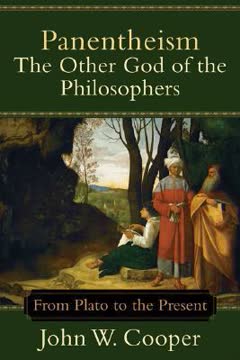
A distinct concept. Panentheism, meaning "all-in-God-ism," posits that while God and the world are ontologically distinct and God transcends the world, the world fundamentally exists "in" God. This distinguishes it from classical theism, which maintains an unqualified separation between God and creation, and from pantheism, which identifies God as the world. Coined by Karl Krause in the 19th century, the term gained prominence through Charles Hartshorne in the mid-20th century.
Beyond traditional views. Many modern theologians, dissatisfied with classical theism's portrayal of God as transcendent, self-sufficient, eternal, and immutable, sought alternatives. They argued that the "God of the philosophers" (classical theism) was neither biblical nor philosophically coherent, leading to a search for a more dynamic, relational understanding of the divine. Panentheism emerged as a compelling framework, offering a middle ground that allowed for divine involvement without equating God with the universe.
Diverse interpretations. While sharing a core definition, panentheism encompasses a wide spectrum of views. Key distinctions include:
- Personal vs. Nonpersonal: Is God a person or a suprapersonal Ground of Being?
- Part-Whole vs. Relational: Is the world a literal "part" of God, or is it "in God" through intimate interaction?
- Voluntary vs. Natural: Does God freely choose to create, or is creation an inevitable expression of divine nature?
- Classical vs. Modern: Does God determine all, or do creatures genuinely cooperate and affect God?
2. Ancient Roots: Plato's World-Soul and Neoplatonic Emanation
"In a certain sense the world itself is in God, since the world is in the Soul, the Soul is in Mind (Nous), Mind is in the One, and the One is not in something else but encloses everything entirely within itself."
Plato's ambiguous legacy. While not a straightforward panentheist, Plato's concept of the World-Soul in Timaeus laid crucial groundwork. He described the cosmos as a living creature with a divine Soul, suggesting the world exists "in" this Soul. This idea, though not fully identifying the World-Soul with the eternal Demiurge, inspired later thinkers to conceive of the divine as encompassing the universe.
Neoplatonic hierarchy. Plotinus, the seminal Neoplatonist, elaborated Plato's ideas into a hierarchical system of emanations from the transcendent One. Reality unfolds as:
- The One (absolute, transcendent, beyond being)
- Intellect (Mind, containing Platonic Forms)
- Soul (World-Soul, animating the universe)
- The physical world (contained within the World-Soul)
This "Great Chain of Being" meant all things originated from and returned to the One, existing within its successive expressions.
Dialectical structure. Proclus further systematized Neoplatonic ontology, emphasizing the dialectical process of emanation. Each level of being is both similar to and different from its source, striving for unity. This triadic dynamic (thesis, antithesis, synthesis) became a foundational element for later panentheistic thought, particularly in German Idealism, providing a framework for understanding how diversity could arise from and be unified within the divine.
3. Medieval & Renaissance Dialectic: God as Unity of Opposites
"For in Him all things are one."
Christian Neoplatonism. Pseudo-Dionysius blended Neoplatonism with Christian theology, becoming a key conduit for panentheistic ideas into the medieval church. His dialectical method (via positiva, via negativa, via eminentiae) affirmed God's transcendence while also asserting that God is the source and container of all creaturely perfections. This approach, though sometimes ambiguous, allowed for the notion of creation existing "in" God.
Eriugena's bold synthesis. John Scotus Eriugena, deeply influenced by Dionysius, argued that God and creation are "one and the same," with creation subsisting in God and God being "created in creation." He posited that God, as the "Superessential One," creates himself in creating other things, moving from "nothing to something." This radical dialectical view, where God is both uncreated Creator and created in creation, bordered on pantheism but maintained a distinction, making him an early Christian panentheist.
Nicholas of Cusa and Böhme. Nicholas of Cusa, a cardinal, further developed the idea of God as the "coincidentia oppositorum" – the unity of all dialectical oppositions. He argued that the truly infinite God must encompass all finite distinctions within himself, with the universe being a "contraction" of the Absolute. Jakob Böhme then boldly placed this dialectic within God's very essence, positing God as the eternal triadic unity of opposing "potencies" (Ungrund/Urgrund), whose temporal outflow generates the world. Böhme's vision became a direct source for later dynamic panentheists.
4. Enlightenment Bridge: Spinoza's Monism and Romantic Vitalism
"All are but parts of one stupendous whole, Whose body Nature is and God the soul."
Spinoza's pantheistic influence. Baruch Spinoza, though often classified as a pantheist, profoundly influenced the development of panentheism. He posited one infinite Substance, God or Nature (Deus sive natura), of which all finite things are modifications. While distinguishing God (Natura naturans – nature generating) from the world (Natura naturata – nature being generated), Spinoza's deterministic monism, where the world necessarily emanates from God, provided a powerful model for divine immanence.
English Neoplatonism. In England, the Cambridge Platonists, influenced by Plotinus and Böhme, adapted the World-Soul concept to the emerging scientific worldview. Figures like Henry More and Isaac Newton considered space and time as divine attributes, implying the universe literally exists within God. This perspective, often expressed poetically by Alexander Pope, reinforced the idea of the world as God's body.
German Romanticism's "Living God." German Romantics like Lessing and Herder reacted against Enlightenment rationalism, embracing a more organic, dynamic view of the universe. They transformed Spinoza's "Absolute Substance" into a "Living Spirit" or "Vital Force," akin to Plato's World-Soul. Friedrich Schleiermacher, a key figure, synthesized Spinozism and Neoplatonism into a panentheistic theology centered on the "feeling of absolute dependence" on a "Living God" who is the "One in All, and All in One," though without fully affirming God's ontological independence from the world.
5. The Modern Turn: God's Dynamic Self-Actualization in History
"Thus in its freedom the basis [Grund] effects the separation and the judgment [of evil] and in this very way accomplishes God’s complete actualization."
Schelling's dynamic God. Friedrich Wilhelm Joseph von Schelling marked a pivotal shift, becoming the first to articulate a panentheism where God himself develops in and through the world. Moving beyond his early "absolute identity" philosophy, Schelling, heavily influenced by Böhme, developed a personalistic panentheism. He argued that God's existence is essentially historical, a mutual self-actualization with free human action.
- God's nature includes an "Ungrund" (groundless abyss) of freedom and indeterminacy.
- God's personal existence is the eternal self-unification of opposing principles (three potencies).
- Creation is a "cosmic fall" from God, making evil possible but not caused by God.
- God suffers and grows through history, culminating in his "complete actualization."
Hegel's Absolute Spirit. Georg Friedrich Wilhelm Hegel, initially influenced by Schelling, developed a more comprehensive system where the Absolute (Spirit) dialectically actualizes itself in nature, history, and human consciousness, culminating in philosophy's absolute self-knowledge. For Hegel:
- The Absolute is inherently dialectical, containing identity, otherness, and their unification.
- God's existence is not static but a process of self-realization; "without the world God is not God."
- The Christian Trinity and Incarnation are religious "picture-thinking" of this philosophical truth.
- World history is God's self-liberation and self-comprehension, a deterministic but rational process.
Both Schelling and Hegel are considered the "godfathers" of modern panentheism, profoundly shaping subsequent thought by positing a God whose very existence changes and develops with the world.
6. Process Theology: God as Dipolar, Relational, and Persuasive
"It is as true to say that God creates the World, as that the World creates God."
Whitehead's philosophy of organism. Alfred North Whitehead, a key figure in process thought, developed a "philosophy of organism" where reality is a dynamic "nexus" of momentary "actual occasions" or "bits of experience." These occasions are self-actualizing, prehending past actualities and future possibilities. God, as the "chief exemplification" of these metaphysical principles, is not an exception but the supreme instance of creativity.
God's dipolar nature. Whitehead's God is "dipolar," possessing:
- Primordial nature: The eternal, unconscious realm of all ideal possibilities, which God "conceptually feels" and offers as "initial aims" to creatures.
- Consequent nature: God's actual, conscious prehension of the entire universe of actual occasions, making the world "objectively immortal" in God.
This means God is both permanent (in essence) and fluent (in existence), one and many, cause and effect. God "saves" the world by luring it towards truth, beauty, and goodness, but does not coerce it.
Hartshorne's personal God. Charles Hartshorne, Whitehead's assistant, refined process theology by conceiving God as a "living person," a "monarchial society" that includes the entire universe as its body. This allowed for a more robust understanding of God's responsive love and suffering. Hartshorne argued that God is "supremely relative," both absolute (in abstract essence) and relative (in concrete actuality), making him the "self-surpassing surpasser of all" and the most rational concept of perfection. Process theology, with its emphasis on genuine creaturely freedom and God's persuasive power, stands as a major form of modern panentheism.
7. Existential Panentheism: God as the Ground of Being and Courage
"Non-being makes God a living God. Without the No he has to overcome in himself and in his creature, the divine Yes to himself would be lifeless."
Tillich's method of correlation. Paul Tillich, deeply influenced by Schelling and Heidegger, developed an "existential panentheism." His "method of correlation" sought to answer humanity's existential questions (e.g., anxiety, meaninglessness) with Christian revelation. Philosophy, particularly existential ontology, articulated the questions, while theology provided symbolic answers rooted in the "New Being" found in Christ.
God as Being-itself. For Tillich, God is not a being, but "Being-itself," the "Ground of Being," and the "power of being." This ultimate reality transcends the contrast of essence and existence, yet everything finite participates in it. He rejected theistic notions of a "heavenly, completely perfect person" as idolatrous, instead proposing a "God beyond God" that is revealed through the "courage to be" in the face of nonbeing.
Dialectical divine life. Tillich's God is a "living God," an "eternal process in which separation is posited and is overcome by reunion." Echoing Böhme and Schelling, he asserted that nonbeing belongs to Being-itself, driving it dynamically. This dialectical unity of being and nonbeing constitutes God's life, making him both transcendent (as the abyss) and immanent (as creative ground). Creation and the Fall coincide as humanity's self-actualization inevitably involves estrangement from its essence in God, a process God actively participates in and redeems.
8. Global Proliferation: Panentheism Across Diverse Traditions
"The Buddhist idea of Nothingness is a positive and dynamic idea. . . . There is nothing outside Nothingness. You and I and everything else are included without losing our particularity in the dynamic structure of this positive Nothingness."
Beyond Western Christianity. The 20th century saw panentheism proliferate not only within Christian thought but also across diverse philosophical and religious traditions. It offered a compelling framework for integrating spiritual insights with modern scientific and existential concerns, often serving as a common language for interreligious dialogue. This widespread adoption highlights its perceived intellectual and spiritual relevance.
Diverse Christian expressions. Within Christianity, figures like William Temple, John Robinson, and John Macquarrie developed Anglican panentheisms, often drawing from process thought or Heideggerian ontology. Roman Catholic theologians like Karl Rahner and Hans Küng, while rooted in tradition, incorporated panentheistic elements, particularly Rahner's "supernatural existential" and the identity of the immanent and economic Trinity, and Küng's Hegelian "historicity of God." Nicolai Berdyaev, from Russian Orthodoxy, articulated a trinitarian panentheism emphasizing divine-human communion and suffering.
Non-Christian parallels. Panentheistic ideas resonated deeply in non-Christian contexts:
- Judaism: Martin Buber's "I and Thou" posited God as the "eternal You" who needs and is affected by the world, encompassing all relations.
- Islam: Muhammed Iqbal's "Absolute Ego" viewed nature as organic to the divine Self, with finite egos participating in God's becoming.
- Hinduism: Sarvepalli Radhakrishnan, while ultimately a monist, described God as the immanent Soul of the world, bound up with time and distinct from individuals until cosmic completion.
- Zen Buddhism: Masao Abe and Alan Watts found parallels between Zen's "positive Nothingness" or "unified field" and panentheistic concepts of ultimate reality.
- Wicca: Starhawk's neopaganism embraced the Goddess as the primal "Matrix" or "Life Force," immanent in nature and human beings, transcending gender yet manifesting through polarity.
9. Theological Cosmology: Science's Embrace of Panentheism
"Panentheism is the theology that most closely matches my understanding of the relationship between God and the physical universe."
Science-theology dialogue. Contemporary scientists and theologians increasingly find panentheism to be the most coherent framework for integrating modern cosmology and evolutionary biology with belief in God. This dialogue builds on earlier figures like Fechner, Alexander, Bergson, and Teilhard, who sought to reconcile scientific understanding with a dynamic, immanent divine presence. The universe, understood as an evolving system of emergent complexity, points towards a God who is both its ground and participant.
Models of divine action. Paul Davies, an astrophysicist, moved from deism to "uniformitarian panentheism." He rejects interventionist models of God's action, where God breaks natural laws, and favors a view where God continuously creates the universe afresh at each moment by choosing laws that guarantee emergent complexity, a "teleology without teleology." This means God is immanent through continuous lawful creation, while remaining transcendent as the chooser of these laws, existing outside space and time.
Emergent monism and sacramental panentheism. Arthur Peacocke, a biochemist and Anglican priest, advocates "sacramental panentheism." He posits an "emergent monism" where all entities are physical but new levels of existence (like consciousness) genuinely emerge. God is the immanent creative force, acting through natural processes, and the world exists "within the Being of God but, nevertheless, with its own distinct ontology." He uses the mind-body analogy, with God as "suprapersonal," and views the universe as sacramental, revealing God's presence.
Personal emergent panentheism. Philip Clayton, a philosopher and theologian, combines Peacocke's emergent monism with a personalist panentheism. He argues that the universe's part-whole structure suggests it is internal to God, and human personhood (the highest emergent product) implies a personal divine Ground. Clayton's "panentheistic analogy" models God as the mind indwelling the universe as its body, genuinely affected by creatures, yet transcendent and freely choosing to create. He draws heavily from Schelling's theology of freedom.
10. Critique: Panentheism's Challenges to Biblical Theism
"No biblical text suggests or implies that the world is part of God, either of his eternal nature or of his actual existence."
Biblical interpretation. From a classical Christian theist perspective, panentheism faces significant biblical challenges. While Scripture speaks of being "in God" (Acts 17:28, John 17:21), this is interpreted as God's omnipresent sustenance and a communal redemptive relationship, not an ontological inclusion where the world is literally "part" of God. The common panentheistic analogy of the world as God's body or God as the World-Soul lacks direct biblical support, and anthropomorphisms for God's body parts in Scripture actually emphasize His distinctness.
Trinitarian distortions. Many panentheistic interpretations of the Trinity, especially those influenced by Böhme, Hegel, and Schelling, introduce speculative dialectical dynamics (e.g., eternal conflict and resolution within God) that go beyond or distort biblical revelation. Furthermore, modern panentheists who temporalize God often struggle to affirm the full, eternal actuality of the ontological Trinity, suggesting God's triunity is still "becoming" in history.
God's self-sufficiency. Classical theism strongly upholds God's aseity – His absolute self-sufficiency and independence from creation. God exists necessarily, whether or not He creates any world. Creation is a genuinely free, gracious act, not an inevitable expression of His nature or a response to an internal "need." Panentheistic claims that God "needs" the world or that creation is an "overflow" of His nature undermine this fundamental aspect of divine sovereignty and grace.
11. Divine Sovereignty and Freedom: A Core Disagreement
"God’s freedom is an oxymoron in almost all panentheism."
Freedom's definition. A central philosophical and theological divergence lies in the understanding of divine freedom. Classical theism, particularly in the Scotist and Reformed traditions, affirms God's libertarian freedom – the ability to choose from genuine alternative possibilities, including whether to create a world or not. God's eternal knowledge of all events, including free human choices, does not negate this freedom but is consistent with His sovereign plan.
Panentheistic limitations on freedom. Most panentheisms, however, implicitly or explicitly adopt a compatibilist view of divine freedom, where freedom is self-determination but not the ability to choose otherwise. This often leads to the conclusion that God must create a world because it's His nature to do so, or that His love "needs" an object. This effectively removes God's ultimate choice regarding creation, making it an inevitable process rather than a free act of will.
- Neoplatonic/Gnostic roots: Freedom is often located in a primordial "nonbeing" or "abyss" within God, an eternal urge to create, rather than a conscious choice.
- Modern panentheism: God's freedom is limited to persuading creatures, not determining them, and His existence is shaped by their choices.
Immutability and simplicity. Classical theism's concepts of divine simplicity (God as ontologically uncomposed) and immutability (unchanging nature and faithful will) are often challenged by panentheists. While a nuanced classical view allows for genuine distinctions within God (e.g., persons of the Trinity, attributes) and for God's engagement in time, panentheism's integration of the world into God's being often implies:
- Composition in God: God's being includes finite elements or is a unity of opposing forces.
- Change in God's actuality: God's existence changes and develops with the world, even if His essence remains constant.
These differences fundamentally alter the nature of God's being and His relationship to creation.
12. The Problem of Evil: Inevitable Flaw vs. Gracious Redemption
"No variety of panentheism can acknowledge the perfect holiness of God as classical theism can."
Evil's origin and nature. Classical Christian theism maintains that God created the world good, and evil entered through the free, though divinely permitted, disobedience of creatures. Sin and evil are an ontological accident, not an intrinsic or inevitable part of creation's fundamental structure. God's perfect holiness means there is no sin, evil, or chaos within His own essence or existence. While God permits evil for a greater, ultimate good (culminating in His kingdom), He is never tainted by it.
Panentheistic inevitability of evil. Panentheism, particularly in its Neoplatonic and modern forms, often views deficiency, nonbeing, or the tension between good and evil as intrinsic to finite existence. If God generates anything other than Himself, the resulting multiplicity inevitably includes these negative aspects.
- Natural Fall: Creation and the Fall often coincide; human sin and suffering are seen as natural, inevitable by-products of cosmic evolution or the dialectical process of divine self-actualization.
- Divine Suffering: While classical theism affirms God's compassionate knowledge of suffering, panentheism often posits that God ontologically includes the world's suffering and evil within His own being, or that chaotic/dark forces are part of His eternal nature.
God's power to save. Most modern panentheisms, in their effort to preserve creaturely freedom, limit God's power to "persuasion" or "luring," rather than ultimate determination. This weakens the certainty of God's final triumph over evil and the establishment of His kingdom, which often requires a supernatural intervention beyond the world's inherent evolutionary trajectory. Classical theism, with its robust view of divine omnipotence, offers a more certain hope for God's decisive, supernatural victory over evil and the establishment of a perfectly holy new creation.
Last updated:
Review Summary
Panentheism receives strong praise for its brilliant historical treatment, tracing the concept from Plato through modern theologians while distinguishing classical and modern strands. Reviewers appreciate its value as a reference, though some note the author isn't a panentheist himself. Criticisms include its Eurocentric focus with minimal coverage of non-Christian perspectives, repetitive content, and occasionally arbitrary statements presented as fact. Despite these limitations, readers find it useful for understanding theological terminology and philosophical doctrines, with most recommending further reading for deeper nuances.





