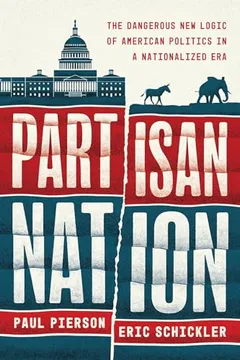


Key Takeaways
Treat polarization as an institutional feedback loop, not just voter anger
The rules are not the whole system. The Constitution divides power among branches and between federal and state governments. But the authors argue that its effects depend on the institutions connecting citizens to government: parties, organized interests, and media. For much of American history, these intermediaries had strong local roots, so national parties contained competing regional factions. Today, those same institutions increasingly share national networks and partisan loyalties. The formal Constitution has changed little, but the wider constitutional order has changed profoundly.
The loop accelerates itself. Nationalized organizations encourage politicians to stick with their party; their behavior then gives voters more consistent partisan cues. Voters’ stronger partisan attachments make politicians even less willing to break ranks. Polarization is therefore not simply a reflection of fixed human tribalism. Its institutions can intensify, organize, and sustain it.
The account usefully shifts attention from individual temperament to the pathways through which political signals travel. In organizational sociology, incentives and communication networks often explain why people behave similarly without requiring them to share identical motives. That perspective makes polarization less mysterious and more open to institutional analysis. It also guards against a simplistic story in which voters alone force elites toward extremism. Still, feedback loops can describe persistence more easily than origin: identifying which links matter most, and how much each contributes, requires evidence beyond the fact that they reinforce one another.
Past party conflicts softened when local interests could cross national lines
History offers a contrast, not a cure. In the 1790s, Federalists and Jeffersonian Republicans treated each other as threats to the republic. Yet Jefferson’s party soon fractured over economic development, with local organizations welcoming urban manufacturers despite the party’s agrarian identity. After the Civil War, Republicans divided over Reconstruction, money, and economic policy. By the 1870s, farmers and railroad regulation were reshaping coalitions across party lines. In the 1890s, silver interests led western Republicans to obstruct their own party’s civil-rights bill rather than abandon local priorities.
A softer conflict can hide grave losses. The retreat from Reconstruction eased partisan conflict, but also abandoned Black Americans to violent disenfranchisement and white-supremacist rule. The authors’ point is not that de-polarization is always virtuous. It is that locally rooted interests once disrupted party unity, sometimes with emancipatory consequences, and sometimes with deeply unjust ones.
These comparisons complicate the comforting claim that today’s conflict is simply another familiar American cycle. Earlier party labels concealed substantial regional disagreement, making coalition changes possible, but the political flexibility they enabled also protected slavery and later helped dismantle Reconstruction. The historical lesson is therefore institutional, not nostalgic: cross-party bargaining can reduce existential conflict, yet the resulting compromise must be judged by who gains rights and who pays for stability. A useful test for any appeal to moderation is whether it broadens democratic inclusion or merely lowers the temperature by excluding vulnerable groups.
Race realignment and federal expansion made national party conflict durable
The first trigger was racial realignment. Black voters and racially liberal labor unions gradually strengthened the Democratic coalition in the North. Civil-rights activism forced national Democrats to support landmark laws in the 1960s, while Republicans increasingly appealed to white conservatives, including in the South. As these voters changed parties, their positions on religion, gender, abortion, guns, and other issues increasingly moved with them. Distinct social disagreements began to reinforce the same partisan divide.
Washington became a bigger prize. During the Long 1960s, the federal government expanded spending, regulation, and enforcement of rights. Between 1955 and 1975, federal nondefense spending rose from 5.7 percent to 15.7 percent of GDP. Issues once settled locally, including environmental rules and abortion, became national policy battles. More groups organized around those decisions, and more political energy flowed toward Washington, where control of government had become more consequential.
The account links two transformations that are often studied separately: the reorganization of party coalitions around race and the growth of national policymaking. Their interaction helps explain why later cultural disputes did not arise on a blank slate. A policy can become a partisan identity marker when group networks and party cues repeatedly connect it to an existing divide. This mechanism is persuasive, though it should not imply that every later issue is reducible to race or federal growth. Independent movements, changing beliefs, and strategic choices also shape which issues become politically fused.
When parties, groups, and media nationalize together, local brakes disappear
Three intermediaries changed in tandem. State parties lost autonomy as primaries, national fundraising, and outside groups weakened local leaders’ control over nominations and careers. Interest groups shifted from cultivating allies in both parties toward helping their preferred party win. Media followed a different path: cable, talk radio, and online platforms made national political content more profitable, while local news organizations lost resources and audience. By 2012, the out-of-state share of itemized contributions to candidates had risen to 68 percent, from 31 percent in 1990.
Newt Gingrich showed how the pieces could work together. He used national conservative media, activist groups, and candidate-training networks to build a more unified Republican message and punish cooperation with Democrats. The result was not merely stronger party coordination. It was a national partisan network reaching from media audiences and donors to local candidates, leaving fewer independent institutions to carry local concerns into national politics.
The central insight is ecological: no single institution needs to cause polarization if each rewards the same behavior. Media attention, activist funding, and primary threats can jointly make a locally popular compromise politically dangerous. Research on information environments likewise suggests that local reporting can make officeholders more visible and accountable for place-specific choices. Yet the decline of local news is not politically uniform, and media audiences retain varied habits. The argument is strongest as an account of lost counterweights, rather than a claim that national media mechanically turns every viewer into an extreme partisan.
Keep social and political identities from collapsing into one partisan team
Stacked cleavages make disagreement feel personal. A cleavage is a social or political division, such as religion, race, geography, or education. When these divisions align with the same party boundary, people encounter opponents not just as policy rivals but as members of groups they already distrust. The authors describe partisanship becoming a “mega identity”: a broad social identity that bundles together many loyalties. In earlier eras, identities often cut across party lines, giving voters alternative ways to understand political conflict.
Institutions shape which cues reach voters. Local party leaders, groups, and news outlets once offered distinct interpretations. Their national alignment now makes partisan messages more consistent and less likely to be interrupted by cross-cutting concerns. Even COVID-19, an emergency without an obvious party label at its outset, was rapidly interpreted through partisan conflict. This helps explain why hostile attachments can persist even when many voters hold mixed or moderate policy views.
Social identity research helps explain why overlapping group memberships can either intensify or soften conflict. When several identities point toward the same political camp, disagreement threatens belonging as well as policy preference; when identities cross-cut, an opponent may still be a neighbor, coworker, or fellow member of another valued group. The book’s institutional emphasis adds an important point: those patterns are politically cultivated, not simply psychological fate. Still, cross-cutting identity is not automatically moderate. A person can belong to many groups and remain intensely hostile when elites frame those groups as under attack.
Gridlock does not stop policymaking; it shifts power to courts and states
Congress has become less responsive. The share of salient issues left without a legislative response averaged 38 percent from 1947 to 1980, rose to 50 percent from 1981 to 2010, and reached 66 percent from 2011 to 2020. Filibusters, party-line obstruction, and fear of giving the other side a political win all contribute. This does not mean government stops changing policy. Presidents increasingly use executive authority, courts decide more consequential questions, and state governments pursue sharply different agendas.
The shift favors some agendas over others. Senate rules make many Democratic priorities, such as new spending programs, difficult to enact, while Republican priorities such as tax cuts can sometimes pass through a simple-majority process. A conservative Supreme Court can also restrict regulation and block executive policies, while state legislatures gain room to act. The result is a polity that may be active yet unable to respond consistently through broad legislative agreement.
This distinction between legislative gridlock and system-wide stasis is crucial. Institutional analysis often treats veto points as barriers to change, but blocked legislation can redirect political action to courts, agencies, and subnational governments. That substitution can make outcomes less durable and less accountable because fewer actors must agree. The authors also identify an asymmetry in which policy tools and constitutional rules fit the parties’ aims differently. The qualification is that courts and states are not simply partisan instruments: their decisions can reflect legal doctrine, public opinion, and local variation, even as national political networks increasingly shape them.
A fragmented Constitution is vulnerable when one party coordinates across its fault lines
Checks need independent actors. The Constitution disperses power so that one branch can restrain another. The authors call this horizontal accountability: institutions checking one another. Elections provide vertical accountability, allowing citizens to punish officials. But when politicians across branches and levels prioritize party loyalty, institutional checks can weaken together. In the Trump era, most congressional Republicans defended the president through investigations and two impeachments, limiting the public impact of evidence that had once helped voters reassess presidential misconduct.
Decentralization can become an attack surface. Election administration is distributed across states and localities, while courts and Congress have roles in resolving disputes. That creates many points where coordinated partisans can challenge or obstruct a result. After 2020, election denial spread among Republican officials across levels of government. The authors warn that the system’s many entry points, combined with partisan teamsmanship and counter-majoritarian institutions, can turn dispersed authority from a safeguard into an opportunity for democratic backsliding.
The argument identifies a weakness shared by many checks-and-balances systems: rules do not enforce themselves when the people who operate them share incentives to protect a political ally. Comparative democratic research similarly emphasizes that informal restraint and credible opposition matter alongside written law. The account also explains why investigations depend on more than formal subpoena powers: cross-party participation can signal that allegations merit public attention. A careful distinction remains necessary between partisan disagreement over election rules and efforts to reject valid outcomes. The danger lies not in decentralization alone, but in coordinated action that disables accountability at several sites.
Reform election incentives before expecting norms or demographics to rescue democracy
The authors doubt self-correction. The Republican Party faces pressure to broaden its appeal, but rural overrepresentation in the Senate and other institutions can reduce the cost of losing the national popular vote. New issues or emergencies may not break existing alignments when national media and party networks can absorb them into the same partisan conflict. Constitutional amendments could address the mismatch more directly, but the amendment process gives defenders of the status quo powerful vetoes.
Change the incentives where legislation can. The authors favor a mix of reforms that could make moderate factions more viable: nonpartisan primaries, ranked-choice voting, and restored fusion voting, which lets a candidate appear on multiple party lines. They also support automatic voter registration and limits on partisan gerrymandering. These measures are not a complete repair, and reforms adopted by only one side could create an uneven playing field. Their purpose is to make winning voters more important than entrenching minority power.
This is a pragmatic strategy rather than a promise of institutional salvation. Electoral rules can change which candidates are viable and whether legislators have room to cooperate, but results depend on how rules interact with party organization, media, and state geography. The authors appropriately distinguish changing incentives from simply exhorting politicians to behave better. Ranked-choice voting and open primaries also have limits, especially when voters lack information or party networks adapt to the new rules. Reform therefore requires monitoring consequences and broad application, rather than assuming a single procedural fix will manufacture consensus.
Analysis
The book’s strongest contribution is its explanation of why contemporary American polarization differs from earlier episodes. It does not rely on a simple claim that voters have become uniquely hostile or that congressional voting scores alone capture democratic danger. Instead, it argues that local parties, interest groups, and news media once supplied cross-cutting cues and political incentives, while their nationalization has made partisan conflict more coherent and self-reinforcing. This connects political behavior to institutional change and offers a plausible account of durability.
Its historical comparisons are most useful when treated as mechanism tests, not comforting precedents. The 1790s, Civil War era, and Gilded Age each show how local factions could disrupt party coalitions, but those same arrangements coexisted with exclusion, slavery, and authoritarian rule. The authors make this moral complication explicit. Pluralism can restrain domination, but it can also preserve unequal power when some groups are denied voice.
The analysis of asymmetry is also consequential. The parties do not simply mirror one another: their coalitions, policy goals, media environments, and geographic advantages differ. The argument that Republican incentives create a distinctive threat to democratic stability follows from this account, though its general framework is stronger than any claim that one party’s future behavior is predetermined. Coalitions and incentives can change, and electoral setbacks can matter even when they do not immediately force moderation.
A central tension remains. The Constitution’s fragmentation is presented both as an earlier source of pluralism and as a contemporary vulnerability. The book resolves this by emphasizing the mediating institutions that once made institutional fragmentation productive. That distinction is persuasive, but it also means reform cannot be reduced to constitutional text or election rules alone. Durable change would require altering the networks that recruit candidates, fund campaigns, shape political information, and reward partisan loyalty. The book’s diagnosis is therefore less a case for nostalgia than a warning that institutions work only through the incentives and social structures that animate them.
Review Summary
Glossary
nationalized polarization
Partisan conflict organized nationallyA form of party conflict in which political disputes, party networks, organized groups, media, and voter cues increasingly align around national Democratic and Republican identities. Unlike earlier episodes, it leaves fewer autonomous local institutions able to introduce cross-cutting interests or disrupt national party divisions.
constitutional order
Constitution plus mediating institutionsThe authors’ term for the formal Constitution together with the intermediary institutions that shape how it operates, especially parties, organized interests, and media. The Constitution can remain textually stable while changes in these institutions alter how power is contested, how citizens receive political information, and whether checks and balances work as intended.
stacking of cleavages
Identities aligned by partyThe alignment of divisions such as race, religion, geography, education, and ideology with the same partisan boundary. When these cleavages stack, party identity carries several social identities at once, making political opponents seem socially distant and weakening the cross-cutting affiliations that might otherwise moderate partisan hostility.
Long 1960s
Era of federal policy expansionThe period from the early 1960s through the mid to late 1970s, marked by rapid expansion of federal spending, regulation, and rights enforcement. The authors argue that this policy surge raised the stakes of national politics, drew interest groups toward Washington, and helped set the conditions for more nationalized partisan conflict.
teamsmanship
Party loyalty across institutionsA pattern in which elected officials and other political actors identify their interests with their party team across branches of government and levels of the federal system. When teamsmanship dominates, officials are more likely to defend copartisans and oppose the other party than to protect their institution’s independent authority or investigate misconduct.
semi-loyal democrats
Officials who excuse antidemocratic alliesA term associated with political sociologist Juan Linz and used in the book for political figures who do not necessarily initiate authoritarian actions but tolerate, defend, or provide cover for those who do. Their cooperation can make democratic erosion possible because institutional resistance depends on insiders willing to oppose abuses, including when the perpetrator belongs to their party.
horizontal accountability
Institutions checking other institutionsThe capacity of relatively autonomous institutions, such as Congress, courts, and executive agencies, to investigate, constrain, or punish improper conduct by other officials. The book argues that partisan teamsmanship weakens this accountability when officials place loyalty to copartisans above the interests and responsibilities of their own institutions.
vertical accountability
Voters holding officials accountableThe check on elected officials provided by free and fair elections. Voters need credible information to assess abuses and decide how to vote. When partisan elites and media present sharply conflicting accounts, or when officials undermine the fairness of elections, this public check becomes less effective.
deck-stacking
Tilting rules toward incumbentsStrategies that alter electoral rules, district boundaries, or institutions to give a party a lasting advantage, rather than simply competing for more votes. The book discusses gerrymandering and restrictions on voting as contemporary examples, and statehood admissions as a historical example whose partisan effects proved less durable.
Download PDF
Download EPUB
.epub digital book format is ideal for reading ebooks on phones, tablets, and e-readers.








