Key Takeaways
1. Disease Origins are Complex and Often Zoonotic
In many cases, we can answer at least the first two components of the disease equation, as more than 60 percent of human pathogens are zoonotic diseases, or those that have jumped from animals to humans.
Animal-to-human leap. The vast majority of novel infectious diseases emerging in the last seventy years have originated in animals, a process known as zoonosis. This "spillover" often occurs when human activities bring us into closer contact with wildlife, disrupting natural habitats and creating new opportunities for pathogens to jump species. Examples include:
- Nipah virus: Transmitted from fruit bats to pigs, then to humans, often via contaminated date palm sap.
- Ebola: Likely jumped from nonhuman primates or fruit bats to humans through bushmeat consumption.
- Lyme disease: Spread by ticks from small mammals and deer, its rise linked to reforestation and increased human-wildlife interaction.
Human impact. Our voracious appetites, agricultural expansion, urbanization, and global travel patterns inadvertently create "greener pastures" for pathogens. Climate change further expands the range of vector-borne diseases, pushing microbes into new environments and hosts. Pathogens, driven by survival, adapt rapidly to these new landscapes, often thriving in human blood and lungs.
Ecological balance. Understanding zoonoses requires viewing humans as part of a complex ecological system, not above it. The intricate dance between host, vector, and environment determines if a pathogen successfully spills over, replicates, and spreads. Our choices as a species have direct consequences on how often and in what ways we are attacked by disease.
2. The Elusive "Patient Zero" and the Blame Game
There is no question that the concept of a patient zero can devolve into a blame-based narrative around who seeded a given epidemic or pandemic, reducing a complex infectious disease chain and ecological evolutionary process to a single person.
Search for the source. Identifying "patient zero" is a critical epidemiological step to understand how a disease starts, how it spreads, and how to prevent future outbreaks. However, this search often becomes a quest for blame, simplifying complex biological and social dynamics into a single scapegoat. Historically, this has led to stigmatization and persecution.
Misidentified zeroes. Gaétan Dugas, a French Canadian flight attendant, was wrongly singled out as the originator of the HIV outbreak in the United States, becoming "Patient Zero" in public consciousness. Genetic analysis later proved HIV was circulating in the US long before Dugas, who was himself a victim. Similarly, Roland Jenks, an Oxford bookseller, was blamed for the 1577 "Black Assize" typhus outbreak, simply because he survived while others died.
Complex origins. Many diseases, like the plague or tuberculosis, have been with humanity for millennia, making a single "patient zero" impossible to pinpoint. Even for newer outbreaks, the initial transmission event can be obscured by political interference, lack of early data, or the sheer speed of spread. The focus should be on the intricate cause-and-effect stories, not individual culpability.
3. Germ Theory Revolutionized Disease Understanding
It has been a long and arduous path to simply discovering germs, let alone proving how they cause disease.
From miasma to microbes. For millennia, humans attributed sickness to wrathful gods, celestial events, witchcraft, or "miasma"—foul-smelling vapors from rotting organic matter. This "bad air" theory, prevalent from Hippocrates to the 19th century, led to some sanitary reforms but fundamentally misunderstood disease transmission. The true culprits, microscopic agents like bacteria, viruses, and parasites, remained invisible.
Pioneering discoveries. The invention of powerful microscopes by Antonie van Leeuwenhoek in the 17th century revealed a "new universe" of tiny living animalcules, laying the groundwork for germ theory. However, it took centuries for this understanding to take hold. Key figures who advanced germ theory include:
- Ignaz Semmelweis: Demonstrated handwashing reduced childbed fever.
- John Snow: Proved cholera spread through contaminated water, not miasma, by mapping cases in London.
- Louis Pasteur: Debunked spontaneous generation and showed bacteria caused childbed fever, pioneering pasteurization.
- Robert Koch: Established postulates proving specific organisms cause specific diseases, identifying bacteria for anthrax, tuberculosis, and cholera.
Transformative impact. The acceptance of germ theory in the late 19th century revolutionized public health and medicine. It shifted focus from abstract forces to tangible pathogens, enabling the development of antiseptics, vaccines, and antibiotics. This paradigm shift fundamentally altered life expectancies and human history, allowing for targeted interventions against previously mysterious and devastating illnesses.
4. Autopsy: Unlocking the Body's Secrets
A dead body carries with it a unique story.
Ancient insights. Autopsies, the systematic examination of dead bodies, have been crucial for understanding disease, dating back to ancient Greece with Herophilus dissecting condemned criminals. While often forbidden by religious or social mores, these examinations provided foundational knowledge of human anatomy and how illnesses manifested internally. Early observations, like Erasistratus noting liver changes in dropsy victims, began to link post-mortem findings to clinical symptoms.
Pathology's rise. Giovanni Battista Morgagni, in the 18th century, is considered the father of modern pathology. He meticulously performed and recorded over 600 autopsies, correlating internal findings with patients' illnesses, establishing "clinical-pathological correlation." This systematic approach moved medicine beyond humoral theory, revealing the physical damage caused by diseases like stomach cancer and osteoarthritis.
Modern relevance. Today, autopsies remain vital for mysterious diagnoses, unexpected deaths, and forensic investigations. For novel infectious diseases, they provide critical information on how pathogens affect the body. Examples include:
- MERS victims: Autopsies provided insights into disease progression.
- 1918 influenza: Lung samples from permafrost-preserved bodies allowed for genetic sequencing of the deadly virus.
- Hantavirus, Ebola, Legionnaires' disease: All better understood through post-mortem examination.
These investigations continue to reveal truths that posthumously save the living, often against societal resistance or personal risk.
5. Quackery: A Persistent Human Response to Fear
In desperation, we resort to a wide variety of unusual, ineffective, or outright dangerous remedies while hoping that science (or pre-science/understanding in general) catches up to the disease.
Desperate measures. Throughout history, in the face of terrifying and poorly understood diseases, humans have turned to quack remedies, driven by fear and a longing for control. These "cures" often offered false hope, unnecessary suffering, and sometimes accelerated death, diverting attention from legitimate scientific inquiry. Examples include:
- Ergotism: Medieval sufferers sought cures from saint relics, believing in divine intervention.
- Plague: "Four Thieves Vinegar" was believed to protect against the Black Death, while flagellants sought divine mercy through self-harm.
- Yellow Fever: Benjamin Rush's "heroic depletion therapy" involved copious bloodletting and toxic mercury, often worsening patient outcomes.
- Syphilis: Mercury treatments, while common, caused severe toxicity, tooth loss, and neurological damage.
Modern manifestations. Even with advanced medical science, quackery persists. The COVID-19 pandemic saw a resurgence of unproven remedies, such as hydroxychloroquine, pushed by political figures despite lack of scientific evidence. Other examples include:
- Colloidal silver for Lyme disease: Can permanently turn skin blue without curing the infection.
- Homeopathy for Ebola: Diluted remedies offered by "medical teams" who were banned from treatment units.
- Urine therapy for Mad Cow Disease: Advocated by a foundation, despite no scientific basis.
- Garlic and oregano oil for Anthrax: Touted after the 2001 attacks, but ineffective against the deadly bacteria.
The allure of the quick fix. The human desire for a simple solution to complex problems, coupled with distrust of authority or scientific uncertainty, fuels the market for quackery. These remedies, from ancient mummy powder for syphilis to modern "antiviral devices," highlight a recurring pattern of human vulnerability to misinformation during times of crisis.
6. Pandemics are Shaped by Social and Political Factors
Facts and science alone do not fully drive the outcome in pandemics.
Politicization of disease. Pandemics are not purely biological events; their course is profoundly shaped by social, economic, and political landscapes. From ancient times to modern outbreaks, leaders have weaponized disease narratives, blamed marginalized groups, and prioritized economic or political agendas over public health. This often leads to delayed responses, misinformation, and exacerbated suffering.
Historical examples:
- San Francisco Plague (1900): Chinatown was quarantined due to xenophobia, despite scientific evidence linking the plague to rats, not ethnicity.
- Yellow Fever (1793 Philadelphia): The outbreak caused a constitutional crisis, with political factions debating its origin (local sanitation vs. French immigrants) and advocating partisan "cures."
- HIV/AIDS: Early stigmatization of gay men and Haitians as "Patient Zero" delayed effective public health responses and fueled discrimination.
- Typhus: Napoleon's disastrous Russian campaign was exacerbated by typhus, highlighting how war conditions amplify disease.
Modern challenges (COVID-19): The COVID-19 pandemic starkly illustrated how politics can undermine public health.
- Chinese government: Obfuscated early data, suppressed whistleblowers, and controlled the narrative, delaying global response.
- US government: Downplayed the virus, politicized mask-wearing, and promoted unproven treatments, leading to high infection and death rates.
- WHO: Navigated complex diplomatic pressures, balancing access to information with the need to avoid alienating powerful member states.
Consequences of politicization. When political allegiance overrides scientific consensus, the consequences are dire. Distrust in public health institutions, spread of misinformation, and unequal access to care disproportionately harm vulnerable populations. The outcome of a pandemic is as much a reflection of a society's political will and social equity as it is of the pathogen's virulence.
7. Vaccines: Humanity's Greatest Triumph Against Disease
Vaccines have prevented billions of illnesses and deaths from notorious diseases like smallpox, yellow fever, rabies, hepatitis A and B, and diphtheria.
A long journey. The concept of vaccination evolved from variolation, an ancient practice of inoculating individuals with a mild form of a disease (like smallpox) to induce immunity. Lady Mary Wortley Montagu popularized variolation in Europe after observing it in Turkey, and Cotton Mather learned of it from an enslaved African man in Boston. While risky, variolation reduced mortality compared to natural infection.
Jenner's breakthrough. Edward Jenner is famously credited with the first true vaccine in 1796, using cowpox to protect against smallpox. This marked a pivotal shift: inducing immunity with a substance not the actual disease. Louis Pasteur later discovered "attenuation"—weakening pathogens to create vaccines for diseases like fowl cholera, anthrax, and rabies, though his methods sometimes involved chemical agents rather than just oxygen exposure as he claimed.
Modern marvels. Today's vaccines are incredibly diverse and sophisticated, ranging from attenuated live viruses (measles, polio oral vaccine) and inactivated pathogens (rabies, hepatitis A) to subunit, toxoid, and recombinant vaccines (hepatitis B). The rapid development of mRNA and viral vector vaccines for COVID-19 represents a new frontier, offering faster production and novel immune responses.
Global impact and ongoing challenges. Vaccines prevent millions of deaths annually and have led to the eradication of smallpox and near-eradication of polio. However, incomplete immunization, vaccine hesitancy, and the emergence of vaccine-derived strains (like circulating vaccine-derived poliovirus) mean that many diseases, like measles and polio, continue to pose global threats, especially in underserved regions.
8. Infections and Cancer: A Hidden Link
One-fifth of all the world’s human cancers are blamed on infectious causes.
Beyond carcinogens. While lifestyle, genetics, and environmental factors are well-known cancer causes, a staggering one-fifth of all human cancers are linked to infectious agents—bacteria, viruses, and parasites. This connection, initially observed in animal studies (like Rous's chicken sarcoma virus), reveals a profound and often insidious way pathogens can alter our cells and destiny.
Viral culprits. Several viruses are established carcinogens:
- Human Papillomavirus (HPV): Causes cervical, throat, anal, and vulvar cancers by disrupting cell growth regulators. Vaccines exist to prevent 90% of HPV-related cancers.
- Hepatitis B (HBV) and Hepatitis C (HCV): Chronic liver infections can lead to liver cancer and non-Hodgkin's lymphoma. An HBV vaccine is available.
- Epstein-Barr Virus (EBV): Linked to nasopharyngeal cancer, stomach cancer, and lymphomas.
- Human Herpesvirus 8 (HHV-8): Causes Kaposi's sarcoma, especially in immunocompromised individuals.
These viruses often have long latency periods, transforming cells over years or decades.
Bacterial and parasitic connections. Bacteria like Helicobacter pylori, which thrives in the stomach, can cause gastritis, ulcers, and stomach cancer by promoting inflammation and genetic mutations. Parasites also contribute to cancer:
- Chinese liver fluke (Clonorchis sinensis): Ingested from undercooked fish, it settles in bile ducts, causing inflammation and increasing risk of bile duct cancer.
- Schistosoma haematobium: A waterborne parasite that causes inflammation in the bladder, leading to bloody urine and bladder cancer.
These links highlight the complex interplay between infection, chronic inflammation, and cellular transformation into malignancy.
9. Containment Strategies Evolve with Understanding
For millennia, the separation of the sick from the healthy was the primary approach to preventing disease spread.
Early isolation. Before germ theory, basic isolation and quarantine were humanity's main defenses against outbreaks. Biblical texts outlined rules for cleanliness and separation. Medieval "lazarettos" isolated plague victims, and leper colonies, like Moloka‘i, forcibly segregated those with Hansen's disease, often with brutal social consequences. These crude methods, though often driven by fear and misunderstanding, sometimes inadvertently limited spread.
Public health advancements. The 1918 influenza pandemic spurred significant public health reforms.
- Masks: Wu Lien-teh's layered gauze masks effectively contained pneumonic plague in Manchuria (1910), influencing mask use during the 1918 flu. Sara Little Turnbull's "bubble" design led to modern N95 respirators.
- Ventilation: The "open-air cure" for tuberculosis, while not a cure, improved hygiene and reduced transmission in crowded settings.
- Sanitation: Metal hospital beds, anti-spitting campaigns, and improved water systems (like those implemented after John Snow's cholera discovery) became standard.
- Contact tracing: Aggressive efforts to identify and monitor contacts of infected individuals became a cornerstone of outbreak management.
Modern challenges and lessons. Despite advanced knowledge, implementing containment remains challenging. The COVID-19 pandemic exposed vulnerabilities:
- Shortages of PPE: Highlighted issues with "throw-away" healthcare culture.
- Resistance to measures: Mask mandates and social distancing faced significant public and political opposition.
- Distrust: Historical injustices (e.g., Tuskegee study) fueled distrust in public health efforts, hindering compliance.
The ongoing evolution of pathogens, coupled with human behavioral and political complexities, means containment strategies must constantly adapt, balancing individual liberties with collective well-being.
10. Disease is an Evolutionary Dance with Humanity
Pathogens are simply making their way in the world free of emotion, taking advantage of the rapidly changing ecology around them, from the tiny universe of gut microbiomes to hurricanes sinking coastline cities.
Constant adaptation. Pathogens are not malicious; they are organisms programmed for survival and replication. They constantly evolve, mutate, and adapt to new environments and hosts, often at a far faster clip than humans. This evolutionary pressure drives the emergence of new diseases and the persistence of old ones.
Genetic agility. Viruses and bacteria exhibit remarkable genetic agility:
- Antigenic drift: Small, continuous mutations in flu viruses necessitate annual vaccine updates.
- Antigenic shift: Major genetic recombinations create entirely new flu subtypes, leading to pandemics (e.g., 1918 H1N1, 2009 H1N1 swine flu).
- Antibiotic resistance: Bacteria rapidly evolve resistance to medications, making once-curable diseases like gonorrhea increasingly difficult to treat.
- Dormancy: Tuberculosis's ability to lie latent for years allows it to persist in populations and re-emerge in weakened hosts.
Humanity's role. Our actions inadvertently shape pathogen evolution. Global travel allows rapid spread, while habitat destruction brings us closer to animal reservoirs. Overuse of antibiotics fuels resistance. This dynamic interplay means that while we develop new defenses, pathogens are simultaneously finding new ways to circumvent them.
An unfinished chapter. The battle between humans and pathogens is an ongoing evolutionary arms race. Each pandemic teaches us invaluable lessons, driving medical and public health progress. However, the inherent adaptability of microbes, coupled with human societal complexities, ensures that this chapter in our history will forever remain unfinished. We must remain vigilant, understanding that our world is theirs too, and they will continue to change, jump, consume, and adapt to multiply.
Last updated:
Review Summary
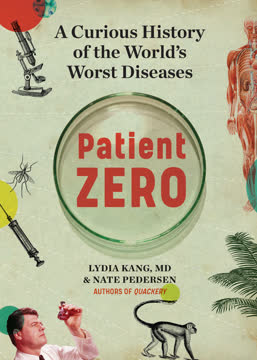
Patient Zero by Lydia Kang and Nate Pedersen explores the history of infectious diseases through accessible, engaging prose with visual elements like illustrations and sidebars. Readers appreciate the book's lighthearted tone despite its grim subject matter, covering diseases from Ebola to COVID-19, explaining patient zero concepts, medical advances, and social factors. The book connects historical pandemics to modern challenges. Some reviewers found it repetitive or politically biased, while others praised its interdisciplinary approach. It's recommended for general audiences seeking an overview of epidemiology, though experts may find it introductory-level.