

Key Takeaways
Treat creativity as a working system, not a miracle inside one mind.
Three parts interact. The book’s central model treats creativity as an exchange among a person making choices, a domain of knowledge, and a field of people who understand and evaluate that knowledge. In popular music, the domain includes songs, styles, and techniques; the field includes collaborators, producers, record companies, critics, and listeners. A creative act changes what already exists, then receives some form of social judgment. Each part matters, but no single part is enough to explain the result.
Connections run both ways. McCartney brings distinctive musical skill and judgment, but his options also come from the songs he learned, the people he worked with, and the institutions that made recording and distribution possible. The model explains why a song can be both recognizably his and the product of many hands.
The model is valuable because it avoids two easy stories: the lone genius who creates from nothing, and the social system that leaves individuals with no agency. Its strongest implication is practical: creative work improves when the maker can reach relevant knowledge and receive informed evaluation. The framework also complicates credit. Acknowledging collaboration does not mean every participant contributed equally, and a systems account needs to preserve differences in skill, authority, and responsibility rather than dissolving them into a vague collective.
Study the tradition deeply enough to make its rules useful.
Practice builds a feel. McCartney grew up with music at home: his father played piano at family gatherings, and familiar songs came from radio, records, and relatives. He learned instruments, switched from trumpet to guitar so he could sing, and taught himself songs by listening and copying. With the Quarrymen and the Beatles, he absorbed a vast range of material by performing covers. By 1963, the Beatles had built a repertoire of about 250 songs and were performing roughly 400 times a year, mostly other people’s work.
A practical sense develops. The book uses habitus for the learned dispositions that give someone an intuitive feel for how a practice works. McCartney’s knowledge of songs and performance was acquired through repeated participation, not a mysterious gift. That familiarity let him work within conventions and make them his own.
The account makes a persuasive case that originality depends on familiarity: a musician cannot vary conventions that remain unknown. This resembles apprenticeship in crafts, where judgment develops through repeated attempts and feedback, not just verbal instruction. Yet immersion is not equally available to everyone. Time, instruments, supportive relationships, and access to performance all matter. The lesson is not simply to practice more, but to find ways to participate in a tradition, study its workings, and make choices inside it.
Let a dream start a song, then test and reshape it in company.
A melody was only the beginning. McCartney recalled waking with the tune that became Yesterday and first suspected he had remembered an existing song. He played it for people whose musical judgment he trusted, including John Lennon and songwriter Lionel Bart, to check whether it was familiar. For a time, he sang temporary words about scrambled eggs. He kept developing the song, later finding its opening lyric while travelling in Portugal.
The recording changed it again. McCartney and producer George Martin worked out a string-quartet arrangement. McCartney pushed for a less conventional detail in the cello part, and he objected to the strings sounding too lush. The finished recording emerged through choices about lyrics, arrangement, performance, and studio sound. Its famous dream origin describes a spark, not the whole creative process.
The story offers a useful distinction between the arrival of an idea and the making of a work. A sudden insight can feel complete because its source is hard to trace, but testing, revision, and arrangement make it usable and legible to others. The account need not deny the importance of sleep or unconscious thought. It simply refuses to treat an unexplained moment as a sufficient explanation. The more revealing question is what knowledge and decisions allowed the initial melody to become a song people could recognize and value.
Treat live performance as training in musicianship, teamwork, and audience judgment.
The stage taught more than notes. McCartney’s early performances included family sing-alongs, a first public appearance with his brother, and gigs with the Quarrymen. The band learned to get bookings, move equipment, keep a set going, and respond to audiences. In Hamburg, the Beatles played for hours each night, building stamina and learning how to hold a crowd. When the band lost its bass player, McCartney took over the instrument, drawing on what he had already learned about bass lines and ensemble playing.
Experience became judgment. Repeated performance taught him how parts fit together and how a crowd reacted. Later, touring Wings from small university venues to arenas required a different kind of coordination, with crews, lighting, sound, and stage technology. A performer’s craft includes adapting to the conditions around the music.
Performance is a form of learning in public. It forces a musician to coordinate attention, technique, other players, and the audience, often under imperfect conditions. That makes live work more than a showcase for skills learned elsewhere: it is a setting where practical judgment gets tested. The book’s examples also show that the stage is shaped by labor beyond the performer. The risk is to romanticize hardship as necessary training. The stronger point is that varied, sustained practice creates capabilities that isolated rehearsal may not.
Give a trusted collaborator permission to improve, reject, and redirect your ideas.
Partnership meant real critique. Lennon and McCartney brought different backgrounds and musical instincts to their songwriting, but they shared a deep familiarity with popular music and learned by writing together. In the early song I Saw Her Standing There, Lennon rejected a weak lyric and helped McCartney find a better one. In We Can Work It Out, McCartney’s hopeful verses meet Lennon’s more impatient middle section, giving the song a tension neither perspective alone would create.
The relationship became part of the method. As the partnership matured, each could anticipate the other’s standards and challenge an idea without ending the collaboration. Their creative work was not a neat division in which one always supplied a verse and the other a bridge. Songs changed through discussion, revision, and shared knowledge of the musical conventions they were using.
Trust makes criticism usable. A collaborator who knows the work and the maker can challenge a choice without making every disagreement feel like a verdict on personal worth. The Lennon and McCartney partnership shows how shared references can speed communication, while contrasting tastes create productive friction. Still, a famous duo is not a universal template: close collaboration can also suppress dissent or concentrate credit unevenly. The key condition is not friendship alone, but a relationship in which the work can be questioned and revised.
A record is made across nested teams, tools, and institutions.
Paperback Writer had many authors of process. McCartney began with a song idea and lyrics; Lennon helped develop the song, and the Beatles shaped its arrangement. George Martin, engineer Geoff Emerick, and other Abbey Road staff helped realize the recording. The wider system included EMI’s studio practices, available equipment, the music scene, and listeners who judged the result.
Technology entered the composition. Lennon wanted a stronger bass sound. Engineer Ken Townsend reversed the wiring of a studio speaker so it could function as a microphone for recording McCartney’s bass. The team also used tape echo and other studio techniques. The book calls these nested layers a holarchy: each unit, from a lyric to a studio team, can be a whole system while also being part of a larger one. The record’s sound emerged from their interactions.
The recording example makes collaboration concrete: tools do not merely capture a finished idea; they can alter what the idea becomes. A studio technique can change the musical balance, while an institutional rule can shape how people solve a problem. This systems view is particularly useful for production, where invisible labor often disappears behind the artist’s name. It should not, however, imply that every contributor has equal influence. The book itself shows that creative authority and institutional power vary across the same network.
Treat production as musical authorship, not merely technical supervision.
McCartney learned by making records. George Martin’s example helped McCartney understand arrangement, studio decisions, and how a producer could guide a performance. McCartney’s own productions show different ways of applying that knowledge. With Mary Hopkin, he coached the vocal until she found the right approach to Those Were the Days. For Badfinger’s Come and Get It, he first made a demo himself, then asked the band to follow its arrangement closely. With the Bonzo Dog Doo-Dah Band, he encouraged experimentation and helped shape the single I’m the Urban Spaceman.
The producer chooses what serves the song. McCartney’s focus was usually musical rather than engineering-centered. He relied on engineers for technical expertise, while making decisions about performances, arrangements, and which unexpected moments to keep.
Production is best understood here as a form of judgment that connects performance to a listener’s experience. The producer may coach, arrange, select personnel, or decide that an imperfect moment carries more life than a polished replacement. McCartney’s approach also shows the value of mentorship: observing a skilled practitioner can transmit standards that are hard to learn from instructions alone. The challenge is that a producer’s authority can either support or overpower an artist. The examples are strongest when guidance sharpens the performer’s contribution rather than replacing it.
Experiment beyond your brand while keeping a route back to listeners.
McCartney repeatedly changed lanes. He helped move the Beatles beyond their early pop sound, explored experimental recording in Carnival of Light, and later made electronic work as the Fireman with producer Youth. He also wrote children’s songs, composed classical works including Liverpool Oratorio, and took on film projects. Some experiments attracted new attention; others, such as Give My Regards to Broad Street, met harsh reviews. His willingness to try unfamiliar forms did not erase his established work as a songwriter and live performer.
Different work needs different audiences. McCartney’s children’s songs were aimed at young listeners, not necessarily the adult rock audience. The Fireman project offered room to work outside his familiar public identity. His career shows that a creator can move among styles and personas without expecting every audience to value every project.
A durable creative identity need not mean repeating one recognizable formula. McCartney’s shifting projects suggest that a public career can contain several kinds of work, each with its own audience and standards. This is a useful counterweight to the pressure to turn past success into a permanent template. The caution is that experimentation is not automatically valuable simply because it is unconventional. A new direction still needs a purpose, a form that fits it, and some way for its intended audience to encounter it.
Build financial and organizational support for the creative work you want to sustain.
Resources make options possible. McCartney’s touring income, royalties, publishing activities, and company MPL helped support a long career spanning records, performances, orchestras, and other projects. The book notes that he lost control of much of the Beatles’ publishing catalogue, then built other business interests and negotiated recording deals. These arrangements were not separate from creativity: they helped provide the money, staff, and time needed to make work.
Success can reinforce itself. Recognition brought access to collaborators, institutions, and audiences; those opportunities could produce further recognition and income. The authors connect this cumulative advantage to the Matthew Effect, the process by which an existing advantage can grow. McCartney’s resources clearly expanded his choices, though they also distinguish his position from that of creators who cannot afford similar support.
This argument corrects the comforting myth that art flourishes best untouched by commerce. Money can pay for time, skilled collaborators, equipment, and the chance to take a risk. Yet the same feedback loop that sustains an established artist can make entry harder for others. A complete account of creativity therefore needs both sides: resources can enable work, and their unequal distribution can shape whose work gets made, circulated, and recognized. McCartney’s business infrastructure is part of his creative story, not merely its administrative background.
Analysis
The book’s most important move is to change the unit of explanation. Instead of asking what quality inside Paul McCartney produced a song, it asks how an individual, a musical tradition, collaborators, institutions, technologies, and audiences interacted to make a particular work possible. The distinction matters because the familiar genius story mistakes the most visible contributor for the entire cause. Yet the authors do not replace individual agency with social determinism. McCartney’s decisions remain consequential, but those decisions become intelligible through the knowledge and relationships that shaped them.
The case studies give this argument a strong narrative engine. Yesterday begins with a remembered dream, then expands into a history of musical immersion, verification, lyric work, arrangement, and recording. Paperback Writer extends the frame from songwriting into engineering, studio policy, and cultural moment. The chapters on collaboration and production show the system working at different scales, from a line of lyric to a full recording team. This makes an abstract model tangible and demonstrates that the creative process is not a simple sequence with one starting point.
The approach also has limits worth keeping visible. A systems vocabulary can become so expansive that nearly everything surrounding a work appears causally relevant. The challenge is to explain which interactions mattered, how they mattered, and whose contributions carried the most weight. The book supplies detailed examples, but its emphasis on interdependence can sometimes soften questions of authorship and power. Its own accounts of EMI, producers, engineers, and business resources show why those questions cannot be flattened.
McCartney is an unusually rich case because his career includes performance, songwriting, production, business, and formal experimentation. The result is not a recipe for reproducing his success. It is a more credible map of creative practice: cultivate knowledge, work with other people, learn the rules well enough to alter them, and recognize the structures that make some choices possible. The central insight is not that systems make artists. It is that artists make work through systems, and their work can reshape those systems in turn.
Review Summary
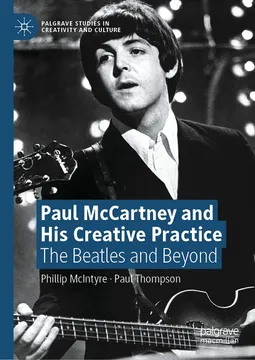
Paul McCartney and His Creative Practice is highly praised for its academic approach to understanding McCartney's creative process. The book is commended for debunking myths surrounding creativity and genius, instead focusing on the sociocultural factors that influenced McCartney's work. Readers appreciate the in-depth analysis of specific songs and collaborations, as well as the exploration of McCartney's role as a producer and businessman. The book is seen as a valuable resource for those interested in creativity studies and McCartney's artistic journey.
Glossary
systems model of creativity
Creativity as interactionA model in which creativity depends on interaction among a person, a domain of knowledge, and a field of people who understand and evaluate that knowledge. The person introduces a variation; the field judges it; and accepted changes may become part of the domain. The model treats these relationships as interdependent rather than as a linear sequence.
domain
A body of knowledgeThe accumulated knowledge and conventions used within a cultural practice. In popular music, a domain includes existing songs, musical styles, instruments, techniques, and shared ways of composing or performing. Creators learn from this inherited material and can alter it, but their innovations remain connected to what the domain already contains.
field
A community of evaluatorsThe social organization surrounding a domain, made up of people who understand it and can influence what gets recognized, circulated, or accepted. In music, the field can include collaborators, producers, record companies, critics, and audiences. It does not merely react to completed work; its expectations and resources can shape how work is made.
habitus
An acquired practical feelA set of durable dispositions developed through immersion and repeated participation in a practice. Habitus gives someone an intuitive sense of how a field works and what choices are likely to fit, without requiring conscious rule-following at every step. It both guides and limits action, while leaving room for personal decisions and variation.
distributed creativity
Creativity across collaboratorsAn approach that understands a shared creative product as emerging through interaction among collaborators, rather than treating the group as a collection of isolated creators. Individual contributions still matter, but the group’s communication, accumulated knowledge, and responses to one another can generate qualities that no participant produced alone.
holon/parton
A whole that is partA system that functions as a complete unit at one scale while serving as a component of a larger system at another. A song arrangement, for example, can be understood as a system in itself and as part of a recording project. The term draws attention to how creative activity is nested across interconnected levels.
holarchy
Nested interacting systemsA structure of interconnected systems, each of which can be understood as a whole and as part of a larger whole. In the book’s account of Paperback Writer, lyric writing, songwriting, the Beatles, the studio team, the record company, and the wider music scene form related levels. No single level explains the finished recording by itself.
constrabling
Constraint that enablesA term for the simultaneous constraining and enabling effects of structures on creative action. Conventions, technologies, institutions, and available resources limit some choices while making other choices possible. The term rejects the assumption that freedom requires the absence of structure, arguing instead that creative action often depends on working within conditions.
flow
Deep creative absorptionA state of concentrated involvement in an activity, where attention is focused on the task and actions proceed with a strong sense of engagement. In the book’s discussion of McCartney’s studio work, maintaining this state means limiting technical interruptions and keeping the process moving. The idea also depends on a workable relation between a person’s skills and the challenge at hand.
Download PDF
Download EPUB
.epub digital book format is ideal for reading ebooks on phones, tablets, and e-readers.








