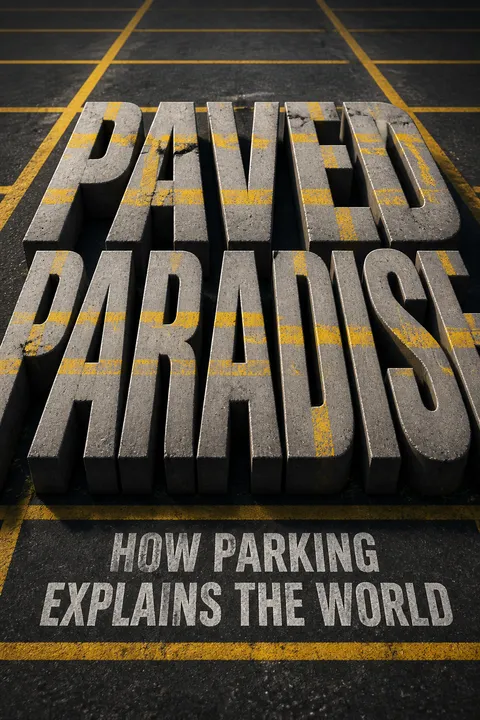


Key Takeaways
Treat parking as city-making infrastructure, not leftover space
The hidden blueprint. A dispute over a Queens parking spot escalated until a car crashed through Rainbow Bakery on its opening day. The violence was extreme, but the expectation behind it is familiar: a space nearby, available immediately, and free. Grabar argues that this expectation shapes far more than curbside behavior. Parking affects building design, neighborhood density, public transit, and who can afford to live near opportunity.
The scale is startling. Cars spend about 95 percent of their lives parked. Los Angeles County has roughly 18.6 million parking spaces, covering about 200 square miles. Midcentury cities treated parking as a remedy for downtown decline, then built streets, lots, and buildings around it. A parking space is not empty background. It is a decision about what land and public resources will serve.
What's striking is how an ordinary convenience becomes a form of infrastructure. Once a city builds wide roads, large garages, and buildings surrounded by parking, those investments shape what can be built next. This is a classic feedback loop: infrastructure makes certain choices easier, and repeated choices then appear to prove that the infrastructure was necessary. The argument does not mean parking is inherently wasteful. People need places to leave cars. It means that treating parking as neutral obscures the lasting choices made about land, access, and other possible uses.
Every mandated parking stall can erase a home before construction starts
A garage swallowed the project. In Solana Beach, developer Ginger Hitzke proposed affordable homes on a municipal parking lot. Local rules required 22 spaces for residents, while officials pressed her to replace 31 public spaces. The result was an underground garage with 53 stalls. After the city reduced the plan from 18 apartments to 10 and a lawsuit delayed construction, costs rose until Hitzke abandoned the project in 2020. The final estimate topped $1.1 million per unit, with the garage central to the project’s failure.
The rule is structural. Parking minimums are laws requiring a set number of off-street spaces for each building or use. A California study found structured parking added an average of $35,945 to the cost of each low-income apartment. The Valley of High Parking Requirements describes the gap where surface lots consume too much land and garages cost too much to build.
The Solana Beach case shows how a technical rule can decide who gets access to a neighborhood without openly stating that purpose. Parking requirements can function as a housing cost, but also as a socially acceptable reason to resist new residents. That does not make every parking objection a pretext. Existing residents may depend on street spaces, and visitors need access too. The sharper question is who must pay to preserve that access, and whether the same public land could meet multiple needs instead of making new homes carry the entire burden.
Free parking subsidizes driving, sprawl, and costs hidden in every purchase
Free at the curb, costly elsewhere. Parking is rarely free to build. Its costs are folded into rents, store prices, taxes, and public spending, including for people who do not drive. One estimate puts the annual cost of supplying parking at $4,400 per vehicle, with drivers paying only a portion directly. A 2017 study estimated that the average U.S. driver spends 17 hours a year searching for parking, wasting time, fuel, and money.
Supply can create demand. In a study of nine cities, adding 10 parking spaces per 100 residents was associated with an 8 percent increase in the share of people driving to work in later years. Offices that made workers pay for parking saw solo driving fall by an average of 25 percent. Cheap, abundant parking also encourages spread-out development, making everyday trips harder to take without a car.
This is an example of a hidden subsidy: the person making a choice does not face its full cost, so the choice becomes more common than it otherwise would. Bundled parking works like a price signal in reverse, rewarding car ownership while making non-drivers help pay for it. Still, parking is only one part of the system. Road design, transit service, housing costs, and work locations also shape travel. The useful insight is not that parking alone causes car dependence, but that parking policy is a practical lever within a larger set of incentives.
Measure actual occupancy before declaring a neighborhood short of parking
A shortage may be a location problem. Drivers usually mean that the space directly beside their destination is occupied, not that every space in the district is full. In studies of Southern California cities, peak parking occupancy averaged 56 percent. An analysis of 27 mixed-use neighborhoods found parking was oversupplied in every case; places where residents complained of shortages had, on average, 45 percent more parking than needed to maintain 15 percent vacancy.
Memory favors the bad search. The availability heuristic is the tendency to judge how common something is by how easily examples come to mind. A frustrating hunt for a space is memorable, while an easy arrival barely registers. The closest spaces fill first, making a district feel full even when lots and garages farther away have room. Count spaces and track peak occupancy before approving more construction.
The distinction between total supply and convenient supply is crucial. A city can have many empty spaces and still fail drivers if information is poor, rules are confusing, or parking is divided among private owners. Better data can prevent expensive construction, but average occupancy should not be mistaken for universal access. A person carrying equipment, making a delivery, or using a mobility aid may need a closer space than the typical driver. Good measurement should reveal both excess capacity and whose access needs are being missed.
Price popular curbs so drivers can find spaces without circling
Keep a few spaces open. Donald Shoup, the economist who helped make parking a serious planning issue, argued that prices should reflect curb demand. SFpark, San Francisco’s demand-based metering program, aimed to keep block occupancy between 60 and 80 percent. Every six weeks, prices changed in 25-cent increments: busy blocks became more expensive, while underused blocks became cheaper. In pilot areas, reported search time fell by 43 to 50 percent, double-parking dropped by 22 percent, and total driving fell by 30 percent.
Make the benefit visible. A Parking Benefit District returns parking revenue to the area that generated it, funding improvements such as bus passes, benches, and street trees. Shoupistas, planners and civic activists inspired by Shoup’s research, have pushed for this combination of better pricing and local reinvestment. The aim is to manage scarce curb space, not simply collect more fines or revenue.
Pricing can coordinate use more fairly than a first-come system that rewards whoever arrives earliest and stays longest. But price is not the same as need: a higher meter rate can burden people with limited incomes, especially where transit is weak. The case for reform is strongest when prices are transparent, adjusted to actual demand, and paired with visible neighborhood improvements. Returning revenue locally also addresses a political problem. Residents are more likely to accept a changed rule when its benefits are concrete and close at hand.
Share garages across schedules before building another concrete box
One space can serve two uses. Office workers usually need parking during the day; apartment residents need it more at night. Charlotte developer Clay Grubb took advantage of that difference by sharing a garage between an office and a residential building. The combined project would have required about 700 spaces under separate rules. Grubb built 480, saving more than $5 million in construction costs and reducing annual operating costs by 40 percent.
Coordinate before expanding. A park-once strategy lets visitors leave a car in one place and reach several nearby destinations on foot, instead of driving between separate lots. Shared parking can support that approach by making existing capacity available across uses and times. It requires planning, clear agreements, and good information, but it can avoid the expense of building separate garages that sit partly empty.
Shared parking is a straightforward application of capacity planning: demand varies by hour, so the same asset can serve more people if schedules complement one another. The idea is common in other shared systems, yet property boundaries and financing can discourage it. There are real limits. A garage must be close enough, safe, accessible, and open when users need it. Those details matter, but they are reasons to design sharing well, not reasons to assume every building needs a dedicated space for every resident or worker.
Give curb space to the uses that move and serve more people
The curb does many jobs. Parking is only one possible use for public street space. Buses, loading zones, bike parking, outdoor dining, and safer intersections can serve more people or make essential trips easier. During the pandemic, New York City allowed nearly 7,000 restaurants to use curbside space, occupying about 8,550 parking spots. The change showed how quickly streets could support public life when the usual rules loosened.
Small changes can matter. New York’s temporary Times Square plaza became permanent after pedestrian injuries fell by 40 percent and car crashes by 15 percent. The point is not that every curb should become a plaza. It is that cities should compare uses rather than treat long-term car storage as the default. Delivery access, accessible parking, and safe crossings also need deliberate space.
A curb is a scarce public resource, and its value depends on how many people it serves, not just how easily a car can stop there. This reframes street design as a question of capacity and public benefit. Yet converting a space can shift costs onto people who rely on cars for work, care, or mobility. A well-designed allocation considers both the users who gain and those who lose, with practical provisions for loading, disability access, and emergency services.
Turn underused garages into homes where housing is scarce
Make room inside the existing footprint. An accessory dwelling unit, or ADU, is a smaller independent home on the same lot as a primary residence, often created by converting a garage or building in a backyard. California’s 2017 law made many ADUs near transit possible without adding replacement parking. In Los Angeles, annual ADU permits rose from 254 in 2016 to 5,429 in 2018; one in five permitted homes that year was built in a backyard.
Old buildings can adapt too. Los Angeles’s 1999 Adaptive Reuse Ordinance made it easier to convert older commercial buildings into housing without providing code-required parking. Over the following decade, more than 60 vacant buildings became over 6,500 apartments. Both changes show how removing a parking obligation can make homes possible without first constructing a new parking supply.
Garage conversions and older-building reuse create housing in places where new construction can be difficult, often with less disruption than large redevelopment. They also offer different scales of choice, from a backyard rental to a downtown apartment. These strategies are not automatic solutions to affordability: construction quality, financing, tenant protections, and local services still matter. Their broader value is that they let communities add homes without assuming every new household needs a newly built parking stall.
Treat public meters as long-term civic assets, not budget jackpots
A quick payment can hide a costly lease. In 2008, Chicago leased the rights to operate 36,000 parking meters for 75 years in exchange for $1.156 billion. The city approved the contract after roughly a day of review. Its inspector general later estimated the meters’ value at $2.13 billion to $3.53 billion. The lease also limited the city’s ability to change streets: removing metered spaces for bus lanes, events, or other uses could trigger payments to the operator.
Separate good pricing from bad governance. Higher meter prices sometimes made spaces easier to find and helped local businesses. The failure was not simply that parking became more expensive. It was that the city gave up control and future revenue without adequate public scrutiny, while remaining responsible for managing the streets.
The Chicago deal illustrates why public-private partnerships need more than a headline payment. Long contracts distribute future risks and constrain choices that may be difficult to predict at signing. Independent valuation, transparent assumptions, and clear protections for public functions are essential. At the same time, the episode does not prove that public agencies always price or manage parking well. The more useful distinction is between improving how a public asset works and surrendering control over it without a credible accounting of long-term costs.
Make parking reform widen access, not punish car-dependent residents
A car can be a necessity. People pushed far from jobs and services by high housing costs may depend on driving because transit is limited or daily destinations are distant. Ginger Hitzke, whose Solana Beach affordable-housing project failed, lived in Temecula, about 70 miles from her work. In Solana Beach, officials defended rebuilding public parking partly as a way to preserve beach access for visitors who could not afford to live nearby.
Aim beyond fewer spaces. Grabar’s case is not that drivers should simply lose parking. It is that parking should not prevent homes, transit, and walkable destinations from being built. A fair reform makes it easier to reach daily life without a car while preserving necessary access for people who still need to drive.
This is the book’s most important qualification: parking supplies real access in places where alternatives have been withheld. Removing spaces without improving transit, housing, or safe walking can impose immediate costs on people with the fewest options. Yet preserving free parking is not an equitable solution if it helps keep housing scarce and pushes workers farther away. A credible transition weighs both effects and asks who can change behavior, who cannot, and what public investment makes the change genuinely usable.
Analysis
The book’s central achievement is to make parking legible as a system of land use, subsidy, and political power. It begins with the intimate drama of the contested curb, then traces how parking requirements, public garages, and street design scale that conflict into housing costs, sprawl, and diminished public space. The narrative works because it joins policy to lived experience: a developer unable to build affordable homes, a city that leases its meters, and residents who find a home in a garage are not separate curiosities. They are consequences of decisions that consistently reserve land and money for storing cars.
The argument is strongest where it combines a specific policy change with observable results. San Francisco’s demand-based meters, Los Angeles’s adaptive reuse rules, and shared parking in Charlotte show that less mandatory parking need not mean chaos or an end to driving. They also reveal an important distinction: reducing required supply is not the same as banning parking. Developers can still provide spaces when tenants, workers, or customers value them.
Some evidence is necessarily harder to interpret. Cities differ in transit, geography, housing demand, and political culture, so a parking reform associated with success in one place cannot guarantee the same outcome elsewhere. The book also acknowledges uncertainty about whether parking abundance weakens cities or whether struggling cities become parking-rich as buildings disappear. That uncertainty is a strength when it prevents a simple one-cause story, but it leaves policy arguments dependent on local data and careful evaluation.
The deeper challenge is distributive. Parking is an inefficient and often regressive way to provide access, yet it can be the only workable access in car-dependent places. Market prices can improve turnover but allocate scarce spaces partly by ability to pay. Reform therefore needs complements: housing near destinations, reliable transit, accessible loading, and careful protection for people who cannot easily switch modes. The goal is not a city without cars. It is a city where parking no longer decides, by default, what gets built and who gets to belong.
Glossary
Parking minimums
Required off-street spacesLocal zoning rules that require buildings to provide a prescribed number of parking spaces, often based on the building’s use, size, or number of residents or employees. The book argues that these rules frequently exceed actual demand, raise construction costs, consume land, and make some housing or businesses impractical to build.
SFpark
Demand-based parking pricesSan Francisco’s pilot program for adjusting meter prices according to how full nearby parking was. The program sought to keep occupancy within a target range, raising prices on crowded blocks and lowering them on underused ones. Its goal was to make spaces easier to find and reduce cruising, rather than to maximize meter revenue.
Parking Benefit District
Local reinvestment of meter revenueA district that uses revenue from parking charges to pay for improvements in the area where the money was collected. Examples in the book include funding bus passes, benches, and street trees. The approach links parking management to visible local benefits and can help residents see a public return from charging for curb space.
Shoupistas
Parking reform advocatesThe informal name for planners, activists, and other advocates influenced by economist Donald Shoup and his work on parking policy. They promote ideas such as removing parking minimums, pricing busy curb spaces according to demand, and using parking revenue for local improvements.
Valley of High Parking Requirements
The gap between sprawl and densityA development zone where neither low-density construction with surface parking nor high-value construction with expensive structured parking is practical. Parking requirements can make mid-sized apartment buildings, small shops, and other infill projects too space-intensive or costly to build, leaving some urban sites undeveloped.
Adaptive Reuse Ordinance
Easier conversion of old buildingsA Los Angeles law adopted in 1999 to make it easier to convert older commercial buildings downtown into housing. Among other changes, it removed the obligation to provide parking when buildings were converted under the ordinance. The policy helped make vacant historic structures viable homes without requiring a new supply of on-site parking.
Accessory dwelling unit (ADU)
A second home on one lotA smaller independent dwelling located on the same property as a primary home. ADUs may be created by converting a garage, adding a backyard cottage, or adapting another existing structure. The book focuses on how parking rules can prevent these units, and how legal changes in California enabled many more to be built.
Download PDF
Download EPUB
.epub digital book format is ideal for reading ebooks on phones, tablets, and e-readers.








