
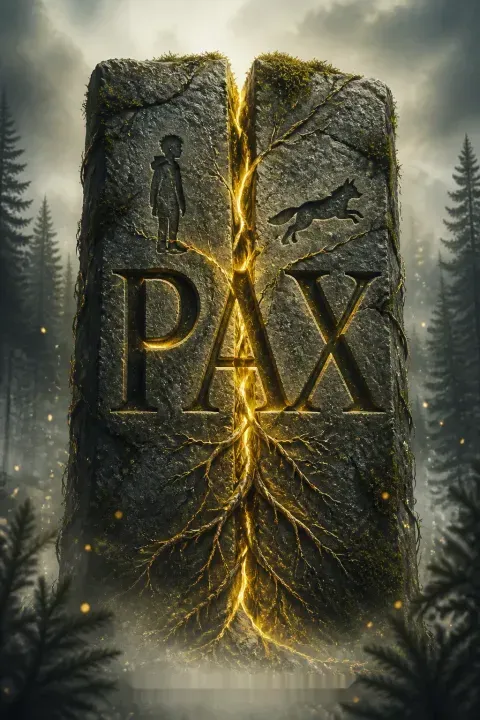


Plot Summary
Pax Abandoned by Roadside
The fox2 felt the car slow before Peter1 did, through his sensitive paws and whiskers. The boy1 gripped his baseball glove and cried silently, something Pax2 had never seen him do. The father7 pulled the car onto a gravel shoulder at the edge of a wood, grabbed Pax2 by the scruff, and set him down. Peter1 threw the fox's2 favorite toy soldier into the trees.
Pax2 sprinted after it, thinking this was their familiar game. By the time he retrieved the toy and trotted back, the car was speeding away. Peter1 reached his arms out the window, screaming the fox's2 name, while the father7 shouted for his son. Pax2 was alone at the roadside, confused, the toy soldier in his mouth.
This opening scene establishes the book's central wound: a forced separation that neither boy nor fox chose. Pax's hyper-attuned sensory experience (vibrations through the car, the father's 'lie-scent') contrasts with Peter's silent, adult-suppressed grief. The betrayal works because Peter is complicit but coerced: he throws the toy to distract, not to trick, yet the consequence is abandonment. The scene introduces the book's core question: what do we owe those who depend on us, and what does it cost to set that right?
Peter Decides to Return
At his grandfather's8 house, Peter1 found an old cookie tin filled with his father's7 childhood plastic soldiers and a photo of his father7 with a black-and-white dog. His grandfather8 said they were inseparable. The word stung Peter.1 That night, coyotes howled outside, unearthing a buried memory: at age five, Peter1 had set a trap for a rabbit destroying his mother's tulips, but coyotes killed the trapped animal before dawn.
His shame for not being where he should have been resurfaced, triggering his anxiety. He tore the photo in half and began packing. He studied an atlas, calculated a 200-mile shortcut across the foothills, and wrote a deceptive note to his grandfather.8 By dawn, he was walking west.
Peter's decision crystallizes around inherited shame: his father's loyalty lesson ('inseparable') collides with his own childhood failure to protect a vulnerable creature. The coyote memory functions as a psychological catalyst, converting abstract guilt into actionable resolve. The tin of soldiers connects Peter to his father's boyhood self, suggesting a lineage of attachment and loss that predates the current conflict. His flight is not merely rebellion but an attempt to rewrite a story he got wrong years ago.
Pax Meets Fox Kin
Pax2 stayed by the road waiting, but hunger and a thunderstorm drove him to follow two foxes: a bright-furred vixen called Bristle4 and her brother Runt.5 Bristle4 bristled at the human scent on Pax2 and shared a memory of their parents killed by a human with a stick, their blood spattered across snow. She warned that all humans are dangerous.
Runt,5 though, was friendly and playful, inviting Pax2 to stay. Pax2 agreed to one night only, resolved to return to the road when the storm passed. Runt5 was fascinated by the toy soldier Pax2 carried. The vixen4 ordered her brother5 home, but Pax2 felt the pull of fox companionship he had never known, his wild instincts stirring beneath years of domestication.
Bristle's traumatic memory introduces the argument Pax will wrestle with throughout the story: are humans inherently dangerous? Her testimony is damning and specific, yet Pax's own experience with Peter contradicts it. The sibling dynamic between Bristle and Runt mirrors Peter's protective instincts. Pax's response to their playfulness reveals a creature caught between two worlds, already beginning to discover what he was born to do. The toy soldier becomes a transitional object linking his old life to this new one.
Peter Breaks His Foot
After escaping his grandfather's8 town and a suspicious hardware store clerk, Peter1 walked through the night. He took a wrong turn onto an old wagon path, fell into swamp water, then stumbled in the dark. His right foot caught a root and he heard the bone snap before he felt it. He crawled to a tree, pulled himself upright, and collapsed again.
The foot swelled so rapidly he could see it changing. He spent the night cold and immobile. In the morning, he dragged himself to a barn he had passed earlier. A woman found him there, tossing his own baseball into his glove. She had a wooden leg and held a wicked curved knife. Peter1 realized he was at the mercy of a stranger who might be dangerous.
The broken foot is both a literal and psychological turning point. Peter's impetuous solo mission collides with the reality that he is a child, unprepared and vulnerable. The injury forces dependence on a stranger, which directly challenges his father's model of self-sufficient anger and his own fear of being a burden. His physical immobility mirrors the emotional paralysis he has felt since his mother's death: wanting to move forward but unable to locate the ground beneath him.
Vola, the Reclusive Woodcarver
The woman, Vola,3 lived alone in a cabin without electricity on twenty wooded acres. She made Peter1 crutches from scrap wood and a cast from plaster and her grandmother's quilt. When Peter1 tried to leave, she blocked him: he could not walk on the broken foot for six weeks.
Desperate, Peter1 agreed to her three conditions: write his grandfather8 to prevent a search, explain why he carried his mother's phoenix bracelet, and help with a project she would not yet reveal. Vola3 was a former medic who lost her leg in a minefield. She had been a soldier and had killed someone, which made her believe she was a grenade, too dangerous to live among people. She found peace in isolation, carving marionettes and tending her orchard.
Vola functions as Peter's mirror and foil. Like Peter, she lost a piece of herself (her leg, her moral identity) and withdrew from the world. Unlike Peter, she chose isolation as permanent punishment rather than a problem to solve. Her three conditions are therapeutic interventions disguised as bargains: reconnecting Peter to family, forcing him to articulate his grief, and engaging him in creative work. Her cabin, with its philosophy index cards and homemade peace, represents an alternative model of survival after loss.
Gray's Warning of War
An elderly, gray-muzzled fox found Pax2 waiting by the road. Gray6 had lived with humans in his youth and was curious about the ones Pax2 knew. Pax2 asked if humans were false-acting, as Gray6 described: turning away starving neighbors, feigning indifference to mates.
Pax2 recalled Peter's father7 smiling through lies. Gray6 then shared what crows had told him: war was coming from the west, a human sickness that caused them to attack without reason, to ruin everything with fire and chaos.
Gray6 himself was searching for a new home for his pregnant mate and their adopted young foxes, Bristle4 and Runt,5 because the war would destroy this valley too. Pax2 insisted he must find his boy1 before the destruction arrived. Gray6 agreed to travel south with him.
Gray's testimony complicates the book's moral universe. He does not condemn humans categorically but differentiates between 'careless' ones who destroy without warning and those who act with awareness. His definition of war as a 'sickness' reframes the human conflict in terms a fox could understand, but also implies that the soldiers (including Peter's father) are themselves victims of a contagion. The crow intelligence network introduces a broader-than-human perspective on the coming violence.
The Marrionette Condition
In the barn, Vola3 pulled a burlap covering from a wall of marionettes: a king, a queen, a sorceress, and animals with jet-bead eyes. She lifted the largest, a Roc with five-foot wings of painted feathers. Then she told Peter1 about the soldier she killed. She had searched his body and found a worn copy of The Seven Voyages of Sinbad, bookmarked at the story of Sinbad escaping from the Roc's nest.
She believed that story had helped the dead man feel brave, and since she had taken his life, she owed it to him to tell the story that meant so much to him. For nearly twenty years, she had carved these puppets alone, never performing for an audience. Her third condition was that Peter1 help her stage the show.
The marionette project crystallizes the book's ethics of reparation. Vola's penance is not self-flagellation but creative memorial: she transforms her guilt into art that honors the person she destroyed. Peter, who carries his mother's phoenix bracelet for similar reasons, recognizes this instinct. The third condition is an apprenticeship in meaning-making: it teaches Peter that guilt can be alchemized into something that serves others, that broken people can make beautiful things.
Peter Learns to Carve
Vola3 taught Peter1 that the wood, not the carver, is the master. He chose butternut, rippled like fur, and began to carve. As he worked, he asked Vola3 the question that haunted him: could a wild part be tamed out of someone, if it was inherited? He meant himself, his father's7 anger, the rage he felt and suppressed.
Vola3 did not know he was asking about himself, but said that asking others to figure out your own truth never works. Peter1 also told her about the merging he sometimes felt with Pax,2 where he sensed what his fox2 felt. Vola3 called this 'two but not two,' a Buddhist concept of nonduality. She assured him that if he felt Pax2 alive, then Pax2 was alive. This gave Peter1 hope.
Carving becomes an embodied practice of attention and release. Peter's question about inherited wildness reveals his deepest fear: that he carries his father's destructive anger like a contaminant. Vola's response, while not a direct answer, models a different approach to the self: not eliminating what frightens you, but understanding and civilizing it. The 'two but not two' concept validates Peter's intuitive bond with Pax while offering a philosophical framework for his experience of empathy.
Gray Dies by Wires
Pax2 and Gray6 reached the abandoned rope mill where Peter1 had left Pax.2 Soldiers had set up camp, the same men whose vehicles Pax2 had seen on the road. Gray,6 already weakened from a fight with a challenger fox, stumbled onto a patch of ground laced with hidden wires. The earth exploded. Soil, rock, and turf erupted skyward and fell back as black rain.
Pax2 found Gray6 under a cleaved hemlock bough, barely breathing. He pressed close, shoulder to shoulder, and experienced Gray's6 final memories: tumbling with brother kits across snowy tundra, his mother's rough tongue, the weight of her chin on his newborn skull. Then the old fox6 was still. Pax2 bayed his grief, then ran north through the night, carrying the news back to Gray's6 family.
Gray's death is the book's first direct collision between the animal and human worlds. The wires are impersonal, indiscriminate killers; Gray dies not because he is a fox but because he stepped in the wrong place, a victim of a human conflict he could not understand. Pax's experience of Gray's dying memories is the book's most explicit depiction of 'two but not two': consciousness shared across the boundary of death. The scene establishes what is at stake for all the foxes, not just Pax.
The Explosion Kills Runt
Pax2 returned to the camp, determined to destroy the wires that killed Gray6 before his boy1 could encounter them. He crept to a granite slab where wires trailed and began gnawing. Bristle4 attacked him, trying to drive him away from the danger, but Runt5 had followed them both. The little fox5 splashed across the river and bounded joyfully toward his sister.4
Before Pax2 could strip the wire's sheathing, another explosion tore through the field. When the debris settled, Pax2 found Bristle4 curled around Runt's5 body beneath a fallen scrub oak. Runt's5 hind leg was gone, shredded and bloody. He was alive, but barely. Bristle,4 who had lost everyone, now had a brother who would never run again. Pax2 stayed with them, guarding through the night.
The explosion sequence reverses Pax's protective impulse: he wanted to destroy the wires to save his boy, but his actions brought Runt into the blast zone. This is the hardest lesson of Pax's wild education: you cannot always control what your loyalty destroys. Bristle's grief deepens her anti-human conviction, but Pax's presence at her side complicates the binary. He is human-adjacent and yet chose to stay. The wounding of Runt creates a debt that Pax will spend the rest of the story repaying.
Peter Stages the Puppet Show
Peter1 built a stage from saplings and scrap wood. But when the moment came, he did not perform Sinbad's escape. Instead, he hung the sorceress puppet and unscrewed her left leg. He dressed her in his camouflage T-shirt, gave her a rifle, and had her shoot, then climb to a nest. He lit a small fire of wood shavings, then drew her out of the flames wearing no uniform.
He set her beside the child puppet and his carved fox. Vola3 watched in silence, tears streaming down her rigid face. Afterward, Vola3 ordered Peter1 to leave her alone. He found her later in the cabin, but something had shifted. She agreed to put him on a bus that would bring him within forty miles of Pax.2 He would leave the next morning.
Peter's puppet show is the most radical act of empathy in the book. He does not merely understand Vola's story; he returns it to her, reframed through the phoenix metaphor, showing her as someone who can rise from her own ashes. His substitution of her story for Sinbad's is a rejection of her self-imposed penance. He argues that the dead soldier might have wanted something different than a perpetual puppet show in an empty barn. The real healing is not in the performance but in being truly seen by another person.
Peter's Father's Deception
The night before the bus, Peter1 crumpled newspaper to start a fire and a headline caught his eye: the area was being evacuated and prepared for battle. He studied the map and saw the rope mill was at the center of the coming fight.
Then he noticed the date on the article: twelve days old, predating the day his father7 had agreed to leave Pax2 on that very road. His father7 had known the site would become a war zone. He had known when Peter1 pleaded for what seemed like the safest spot. Peter's1 hands balled into fists.
He forced them open, repeating his mantra: he was not like his father,7 he did not get angry. Vola3 told him that anger was not the problem; learning to civilize it was. She pressed a blank index card into his hand and told him to fill it with his own truth on the journey.
The newspaper revelation transforms Peter's guilt into a more complex moral reckoning. His father's lie was not merely unkind; it was a knowing abandonment to mortal danger. Peter's struggle to contain his rage reflects his deepest fear: that he is genetically programmed for the same destructive anger he witnessed in his father. Vola's reframe is crucial: anger, like any powerful force, can be harnessed. Her blank card commissions Peter to become the author of his own moral framework, rather than inheriting his father's unexamined one.
Pax Learns to Hunt
Bristle4 led Pax2 to a mouse warren and demonstrated a hunting technique: lying motionless, eyes slitted, until a mouse believed the fox was asleep and darted from cover. Pax2 tried and failed twice, but on his third attempt, he swiped and caught his first prey. The mouse's life merged with his own, a hot current of energy. He ran joyful circles around the clearing.
Then he scaled a crooked sweet-gum tree, balanced on a low branch, and looked down at a transformed world. From this height, he could see the soldier encampment below and the vast green bowl of the meadow. He coiled and sprang, feeling air ruffle his belly fur, then landed lightly. He barked his happiness. He was free, able to feed himself, no longer dependent on humans.
Pax's hunting success completes his psychological arc from domesticated pet to wild animal. The scene deliberately mirrors Runt's earlier flight from a branch, suggesting Pax has internalized the playfulness and risk-taking of his fox companions. His joy is not simply about food but about agency: for the first time, his survival depends on his own capacities. The aerial perspective symbolizes his new understanding of his place in the larger ecosystem, no longer confined by the boundaries of a pen or a boy's expectations.
The Blood Vow to Pax
Peter1 traveled south through abandoned towns where hungry dogs and skinny cats watched from doorways. As dusk fell and coyotes began to howl, his crutch snapped on loose stones. He used Vola's3 baseball bat as a splint, winding it tight with duct tape. Then he sterilized his jackknife in a small fire and slit open his blistered palms. The pain was fierce, but he applied Vola's3 salve until it numbed.
He remembered the first time he saw her knife, how she had shaved a chunk from her wooden leg. He pressed the blade against his calf and drew a slice, then used the welling blood to shape a leaping fox on his skin: pointed nose, two ears, a wild smear for the brush. A red-fox blood vow. Tomorrow, he would find Pax2 or know what happened.
The blood ritual is Peter's most visceral act of commitment. It transforms his internal promise into a bodily inscription, permanently marking him as both hunter and hunted. Using Vola's knife connects his journey to her story of self-reclamation. The broken crutch and bat repair demonstrate that Peter has learned Vola's lesson: tools serve us, but we serve what we create. The scar will remain long after the journey ends, a physical record of a promise kept, unlike the verbal promises his father broke.
Coyotes Attack the Clearing
The next morning, while the three foxes played in the clearing, a dark brindle coyote emerged from the junipers, following Runt's5 blood trail. Bristle4 lunged at his flank, limping to feign injury and lure him away from the den. The coyote recognized the ploy and dropped his nose back to the scent. Bristle4 flew at him again, then retreated to the sweet-gum tree.
She scrambled onto its slanted trunk and padded out along a low branch, hissing a taunt. The coyote leaped, claws scraping bark. He circled and jumped again, forepaws catching briefly before he fell back. Pax2 understood she was buying time, but the coyote would eventually catch her or return to the den. Pax2 ordered Runt5 to stay hidden and tore across the clearing to help.
The coyote confrontation dramatizes Bristle's character arc. The vixen who once despised Pax for his human scent now risks her life for a family that includes him. Her tactical intelligence (the fake limp, using the tree as a vulnerable perch) reveals how survival has honed her cunning. The scene also sets the stage for Peter's arrival: the clearing has become a place where foxes protect each other from predators, a stark contrast to the lone and helpless Pax of chapter one.
Peter Finds a Fox Leg
Peter1 reached the rope mill and found a wasteland. Trees were uprooted and blasted to splinters, grasses scorched to ash, the river choked with muddy boulders. Vultures circled three spots. He checked the first: a hemlock bough covering a fox carcass. Not red. Not Pax.2 He crossed the river, swimming with the heavy cast, and climbed to a charred patch of field.
There he found a single hind leg, black-furred with a small white paw and a drift of cinnamon fur at the top. Fox. He dropped to his knees. Then his hand brushed something in the rubble: a plastic soldier, sighting down its rifle. Pax's2 toy. Peter1 keeled over and screamed his fox's name, believing the worst. At his cry, soldiers streamed from the mill walls and surrounded him.
The discovery of the leg is the emotional nadir of Peter's journey. The toy soldier, last seen when Peter threw it into the woods, physically links this carnage to the abandonment. Peter's grief is not just for Pax but for the whole chain of choices that led here: his father's lie, his own compliance. The soldiers' arrival connects the personal tragedy to the impersonal machinery of war. The leg, however, belongs to Runt, not Pax, which the reader may suspect but Peter cannot yet know.
Father and Son at War
The soldiers parted and one man ran down to the field to embrace Peter.1 It was his father,7 sobbing. Peter1 let himself be held, but his hands remained clenched. He pulled away and looked at the scorched field, the strangled river, the vultures.
Then he understood: his father7 had not been laying wires in safety; he had been here, preparing this ground for battle. Peter1 shoved the toy soldier into his pocket, lifted the severed fox leg, and thrust it at his father.7 He accused him of knowing what would happen here. His father7 tried to explain about duty, about the war.
Peter1 pointed to the ridgeline where a flash of red fur had appeared, where a fox had risen on two back legs. He thumped his chest and said that was his duty. Then he turned and climbed toward the fox, ignoring his father's7 shouts about hidden wires.
The confrontation between Peter and his father externalizes the book's central conflict: duty to abstract causes versus duty to living beings. Peter's father weeps for his son's survival while having created the conditions for Pax's death (as Peter believes). His embrace is genuine and yet does not undo his deception. Peter's gesture toward the ridgeline redefines loyalty: not inherited, not coerced by shame, but chosen. The father's warning about wires echoes Vola's lesson about honesty: the truth about what war costs includes everything, even the son you meant to protect.
Peter Saves the Foxes
Peter1 climbed through the woods, following Pax2 who kept bounding ahead as if testing his loyalty. They broke into the clearing where a dark coyote had Pax2 by the neck. Another pale coyote circled below a vixen treed on a branch.
Peter1 braced on one crutch and side-armed the other like a baseball bat, slamming it between the two coyotes. The dark one fled. The pale one bared its teeth, but Peter1 swept the crutch overhead and roared, and Pax2 snarled at his side. The coyote crashed away through the brush.
Peter1 slid to the ground, shaking. Pax2 was instantly on him, licking his face, nuzzling his broken foot. A small three-legged fox emerged from the brush, followed by the vixen. Peter1 understood: this was Pax's2 new family. The one whose leg he had buried below.
The rescue scene completes Peter's arc from passive victim to active protector. The crutch, built by Vola to help Peter walk, becomes a weapon to save Pax. The baseball bat Vola insisted he carry fulfills its purpose: not to hit balls but to defend what he loves. Peter's roar echoes the contained rage he has feared his whole life, now deployed in service of protection rather than destruction. The appearance of Runt on three legs resolves the earlier mystery: Peter grieved the wrong fox, but the grief itself was true.
Pax Chooses the Wild
Peter1 knelt in the clearing and placed his hand on Pax's2 back, feeling the muscles jump as the fox strained toward the vixen4 and her brother.5 All this way he had come. He looked around at the woods, now full of danger: coyotes, bears, and soon humans at war.
He told Pax2 to go. The fox2 sprang away, then turned back, whimpering at the tears streaming down Peter's1 face. Peter1 pushed him down, using the crutch to lever himself upright. He dug the plastic soldier from his pocket, the same one Pax2 had carried since the roadside.
He lifted it, and Pax2 raised his head. Peter1 hurled the toy over the brush and into the woods, as far away as he could. Pax2 looked once more at his boy,1 then followed his new family into the trees. Peter1 stood alone, watching them disappear.
This ending inverts the opening scene perfectly. Where Peter once threw the toy to distract Pax so his father could abandon him, he now throws the toy to release Pax to his true life. The gesture is an echo and a correction. Peter's tears are not suppressed this time but flow openly, an adult grief acknowledged rather than hidden. The phrase 'I'll always leave the porch door open' echoes Vola's words about her raccoon companion: it is an invitation without coercion. Pax's departure is not abandonment but completion: both boy and fox have become who they needed to be.
Analysis
Pax2 is a novel about the cost of loyalty and the work of becoming whole after loss. It operates on two intertwined levels: a boy's1 quest narrative and a fox's2 coming-of-age in the wild. The brilliance of the dual perspective is that it refuses to privilege human experience over animal consciousness. Pax's2 chapters are rendered in sensory language that translates fox communication without anthropomorphizing it. His grief, his joy, his growing competence are not analogues for human feelings but parallel experiences that demand equal moral weight. The book proposes that caring for another creature is not a sentimental indulgence but a fundamental responsibility that reveals who we are. Peter's1 journey is not really about retrieving a pet but about reclaiming the self he lost when his mother died and his father's7 anger taught him to suppress his own. Vola3 is the crucial third figure: a veteran who has done what Peter1 fears he might do (become a killer) and has responded not with further violence but with decades of quiet, creative penance. Her philosophy index cards, her marionettes, her refusal to offer easy answers all model a way of living with guilt that does not require self-annihilation. The book's handling of war is nuanced for a middle-grade novel: it does not take sides in the unnamed conflict but insists that someone must tell the truth about what war costs, which includes children separated from parents, pets abandoned to die, rivers choked with rubble, and foxes blown apart by hidden wires. The final scene is remarkable for its restraint and maturity. Peter1 does not get to keep Pax.2 He gets to choose Pax's2 freedom over his own need, which is a more profound reunion than any physical capture could be. The toy soldier, thrown into the woods at the beginning and thrown again at the end, traces a perfect circle from betrayal to release. Peter1 enters the woods a boy driven by guilt and emerges someone who can act from love without possession. Pax2 enters the wild as a dependent and emerges as a full participant in a fox community, no longer 'tame' but still connected to the boy1 who once saved him. The porch door stays open, an invitation that does not demand. That is the book's final, quiet wisdom about love: true loyalty sometimes means letting go.
Review Summary
Pax is a beautifully written middle-grade novel about a boy and his pet fox separated by war. Readers praise the poetic prose, emotional depth, and themes of friendship, loss, and the impacts of war. Many found the alternating perspectives between Peter and Pax compelling. However, some felt the human characters were underdeveloped and the anti-war message heavy-handed. The abrupt ending and ambiguous setting also divided opinions. Overall, most reviewers found it a touching, thought-provoking story, though some questioned its target audience.
Characters
Peter
Boy who walks 200 miles for his foxA twelve-year-old whose mother died when he was seven. He rescued Pax2 as an orphaned kit and raised him for five years, forming a bond so deep he sometimes feels merged with the fox. Haunted by his father's7 explosive anger, Peter suppresses his own rage, terrified he is genetically doomed to the same violence. He is a skilled baseball player who finds peace only on the field, where the fence tells him exactly what is and is not his responsibility. His anxiety manifests as a snake coiling at his spine, hissing that he is not where he should be. His journey to reclaim Pax2 becomes a journey to reclaim himself: his grief, his anger, his capacity for loyalty.
Pax
Tame fox learning to be wildA red fox who has lived his entire life with Peter1, sleeping in his bed and eating kibble. He experiences the world primarily through scent, detecting emotions (the father's7 'lie-scent,' Peter's1 grief-yearning) long before humans register them consciously. He feels responsible for protecting Peter1, suffering acute distress when separated from his boy. Over the course of the story, he learns to hunt, to navigate wild territories, to bond with other foxes, and ultimately to choose a life independent from humans. His name, which means 'peace,' becomes deeply ironic as war encroaches on all the world he knows.
Vola
Reclusive ex-soldier and woodcarverA woman in her mid-thirties living alone on twenty acres of orchard and woodland. She lost her leg in a minefield during war and constructed her own wooden prosthetic after rejecting the one the military provided. As a medic, she killed a soldier and has spent two decades performing penance by carving marionettes to tell his favorite story, The Seven Voyages of Sinbad, to an empty barn. She calls herself a grenade, believing she is too dangerous to be near people. She keeps her philosophy on index cards tacked to a wall and grows everything she eats. Her grandparents were Creole and Italian; she speaks with a faint melodic accent. She saved Peter1, set his broken foot, trained him to move on crutches, and restored his sense of self.
Bristle
Fierce vixen who distrusts humansA young female fox who lost her parents to a human with a stick when she was a kit. She and her younger sister fled, but the sister froze to death beneath a pine within sight of home. She now protects her runt brother5 with ferocious devotion, though she is often sharp with him. Her distrust of humans is deep and justified: she has seen what they do. She initially rejects Pax2 for his human scent, calling him 'Human-Stinker,' but gradually accepts him as he proves his loyalty to her family. She teaches him to hunt and, in the end, becomes part of the family Pax2 chooses.
Runt
Playful brother who loses a legBristle's4 younger brother, smaller and skinnier than his sister, with tufty sparse fur and protruding hip bones. He is irrepressibly playful, leaping from branches in soaring arcs that make him seem, to Pax2, like a bird. He befriends Pax2 immediately, insisting on play when his sister warns him away. He follows Bristle4 and Pax2 to the soldier camp and is caught in an explosion that severs his hind leg. Afterward, he must learn to walk on three legs, but his spirit is uncrushed: he still wants to play. His injury is the cost of the war that neither fox nor boy could prevent.
Gray
Wise elder fox who once knew humansAn elderly male fox with a graying coat and clouded eyes who once lived with humans in a distant northern land. He acts as a calm, centering presence among the younger foxes, offering guidance without dominance. He is searching for a safe place to move his pregnant mate and their adopted charges before the war arrives. He travels south with Pax2, sharing what he knows about human duplicity and carelessness. He dies in an explosion at the soldier camp, killed by wires hidden in the grass. In his final moments, he shares his memories with Pax2: tumbling with brother kits across snowy tundra, his mother's warm milk, the weight of her chin on his newborn skull.
Peter's Father
Duty-bound soldier who abandons PaxA man whose anger has hardened into a permanent scowl and clenched fists since his wife's death. He volunteers for military service when the war comes, though as a thirty-six-year-old he would not be drafted. He forces Peter1 to abandon Pax2, and the lie-scent Pax2 detects reveals his regret is feigned. He later appears at the rope mill, revealed to be part of the unit preparing the area for battle. He weeps when he finds Peter1 alive, but his embrace does not undo his earlier deception. He represents a model of duty and masculinity that Peter1 must define himself against.
Peter's Grandfather
Reluctant guardian in an onion-scented houseAn angry old man whose house reeks of fried onions and bitterness. He was not expecting to host his grandson and makes it clear the arrangement is unwelcome. He inadvertently provides Peter1 with the photo of his father7 and the family dog, which sparks Peter's1 resolve to reclaim Pax2. His remark that the men in their family are apples that don't fall far from the tree becomes Peter's1 nightmare.
Gray's Mate
Pregnant vixen awaiting Gray's returnA dark-furred vixen, heavy with kits, who relies on Gray6 to find a safe territory. She greets Gray's6 return with affection and receives the news of his death in the meadow, learning from Pax's2 scent that her mate died in a human explosion and that the south is no longer safe for them.
The Soldier at the Barricade
Young guard who lets Peter passA soldier not long out of high school, manning a checkpoint at the edge of the evacuated zone. He shows Peter1 a worn photo of his beagle, Henry, whose hips are bad and who waits at the door for a master who will not return soon. Moved by Peter's1 determination, he quietly reveals how to bypass the patrols through the woods, risking his own position to help a boy reunite with his animal.
Shortstop
Small player who understands the fieldA short boy with a straw-colored crew cut and faded red T-shirt whom Peter1 watches during a baseball practice. His intense focus and territorial command of his position mirror Peter's1 own relationship to the game. When Peter1 later explains the holy calm of the field, the shortstop flashes a peace sign, a small gesture of recognition between two boys who share an inarticulable feeling.
Bea Booker
Librarian who welcomes Vola's puppetsThe town librarian, dressed in bright jewel tones, who reacts with delighted astonishment when Vola3 brings her marionettes to the library. She accepts Vola's3 offer to teach children how to use them, extending an invitation for coffee afterward. Her warmth provides the bridge Vola3 needs to re-enter a community.
Plot Devices
Toy Soldier
Symbol of bond, betrayal, and releaseA small plastic soldier, one of hundreds Peter's father7 owned as a child, that became Pax's2 favorite toy. Peter1 throws it into the woods to distract Pax2 during the abandonment, making the fox believe they are playing their familiar retrieval game. Pax2 carries it with him, caches it in milkweed stalks, and later shares it with Runt5. At the devastated mill, Peter1 finds the toy beside a severed fox leg, convincing him Pax2 is dead. In the final scene, Peter1 hurls the soldier into the woods one last time, releasing Pax2 to his wild family. The toy tracks the arc from betrayal to redemption: the same gesture that once deceived now liberates.
Phoenix Bracelet
Token of maternal memory and rebirthA gold bracelet with an enameled phoenix charm that Peter's1 mother wore every day. He carries it in his backpack alongside her photo and gardening gloves. His mother taught him the phoenix story: the bird builds a nest, ignites it, and rises renewed from its own ashes, meaning no matter how bad things get, you can make yourself new again. The bracelet symbolizes the grief Peter1 cannot speak. He leaves it on Vola's3 hammock as a gift when he departs, passing the story of renewal to the woman who most needs to hear it.
Vola's Wooden Leg
Physical marker of chosen penanceAfter losing her leg in a minefield, Vola3 rejected the military prosthetic because it scared her and instead carved her own replacement from solid heart pine. It is heavy and clumsy, and she wears it deliberately as a form of punishment for the killing she committed during war. She shaves off imperfections with her knife, treating her body as another piece of wood to be shaped. Peter's1 final condition orders her to burn the wooden leg in the fireplace like the phoenix's nest and wear the prosthetic instead. The act signals her willingness to release an old version of herself.
The Marrionettes
Art as memorial and reparationVola's3 hand-carved puppets, stored in her barn under burlap covers, include a king, queen, sorceress, child, pirate, and animals, all with jet-bead eyes from her grandmother's necklaces. The largest is the Roc, a massive bird puppet with five-foot wings of overlapping feathers painted red at the tips. Vola3 created them over twenty years to tell the story from The Seven Voyages of Sinbad, the book she found on the soldier she killed. The puppets represent her attempt to honor a life she took by telling a story that mattered to him. Peter's1 puppet show, which tells Vola's3 own story instead of Sinbad's, repurposes the art from penance into a tool for healing.
Philosophy Index Cards
Fragments of a reconstructed selfIndex cards thumbtacked to Vola's3 kitchen wall, each bearing a single truth she has discovered since the war. Examples include The Gulf Stream will flow through a straw, provided the straw is aligned to the Gulf Stream (number 11), and Two but not two, a Buddhist concept of nonduality. The cards are visible philosophy, truths Vola3 is willing to share. But she keeps her personal truths hidden in a biscuit tin in the barn, including one that reads I would have been a good teacher. Before Peter1 leaves, Vola3 gives him a blank card and tells him to fill it with his own truth from the journey. The cards represent the slow, painstaking work of rebuilding an identity after it has been shattered.
FAQ
Synopsis & Basic Details
What is Pax about?
- A boy's quest for his fox: Twelve-year-old Peter is forced by his father to abandon his beloved pet fox, Pax, in the woods as war looms. Peter, unable to bear the separation, runs away from his grandfather's house to embark on a perilous 300-mile journey to find Pax.
- A fox's struggle for survival: Left alone and domesticated, Pax must navigate the dangers of the wild, learning to hunt and survive while waiting for Peter's return. He encounters other wild foxes who teach him the ways of their world and the harsh realities of human impact.
- Parallel journeys of love and loss: The narrative alternates between Peter's and Pax's perspectives, detailing their separate but mirrored struggles for survival, connection, and understanding in a world increasingly disrupted by war.
Why should I read Pax?
- Deep emotional resonance: The story offers a powerful exploration of the bond between humans and animals, the pain of separation, and the complex emotions of grief, guilt, and love, resonating deeply with readers of all ages.
- Unique dual perspective: Experiencing the story through both a boy's and a fox's eyes provides a rare and insightful look into different ways of perceiving the world, highlighting empathy and interconnectedness.
- Thought-provoking themes: The book subtly addresses the devastating costs of war, not just on humans but on the environment and wildlife, prompting reflection on responsibility, sacrifice, and the meaning of home.
What is the background of Pax?
- Set against an unnamed war: The story takes place during an unspecified conflict, referred to as "the war," which serves as a catalyst for the separation and journey. The focus is on the personal impact of war rather than specific historical or political details.
- Explores human impact on nature: The setting shifts from domesticated spaces (Peter's home, grandfather's house, Vola's barn) to increasingly wild and war-torn landscapes (woods, meadows, river, mill ruins), illustrating how human actions, particularly conflict, devastate the natural world.
- Informed by fox behavior: The author's note indicates that the portrayal of fox communication and behavior, particularly Pax's sensory experiences, is based on research, aiming to translate their "eloquent language" and lend authenticity to Pax's perspective.
What are the most memorable quotes in Pax?
- "Just because it isn't happening here doesn't mean it isn't happening.": This epigraph sets a tone of awareness, urging readers to consider suffering and conflict beyond their immediate experience, connecting the personal story to broader global issues like war and environmental destruction.
- "Two but not two.": This phrase, introduced by Vola as a Buddhist concept of nonduality, becomes a central theme, representing the deep, inseparable connection between Peter and Pax, and the interconnectedness of all living things despite apparent separation.
- "I'm an unpredictable, deadly weapon. It's best I stay hidden here, where no one will ever be hurt by me, even by accident.": Vola's self-assessment reveals the depth of her trauma and guilt from the war, encapsulating her self-imposed exile and the struggle to reconcile her past actions with her present self.
What writing style, narrative choices, and literary techniques does Sara Pennypacker use?
- Alternating first-person perspectives: The novel employs a dual narrative, switching between Peter's first-person account and Pax's perspective, rendered in italics with translated fox communication, creating intimacy and contrasting worldviews.
- Sensory and instinctual language: Pennypacker uses vivid descriptions focusing on scent, sound, and physical sensation, particularly in Pax's chapters, immersing the reader in the animal's immediate, instinct-driven experience of the world.
- Symbolism and motif: Recurring objects (toy soldier, phoenix bracelet, marionettes, baseball bat) and concepts ("two but not two," the open door, the costs of war) are woven throughout the narrative, adding layers of meaning and reinforcing thematic depth.
Hidden Details & Subtle Connections
What are some minor details that add significant meaning?
- Peter's father's lie-scent: Pax notes the "hard lie-scent" of Peter's father when he says something soft that doesn't match his actions (abandoning Pax). This subtle detail, perceived only by Pax, immediately establishes the father's duplicity and the emotional dishonesty underlying his decisions, foreshadowing Peter's later realization of his father's deeper deception about the war zone.
- The grandfather's house smell: Peter describes his grandfather's house as reeking of "fried onions" and "stale grease," a smell he believes will "outlive his grandfather." This seemingly minor sensory detail symbolizes the grandfather's stagnant, emotionally closed-off life and the oppressive atmosphere Peter feels trapped in, contrasting sharply with the fresh, natural scents Peter encounters on his journey.
- Vola's feather necklace: Vola wears a necklace of feathers, which she later explains are from her chickens and remind her of being called "Ti Poul" (Little Chicken) and "Vola" (fly) as a child. This detail, initially just a quirk, becomes a powerful symbol of her connection to nature, her hidden identity, and her longing for freedom and flight despite her physical limitations and emotional burdens.
What are some subtle foreshadowing and callbacks?
- The rabbit in the trap: Peter's buried memory of the baby rabbit killed by coyotes in a trap foreshadows the dangers Pax faces in the wild and the potential fatal consequences of human interference (the trap) and natural predation. It also links Peter's past trauma to his present guilt over abandoning Pax.
- Vola's "dyableman" swear: Vola's frequent use of the word "dyableman," initially just a colorful quirk, is later revealed to be a swear from her grandfather's first language. This callback subtly connects Vola to her family history and heritage, hinting at the layers of identity and memory she carries, much like Peter with his mother's bracelet.
- The baseball bat's significance: Peter initially leaves his baseball bat behind, seeing himself only as a fielder who reacts. Vola later insists he needs a bat, symbolizing taking action and control. The bat's eventual use to defend Pax and its role in splinting Peter's crutch callbacks to Vola's lesson and Peter's evolving understanding of his own agency and capacity for both defense and repair.
What are some unexpected character connections?
- Peter's father and the dog Duke: Peter discovers a photo of his father as a boy with a dog named Duke, whom his grandfather describes as "inseparable." This reveals a hidden, softer side to Peter's father and a past experience of deep animal companionship, creating an unexpected parallel to Peter's bond with Pax and adding complexity to the father's decision to abandon the fox.
- Vola and Peter's mother's therapist: Pax's memory of a woman with a "long silver braid" visiting their house, whom Peter's father treated with fear and deception, is later implicitly linked to Peter's description of his kind-eyed therapist with a silver braid. This suggests Vola might have been trying to help Peter after his mother's death, creating a poignant, unspoken connection between Vola and Peter's past trauma and highlighting the father's efforts to control Peter's healing process.
- Pax and the coyote following Runt's trail: The coyote that attacks Runt is drawn by the scent trail left by his injured leg. This highlights a direct, albeit dangerous, connection between Runt's vulnerability (caused by the human explosion) and the threat he faces from a natural predator, illustrating how human actions can have cascading, unintended consequences in the wild ecosystem.
Who are the most significant supporting characters?
- Vola: A reclusive war veteran, Vola is Peter's most crucial human ally and mentor. She provides physical healing, survival training, and emotional guidance, forcing Peter to confront his anger and grief and helping him understand himself. Her own journey of healing mirrors and informs Peter's.
- Bristle: A fierce wild vixen, Bristle is Pax's primary teacher and protector in the wild. Her initial distrust of Pax due to human trauma gradually evolves into acceptance and a deep bond, demonstrating the possibility of overcoming past wounds and forming new family.
- Runt: Bristle's playful but vulnerable brother, Runt is the first wild fox to accept Pax. His injury from the human explosion becomes a focal point for the foxes' shared experience of human-caused harm and solidifies the protective bond between Pax and Bristle.
Psychological, Emotional, & Relational Analysis
What are some unspoken motivations of the characters?
- Peter's father's need for control: Beyond duty, Peter's father's harshness and decision to abandon Pax seem partly motivated by a need to control Peter's life and emotions in the face of his own inability to cope with loss (his wife's death) and the impending chaos of war. His lie about the safety of the mill road reveals a deeper motivation to manage Peter's perception and actions.
- Vola's penance through isolation: Vola's self-imposed exile isn't just about healing; it's a form of penance for the lives she took in the war. Her statement about being a "grenade" and needing to stay hidden reveals a deep-seated guilt and belief that her presence is inherently dangerous to others, motivating her isolation and initial reluctance to connect with Peter.
- Pax's protective instinct: While driven by love and loyalty, Pax's journey is also fueled by a powerful, almost instinctual need to protect Peter. This motivation is evident from his early days as a kit, defending Peter from his father's anger, and continues as he fears the "war-sick" humans will harm his boy.
What psychological complexities do the characters exhibit?
- Peter's anxiety and anger suppression: Peter's anxiety is personified as a "snake," coiling and striking when he feels out of place or responsible for harm. He actively suppresses his anger, fearing he will become like his volatile father, leading to internal conflict and difficulty processing his emotions until Vola helps him confront it.
- Vola's trauma and dissociation: Vola exhibits symptoms of PTSD, including emotional numbness ("forgetting-who-you-are disorder") and a struggle to reconcile her past self with her wartime actions. Her carving and puppet shows are a form of therapeutic processing, attempting to give form and narrative to her fragmented psychological state.
- Bristle's learned trauma response: Bristle's extreme wariness and hostility towards humans are a direct result of witnessing her family's violent deaths in human traps. Her psychological state is one of hypervigilance and deep-seated fear, which she projects onto Pax until his actions prove him different.
What are the major emotional turning points?
- Peter's decision to run away: The moment Peter tears up the photo of his father and decides to leave his grandfather's house is a major turning point, signifying his shift from passive victim to active agent driven by guilt and love for Pax. It's an emotional rebellion against the circumstances forced upon him.
- Pax's acceptance by Bristle and Runt: Pax's gradual acceptance into Bristle and Runt's small group, culminating in shared hunting and grooming, is a crucial emotional turning point. It provides him with companionship and belonging in the wild, lessening his desperate loneliness and enabling his survival and transformation.
- Vola's puppet show revelation: Peter's impromptu puppet show, revealing Vola's hidden trauma and guilt through the story of the soldier and the book, is a powerful emotional turning point for Vola. It forces her to confront her past and her self-perception as a "grenade," paving the way for her decision to re-engage with the world by teaching.
How do relationship dynamics evolve?
- Peter and his father: Their relationship deteriorates from strained cohabitation to outright defiance and betrayal. Peter's initial fear of his father's anger gives way to deep hurt and anger upon realizing the extent of his father's deception regarding Pax's safety, culminating in Peter choosing his bond with Pax over his father's demands.
- Pax and Bristle: Their dynamic shifts from initial hostility and distrust (Bristle viewing Pax as a dangerous "Human-Stinker") to cautious acceptance and eventually a deep, protective bond. Bristle learns to see beyond Pax's human scent to his loyalty and courage, forming a new family unit based on shared experience and mutual care.
- Peter and Vola: Their relationship evolves from suspicious captor/captive to reluctant mentor/student, and finally to a bond of mutual respect and affection, akin to family ("That's as true a thing as I've ever known"). Vola's gruff exterior softens as she witnesses Peter's determination, and Peter learns to trust Vola's honesty and wisdom, finding a temporary home and emotional anchor with her.
Interpretation & Debate
Which parts of the story remain ambiguous or open-ended?
- The specific nature and outcome of the war: The novel deliberately keeps the details of the war vague – its participants, cause, and ultimate resolution are unknown. This ambiguity emphasizes the universal, devastating impact of conflict on individuals and the environment, rather than focusing on a specific historical event.
- The future of Peter and Pax's connection: While the ending shows Peter letting Pax go physically, the depth of their "two but not two" connection and whether they will ever truly reunite or remain connected only spiritually is left open. The "porch door open" symbolizes hope for future connection, but the form it might take is uncertain.
- Vola's long-term reintegration into society: Vola decides to teach the puppet class twice a week and leaves her porch door open, signaling a step towards re-engagement. However, her deep-seated belief that she is a "grenade" and best hidden suggests her path to full reintegration is complex and its ultimate success remains an open question.
What are some debatable, controversial scenes or moments in Pax?
- The father's decision to abandon Pax: This is perhaps the most controversial moment, sparking debate about whether his actions, justified by duty and the impending war, are understandable sacrifice or unforgivable cruelty and neglect, particularly given his deception about the location's safety.
- Peter's choice to leave Pax at the end: While framed as an act of love, Peter's decision to leave Pax with the wild foxes can be debated. Some readers might see it as a second abandonment, questioning whether Peter is truly acting in Pax's best interest or succumbing to the difficulty of their situation, despite their deep bond.
- Vola's methods of teaching/healing: Vola's gruffness, her "tests," and her seemingly harsh honesty (like disassembling the puppet or telling Peter his father volunteered) could be seen as controversial teaching methods, sparking debate about whether her approach is truly beneficial or adds further trauma to Peter's already fragile state.
Pax Ending Explained: How It Ends & What It Means
- Physical Separation for Love: The novel ends with Peter finding Pax at the mill ruins, but after witnessing Pax's bond with Bristle and Runt and seeing Runt's injury (a cost of the human war), Peter makes the heartbreaking decision to leave Pax with his new fox family. He throws the toy soldier one last time, not as a game, but as a symbolic release. This signifies Peter prioritizing Pax's survival and belonging in the wild over his own desire for reunion and comfort.
- Embracing "Two But Not Two": The ending reinforces the theme of "two but not two." While physically apart, Peter and Pax's deep connection remains. Peter understands that their bond transcends physical presence; they are still "inseparable" in a deeper, spiritual sense. This means their love and shared experiences continue to shape who they are, even as they live separate lives.
- Moving Towards New Beginnings: Both characters are set on new paths. Peter, healed physically and emotionally by Vola, returns to the human world stronger, more self-aware, and ready to confront his anger and grief. Pax, having found a new family and learned to survive in the wild, has found his place in the natural world. The ending is not a traditional happy reunion but a poignant acceptance of change, growth, and the enduring power of love and connection despite loss.
Download PDF
Download EPUB
.epub digital book format is ideal for reading ebooks on phones, tablets, and e-readers.








