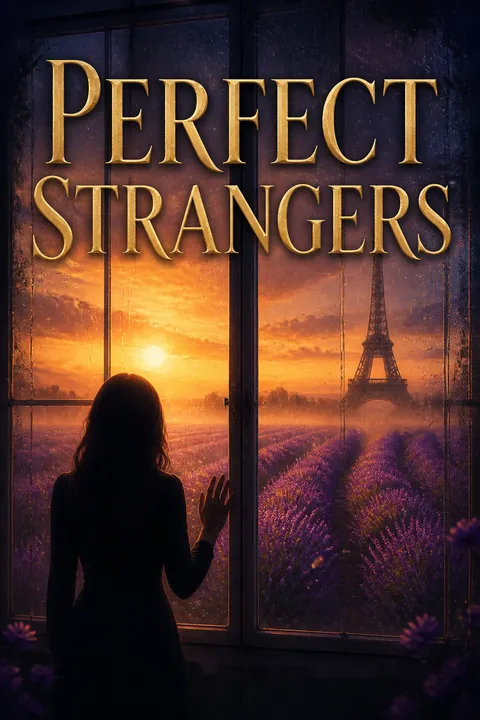


Plot Summary
A Stranger in Paris
Olivia Rossi, a divorced American novelist unable to write after a devastating loss, borrows her agent Estelle’s Paris apartment for the summer. The couple across the courtyard, Gigi and Gaspard, make such a spectacle of their sex life that Olivia drinks bourbon to drown them out, then unexpectedly finds her own desire stirring.
At a café, she notices James Blackwood, a striking blue-eyed man whose attention unsettles her. She mistakes his request to draw her for a clumsy come-on, but James sees past her sarcasm and recognizes the grief in her face.
Olivia flees before she can understand why his gaze feels so intimate. Yet his attention follows her out of the café, and the encounter breaks through the numbness she brought with her to Paris.
Olivia’s humor is not simply a charming defense. It gives her a way to control the terms of attention, especially when she feels exposed. James disrupts that strategy because his gaze registers pain she has not chosen to disclose. The neighbors’ exuberant sexuality also acts as a bodily counterpoint to Olivia’s emotional paralysis: their pleasure irritates her, then awakens a capacity she believed grief had erased. The novel begins by making desire less a cure than evidence that feeling remains possible.
Portraits of Grief
Edmond Chevalier, the building manager, persuades Olivia to attend a reception honoring the building’s artist-in-residence. There she discovers that the artist is James, now surrounded by admirers but looking more trapped than pleased.
Edmond introduces her to Gigi and Gaspard, whose unembarrassed intimacy makes Olivia’s earlier window-side voyeurism newly awkward. James does not press her to pose. Instead, Edmond shows her James’s ink portraits of grieving women, each face rendered with unnerving attention to its suffering.
Olivia understands that loss has touched James, too, though neither of them names the source. The recognition changes her decision: she agrees to sit for him, not because she wants her likeness preserved, but because his art makes her feel that her pain has been seen without being explained away.
The portraits establish a shared language before either character risks biography. James studies grief as visible expression, while Olivia recognizes herself in the faces without needing to narrate her history. That distinction matters: being witnessed is not the same as being interrogated. Edmond’s social warmth pushes Olivia toward the gathering, but the decisive invitation comes from the artwork itself. Her agreement to sit is therefore an early, limited act of trust, one that lets her approach intimacy through looking before she can manage disclosure.
Terms for Desire
The morning after the reception, white tulips and a phone number arrive at Olivia’s door. James has sent them without a signature, confident she will know who they are from. Their call becomes a negotiation: Olivia wants a brief affair without shared histories or future promises, and James accepts the limits while making clear that the attraction is mutual.
Over dinner by the Seine, Olivia’s anxiety rises until she escapes to the restroom. James follows and steadies her with a patient embrace rather than demanding an explanation.
Back at the table, they talk easily, then kiss with a hunger neither can disguise. When James insists they clarify boundaries before going further, Olivia says she will leave in September and asks him not to pry into her past. He agrees, and she chooses to continue.
The rules are an attempt to make desire manageable by placing it inside a calendar and excluding the past. Yet the date immediately exposes the limits of that arrangement: Olivia’s panic is not solved by flirtation, but by James’s ability to offer physical reassurance without treating her distress as an obstacle. His insistence on boundaries complicates the simple fantasy of a dominant lover. He seeks consent and clarity even while their attraction threatens to outrun their plans. The September deadline gives Olivia a form of control, but it also creates the countdown that will later shape her choices.
Trust Before Sex
At Estelle’s apartment, James and Olivia begin exploring the sexual chemistry they have been trying to contain. Olivia is wary of spanking and uncertain about speaking openly about pleasure. James checks her objections, explains what he wants to try, and gives her room to change her mind.
She discovers that controlled roughness can excite her when it is paired with attention and trust. Their encounter stops short of intercourse, but leaves Olivia shaken by how fully she has responded. James’s tenderness afterward makes the experience feel more consequential than their no-strings agreement allows.
The next morning, he leaves Hemingway beside her bed with a note marking the passage they had argued over. Olivia reads it, finds herself newly receptive, and suddenly writes for hours, ending a creative silence that has lasted more than two years.
The scene links sexual surrender to agency rather than its opposite. Olivia’s old assumptions about roughness give way only after James listens to her concerns and adjusts his approach; the pleasure depends on the ability to refuse. That new trust also makes emotional intimacy harder to disavow. Hemingway’s marked passage becomes an unexpected artistic prompt, joining erotic awakening to the return of Olivia’s writing. The book resists treating either sex or creativity as magical cures. Instead, each gives her access to attention and sensation that grief had narrowed.
The Russian Shelves
James takes Olivia through Paris’s literary landmarks, including Shakespeare and Company, where he brings her into the Russian section and turns their visit into a charged, nearly public encounter. His attentiveness and their shared love of books deepen her attachment, even as she reminds herself that she has not agreed to a future.
Their dates also restore her appetite for writing: she becomes absorbed in a new manuscript and sends pages to Estelle. At dinner atop the Eiffel Tower, a message interrupts James’s focus.
He abruptly ends the evening and takes Olivia home, refusing to explain the emergency. His sudden shift from warmth to controlled distance revives her suspicion that he is hiding something. Still, she cannot make herself walk away, and his unexplained absences become part of the attraction’s growing danger.
Books let Olivia and James approach subjects that direct confession would make too dangerous. Their shared reading gives her a way to be intimate while maintaining the fiction that they are not getting personal. The interrupted dinner breaks that comfortable arrangement. James’s secrecy is no longer an abstract quirk; it has consequences for Olivia’s sense of safety. Meanwhile, the manuscript’s return makes desire productive without making it harmless. Olivia’s renewed creative energy is real, but it is bound to a relationship whose emotional intensity she has tried to label temporary.
A Diagnosis in Secret
While James is away in Germany, Olivia’s friend Kelly asks her husband, FBI agent Mike Hanes, to investigate him. Mike finds no criminal record but uncovers a diagnosis of ALS and clinical-trial involvement. Olivia is horrified and considers ending the affair before she becomes more attached.
The same day, her ex-husband Christopher calls from abroad, speaking with uncharacteristic regret about their marriage and their dead daughter. Estelle’s blunt criticism of Christopher’s past absences deepens Olivia’s anger and grief, and she drinks too much rather than face either.
James finds her the next morning and stays while she admits that an old wound has reopened. Instead of leaving, Olivia decides that meeting him is still worth the risk, even if their time together must end in September.
Olivia’s investigation violates the privacy rules she created, but it also expresses a survival habit: she tries to make uncertainty manageable by gathering facts without asking for intimacy. The false diagnosis gives the summer a new, devastating deadline. Christopher’s call then brings back the older loss that made Olivia flee into emotional isolation in the first place. Choosing James after learning he may be dying marks a shift from avoiding pain to accepting that love can be valuable without being permanent. The choice is brave, but it is made on incomplete information, a crucial tension the novel preserves.
The Ex-Husband Returns
Christopher arrives at Olivia’s apartment and finds James there. Their hostility is immediate, though both deny having met before. At lunch the next day, Christopher tells Olivia that he has kept her under surveillance in New York because enemies might use her against him.
He urges her to return home, then admits that their daughter Emmie was killed by a bullet intended for him at a political rally. Olivia is furious that he concealed the danger and that his career may have put their child at risk.
Christopher also insists that his warnings are meant to protect her, even as he threatens to have her brought back by force. The encounter leaves Olivia frightened and distrustful. James’s warnings now seem less like jealousy than evidence that a larger danger surrounds them.
Christopher’s claim that he acted to protect Olivia arrives too late to repair the marriage, and its paternal certainty repeats the very power imbalance she resists. His disclosure about Emmie changes the meaning of her grief: in the story Olivia believes she has been given a causal explanation, but that explanation also intensifies her suspicion of him. The two men embody competing forms of control, one political and covert, the other intimate and physically commanding. Olivia’s insistence on making her own decisions becomes more than a personality trait; it is a response to men who keep withholding the facts that govern her life.
The Armory Upstairs
James gives Olivia a secure phone and a set of diamond ornaments whose sexual purpose she only gradually understands. When Christopher’s threat reaches James, he orders Olivia to leave Estelle’s apartment and wait in his.
She enters using a keypad code based on her name, then discovers that one living-room wall is covered with firearms and ammunition, while the windows are reinforced with steel. The room contradicts the harmless artist identity she has accepted.
Olivia panics, abandons the apartment, and takes a taxi to a hotel under an assumed name. She cannot reconcile the weapons with James’s tenderness, or his knowledge of her danger with the boundaries she had insisted on. For the first time, she chooses flight over the desire to believe him.
The armory transforms James’s secrecy from romantic mystery into material evidence. Olivia’s fear is not irrational: the apartment is built for surveillance, security, and violence, not ordinary domestic life. Her flight is a decisive recovery of agency after several men have instructed her where to go and what to believe. At the same time, the secure phone and the keypad show that James anticipated danger long before Olivia understood it. Protection and captivity begin to resemble each other, leaving trust dependent on an explanation he has not yet given.
The Hotel Gunfight
James tracks Olivia to the hotel, but she greets him with thrown lamps, a phone, and anything else she can reach. Before he can calm her, a shot shatters the balcony door. James tackles her to the floor and returns fire at attackers entering through the room’s main door.
He kills four men, then pulls Olivia through the wreckage with her suitcase and purse. They escape by car to a rural airstrip, where James pilots a small plane to the French countryside.
Olivia remains in shock, unable to decide whether the man who saved her is more frightening than the men who attacked them. As they cross into Provence, James calls the lavender country his home. The beauty outside the car does not soften the fact that their affair has become a matter of survival.
The gunfight collapses the distinction Olivia has tried to maintain between James’s private life and her own. Violence is no longer rumor or metaphor; it has entered the hotel room and determined where she will go. James’s competence protects her, but it also confirms that the arsenal was not decorative. The escape turns romance into forced proximity, yet the scene avoids making rescue equivalent to consent: Olivia is still frightened and confused. Provence appears as refuge, but its pastoral beauty now sits beside the evidence of lethal danger.
The Artist Is an Assassin
In Provence, James admits that portraiture is only part of his life: he works as a hired assassin, choosing targets he considers dangerous and donating art proceeds to victims of violence. He explains that his portraits of bereaved families come from funerals connected to his jobs.
Christopher, he says, is an international arms dealer whose weapons deals helped provoke the attack that killed Emmie. The shooter was a rival assassin who missed his intended target, Christopher.
Olivia also learns that James’s biography and ALS diagnosis are fabricated covers; he periodically takes on a dead identity to evade detection. Furious at his lies but desperate for the truth, she asks him to find the man who killed her daughter. James agrees to leave for Germany, where the shooter is hiding.
James’s art is revealed as both moral accounting and self-exoneration. He studies the grief his work causes, but drawing the bereaved cannot restore the dead or cancel his choices. His personal code complicates the familiar fantasy of the honorable killer without making violence ethically clean. The false ALS diagnosis also exposes how Olivia’s love has been shaped by a deadline that James invented for safety. Her anger is therefore not a distraction from desire; it is an essential demand that intimacy must include truth.
A Head in the Satchel
After spending a day in the lavender fields, Olivia accepts that she wants Emmie’s killer to suffer, not merely face an abstract justice. James returns before dawn with bruises and a leather bag containing the result of his mission.
Olivia cannot look inside and asks him to bury it far from the house. They remain together in Provence, telling Kelly and Estelle that Olivia has gone elsewhere. In September, Olivia discovers she is pregnant. James says he has already quit his work because he wants a life with her and their child.
As they discuss the future, Olivia opens a calendar marked for September twenty-third, the day she was meant to leave Paris. The garden vanishes, and her imagined life breaks apart into the white light of a hospital room.
Revenge gives Olivia a temporary direction for grief, but the scene refuses to present it as healing: she cannot even witness the act’s physical evidence. The pregnancy and James’s decision to quit create the domestic future her story has been moving toward, while the marked date exposes how carefully that future has been built around the original summer deadline. The calendar does not merely reveal a plot trick. It turns an apparently romantic promise into a psychological structure Olivia has constructed to survive unbearable facts.
The Life Beneath the Fantasy
Olivia awakens at Rockland Psychiatric Center, where she has spent three months catatonic. The Paris affair, the assassin, and the lavender refuge belonged to a psychotic episode. In her actual life, she has ALS and is largely paralyzed; Christopher is a mechanic, not an ambassador, and their marriage has been failing.
The memory she has avoided returns: while backing Christopher’s large vehicle from their driveway, Olivia ran over their young daughter, Emmie, who had wandered outside while her father was distracted.
The accident and ALS symptoms overwhelmed her ability to bear reality. After several more weeks, she is discharged to Christopher’s care. Kelly visits, and Olivia begins dictating a memoir of the world she experienced, naming it Until September.
The reveal replaces the story’s external conspiracy with an unbearable collision of guilt, disability, and grief. Olivia’s hallucination did not erase her responsibility so much as rearrange it: the assassin’s bullet shifted causality away from her, while James gave her a protector capable of imposing order on a world that felt senseless. That psychological function does not make the imagined love emotionally false. The memoir becomes an act of integration, allowing Olivia to record the refuge without mistaking it for the life she has to inhabit.
Lavender Opens the Door
A year later, Olivia is in the late stages of ALS, unable to move or speak, and waiting for death. Her memoir has become a bestseller, but success cannot give her back the life she imagined. Maria brings a lavender plant into the room, and its fragrance recalls James’s promise to meet her in the fields. Olivia experiences herself rising from bed and crossing the rain-soaked garden toward him.
The scene presents a reunion as vivid as the Paris summer, while the hospital remains around her, with Maria nearby and her body still failing. Whether understood as a final hallucination or a passage into death, Olivia meets the love that sustained her inner life. The image closes the hospital story on connection rather than cure.
The lavender scent gives memory a physical route into consciousness, turning the novel’s recurring landscape into a final threshold. Olivia’s return to James does not reverse ALS, restore Emmie, or repair her actual marriage. Its force lies elsewhere: the experience preserves the emotional reality of the refuge she created. The novel leaves the status of this last vision deliberately tender rather than clinical. A reader can understand it as psychosis, dying, or both, without needing to deny that love shaped the life Olivia felt inside it.
Epilogue
The epilogue reveals that Olivia is a novelist discussing her manuscript with Estelle, who has been moved by its twist and ending. The story of the hospital and the assassin belongs to Olivia’s book, not to her actual biography.
At home, the real James is her husband, an artist with whom she has built a life, and their daughter Emmie is alive. Olivia tells James that she has made him an assassin for her novel, and the couple joke about the extravagant hero she has created. When Emmie returns from school, her parents are still together behind their bedroom door.
The final frame does more than cancel the tragedy. It shows how Olivia converts familiar materials into fiction: her agent, husband, child, and artistic life become components in a story that imagines grief at its most extreme. The reveal invites readers to revise what they believed without dismissing the emotional experience of the preceding narrative. James’s fictional danger magnifies the real intimacy between author and spouse, while Emmie’s survival restores the ordinary family scene that the novel’s imagined plot had taken away. The book ends by making storytelling itself the bridge between fear and gratitude.
Analysis
Perfect Strangers makes narrative reliability inseparable from grief. Olivia’s imagined Paris romance first appears to offer a coherent explanation for pain: Emmie’s death becomes the result of political violence, James becomes a protector with a code, and a future pregnancy promises renewal. The reveal of Olivia’s actual circumstances exposes that structure as psychological self-defense. Her fantasy reallocates blame because reality has made guilt, illness, and loss almost impossible to endure. Yet the book does not reduce imagination to delusion. The love she experiences remains emotionally consequential, and her later memoir turns that private refuge into a work another person can read.
The romance also tests the difference between consent and surrender. Olivia enters the relationship with rules designed to prevent emotional dependence, while James’s sexual confidence could easily overwhelm those limits. His repeated attention to her boundaries makes their intimacy depend on negotiated trust, not merely on power. That trust is imperfect because James withholds crucial facts, and the plot treats secrecy as both a source of danger and an attempted form of protection. Olivia’s eventual demand for truth marks a stronger intimacy than either attraction or sexual intensity alone.
Art binds these questions together. James’s portraits record the grief left behind by violence; Olivia’s novel converts unbearable experience into a structure with beginnings, revelations, and endings. The final frame complicates the apparent tragedy by showing that fiction can borrow from life without being identical to it. The book’s deepest claim is not that love defeats death or that imagination repairs trauma. It is that people use stories to approach experiences they cannot yet face directly, and that those stories can preserve emotional truth even when their events are invented. The lavender scent, the manuscript, and the restored family life make remembrance a form of connection, not proof that suffering has disappeared.
Review Summary
Perfect Strangers received mixed reviews, with many praising its unexpected plot twists and steamy romance. Some readers felt cheated by the multiple surprises, while others appreciated the author's creativity. The story follows Olivia, a writer in Paris, and James, an artist, as they begin a passionate affair. Many reviewers were shocked by the ending, which drastically changed their perception of the entire book. Despite the divisive reactions, most agreed that the writing was strong and the story was unpredictable, making it a memorable read for both fans and critics.
People Also Read








Characters
Olivia Rossi
The grieving storytellerOlivia is a novelist whose wit, intelligence, and appetite for exaggeration help her manage pain without having to name it. She arrives in Paris feeling emotionally sealed off, yet her attraction to James awakens both sexual curiosity and creative energy. She values independence and sets strict limits on intimacy, partly because she fears attachment will make future loss unbearable. Her sharp self-mockery can be funny, but it also reveals how harshly she judges her body and her own needs. Across the story, she struggles to distinguish protection from avoidance and to decide what truths she can bear. Her imagination is both a refuge and a powerful force for reshaping experience.
James Blackwood
The watchful artistJames is an American artist in Paris, known for lifelike portraits that capture grief with unusual precision. Tall, beautiful, and self-possessed, he attracts attention but often appears isolated from the people around him. He studies Olivia closely and responds to her unease with an uncommon blend of patience, confidence, and directness. Their attraction draws out a dominant sexual side, but his emphasis on communication and trust complicates any simple image of him as controlling. James is attentive to small shifts in Olivia’s expression and is comfortable with books, art, and silence. His secrecy creates friction with Olivia’s need for honesty, while his art suggests a man trying to understand the cost of suffering.
Christopher Ridgewell
Olivia’s distant ex-husbandChristopher is Olivia’s former husband, a high-profile political figure whose work repeatedly takes him away from home. He presents himself as disciplined and protective, but his emotional reserve leaves Olivia feeling alone during the hardest periods of their marriage. His attachment to career and control shapes how he responds to danger and grief. Christopher’s formal manner can conceal strong feeling, making it difficult for Olivia to know what he believes or what he is willing to share. Their relationship is defined by love, disappointment, and unresolved mourning, rather than by a simple absence of care.
Estelle
Olivia’s formidable agentEstelle is Olivia’s longtime literary agent, a petite, sharp-tongued woman with an imposing beehive and a generous streak beneath her abrasiveness. She lends Olivia her Paris apartment and urges her to rest, while also expecting honesty about the state of her writing. Estelle is perceptive enough to recognize when Olivia has retreated into self-blame, but she does not soften every difficult truth. Her loyalty is practical as well as affectionate: she supports Olivia’s work and challenges the stories Olivia tells herself.
Kelly
The fiercely loyal friendKelly is Olivia’s longtime friend, a busy mother and care worker who keeps their friendship alive through frequent calls. She uses irreverent humor to make painful subjects easier to approach, but her concern for Olivia is serious and steady. Kelly listens to the details of the affair, warns Olivia that sex may complicate her feelings, and helps her seek information when James’s secrets frighten her. She wants Olivia protected without pretending that a clean escape from attachment is always possible.
Edmond Chevalier
The welcoming building managerEdmond manages Estelle’s Paris building and takes it upon himself to welcome Olivia into the neighborhood. He is elderly, theatrical, and eager to share stories, often steering Olivia toward people and gatherings she would otherwise avoid. His easy warmth and colorful past provide comic relief, while his insistence that she attend the residents’ reception helps bring her into James’s social world.
Emmie
Olivia’s beloved daughterEmmie is Olivia and Christopher’s young daughter, whose place in Olivia’s memories shapes the story’s deepest grief. She is remembered through small, vivid details that make her more than an emblem of loss. Olivia’s longing for her informs the choices she makes about love, safety, and the future. Emmie remains central even when she is absent from the present action.
Gigi
The uninhibited neighborGigi is a young neighbor whose uninhibited relationship with Gaspard is audible and visible across the courtyard. Her sexual confidence initially irritates Olivia, then becomes an unexpected spark for Olivia’s rediscovered desire. Gigi’s openness contrasts with Olivia’s self-consciousness about age, grief, and her body.
Gaspard
Gigi’s devoted partnerGaspard is Gigi’s partner and the other half of the couple whose exuberant lovemaking fills Olivia’s apartment. He is friendly at the reception, though Olivia’s embarrassment makes their introduction awkward. His unselfconscious presence helps establish the sensual, communal atmosphere of the Paris building.
Mike Hanes
Kelly’s FBI husbandMike is Kelly’s husband and an FBI agent. At Kelly’s request, he investigates James, giving Olivia information that intensifies rather than resolves her fears. His professional access makes the couple’s attempt to protect Olivia consequential.
Maria
The steadfast caregiverMaria is a forceful, capable caregiver who helps Olivia manage the practical demands of severe illness. She takes pride in her work, speaks of herself in the third person, and is unafraid to challenge Christopher when she thinks he is neglecting Olivia. Her brisk competence and affection bring humor and human warmth into an institutional routine.
Ernest
The kind orderlyErnest is an orderly at Rockland who assists Olivia with daily care and transports her through the hospital. His practical kindness, gentle teasing, and willingness to treat her as an adult preserve small moments of dignity. He brings warmth to an environment where routines can make patients feel reduced to their illnesses.
Andrea Perkins
Olivia’s literary representativeAndrea is the agent who represents Olivia’s memoir after Kelly helps connect them. She brings professional enthusiasm to Olivia’s work and shares important news about its reception, offering recognition at a time when Olivia has little control over her physical life.
Plot Devices
The Grief Portraits
Make pain visibleJames’s portraits of bereaved women introduce his artistic attention to suffering before the story explains its source. Olivia recognizes an affinity with the faces and understands why James might be drawn to her. Later, the portraits acquire a darker context within the apparent thriller, connecting art to the consequences of violence. They also establish a recurring question: whether representing grief can honor the bereaved, ease the artist’s guilt, or merely turn another person’s pain into an image.
The September Deadline
Give desire a clockOlivia plans to leave Paris on the first day of fall, and she and James use that date to justify a relationship without promises. The deadline lets Olivia imagine that she can experience intimacy without risking a lasting attachment. It also gives the romance a clear temporal shape, making each new step feel both precious and dangerous. When the date resurfaces on a calendar, it becomes evidence that the apparent summer life has been organized around a deeper psychological threshold.
The Secure Phone
Turn secrecy into dangerJames gives Olivia a voice-activated, encrypted phone that also allows him to locate her. At first it seems like an extravagant gift and a sign of his technical reach. Its capabilities become more unsettling when the phone reveals how much information has been collected about Olivia and guides her toward James’s hidden apartment. The device binds protection to surveillance, making it difficult for Olivia to know whether James’s precautions safeguard her or remove her control.
The Lavender Fields
Connect memory to placeThe lavender landscape of Provence first offers Olivia a sensuous refuge after violence and revelations. Its color and fragrance become linked to James, safety, and the future she imagines building with him. Much later, lavender returns through a plant brought into Olivia’s hospital room. The scent carries her back to the imagined fields, making smell the bridge between present suffering and memory. The motif allows the ending to remain emotionally powerful without pretending that her illness or losses have been undone.
The Embedded Manuscript
Reframe the whole romanceThe epilogue reveals that the story’s apparent romance, thriller, and psychiatric tragedy belong to a manuscript written by Olivia. The frame encourages readers to reinterpret earlier events as fiction shaped by recognizable people and real emotional materials, rather than as a straightforward account of the author’s life. It does not make the story’s feelings meaningless; instead, it makes authorship part of the plot. Olivia uses invention to explore grief at its most extreme while the final frame restores the living family from which her characters were drawn.
About the Author




Download PDF
Download EPUB
.epub digital book format is ideal for reading ebooks on phones, tablets, and e-readers.








