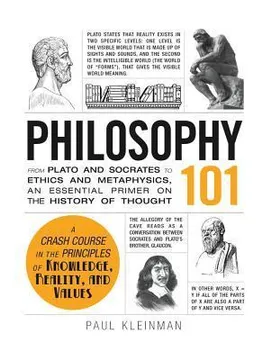


Key Takeaways
Treat philosophy as a method for testing assumptions, not memorizing answers
Start with a question. Philosophy begins when people ask what the world is made of, what counts as a good life, or how anyone can know what is true. The pre-Socratic Greeks sought natural explanations instead of relying only on myth. Socrates shifted attention toward human conduct and used questioning to uncover contradictions in confident answers. This approach, described as the Socratic method, makes inquiry a shared investigation rather than a lecture with a ready-made conclusion.
Let answers be challenged. Plato carried that practice into written dialogues, often leaving questions open for readers to examine. In the Allegory of the Cave, prisoners mistake shadows for reality until one is forced to see what produced them. The image captures both the promise and discomfort of questioning familiar beliefs.
What's striking is that this primer presents philosophy as an activity before it presents it as a collection of doctrines. That connects naturally to scientific peer review and legal cross-examination, where claims gain strength by surviving informed challenge. Yet questioning is not automatically fair: a skilled interrogator can steer a discussion toward a preferred conclusion. The useful discipline is reciprocal scrutiny. Each participant should be willing to state what would count as evidence against their own view, not merely expose weaknesses in someone else's.
Ask whether reality is what senses show or what reason can defend
Start with rival pictures. Early Greek thinkers offered sharply different accounts of reality. Heraclitus emphasized constant change, while Parmenides argued that reason, not shifting sensory appearances, reveals what truly exists. Plato developed the divide between visible things and eternal Forms, abstract realities such as justice or beauty. In his cave story, shadows stand for appearances that people mistake for the whole truth.
Look for explanations in things. Aristotle rejected a separate world of Forms and argued that form and intelligibility belong within the things we encounter. His four causes ask what something is made of, what shape it takes, what brings it about, and what purpose it serves. These competing views establish a recurring philosophical question: does understanding come mainly from observation, or from principles reason can uncover?
The contrast between appearance and underlying structure remains useful in fields such as physics, where visible behavior is explained through models that cannot be seen directly. But Plato's distrust of sensory knowledge can be overstated: observation is often the only way to correct elegant reasoning that has drifted free of the world. Aristotle's attention to both particular things and explanatory structure offers a productive counterweight. The point is not to choose senses or reason once and for all, but to ask what each can establish and where each can mislead.
Require more than a true belief and plausible evidence before claiming knowledge
Truth can arrive by luck. A traditional account says knowledge requires belief, truth, and justification. A person must believe a claim, the claim must be true, and there must be evidence supporting it. Edmund Gettier challenged this account with cases where someone has a justified true belief, yet seems not to know the truth because luck connects the evidence to the outcome.
The hidden cow. In the book's example, a farmer sees a black-and-white shape in a field and concludes that his cow is there. The cow really is in the field, but hidden among trees. The shape the farmer sees is a piece of paper, not the cow. His conclusion is true and appears supported, but the evidence does not establish it in the right way. Philosophers have proposed extra conditions, but no single repair settles the problem.
Gettier cases matter because they separate being correct from being reliably informed. The same distinction appears in everyday decisions: a person may guess a diagnosis correctly for the wrong reason, then mistake good fortune for expertise. The challenge is not to demand impossible certainty. It is to examine whether the evidence actually tracks the fact being claimed. A useful question is whether the belief would still be justified if the lucky coincidence were removed.
Treat your concepts as tools, not transparent windows onto reality
Experience needs a frame. Locke argued that knowledge develops through experience rather than arriving as a complete set of innate ideas. Hume likewise emphasized sensory impressions, while Kant argued that the mind organizes experience through categories. For Kant, we know phenomena, the world as it appears through our mental framework, but cannot directly know noumena, things as they are independently of that framework.
Meaning reaches beyond the mind. Hilary Putnam's Twin Earth thought experiment imagines a planet where a water-like substance has a different chemical makeup. Its inhabitants use the word “water,” but it refers to that other substance. The example suggests that a word's meaning depends partly on the world and community around its speaker. Wittgenstein adds that words gain meaning through their use in shared practices, not through a private definition alone.
These arguments challenge the appealing idea that thought simply labels a world already divided into obvious categories. They also connect to cognitive science, where perception is understood as an active process shaped by prior expectations. That does not mean reality is merely invented by the mind. Putnam's example makes the opposite point too: the environment helps determine what a speaker means. The productive stance is neither naïve realism nor total relativism, but attention to how minds, language, and the world constrain one another.
Name the moral standard before deciding what a difficult choice demands
Different tests give different verdicts. Aristotle's virtue ethics asks what kind of character and habits make a good life, recommending a fitting balance between extremes. Kant's duty-based ethics evaluates the principle and motive behind an action. Consequentialism judges actions by their results, and utilitarianism seeks the greatest overall happiness or welfare.
The trolley makes the conflict vivid. In one version, a person can divert a runaway trolley from five workers onto a track where one person will die. In another, saving the five requires pushing a person from a bridge. The outcomes are similar, but many judge the actions differently. The doctrine of double effect distinguishes intended good from foreseeable harm: a harmful side effect may be permissible under certain conditions, even when deliberately using a person as a means is not.
The trolley cases show why moral judgment cannot always be reduced to a quick calculation. Consequences matter, but so do intention, rights, and the character of the person acting. In public policy, these standards can pull in different directions: maximizing aggregate benefit may burden a minority, while strict rules may produce preventable harm. The thought experiment is valuable precisely because it strips away context. Its limitation is the same: real decisions usually involve uncertainty, relationships, and alternatives absent from the track.
Build institutions that make cooperation safer than short-term self-interest
Self-interest can defeat itself. In the Prisoner's Dilemma, two suspects are questioned separately. Each can confess or stay silent. Confessing may protect one person if the other stays quiet, but if both confess, both receive worse outcomes than if both had cooperated. The setup shows how individually cautious choices can harm everyone.
Rules shape collective life. The same pattern appears in the tragedy of the commons: farmers benefit by grazing more cattle on shared land, but excessive use ruins the resource for all. Hobbes argued that fear and insecurity make a common authority necessary; Locke grounded government in protecting rights and consent; Rousseau argued that legitimate laws should express the common good, or general will. Their disagreements make a shared point: political arrangements influence whether people can live together peacefully.
This section anticipates a central problem in institutional economics: cooperation is fragile when benefits are private and costs are shared. Clear rules, credible enforcement, and public participation can change the incentives that produce destructive outcomes. Still, centralized authority is not the only answer. Hobbes's emphasis on order addresses genuine insecurity, while Rousseau's emphasis on collective consent raises the question of who gets to define the common good. Institutions need both coordination and safeguards against domination.
Own your choices without pretending you control every cause
Causation complicates freedom. Hard determinism holds that every event has a cause, so no one could have acted differently than they did. Compatibilists answer that freedom can still mean acting according to one's own motives without external coercion, even if those motives have causes. The dispute affects how people understand responsibility, praise, blame, and punishment.
Existentialists begin from lived choice. Kierkegaard, Nietzsche, and Sartre placed human existence and decision at the center of philosophy. Sartre argued that people are not born with a complete, fixed nature: they shape themselves through choices and must face responsibility for action and inaction. That freedom can feel like anxiety because no external script can make every decision for a person. Authenticity means recognizing both one's circumstances and one's capacity to respond.
The distinction between causation and coercion is especially useful in debates about responsibility. A choice can have causes without being forced by another person, and those are morally and legally different situations. Modern psychology also makes it harder to treat people as entirely self-created, since upbringing and circumstance constrain their options. Existentialism is strongest as a demand for honest engagement with available choices, not as a claim that everyone has equal freedom or control over their conditions.
Use paradoxes to locate the edges of identity and ordinary language
Identity changes by degrees. In the Ship of Theseus puzzle, every plank of a ship is replaced over time. Is it still the same ship? If the discarded planks are assembled into another ship, which one has the stronger claim? The puzzle tests whether identity depends on parts, continuity, structure, or history, and it connects the problem to how people understand personal identity as their bodies and memories change.
Words can resist sharp boundaries. The sorites paradox asks how many grains make a heap, or how many hairs make someone no longer bald. Each small change seems insufficient to alter the description, yet the accumulated changes eventually do. The liar paradox creates a different trap: a sentence that says it is false seems to be true if false, and false if true. Such puzzles expose assumptions hidden in ordinary categories and claims about truth.
Paradoxes are not just clever diversions. They function like stress tests for concepts, revealing where apparently simple words rely on unstated criteria. That insight is practical: legal definitions, medical thresholds, and identity records all require boundaries that nature may not supply neatly. Still, not every paradox proves that a concept is useless. Sometimes the better response is to specify the context and purpose of a category rather than demand one perfect definition for every case.
Demand testable evidence, while remembering observation carries assumptions
Inspect how claims are built. Francis Bacon urged systematic observation and experimentation instead of deference to inherited authority. His “idols” name common sources of error: tendencies shared by human nature, personal bias, misleading language, and philosophical systems mistaken for reality. Inductive reasoning gathers observations to develop general explanations, but repeated success cannot guarantee that every future case will match.
Make claims vulnerable to evidence. Karl Popper proposed falsifiability as a way to distinguish science from claims that cannot be tested against possible observations. Thomas Kuhn emphasized that observations are interpreted within scientific frameworks, and that new paradigms can change how problems are understood. Together, these ideas support rigorous testing while cautioning against the fantasy of completely assumption-free observation.
Bacon's warnings resemble modern efforts to reduce bias through preregistration, replication, and independent review, although the book does not discuss those particular practices. Popper's demand that a claim risk being disproved is a powerful filter, but it is not a complete definition of good science: difficult theories may depend on networks of assumptions and evidence. Kuhn's point helps explain why observation is not a neutral camera. The practical lesson is to expose claims to criticism and make their evidential limits visible.
Compare philosophical traditions without collapsing their different questions into one
There is no single Eastern philosophy. The book surveys Indian, Chinese, Korean, and Japanese traditions, including Hindu schools, Buddhism, Jainism, Confucianism, and Taoism. Buddhist thought centers on suffering and the path toward its end. Confucianism stresses ethical relationships and social duties, while Taoist thought emphasizes alignment with the natural way and values such as spontaneity and nonaction. Jain philosophy highlights nonviolence and the limits of any one perspective.
The map is wider still. The book also introduces Avicenna, whose Islamic philosophy examines essence, existence, and reason, and Spinoza, who identifies God with nature and treats human beings as part of the natural order. These accounts show that philosophical inquiry has developed across cultures and religious contexts, not only in the Greek and European line often treated as the whole story.
What's valuable here is the reminder that philosophy is not synonymous with one regional canon. The traditions named in this survey ask different questions and cultivate different intellectual practices, from logical analysis to ethical discipline and contemplative inquiry. The book's broad East and West contrast, however, risks flattening immense internal diversity. Comparative philosophy works best when it treats similarities as invitations to investigate, not proof that distinct traditions share one worldview. Respectful comparison preserves both connection and difference.
Analysis
This primer's chief achievement is making philosophy legible as a set of recurring disputes rather than a parade of famous names. Across its chapters, the same fault lines reappear: reason against experience, appearances against underlying reality, individual freedom against causal necessity, and private advantage against shared welfare. The recurring thought experiments give those abstractions handles. A cow mistaken for a real cow tests theories of knowledge; a ship repaired plank by plank tests identity; a runaway trolley tests the moral weight of intention and outcome.
That breadth is also the book's principal limitation. A short account of a philosopher's position can make a live controversy look settled, and the compressed explanations sometimes treat complex traditions as tidier than they are. For example, the contrast between Western truth-seeking and Eastern balance is a useful orientation, but not a reliable boundary between civilizations. Likewise, the hard determinist case is presented forcefully, while compatibilism shows that freedom can be defined in more than one way. Readers should treat the summaries as maps of arguments, not final verdicts.
The strongest way to use the book is as a toolkit for disciplined disagreement. When a claim appears obvious, ask what it assumes about evidence, language, identity, or value. When two people reach opposite moral judgments, identify whether they are weighing consequences, duties, or character. When a theory explains everything, ask what observation could count against it. Philosophy does not promise that every question has a clean answer. Its practical gift is sharper judgment: the ability to distinguish a persuasive story from a supported claim, and to see where a disagreement actually begins.
Review Summary
Reviews of Philosophy 101 are mixed, averaging 3.64 out of 5. Many readers criticize the book's lack of chronological or thematic organization, making it difficult to follow. Some feel concepts are oversimplified or poorly explained, and note the insufficient coverage of Eastern philosophy and female philosophers. However, others appreciate it as an accessible introduction for beginners seeking a broad overview of Western philosophy. Several readers suggest using it as a springboard for deeper exploration rather than a comprehensive study.
Glossary
archê
primary principle of realityA term used by pre-Socratic philosophers for the fundamental principle or basic material from which the universe originates. Thinkers proposed different candidates, including water, air, fire, mathematical relations, or an indefinite substance. Their disagreements mark an early effort to explain nature through reasoned principles rather than relying only on mythological accounts.
Socratic method
questioning to test beliefsA method of philosophical discussion associated with Socrates and known through accounts by his students and contemporaries. A questioner examines a claim through follow-up questions, tests it against examples, and exposes contradictions or exceptions. The process aims to clarify beliefs and move toward a better-supported answer, rather than simply delivering information.
Theory of Forms
eternal realities behind appearancesPlato's account of reality as having a visible level of changing things and an intelligible level of eternal Forms. Particular beautiful or just things can change, but their qualities are understood through unchanging Forms such as Beauty or Justice. Plato's cave story illustrates how people may mistake appearances for the deeper reality they only partly reflect.
Gettier problem
luck in justified true beliefA challenge to the traditional definition of knowledge as justified true belief. Edmund Gettier described cases in which someone has a belief that is true and supported by evidence, yet the truth results from luck or is disconnected from the evidence in the right way. These cases raise the question of what additional condition knowledge requires.
synthetic a priori
substantive knowledge without experienceKant's term for knowledge that adds information rather than merely unpacking a definition, yet is considered necessary and independent of particular experience. Kant argues that the mind organizes experience through categories, such as causation, so some features of experience are universal for human knowers. The idea helps explain how substantive claims can seem necessary.
semantic externalism
meaning partly depends on surroundingsA view associated with Hilary Putnam that the meaning or reference of a word depends partly on factors outside the speaker's mind. In the Twin Earth thought experiment, two physically similar speakers use the same word for different substances because their environments differ. Meaning therefore cannot always be determined by an individual's internal mental state alone.
Prisoner's Dilemma
individual choices harm mutual outcomesA game theory scenario in which two people choose independently between cooperation and defection. Each has an incentive to protect themselves by defecting, yet if both do so, they receive a worse outcome than if both had cooperated. The structure illustrates conflicts between individual and collective rationality, including problems such as overusing shared resources.
general will
common interest of the peopleRousseau's idea that legitimate political authority should express the collective interest of the people, rather than simply add together private preferences or serve a ruler. In his account, the general will should guide laws and protect the common good. Rousseau's theory also stresses direct participation by citizens in assemblies.
being-for-itself
conscious, self-defining existenceSartre's term for conscious beings, especially humans, who are aware of their existence and are not defined by a complete, fixed essence. A being-for-itself can reflect on its circumstances and make choices that shape its identity. Sartre contrasts it with being-in-itself, the mode of things that have a settled nature but no consciousness.
falsifiability
capacity to be disprovedA criterion associated with Karl Popper for distinguishing scientific hypotheses from claims that cannot be tested. A falsifiable claim rules out some possible observations, so evidence could show it to be wrong. If no conceivable test could count against a claim, Popper argues, it does not have the characteristic he identifies as central to science.
language-games
words used in social practicesWittgenstein's term for the varied ways language functions within human activities and social contexts. The meaning of a word is not always a fixed object or definition hidden behind it; it can depend on how people use it in a particular practice. The term illustrates his later view that ordinary language is flexible and context-dependent.
Four Noble Truths
Buddhist account of sufferingA foundational Buddhist teaching that identifies suffering, its cause, the possibility of its ending, and a path toward that end. The book presents these truths as a framework for understanding Buddhist philosophy and its emphasis on reducing suffering. Schopenhauer drew on this account when developing his own pessimistic view of desire and human life.
Download PDF
Download EPUB
.epub digital book format is ideal for reading ebooks on phones, tablets, and e-readers.








