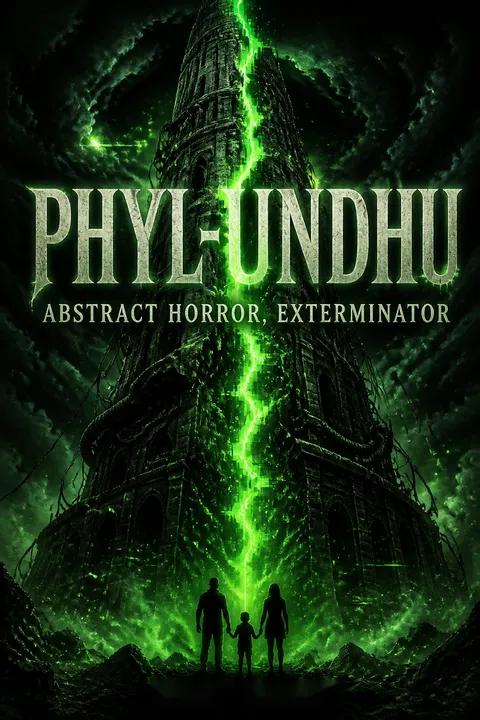


Plot Summary
Prologue
A fragment from an ancient text treats paradise as unknowable while describing the Hells with unnerving precision. Then the story drops into a void, where a lone awareness struggles toward sensation.
Alison Turner wakes from a nightmare of nested sleep and false awakenings, unsure whether she has escaped it or merely reached another layer. Outside, a curtain rustles and a twig taps the window. The ordinary bedroom offers a fragile return to the world, but the dream has left her exposed to something she cannot name.
The opening makes uncertainty physical before it becomes intellectual. Alison cannot trust the apparent boundary between sleep and waking, so the reader enters a world where perception may be a shelter rather than evidence. The ancient fragment sharpens that unease by contrasting the unknowability of paradise with an almost bureaucratic certainty about Hell. The terror is not simply that something terrible exists, but that a mind might learn its structure without gaining any power to escape it. This prepares the story’s central tension: rational explanation can map a threat while still failing to make it manageable.
The Name Beneath the Toy
Unable to sleep, psychologist Alison Turner tells her husband, Jack, that their eleven-year-old daughter, Suzy, faces an exceptional school meeting after frightening classmates. Jack admits the online game has swallowed so much of Suzy's attention that they know little about her life inside it.
Alison's other worry is a client from a gentle, intellectually serious cult. He fears his doctrine, which holds that the universe's end is an intelligence that can be contacted. When Jack asks its name, Alison freezes.
The group uses Phyllis, and Suzy once named an imaginary companion Phil, after a ragged octopus toy. Alison remembers hearing the name in therapy with a force she cannot explain. The school complaint, the game, and her case now seem connected.
The story's first connection is deliberately small: a childhood nickname meets a cult's cosmic vocabulary. Alison's professional instinct is to separate categories, treating her client's beliefs as a therapeutic problem and Suzy's game as a parenting concern. The name defeats that compartmentalization. Jack's attention to both worries makes him a practical witness, but his readiness to joke also shows how quickly ordinary intimacy reaches for insulation. The scene establishes the family's central conflict before anyone enters the game: Alison senses that a pattern is forming, yet cannot decide whether recognizing it is insight or the beginning of contagion.
Therapy Loses Its Exit
Alison's client, called Simon for convenience, belongs to TotAL, a cult that demands little from its members but offers a terrifying account of reality. In their sessions, he describes existence as an overwhelming flood of signs, all issuing from reality itself, and says his cult leader, Phyllis, helped him understand that the universe's end can communicate.
Alison usually relies on humor to loosen a client's grip on doctrine. A careless joke about TotAL's name wounds Simon instead, and the familiar route out of belief closes.
He had come seeking relief from his own conclusions, but Alison's professional method only helps him articulate them more completely. Her memory of this failure gives the name Phil its emotional weight, and leaves open the possibility that her therapy has carried the idea further.
Simon is not trapped by coercion or an abusive institution. His predicament is more difficult for Alison because the source of distress is a belief he regards as intellectually unavoidable. Her therapeutic method depends on making a system look absurd enough to loosen its hold; the failed joke demonstrates that ridicule can strengthen a conviction when the client experiences it as proof of being misunderstood. The flood metaphor also gives the story a model of contagion: meaning arrives faster than the mind can filter it. Alison's expertise cannot protect her from becoming a channel for the material she hoped to neutralize.
The Classroom's Unthinkable Cost
At school, Suzy's teacher, Clifford Bagley, struggles to explain why her classmates are frightened. Suzy has shared unusually sophisticated religious ideas and written a poem about endings; one student has attempted suicide after hearing her.
The child survives, but the school faces furious parents and possible legal action. Alison insists her casework has never entered the home, then realizes Suzy's game may be the source. As Bagley describes the incident, Alison is seized by nausea and remembers George Filkin, a teacher whose manner once seemed to erase her.
Bagley resembles him, though she cannot yet explain why the resemblance matters. The meeting turns parental concern into guilt: Suzy's ideas are not just private play, and Alison has no clear way to reach her.
The school's report converts a private mystery into a moral emergency. Alison's first defense is professional separation: she has protected Suzy from her clients, so the disturbing ideas must have arrived by another route. That defense collapses when the game becomes a plausible source, making parental neglect feel more concrete than supernatural danger. Bagley's resemblance to Filkin adds a second disturbance, one rooted in Alison's own memory rather than her daughter's behavior. The attempted suicide also prevents the adults from dismissing Suzy's speech as precocious performance. Words in this story have consequences before their speakers understand what they are transmitting.
A Dream Crosses Over
After Suzy goes upstairs, Alison and Jack try to access the game through the family terminal. Alison has found Suzy's watch password, but the game demands two further codes, and Jack calculates that guessing them is hopeless. Their intrusion stalls before they learn anything. Suzy then comes downstairs for milk after a dream, giving Alison a chance to ask what she saw.
Suzy describes an abstract puzzle, then a house like theirs, where she seemed to enter a dream belonging to her parents, though not quite to either of them. Alison sends her back to bed without asking more. The report unsettles her because it resembles the boundary-breaking nightmares she has been hiding from Jack, while the locked terminal remains an unopened door.
The failed password attempt gives the parents a practical limit: love and access to the hardware do not equal access to Suzy's experience. The dream complicates that limit by suggesting that the private boundary between child and parent may already be porous. Suzy speaks plainly about crossing into a dream that belongs to neither parent, while Alison retreats into routine and sends her back upstairs. Their roles briefly reverse: the child offers a careful account, and the adult refuses the inquiry. The scene makes the game feel less like a destination than a possible architecture for experiences already bleeding into family life.
The Filter Goes Unanswered
At work, cosmologist Jack discusses the Great Filter with his colleague Alex Scott. Jack sees the silence of the galaxies as evidence that some unknown process destroys advanced civilizations; Alex argues that familiar catastrophe theories fail and rejects terror over a threat nobody can describe.
Their debate gives Jack no answer, only a sharper sense that scientific knowledge may be narrowing the range of comforting explanations. Later, Alison tells him that George Filkin, the teacher she once hated, killed himself.
She had never cared why, but the coincidence between his name and the cult's language now feels harder to dismiss. When they collect Suzy after a film, they stop treating access to her game as optional. Suzy agrees to guide them and supplies her credentials.
Jack and Alison approach danger through different habits. He tries to infer a threat from missing evidence, while Alex insists that an untestable fear is not yet a scientific claim. The disagreement echoes Alison's clinical dilemma: when does uncertainty justify intervention, and when does interpretation become its own hazard? Filkin's suicide does not prove a connection, but it makes coincidence feel ethically charged, especially to Alison, who once dismissed his suffering. The parents' decision to enter the game follows not certainty but a change in the cost of waiting. They cannot explain what is happening, yet the consequences outside the game have become too serious to ignore.
Parents Enter Suzy's World
Suzy's credentials carry Alison and Jack into a world that defeats their expectations of a children's game. Their avatars are recognizable but weathered, dressed for survival; Suzy appears more experienced, her equipment cluttered with scavenged tools and a compact weapon.
They stand above jungle, scattered settlements, and a colossal structure rising into cloud. Jack identifies it as a ruined space elevator, while Suzy names it Ashenzohn and warns that time does not behave normally there.
The landscape feels too extensive and damaged to serve as a simple fantasy setting. Jack wonders whether such worlds could absorb entire civilizations, a version of the Great Filter he had feared in abstract. Suzy leads them toward a library near the structure's base.
The parents' entry changes the game from a screen habit into a place with scale, history, and apparent inhabitants. Jack immediately reaches for a science-fiction analogy, an attempt to make the unfamiliar legible through existing knowledge. Suzy's greater competence exposes the limits of that approach: she understands this terrain through sustained experience, not theory. The ruined elevator links the game's spatial enormity to Jack's concern about civilizations vanishing into simulations, while Suzy's warning about time destabilizes even that analogy. Their family hierarchy shifts without ceremony. The child is now the guide, and the adults must accept instructions from someone they had assumed needed protection.
Ashenzohn's Wounded Streets
On the way to the library, Suzy explains that the nearby Pralh are dangerous inhabitants, though she expects the group can skirt their settlement. Alison objects to the violence the game requires; Suzy warns that her mother's hesitation could get them killed.
Alison falls silent, recognizing that Suzy knows the rules better than she does. From the ridge, Jack sees layers of settlements built over old destruction, with increasingly primitive communities closer to Ashenzohn.
They pass a devastated slum where armed danger stays mostly out of sight, then reach upper districts thick with temples and security checkpoints. Suzy's reputation lets them pass. At the library, its senior official receives her as a trusted visitor, confirming that she has done consequential work in this world.
The journey forces the family to negotiate whose judgment counts. Alison's protest is morally understandable, but in the immediate situation it risks the people she wants to protect. Suzy's harsh warning is not simply a display of adolescent power; it is knowledge acquired in a setting where hesitation has material costs. Jack, meanwhile, reads the landscape as a record of collapse, noticing that the nearer they approach the central structure, the more degraded the surrounding society appears. The checkpoint passage and Suzy's welcome at the library reveal that she is not merely wandering through a game. She has standing, history, and obligations there.
The Manual Survives Millennia
Inside Ashenzohn's library, the librarian presents a fragile, forbidden artifact and a calendric ledger. Jack calculates that the recorded age of the world reaches nearly ten million years.
Suzy recognizes the artifact's faint cover image and lettering: it matches the instruction manual for the game at home, though time has erased much of it. The discovery makes the parents' familiar object part of this world's deep past. Jack tries to treat the match as a production detail, but Suzy rebukes him for acting as if the people around them are unreal.
Alison embraces her daughter, asking for help rather than asserting control. Suzy accepts the closeness and says they are nearly finished, leaving her parents to follow her deeper into the archive.
The surviving manual collapses the distinction between a designed game and an independently meaningful world. Its age is too vast for the parents' usual account of software, yet the artifact does not tell them whether they are witnessing a deliberate construction, an impossible coincidence, or something else. Jack's instinct to downgrade the discovery to a design choice protects him from its implications, and Suzy recognizes the evasion as a refusal to take her experience seriously. Alison's embrace is therefore more than reassurance. She gives up the authority of explanation and asks her daughter to guide her, a fragile repair made under pressure.
History Descends Into War
Among the library's records, Suzy recounts the uncertain history of Ashenzohn. In the oldest account, a catastrophe called the Scission broke the tower's connection to Heaven and began a long decline.
The Geniers, descendants of gods and humans, once held power over the more numerous Pralh; generations of violence reduced both peoples and the world they inhabited. Later, Ja'aab led the Pralh in wars that promised unity through mass slaughter, though Suzy doubts the surviving histories.
She says visitors keep returning partly because they hope to discover who they are, yet may be more attached to the unresolved question than to any answer. Jack hears a society consuming its past, while Alison drifts into a distant, unnerving state. The family continues inward.
Suzy's account is explicitly unstable, assembled from records that have themselves decayed. This matters because the history does not function as a definitive lore dump; it demonstrates how a civilization makes meaning from damaged evidence while living through the damage. The tower's fall repeats at social scale in the Geniers' decline and the Pralh wars, so historical progress becomes a sequence of losses rather than a clean ascent. Suzy's claim that people prefer not knowing their identity reframes the archive: it is not a machine for resolving mystery, but a structure that sustains it. Her parents must decide whether understanding requires an answer or the courage to remain inside the question.
Undhu in the Shaft
Beyond the library, the family enters the Gallery of Time, where historical images give way to a dark passage leading into Ashenzohn's core. Suzy explains that an inscription on a ruined statue once described humanity as bound; the surviving letters suggested Undhu, the remnant left behind.
She says the being associated with that name is broken, repetitive, and difficult to understand. At the Shaft, where power, data, and thought have fused, a presence speaks through the dark.
It describes itself as a discarded remainder shaped by an immense, indifferent force, and compares that force to a motionless source of motion. Jack asks whether it represents the Great Filter, but the presence turns instead to the ancient Scission. The family is offered a vision rather than an answer.
The approach to the Shaft converts the story's wordplay into a material discovery: a damaged inscription and a damaged intelligence share the idea of what remains after a break. Yet naming Undhu does not restore coherence. Suzy's description insists that the presence is fragmentary, while its account of itself is eloquent enough to tempt Jack into treating it as a reliable witness. Its refusal to answer his question about the Great Filter preserves the novel's central discipline: a powerful explanation is not the same as proof. The scene makes contact feel less like revelation than exposure to a mind whose categories may not fit human needs.
The Screen Never Settles
The presence shows Jack and Alison the Scission as a cataclysm: a lesser star appears, destruction spreads across the world, and Ashenzohn stands stripped of its former life. Another image reaches back to early humans gathered around fire beneath an immense night sky.
The sequence seems to end with the family on their sofa, watching a video that labels Phyl-Undhu a game. Jack cannot decide whether they have returned from the world or were ever outside it; Suzy wonders whether they can enter again.
Alison's closing sarcasm offers no firm reassurance. The immersion device still displays patterns indicating activity. The story ends without confirming whether the family woke, whether the images were evidence, or whether the supposed game remains open.
The final movement refuses the relief of a clean return. The cosmic catastrophe places human beginnings and civilizational extinction in one frame, but the apparent video format makes the images as ambiguous as the world that produced them. Jack's doubt is not simply a failure of nerve; his scientific habits have brought him to a point where the evidence cannot distinguish simulation from reality. Alison's sarcasm tries to recover ordinary speech, while the active device undercuts that recovery. The appended essays clarify the intellectual design: horror intensifies when a threat cannot be reduced to a recognizable monster or fully known cause.
Analysis
Phyl-Undhu builds its horror by making interpretation itself feel unsafe. Alison is trained to listen for belief systems and to dismantle them without humiliating the person who holds them. That skill initially seems suited to the problem, but her work with Simon shows how explanation can deepen a conviction rather than release it. The threat does not arrive as an invading monster. It appears through a shared name, a child's game, a teacher's report, and the habits of ordinary family life. Each clue is plausible on its own, which makes the accumulating pattern more difficult to dismiss.
The family story also turns on changing authority. Alison and Jack begin by treating Suzy as the child who must be protected from a world they do not know. Once they enter the game, Suzy's experience becomes their best guide. Her expertise saves them from some dangers, but it cannot give them full command of what they encounter. The novel refuses the reassuring idea that adulthood automatically confers comprehension. Parental love matters here most when it becomes a willingness to follow, listen, and admit ignorance.
Ashenzohn's history extends this family problem into a cosmic one. Its civilizations inherit damaged records, mistake remnants for explanations, and repeat violence as their world declines. The archive provides evidence, but never enough to settle the origin of the world or the identities of those living in it. Jack's Great Filter concern gives this structure a scientific counterpart: the absence of visible civilizations may indicate a danger that cannot yet be named. The appended essays make the argument explicit, defining horror through the unknown rather than through a monster with a stable shape.
The ending preserves that uncertainty rather than resolving it. A video, a family sofa, and a still-active device offer competing signs of return. The reader is left with the same problem as Jack and Alison: experience has occurred, but no reliable vantage point confirms what kind. The book's deepest unease is therefore epistemic and intimate. It asks what care can mean when certainty is unavailable, and whether acknowledging a limit is wisdom or simply the last shelter before the unknown.
Review Summary
Phyl-Undhu by Nick Land receives mixed reviews (3.55/5). Readers praise the philosophical essays, particularly "On the Exterminator" about the Fermi Paradox and Great Filter, calling them genuinely terrifying and thought-provoking. The fiction itself divides opinion: many appreciate the strong opening but criticize the exposition-heavy ending and "dogshit prose." Several reviewers note Land's Lovecraftian influences and problematic politics, with some refusing to recommend supporting his work due to his racist and neo-fascist views. Overall, the appendices are considered superior to the main story.
Characters
Alison Turner
The troubled therapistAlison is a psychologist who helps people leave cults by loosening the authority of their beliefs. At home, she is a protective mother and Jack's partner, but the boundary she tries to maintain between professional work and family life begins to feel porous. Her methods depend on careful listening, humor, and the conviction that distress can be handled in stages. When those tools fail, she reaches first for explanations and then for control. Suzy's growing independence forces Alison to confront the difference between protecting a child and refusing to trust what the child knows. Her strongest trait is not certainty but a capacity, hard won, to admit when she needs help.
Jack Turner
The wary cosmologistJack is Alison's husband, Suzy's father, and a scientist preoccupied with the Great Filter, the possibility that some unknown force explains the silence of the cosmos. He is affectionate and attentive, often trying to keep family anxiety manageable with humor or practical suggestions. His instinct is to test ideas against evidence, but he also recognizes that the evidence may be incomplete in ways science cannot yet repair. That tension makes him both a skeptic and a man haunted by possibilities he cannot calculate. With Alison, he offers companionship without always knowing how to help. With Suzy, he must learn to follow rather than interpret.
Suzy Turner
The guarded game expertSuzy is the Turners' eleven-year-old daughter, highly intelligent, private, and deeply absorbed in an online game her parents barely understand. At school, her ideas unsettle other children, though she does not appear to grasp all the consequences of sharing them. At home, she can be petulant or funny, but she also notices her parents' anxieties and tests the limits of their attention. She resists being treated as a child when her experience exceeds theirs, yet still wants their presence and affection. Suzy's defining tension is between secrecy and responsibility: the game is hers, but its effects have reached beyond her private life.
Simon
The distressed cult memberSimon is a pseudonym Alison uses for a client of TotAL, a group whose members are not held by obvious coercion. He is frightened by the implications of his own beliefs and seeks help because he cannot simply abandon a conclusion he considers intellectually serious. He thinks in elaborate systems and uses the image of overwhelming information to describe how reality presses on the mind. His relationship with Alison exposes the limits of her therapeutic approach: understanding his argument does not necessarily free him from it.
Phyllis
The cult's poised leaderPhyllis leads TotAL and is known to Alison through the cult's members, including Simon. She is described as intelligent, courteous, and respected by the people around her, rather than as a conventional coercive cult leader. Her importance lies in how calmly she presents a worldview with disturbing implications. That contrast unsettles Alison, who expects visible manipulation to explain a client's distress. Phyllis represents the possibility that a dangerous belief can spread through persuasion and intellectual attraction rather than force.
Clifford Bagley
Suzy's worried teacherBagley is Suzy's class teacher, a nervous and conscientious man who calls a meeting because her ideas are distressing her classmates. He tries to explain the problem without pretending to understand everything Suzy has said. His concern is complicated by the school's responsibility to a family whose child has attempted suicide. Alison initially experiences him through memories of another teacher, but Bagley remains focused on the immediate harm and the need for help.
Alex Scott
Jack's skeptical colleagueAlex is Jack's colleague, a confident scientist who enjoys argument and dismisses the Great Filter as an overextension of probability. His role is to make Jack defend a fear that cannot be tied to a known mechanism. Alex's skepticism is not simple foolishness; it reflects a reasonable demand that scientific claims remain testable. Their disagreement gives Jack a human counterweight to his cosmic anxiety and keeps the novel from treating unease as automatic proof.
The Librarian
Ashenzohn's careful custodianThe Librarian oversees Ashenzohn's damaged collection and protects its fragile artifacts. Reverent toward the past, he treats the library as both an institution and a sacred responsibility. His hospitality gives Suzy's parents access to records they could not have reached alone.
George Filkin
Alison's remembered teacherFilkin is a teacher Alison hated decades earlier, though she has trouble identifying what made his manner so unbearable. His memory returns during the school meeting, linking present distress with an unresolved part of Alison's past.
Bob and Sally
The octopus-toy grandparentsBob and Sally are Suzy's grandparents, who gave her the stuffed octopus that became part of her childhood attachment to the name Phil. Their brief role supplies the ordinary family history beneath a name that later acquires a disturbing significance.
Plot Devices
Suzy's immersive game
A door into uncertaintyThe game first appears as an absorbing private pastime that has separated Suzy from her parents. When Jack and Alison enter it, they find an immense, decaying world with inhabitants, institutions, weapons, and a history that seems to reach far beyond the game's apparent design. The device drives the family into direct contact with the mystery while refusing to establish whether they are exploring software, a constructed reality, or something else. Its changing scale also makes the parents' assumptions about childhood play increasingly inadequate.
Phil and Phyl
A name that binds worldsSuzy's childhood imaginary companion Phil, associated with a worn octopus toy, shares a name with the frightening doctrine Alison encounters through her cult client. The similarity becomes the first concrete bridge between family memory and the adults' professional worries. Later, the spelling Phyl-Undhu gives the sound a larger place in the story's mystery. The name does not by itself explain the connection, but its recurrence makes coincidence increasingly difficult for Alison to treat as harmless.
The Great Filter
An unseen cosmic threatThe Great Filter is Jack's scientific concern that some process prevents civilizations from surviving or becoming visible across the universe. Alex challenges Jack to identify a plausible mechanism, but Jack argues that an unknown danger cannot be dismissed merely because it exceeds current explanation. This concept supplies the novel's philosophical scale and connects private dread to cosmic silence. The appended essay on the Exterminator develops the same idea as abstract horror: the threat matters precisely because its nature remains ungraspable.
The Ashenzohn archive
History as decaying evidenceThe library's surviving calendars, ruined media, and fragile book let Suzy's parents measure the age and decline of Ashenzohn. The ancient artifact's resemblance to the game's instruction manual collapses the distinction between their everyday world and the world's recorded past. But the records are incomplete, and Suzy presents the oldest histories as disputed rather than certain. The archive therefore reveals enough to enlarge the mystery without resolving who created the world or what it means.
The dream boundary
A doubtful waking lineAlison's nested nightmares, Suzy's dream of entering a parental dream, and the final uncertainty about whether the family has returned all unsettle the division between sleep, game, and waking life. Dreams are not merely symbols of fear; they become possible routes through which one person's experience may overlap with another's. By ending without certifying that the family has awakened, the story turns the reader's desire for a safe outside into part of the suspense.
About the Author
Download PDF
Download EPUB
.epub digital book format is ideal for reading ebooks on phones, tablets, and e-readers.








